
I’ve briefly mentioned Gary Stevenson before.
Even though he calls himself “an inequality economist” – scratch that, he actually styles himself “one of the best, if not the best, inequality economists in the world” – I pointed out in that piece that he’s not really an economist at all. For instance, he is not a professor of economics, he doesn’t have a PhD in economics, and he doesn’t conduct or publish economics research. That’s not necessarily a problem or a put-down, of course, but it is a fair description of reality. So, he’s not an economist, but his ideas about economics might in principle still be relevant, interesting, and even true – regardless of his credentials and (absence of) research.
The real issue is that when we turn to how he talks about inequality economics, Stevenson seems to be, far from “the best,” profoundly confused about both economics and inequality.
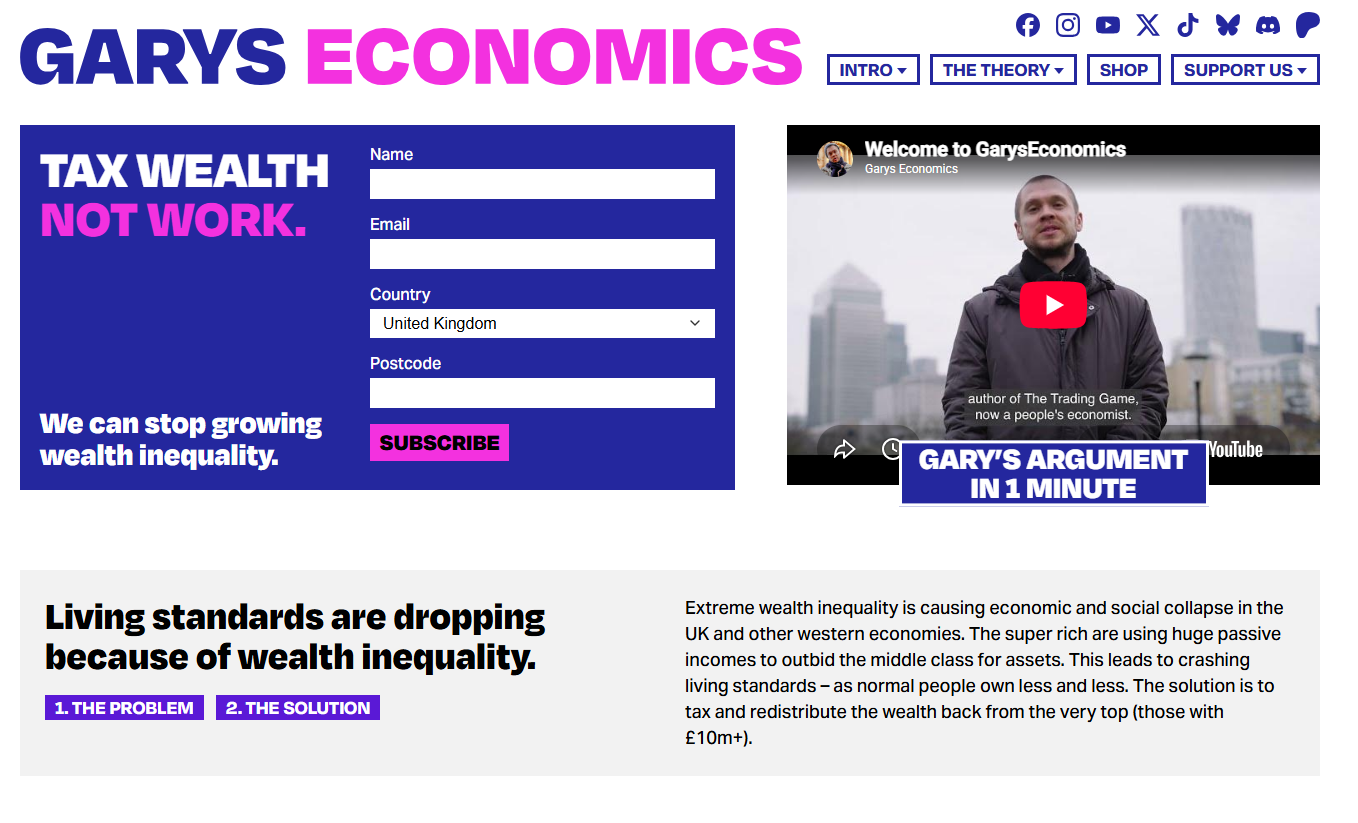
What’s his main claim to fame? If you go to his website, he says that “Living standards are dropping because of wealth inequality.”
He explains in more detail what “The Problem” is. As he states:
The 50s, 60s, 70s and 80s were the only time in history when society successfully created decent living conditions for ordinary people. This was done by aggressively redistributing wealth.
We are now losing this.
Poverty is rising, health is declining, public services are crumbling. People are losing trust in the government and each other. Far right politics is surging.
Okay, so there are a couple of claims here that need disentangling and checking. He basically repeats this in a very recent interview titled “Is this Gary Stevenson’s last EVER interview?” on PoliticsJOE (~800k subscribers):
We have economies where living standards are being aggressively destroyed by growing inequality of wealth but we have a broad academics economics class of people who do not believe that’s true, have never studied inequality anyway, so have no way of understanding even if it would be true …
Inequality is growing, living standards are in turn being destroyed by it, and (an additional claim now) economists are oblivious to it all. In fact, as he emphasizes:
When the government goes to its economists, in academia or in think tanks or in civil service, they have never ever studied inequality.
So after three years of studying economics, two years at Oxford, I was specifically looking for courses where we could study inequality. Those courses did not exist on a two-year economics Master’s.
Let’s start with the 1950s-1980s claim. Were those decades “the only time in history when society successfully created decent living conditions for ordinary people?” Well, no. Here’s just the data for the United States, which is often singled out by critics as the clearest example of a developed society that is “broken” for the ordinary person, and data on the United Kingdom, of which Stevenson typically speaks as a case in point.
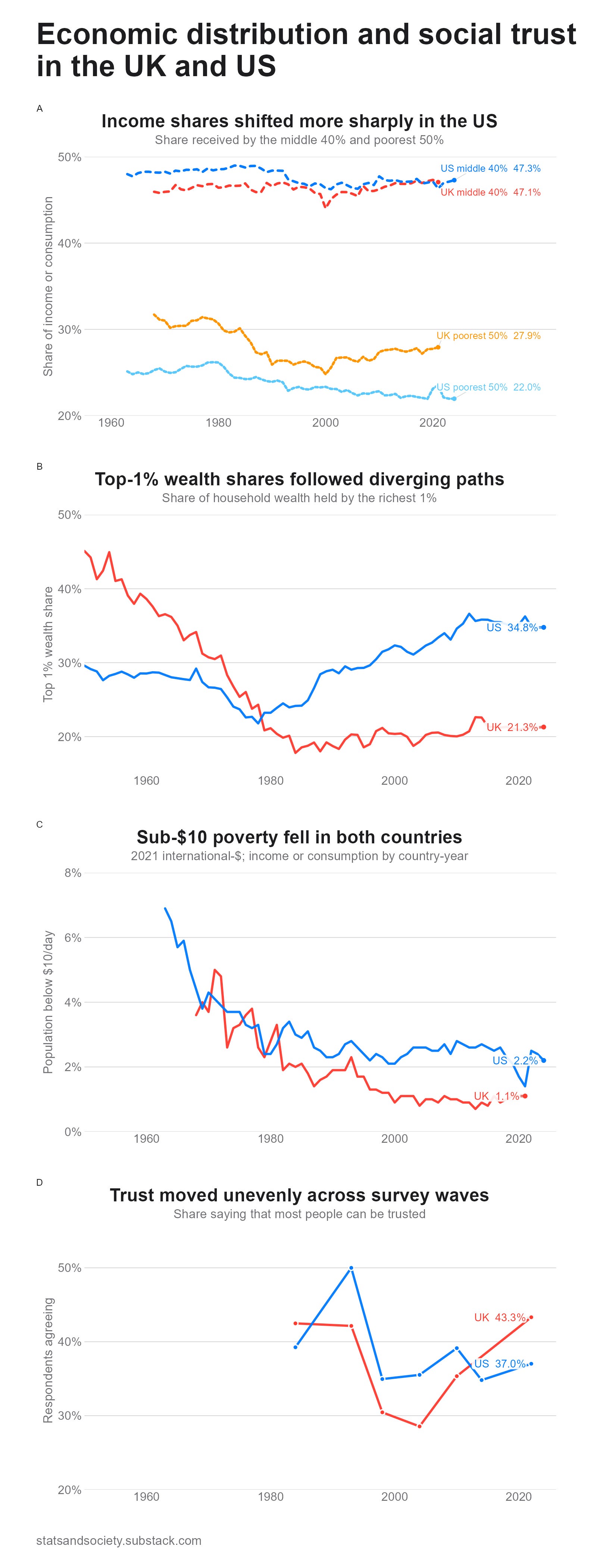
We’re looking at four things here:
(1) Income shares across social groups (including the bottom 50% and the middle 40%),
(2) wealth inequality (top 1% share of wealth),
(3) a high-threshold absolute poverty rate (life with $10 or less per day, adjusted for inflation),
(4) and general trust.
Stevenson is saying that various measures of living standards are being aggressively destroyed while inequality of wealth is growing. Only when aggressive redistribution of wealth had been in effect were living conditions good. But that’s not true at all.
First, the middle 40% of income earners command the same share of total societal income today as they did in the 1970s in both countries. Second, the bottom 50% in the UK are, in recent years at least, just a tad below where they were in the 1970s. In the US, the declining trend is a bit clearer (though still very modest), which means some corroboration of what Stevenson is saying there; maybe? Third, don’t forget that the same or slightly declining relative income share over a decades-long period where absolute incomes are going up fast (even when corrected for inflation) means people are materially or absolutely better off than in the past. See the figure in the footnote, in which income is of course adjusted for inflation.1
Fourth, during the 1960s and 1970s, wealth inequality in the UK was actually higher than it is today (see panel A in the first figure above). The same, though, is not true of the US. There, wealth inequality has grown. Fifth, poverty was much higher in the 1960s in both countries than it is today (panel C in the first figure above). Sixth, trust in other people (panel D) is on par with where it was in the allegedly glorious 1980s.
So, Stevenson is quite far off the mark. But he also claimed that “health is declining.” Is this true? According to one key metric, no. In both countries, Disability-Adjusted Life Years (DALYs) per 100,000 individuals from all causes have declined if you standardize for aging. This is a measure of the total burden of disease, and it registers both premature death and years lived with a disability. So on this important aggregate measure of health (“One DALY equals one lost year of healthy life”), Stevenson is quite wrong.
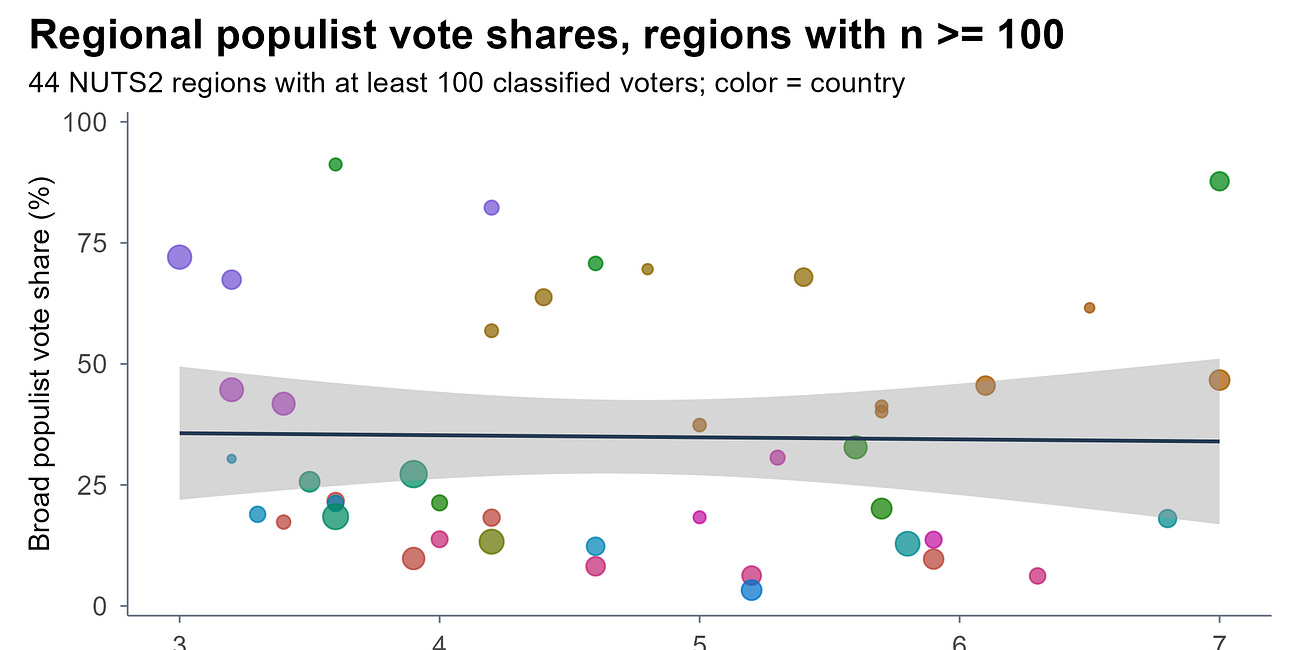
To be fair to him, it is absolutely true that trust in government is going down, and that right-wing populism is surging – which were his other two claims. No doubt about that. However, he’s done nothing to show that declining trust in government and the surging far-right are caused by, or are at least related to, ostensibly declining living standards (which are not actually declining) and rising inequality. In fact, my research on whether income and/or wealth inequality are in any sense related to populist electoral victories explicitly finds no relation (still in R&R). I’ve also written about some of the inequality-populism link in one of my previous posts (though this is only on income inequality). See below.
Did inequality trigger the rise of populism?
·
May 8
In a 2019 Foreign Affairs piece, Francis Fukuyama threw his weight behind the standard economic story for the rise of populism over the past two decades and the onset of the democratic recession. Here’s how he put it:
What about those dastardly economists, who according to Stevenson are either hiding inequality from us or are oblivious to it? I think there’s virtually nothing to that claim.
For at least the past two decades, inequality has been an extensively studied topic in economics. Here’s how I put it in my book Capitalism for Realists 5 years ago: Especially in recent decades, inequality has been a primary research agenda for mainstream economics. Thomas Piketty wrote a bestselling, 800-page book on the topic in 2014. His colleagues Gabriel Zucman and Emmanuel Saez are superstar economists (with over 65,000 citations between them at the time of my writing) whose claim to fame was precisely the study of inequality.
Additionally, Saez received the John Bates Clark Medal in 2009. Zucman got it in 2023. This is basically the Nobel for young economists.
In just these last few years after writing my book, Zucman and Saez’s combined citations have move significantly north of 100,000. Thomas Piketty’s 2014 bestseller on inequality has already amassed almost 40,000 citations. Inequality might be the hottest thing in econ today.
Don’t take it from me, though. Here’s how Anthony Atkinson, who “virtually single-handedly established the modern British field of inequality and poverty studies,” characterized it already in 1997 (my emphases):
The title of this Presidential Address is chosen to highlight the way in which the subject of income distribution has in the past been marginalised. For much of this century, it has been very much out in the cold. There are signs that in the 1990s it is being welcomed back …
On wealth inequality specifically, Zucman was able to say almost a decade ago now in the Annual Review of Economics that “there has been an explosion of research on wealth inequality” during the 2010s. That’s right around (actually, a bit before) when Stevenson did his MPhil, when on his account no economist was talking about either wealth or income inequality.
But there’s more. When you poll economists, they overwhelmingly agree with the statement that distribution of income in America should be more equal (they’ve done so at least since 1990). Why do they say this if “they have never ever studied inequality?” Already in 2000, there was a moderate consensus among economists that inequality can have deleterious effects on growth and stability; after 2011, this consensus has become “strong.” Again, how is this possible on the hypothesis that economists are uneducated on inequality? You literally have the well-known Journal of Economic Inequality, which is currently in its 24th volume (publication started a bit more than 2 decades back) and ranks in the 1st quartile by citations (Scopus).
Even an explicitly conservative, Bush-supporting economist like Gregory Mankiw has a whole standalone chapter on inequality in his widely-taught textbook from the mid-2000s. He opens it by saying “The gap between rich-and poor is a fascinating and important topic of study—for the comfortable rich, for the struggling poor, and for the aspiring and worried middle class.” But economists disregard and never study inequality? Their students never hear about it? Baffling.
If for some reason you want to learn more about Stevenson, check out how Decoding the Gurus have covered him. Here’s a preview:
In this episode, Matt and Chris take a look at one of the UK’s most compelling economic crusaders: Gary Stevenson, aka Gary’s Economics. A millionaire trader turned YouTube firebrand, Gary’s message is simple and potent: wealth inequality is spiralling, the ultra-rich are hoarding everything, and economists and politicians are either complicit or clueless.
Gary’s story has all the trappings of a mythic arc: from humble East London roots to Citibank’s trading floor, where he made millions betting against the poor during the financial crisis. Now he claims the system is so broken that only someone like him, working class and mathematically gifted, someone who entered the high-power world of financial trading and took on the system, could see it. As Gary puts it, a sort of economic Copernicus, who brought a revolutionary message that was dismissed by a stultifying orthodoxy.
With his righteous critique comes a hefty dose of swagger, whether it is in considering himself like a Usain Bolt of trading or in the frequent laments about how exhausting it is to be a lone voice of truth facing bad-faith hit pieces. Gary straddles an odd tension: self-effacing underdog one moment, saviour-on-a-soapbox the next. He rails against academia, dismisses journalists as clickbait merchants, and urges people not to heed critics, due to their ulterior motives.
No posts
Comments
Nothing yet. Say the first thing.
Sign in to join the conversation.