
I have explained before that we have precious little evidence for the popular claim that (objective) economic conditions and grievances explain the electoral success of illiberal populism in the developed world. Despite what Hasan Piker, Cenk Uygur, or Bernie Sanders say, people are not attracted to populists because of inequality, stagnating wages, or the corrupt rich elites. It’s not the economy, stupid.
To the extent that the economy play a role, it does so subjectively. Citizens who (wrongly) feel they’re low on the income distribution ladder and (wrongly) think their national economy is doing bad, are more attracted to populism. I’m tempted to say that it’s precisely because Piker, Uygur, and many other right-wing pundits are falsely telling people that the economic sky is falling, these voters then develop subjective economic grievances, and are thus more attracted to populists. The same pundits, of course, use this fact to confirm to themselves that they were right all along – it is the economy! How ironic.
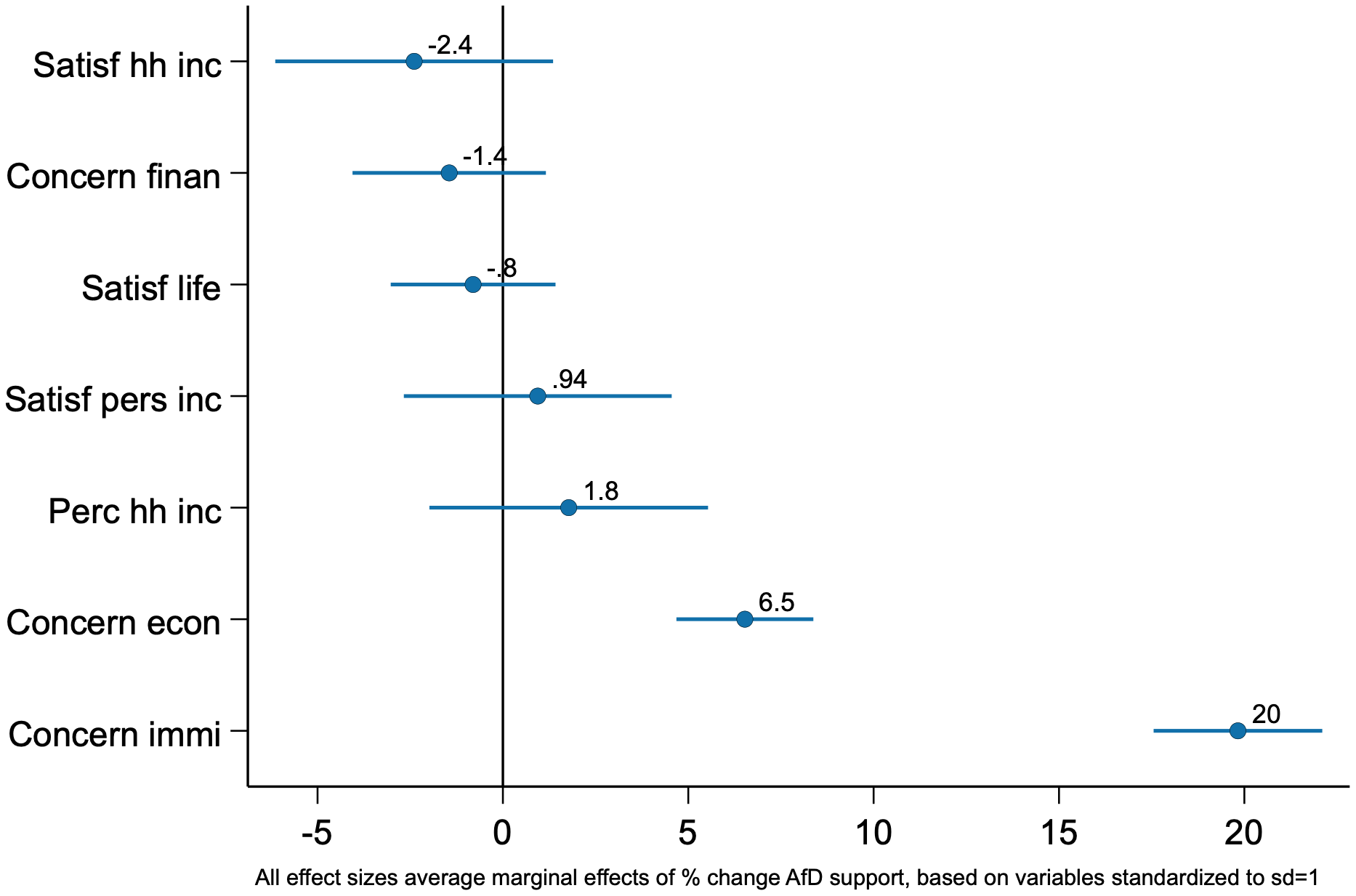
Aside from the social-media-generated subjective economic grievances, it seems that cultural issues are a much more salient explanatory factor for populism. If you worry about your nation’s finances (though you yourself are doing just fine), you’re somewhat more likely to vote for populists. But if you worry about stuff like immigration, you’re much more likely to succumb to the populist temptation.
There’s a new paper that shows this for Germany and the radical-right party AfD.
Using eleven waves of the German Socio-Economic Panel from 2014 to 2024, Martin Schröder and colleagues compare the explanatory power of concern about immigration with a wide range of variables intended to capture economic deprivation (including objective and subjective deprivation, and fear of future deprivation). They find that concern about immigration is by far the strongest predictor of AfD support both across individuals and “within” them (over time).
Cross-sectionally, a one-standard-deviation (SD) increase in concern about immigration is associated with roughly ten times higher odds of supporting the AfD. When they control for socio-economic variables, like income, life satisfaction, concern about the national economy, and so on, the migration-populism association remains almost as large as it was initially without these controls. Immigration concern by itself explains about 3/4 of the variation explained by the fuller model containing the mentioned deprivation measures. Depending on the specification they run, immigration sometimes explains even 90% or more of the variation explained compared to a model that also includes deprivation.
Because the 2014-2024 data they use are true panel data, they were able to run even more informative analyses. Do changes about immigration concern (or anything else) within the same person over time predict changes in AfD support? They of course do. As the same individual becomes more concerned about immigration, that individual becomes substantially more likely to support the AfD. The economic variables, in contrast, mostly show nothing – except for the expected subjective grievance about the national economy, though that’s comparatively tiny.
We would also want to know whether various forms of economic deprivation might still be important for populist voting by making concerns over immigration more politically consequential. That is, instead of treating concerns over migration and economic deprivation as two separate explanatory forces, it could be that the effect of migration concerns depends on how economically deprived people are. Put simpler, globalization and neoliberalism might be impoverishing voters, who for that reason are especially likely to react to worries about migrants stealing their jobs or putting pressure on scarce resources by supporting the populists more.
This isn’t the case. In the between-person models, some of the interactions actually go in the opposite direction, which would suggest that more educated and relatively affluent people who are also concerned about immigration are, if anything, especially likely to support the AfD!
The authors further illustrate how weakly deprivation matters (relative to immigration) with two hypothetical respondents. One is maximally deprived according to the variables in the model but not concerned about immigration. The other is maximally advantaged but very concerned about immigration. It turns out that the latter has more than twice the predicted probability of supporting the AfD. The exact probabilities are not especially important, since they refer to extreme and statistically constructed cases. The key thing is that the model doesn’t behave as one would expect if deprivation were the main force underlying immigration politics. Knowing how somebody feels about immigration tells us much more about whether that person supports the AfD than knowing whether that person is economically secure or insecure.
Okay, so at least in Germany but probably elsewhere too, populism is to a significant extent about migration. But this finding is compatible with several hypotheses about how migration works. The first, obvious one would look as follows: migrants are objectively something to be feared, German voters are rational people, hence they correctly perceive the objective, real danger of rising migrant influx, and so they vote for the party which will get rid of this migrant danger.
What can we say about this? Well, for starters, there’s some clear evidence that some groups of migrants have higher offending rates (and are thus plausibly “more dangerous”). As I reported a few months back:
[T]ake actual conviction rates in Denmark. The overall male population stood at 0.8% convicted in 2023. For male immigrants from the Middle East and North Africa, the share was 1.8%. Their male descendants were higher still, at 4.3%.
In Sweden, after adjusting for age, sex, income, education, and municipality type, relative risks fall from 2.5x to 1.8x and from 3.2x to 1.7x, respectively. Note that even after demographic adjustments, rates can remain elevated compared to the native population.
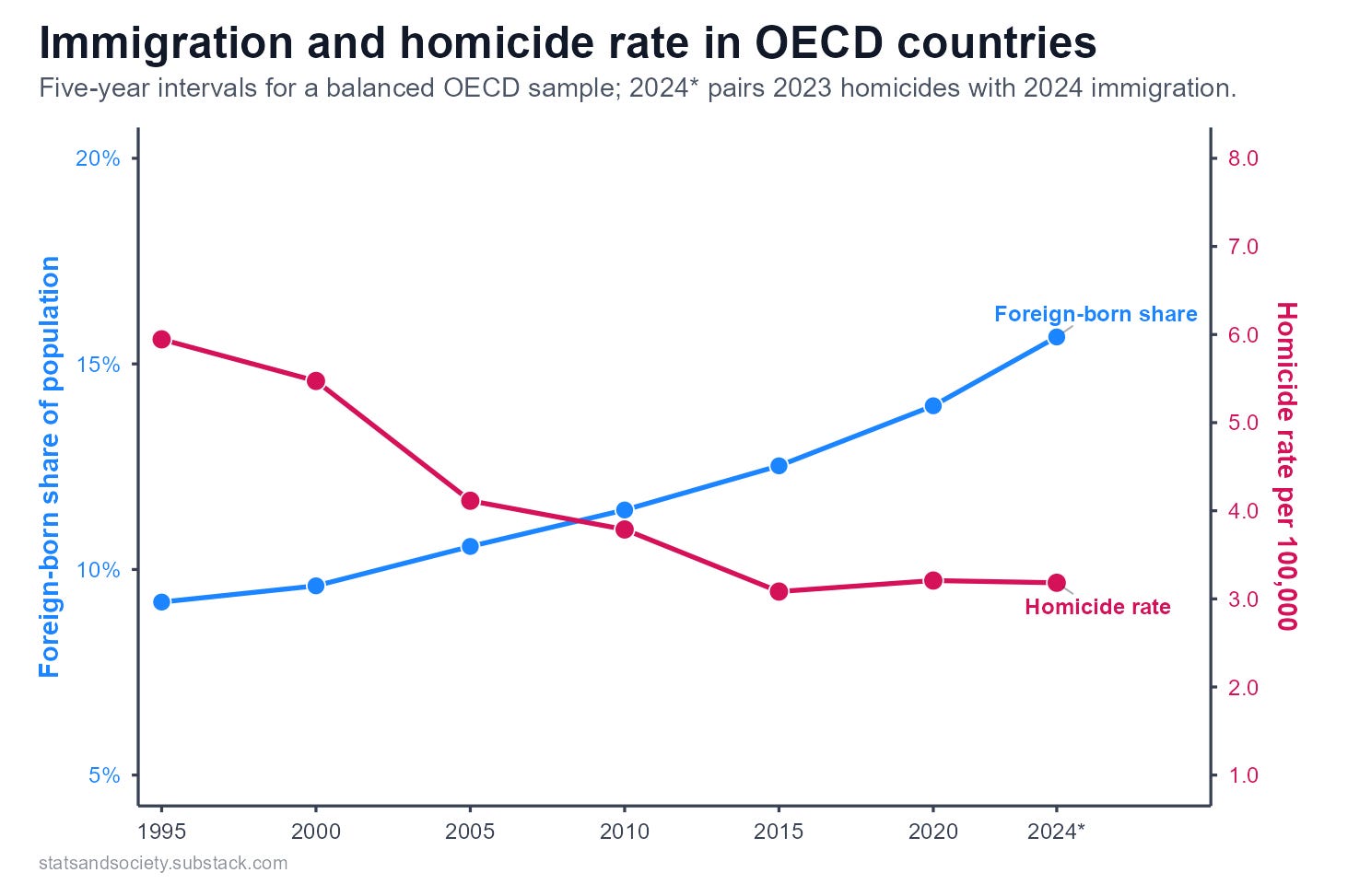
At the same time, these are not extreme numbers. And we don’t have clear causal evidence that aggregate migrant influxes generate more violence and crime. In simple descriptive terms, it’s also true that as the developed world has seen rising migrant shares over the past few decade, the national homicide rate has not concomitantly increased – instead, it’s fallen. Moreover, it is an undisputable fact that people on social media routinely go berserk when it comes to migrants and the alleged downfall of the Western world due to viral but misleading or outright fake content.
It would be foolish of me to say there’s nothing to this first hypothesis about why some Germans are (and have increasing become) worried about immigration. More knowledgeable people than me, like Sheri Berman, think the German state has lost the plot on immigration. I agree Germany has some answering to do. And sure, it’s true that some migrants in some places are a real threat that affects some people and makes them (justifiably) more worried. This is true of many social issues.
But I’m not sure we have good evidence this is all there is or that this is the predominant explanation of migration worries. Just think of the Springfield pet-eating hoax and how many people (especially populist Trump voters) fell for it immediately. It’s possible to be legitimately concerned about migration, and it’s very possible to be illegitimately concerned about migration, especially in today’s social media-soaked world.
You can make up your own mind, but to me, an important datapoint in this regard is how many people who worry about immigration are not actually the people who might have something to lose from immigrants. As both the authors and the study mentioned above find and as I did back in April, it’s simply not true that migrant worries are most concentrated in the cities, where most (ostensibly dangerous) migrants live. They’re also not concentrated in country-regions where migrants are most salient, nor is it true to say that migrant fears come primarily from people who are objectively economically threatened by them – the poorer and the unemployed, say.
(It’s also not true that, in Germany, living near a refugee facility and thus being exposed to potential everyday dangers from these foreigners has any effect on locals’ attitudes toward refugees. Anti-immigrant sentiments are “unaffected by the presence of refugees in respondents’ hometowns.”)
Instead, as I report in the piece below, people with right-wing ideology and subjective economic grievances, the less-educated, and the less-trusting folks are those who are most worried about immigration. That’s at least consistent with if not outright suggestive of the possibility that people misperceive the dangers of migration.
Who are Europe's immigration worriers?
·
Apr 24

Look, I’m open to being wrong. So correct me if I am missing something. And if it helps you feel better, my initial intuitions (before looking at the research or the data) back in 2015, 2016 were wholly materialist and not really politically correct.
Obviously, none of this proves migrants aren’t an objective danger, and it doesn’t rule out that many German citizens develop worries about migration based on their real-world contact with problematic migrants. But to me, it makes it at least a bit less plausible – or, it increases my belief that some (if not many) populist voters are actually in large part concerned for false, invented reasons. Might also be both: some people justified, others less so; some worries justified, others not.
Okay, but set aside the debate over whether migration worries are justified or not. You might simply say that, justified or not, this is what Germans worry about. And so if a liberal like me hopes the AfD and similar populists would go away, shouldn’t I support severe crack-downs on immigration? Additionally, isn’t Germany a democracy? Suppose, for a second, that it’s hypothetically true that migration has no downsides or is on net beneficial. Despite that, if the majority of voters, for whatever reason, normatively value that Germany’s migrant share be reduced or new immigration stopped, isn’t that completely fair? Immigration doesn’t need to be objectively harmful for people to legitimately democratically reject it. Values are not matters of fact, so you can’t say someone’s values are right or wrong. Values just are. And in a democracy, shouldn’t the values of the majority be implemented?
I take that line of reasoning seriously. And if it really turns out that the AfD takes over and destroys a liberal society just because people’s (justified or false) migration concerns weren’t respected, then it would have been better to severely restrict migration, thus cutting off AfD’s oxygen supply, and preserving a future liberal Germany (albeit one with sad illiberal migration restrictions).
But apart from that extreme, emergency scenario, I don’t think I wholly buy the “values objection.” That’s because I’m not for democracy simpliciter: I’m for liberal democracy, where certain rights and social issues are taken off the electoral menu and are non-democratically protected. For instance, it’s good that voters can’t democratically decide to revert women’s rights and private property, or elect judges, or have a say over central banking – despite what their values are on these issues. Having at least a somewhat-to-moderately open border (with proper regulation, of course) seems to me to be one of these fundamental liberal, non-democratic aspects that should typically be preserved regardless of what the majority wants in terms of their values. (Note, of course, that I’m not advocating for completely open borders here.)
Like, suppose that even though private property and free international trade pose no danger to the of voters or are on net beneficial, the majority for whatever reason becomes fearful of these capitalist institutions and wants to reject them. (*Ahem.*) Would we just say: yeah, let them, it’s a democracy after all. Or would we hope our liberal institutions manage to prevent the majority from implementing their illiberal, anti-capitalist values?
Now, to the extent that migration has real fiscal, criminal, cultural, and other downsides, something should be done to ameliorate those. To the extent that a serious and threatening political backlash is generated by worried voters, their worries should of course also be addressed somehow. But here, compromises will have to be made. Yes, just continuing with the status quo seems unworkable (for justified and unjustified reasons), but swinging to the other extreme and enacting illiberal and inhumane closed-borders measures is even worse. How the compromise that lies somewhere on the continuum between these two possibilities looks like, I have no idea.
No posts
Comments
Nothing yet. Say the first thing.
Sign in to join the conversation.