
I was alerted to Ryan Ward’s (Free Market Moralism on Substack) very popular piece on capitalism and poverty from last year. One of my readers found it persuasive and wanted to hear my take. I agreed to a writeup because the piece is quite misguided and misleading, despite its popularity.
Ward bills himself a Marxist of sorts or is at least interested in “Marxism,” judging from his Substack tag. That’s cool, because my past self shares that with him (see also this by me). He’s written a critical essay in which he tries to demonstrate a series of claims that undermine the optimistic story about capitalism and poverty told by Steven Pinker and others like him. That’s cool too, because I’ve also been critical of Pinker on both poverty and war.
He says a lot in the piece, and I won’t be able to cover everything, lest my essay become too long. So, for this installment (perhaps there’ll be another one), I’ll just focus on what are to my mind the most important and most biasedly presented claims, those that need the most correcting and additional context.
Here they are:
The World Bank and other organizations are (perhaps nefariously) changing the poverty line, so that the overall poverty trend looks better. This is, as Ward puts it, “deeply disingenuous and amoral if not immoral.”
Even if they made no changes to the line, the extreme- or international-poverty threshold is simply not enough – it’s just about mere survival, he says, which shows its “utter unseriousness.”
Relatedly, the international poverty line according to him “severely underestimates poverty and associated deprivation.”
Capitalism actually began earlier than in the 1800s, the century after which we have poverty data available. It began already in the 15th and 16th centuries, and in the following centuries (up to the 19th), “rates of poverty (lack of access to basic needs for subsistence) sharply increased.” Capitalism goes up, colonialism goes up, poverty goes up as well!
It wasn’t so much capitalism but rather anti-capitalist social justice movements that reduced poverty. In his words, global poverty decreases “since the Industrial Revolution correspond[] with the rise of organized labor movements and progressive and anti-colonial efforts against capitalism.”
It’s of course true that the World Bank raises (“shifts”) the extreme poverty threshold over time in nominal terms. It was $1 a day under the 1985 purchasing-power parity (PPP) anchor, then it nudged up to $1.08 in 1993 PPP, and so on over the years. It stood at $1.9 in 2011 PPP, and it’s now $3 (in 2021 PPP).
Why would they do that? Ward is clear that, for him, it’s just “statistical jiggery pokery,” an arbitrary “click of a button.” In reality, you have to do this because you want to take account of changing prices through time, so that your dollar/poverty numbers capture the real and changing cost of living in different countries. For instance, the jump from $1.25 (2005 PPP) to $1.90 (2011 PPP) happened when the World Bank took the same national poverty lines of 15 poor countries, updated them into 2011 local prices, converted them using the new PPPs, and obtained an average of $1.88, rounded to $1.90.
They did so because they were following these three rules:
Use the most accurate and recent set of prices available to compare the real standards of living across countries.
Minimize changes to the goalposts: keep the definition of the line unchanged, and its new value as close as possible to the $1.25 line in real terms.
When defining “real terms”, the price levels that matter most for measuring global poverty are those faced by the world’s poorest people.
Nefarious indeed. If you’re an epistemically curious person and just want to find things out, it’s easy to do so. Oh, and by the way, when the World Bank did this PPP updating, global poverty remained “basically unchanged.” So much for them shifting the threshold with the intention of obtaining a better picture.
Now, sometimes it’s not just about the PPP updating. Some changes to the extreme poverty threshold have to do with the country-sample that’s used for benchmarking. When we got the jump from $1.90 to $2.15, this happened because the World Bank used the national poverty lines of a new sample of 28 low-income countries for its calculation. In part, this decision was made because the previous sample of 15 countries became outdated (some of the countries stopped being poor, and the poverty lines were just no longer comparable). Again, you can just read about these things from the horse’s mouth. It’s all out there, publicly available and transparent.
The World Bank has perfectly legitimate reasons for revising the numbers. It’s simply a conspiracy theory that the revisions are made so that capitalism looks good. I’ve seen no evidence presented for that conspiracy theory. However, if Ward’s criticism was simply aimed at the fact that PPP updating and sampling can be methodologically fraught (whether we’re talking about poverty or GDP per capita or anything else for that matter), I’d wholeheartedly accept it in principle. This is hard and uncertain work.
(To foreshadow what’s coming, Ward states that in 2010, the Mexican government reported a whopping 46% poverty rate, while the World Bank estimated it to be around 5%. A serious underestimate, he charges. What he doesn’t say is that the two measures are completely incommensurable. The World Bank figure refers to the share living in extreme poverty, while the Mexican government figure refers to a much broader “multidimensional” poverty measure, which deliberately has nothing to do with extreme poverty. So we could just as well report that in 2018, in Guinea, 12% of the population was in extreme poverty, yet almost 70% experienced multidimensional poverty. And you can do the reverse too: in South Africa, there was only 6% of the population in multidimensional poverty in 2016, while almost a third of the population was extremely poor in 2014. It’s of course good to know both measures for every country – they’re measuring different sorts of deprivation. But this has nothing to do with the World Bank being nefarious or it underestimating anything.)
When lay people come to me with their misunderstandings of how PPP works and why the nominal poverty threshold changes, I can somewhat understand them. I’m less understanding of the next critique: being lifted out of extreme poverty isn’t that important or salutary, because even when you’re no longer extremely poor, you still aren’t living a decent life.
Like, it’s in the name of the thing: extreme poverty. Yes, people who are no longer extremely poor are still … very poor. Shocker. They’re not living it up. It’s of course better that they’re no longer extremely poor, because now they’re at least no longer on the verge of starvation. But it’s still not good enough. Absolute poverty of all kinds should be reduced as much as possible. But for that to happen, you must first abolish extreme poverty. After that’s done, we shouldn’t stop. That’s just the first (and very important) step. Other absolute thresholds of poverty must fall to zero subsequently. And even then we shouldn’t stop. Everyone’s income must rise, so that comfortable living standards are achieved. The mere absence of extreme (or any other absolute) poverty isn’t enough! Hence the utmost importance of economic growth, but that’s for another day.
Ward asks:
If those who live just underneath or above the IPL do not have a realistic chance of having a normal human life, what good does lifting anyone above this line do in real terms?
What good does it do in real terms? Apart from reducing chronic hunger, resulting in fewer skipped meals, and allowing for more vegetables and meat, and so on, moving from $1 a day to ~$3 a day for a rural household literally means almost a doubling (descriptively speaking) of high school attendance share (from around 38% to 65%). So, yeah, nothing really, I guess?
But that’s not all. The other thing about extreme poverty is that you can just express it (or measure it) more directly in terms of basic needs instead of abstract dollars. There are at least two upshots of doing so: it becomes more transparent to the lay person what we’re measuring and how important it is for a person to be above (not below) the threshold, and we no longer have a problem of relying on a singular poverty line for all countries. As Michail Moatsos, whom Ward cites a lot, explains:
The most important difference between the cost of basic needs and the dollar-a-day methodologies is that while the later [sic] uses one poverty line value for years and countries, the former allows us to estimate the poverty line separately for each country and year. At the same time the contents of the basket are explicitly defined, while in the dollar-a-day approach those are only implicit in nature due to the statistical nature of its definition.
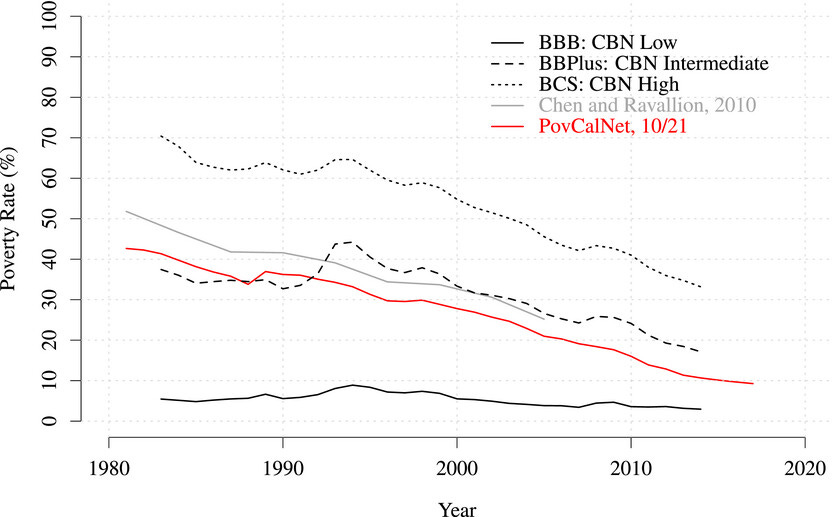
In the figure below, you can see what’s been happening to extreme poverty over the past 40 years according to a variety of measures.
There are two key “cost of basic needs” measures. First, the black BBB line shows the Bare Bones Basket aiming at subsistence level conditions. It includes the following as a basket of goods (locally measured and focused on the absolute cheapest sources):
In terms of food the BBB matches the calories required by the MDER (minimum dietary energy requirement) and provides for at least 40 g of proteins per day.
In addition, the BBB basket, following the tradition by Allen of the real wages literature, includes (per year):
3 kg of meat or 6 kg of fish (depending which one is cheaper),
3 kg of fat,
2 kg of sugar.
It also includes
1.3 L of lamp oil,
1.3 kg of soap,
1.3 kg of candles (all per year) and
a 8% allowance is allocated to clothing expenses.
Housing costs are assumed to be 5% of the BBB cost.
Finally, the costs in fuel are included (a) heating fuel (based on the heating needs of a room shared by the household and the given meteorological conditions), and (b) cooking fuel (depending on the kcal to be consumed cooked).
Truly, absolute bare bones. As you can see on the graph, over the past 40 years, this measure has remained virtually flat and has been hovering at about 5%.
Moving beyond just bare-bones survival, second, the dotted BCS line shows what happens to extreme poverty when we stop focusing only on the absolute cheapest sources (so that “some minimal variety is introduced in the dietary consumption”) and when we add:
at least 40 kg of beans, peas, or legumes, and 12 kg of meat or 24 kg of fish (all per year), depending which one is cheaper. The costs for clothing, lighting, personal hygiene, heating, cooking and housing are now based on the consumption shares provided by the World Bank Consumption database.
Measured in this very clear and substantive way, extreme poverty has more than halved from just over 70% in the mid-1980s to almost 30% in the mid-2010s. Why is this important? Because, as you’ve seen, people above the extreme poverty threshold can at least heat themselves and eat some decent, humane amount of nutritious food that’s required for normal biological functioning. Sounds kinda important.
Finally, the grey and red lines represent the more standard dollar-a-day measures ($1.25 in 2005 PPP and $1.90 in 2011 PPP). As you can see, the levels are different, but the trends are virtually exactly the same – huge reduction over time – if we compare them to the dotted BCS (“cost of basic needs high”) headcount. Even in terms of levels, the intermediate measure of cost of basic needs (dashed line) is on par with the traditional World Bank measure.
Note, by the way, that with the exception of the red line, all other series show what’s been happening to the developing world, not the world as a whole. In that sense, as Moatsos warns, you should not focus too much on the levels of the red line (just its trend). It’s somewhat low in the present context solely because it also includes the developed world – it is, after all, meant to measure the whole world, including developing and developed countries.
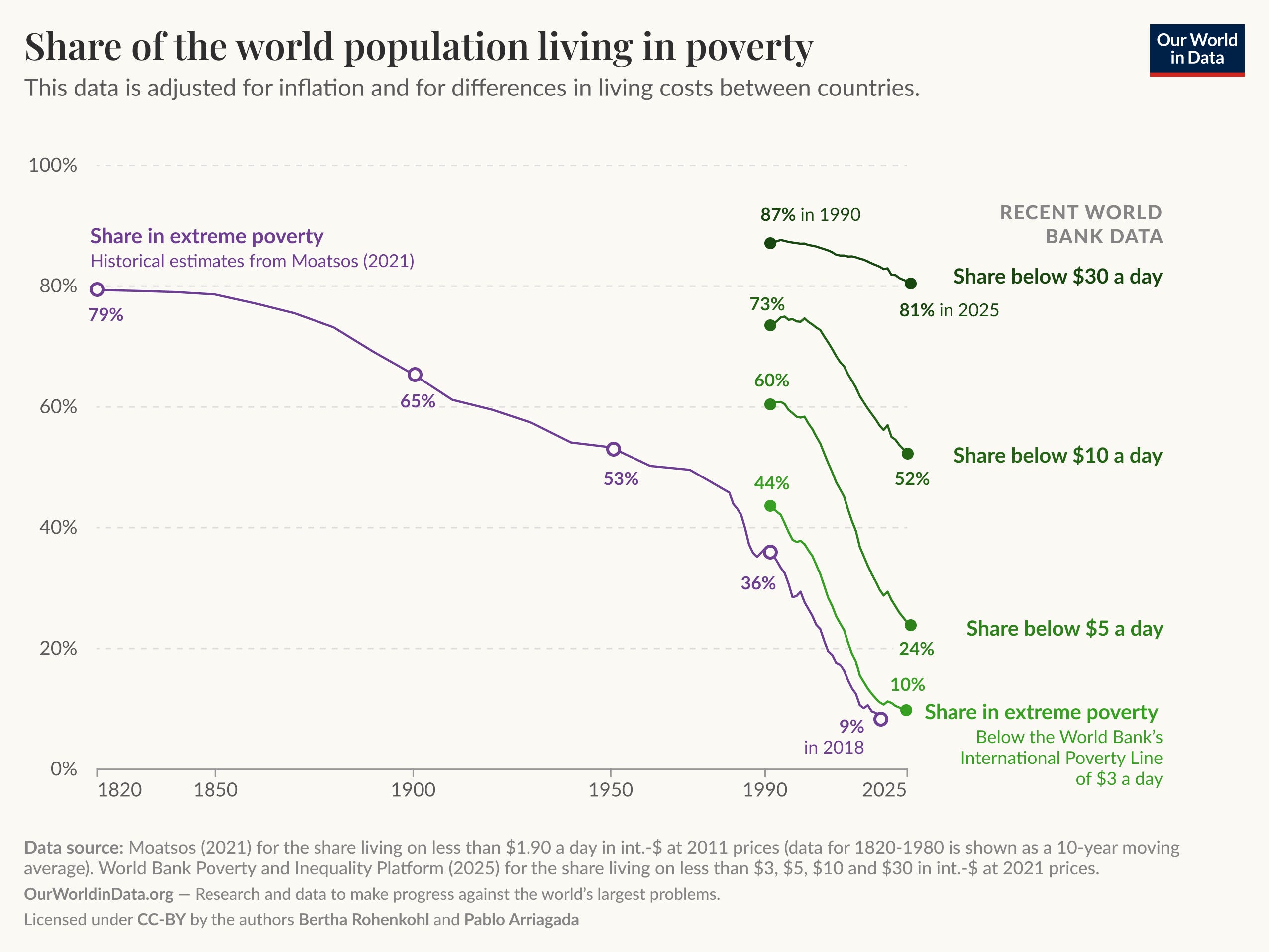
But okay, we don’t need to concern ourselves with extreme poverty, however measured (i.e., in terms of dollars or cost of basic needs). We can just look at various other, lower and higher, thresholds of absolute poverty to see if decreases in extreme poverty are misleading. Do decreases in this allegedly unimportant (because low) threshold mask stagnation (or perhaps even an increase) in higher-threshold and apparently more meaningful poverty lines? See figure below – it’s clear that for decades now, all absolute poverty lines have been falling, not just the “unserious” one. Note that $5 a day is slightly higher (so more stringent) than the World Bank’s poverty line for lower-middle-income countries, while $10 a day is higher (again, more stringent) than the poverty line for upper-middle-income countries.
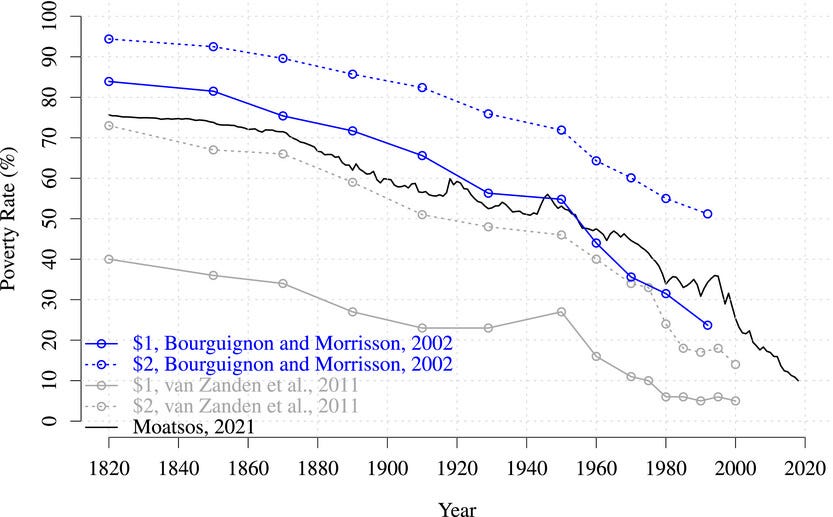
In the last graph, you can see the extreme poverty line being extended back into the 19th century. If you don’t like the dollar-a-day measure, you can look at the more rigorous and direct cost of basic needs measure of extreme poverty for the 19th century as well. See the black line below (“Moatsos, 2021”).
People have used the decline you see to argue that extreme poverty was pervasive before the Industrial Revolution around 1800, but then started falling with the emergence and spread of capitalism throughout the world, especially during the 20th century and after 1950. I say “people,” because funnily enough, they can be, depending on the context, either anti-capitalist Marxists or pro-capitalists and anti-Marxists.
Already in the 1980s, Baumol called it as it is:
Both vulgar Marxists and vulgar opponents of Marx have propounded two associated myths: that he believed wages under capitalism are inevitably driven near some physical subsistence level …
Marx himself argued that before capitalism and modern growth, all you had was poverty. Moreover, at least in his mature works, he was quite sure that capitalism will rapidly do away with material scarcity and will thus eradicate extreme poverty. This was my view of Marx back when I was a well-read Marxist, and it was also my own Marxist view. I grew up on Marxists like Andrew Kliman, Ellen Wood, Robert Brenner, Erik Wright, and others, all of whom were quite adamant that Marx didn’t view capitalism as materially immiserating the majority of people (that’s a silly caricature of him, they’d say), and they all outlined several theoretical reasons and mechanisms that explain why capitalism can do away with absolute poverty.
So, if you show these graphs of declining extreme poverty to contemporary Marxists, many of them will scoff and say, “Of course, that’s what Marx himself expected. What, did you think I’d be surprised and shocked because capitalism reduced poverty? It was never our (or Marx’s) critique of capitalism that the system would generate extreme poverty for the typical person. You’re thinking of feudalism and tributary societies! We’re well aware that capitalism generates immense growth, which can benefit the ordinary person.” The problem with capitalism is exploitation and inequality, we’d say, not absolute poverty.
At the same time, there are many (vulgar) Marxists around today who wouldn’t say that. Instead, they would be surprised if capitalism were credited with reducing poverty. So, they’d want to deny it, perhaps by stating that these poverty measures are wrong, or tampered-with, or in any case unimportant for what really matters to human beings. I’ve covered those objections already, so let me now say a few words on what we actually know about the relation between capitalism and extreme poverty.
Citing Sullivan and Hickel’s work on the topic, Ward self-assuredly proclaims that, in fact, “rates of poverty (lack of access to basic needs for subsistence) sharply increased with the rise of global capitalism and colonialism.” Instead, what has reduced poverty or is at least consistent with its reduction (temporally), is “the rise of organized labor movements and progressive and anti-colonial efforts against capitalism.” What can be said about this?
I’m well-acquainted with Sullivan and Hickel’s World Development paper. In fact, I’ve written and published (in the International Review of Sociology) research of my own, directly contradicting key parts of their story (while also corroborating some of what they say against Steven Pinker). My paper is 35 pages long with another 20 page appendix, so I won’t bother you too much with it. I also have an accessible writeup of it published here.
Here are the most important things I find:
First, the standard narrative is wrong to suggest that extreme poverty was nearly universal before capitalism. In many pre-capitalist societies, particularly in Europe, most people likely lived above the extreme poverty threshold most of the time [though just barely above it!]. The claim that 90% of humanity lived in extreme poverty before 1820 simply isn’t supported by the non-GDP evidence we have. I mean, it might be true, but we simply don’t know. And the more direct data on laborer wages we do have seem to go against the idea.
At the same time, second, pre-capitalist life was pretty shitty: absolute poverty for the majority, bodily stunting, high likelihood of dying as a kid, high likelihood of dying early as an adult, relatively frequent famines, high rates of violence, and all the rest of it.
Third, the transition to capitalism, at least as measured as the start of “endless growth,” i.e., by the onset of sustained GDP per capita growth, was generally associated with improving living standards, not deteriorating ones. Famines virtually disappeared, heights eventually (though veeery slowly and unevenly) began to increase, and extreme poverty rates declined. The regions that transitioned to capitalism earliest (England, possibly the Low Countries) unsurprisingly saw these improvements earliest.
You might ask: why define capitalism with reference to “endless growth?” In part, because this is how Sullivan and Hickel, using Wallerstein, define it. As they say, “According to world-systems theorists, capitalism is a system predicated on the ‘constant accumulation of capital,’ or endless economic growth …” But I also have other reasons for focusing in on that key aspect of capitalism.
As I review in my paper:
What distinguishes a modern capitalist economy from a premodern, precapitalist economy is the breaking out of Malthusian cycles of extensive growth, stagnation, and decline that have characterized human societies for millennia since the Neolithic revolution, and the emergence of systematic economic dynamism and intensive growth exhibited in the famous ‘hockey stick’ graph, which depicts a sudden, almost completely vertical increase in the GDP per capita curve after millennia of virtual stagnation.
General agreement about this exists among many contemporary neoclassical economists (see textbooks such as Cowen & Tabarrok, 2018; Bowles et al., 2017), institutional economists (North et al., 2009; Acemoglu & Robinson, 2012), notable Marxist historians and historical sociologists (Wood, 2017; Brenner & Isett, 2002; Teschke, 2003; Brenner, 2007; Žmolek, 2014; Dimmock, 2015; Isett & Miller, 2017; Lafrance & Post, 2019; Clegg, 2020; Wickham, 2021), libertarian philosophers and economists (Brennan and van der Vossen, 2018; McCloskey, 2017), and economic historians (Allen, 2011).
The economic institutions or structures which this diverse literature points out as principally responsible for generating the modern, intensive type of long-run, self-sustaining economic growth are foremost market competition between economic actors (not just markets in themselves), widespread market dependence of these economic actors (instead of the majority of producers being shielded both from market competition and market dependence through the institution of small-scale subsistence farming), and secure rights of private property.
These structural characteristics induce or incentivize economic actors to systematically invest in, and uncover, technological innovations; they also systematically pressure them to cut production costs so as to be able to outcompete rivals. This, in turn, results in systematic improvements in labor productivity, which unleashes ‘endless growth’ or sustained increases in GDP per capita decade-on-decade, century-on-century.
In this key sense, capitalism most definitely hadn’t existed during the 15th or 16th centuries, except in England and perhaps the Netherlands. Remember that Germany still had serfdom in 1806! For Europe, the rise of capitalism is a decidedly 19th century phenomenon. So, to the extent that we believe the historical reconstructions of extreme poverty during the 19th and 20th century (which, again, I’m iffy about), the documented decline very well coincides with the emergence of capitalism. That’s no causality, but the correlation is there. So you can’t just point to the rise of organized labor in the late-19th century and take that as the preferred explanation for the decline in poverty. There’s much more work you need to do to rebut the “capitalism did it” theory, and you also need to do much more to rule in your “anti-capitalist struggle did it” theory.
What about the link between capitalism and colonialism? We can’t just skip that, you might say! Indeed, check out this post of mine below.
Capitalism and colonialism are not as linked as you think
·
October 6, 2025
A recurring claim in contemporary debates about capitalism’s origins is that European colonialism was either necessary for, or somehow intrinsically linked to, the rise of capitalist economies. This narrative suggests that the violence, extraction, and brutality of colonial expansion was baked into capitalism itself – that the two cannot be meaningfully…
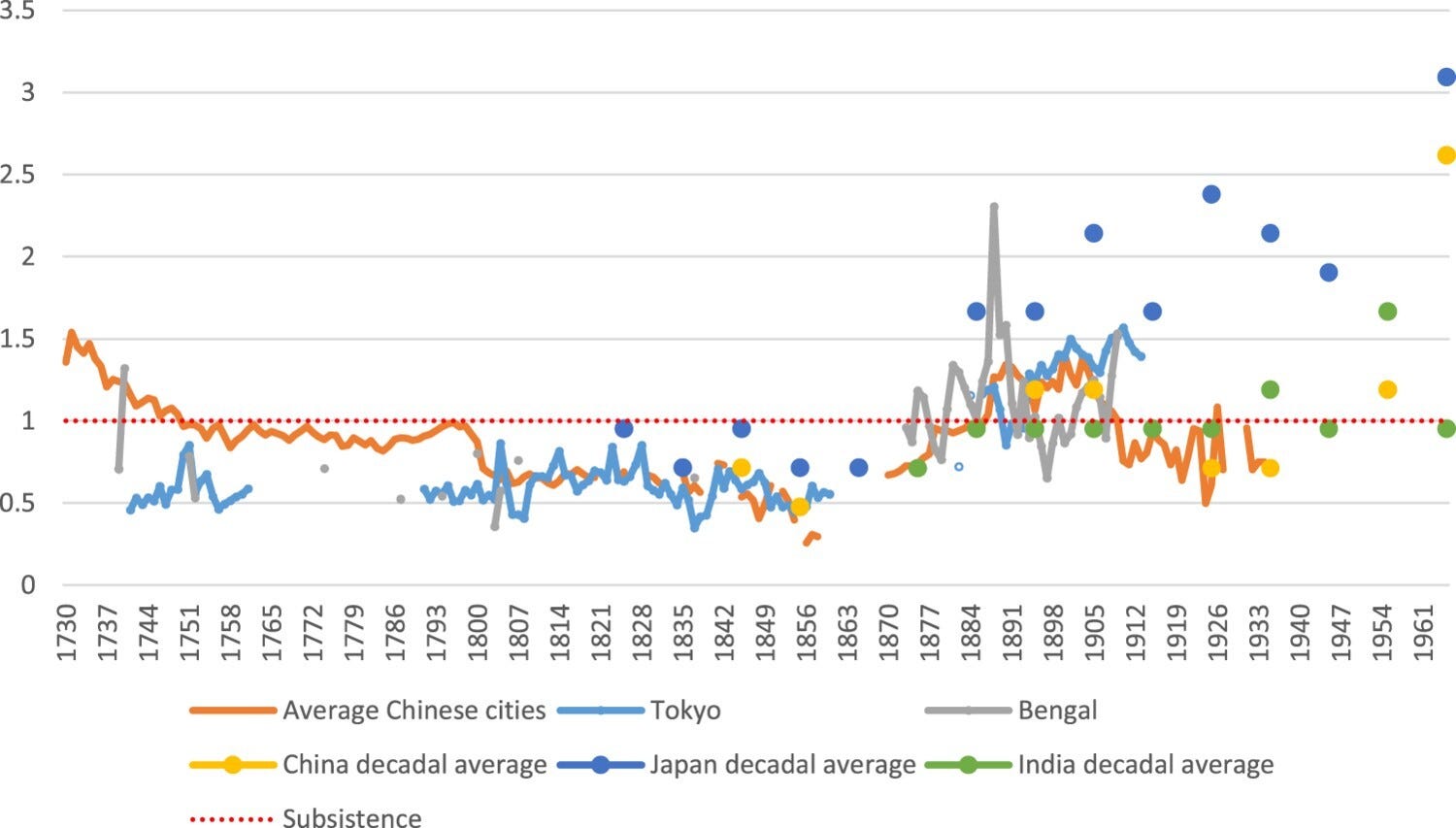
Remember also that Japan offers a fairly pristine case study, where there was no capitalism or European colonialism in the pre-1853 era, yet subsistence-ratio data show extreme poverty. Moreover, as capitalism was introduced to Japan during the late 1800s with the Meiji restoration, subsistence ratios concomitantly jumped above extreme poverty levels. See the two blue series from my paper below. Note that organized labor in Japan was very weak for the first few decades after its rise in 1890 – yet subsistence ratios jumped. It’s almost as if what you need is simply explosive economic growth for the initial spell to be broken.
Last thing. Allen (2020) reports that every fourth person in England lived below basic-needs poverty at the end of the 13th century, when the country was clearly pre-capitalist. Then, around 1688, as England was well on the road to capitalism, less than 10% of the population lived in extreme poverty according to Allen’s social tables. During the Industrial Revolution, “absolute poverty largely ended.” Again, capitalism and the breaking out of Malthusian stagnation turns out to be key, not so much contemporary progressive movements.
I have no objections to Ward’s postscript, which he appended to his piece 10 days after its release. There, he states that we can question how reliable poverty measures are and whether they all show the same decrease. He adds that merely claiming that capitalism decreased poverty is overstated and that there’s nuance to the story. Moreover, he recognizes that free-market economies have nevertheless contributed to economic growth and to poverty reduction, and that denying this would be foolish. Globalization, too, he says, has played a role.
All of that is well said, and it’s good that he updated in light of criticism and further reading. However, some of the key strong statements from the piece itself are either wrong, undocumented, misguided, or biased in the sense that too many legitimate arguments and empirical facts are overlooked and not reported. There’s nuance, indeed, but the reader would scarcely get that impression from reading the initial piece (without the postscript).
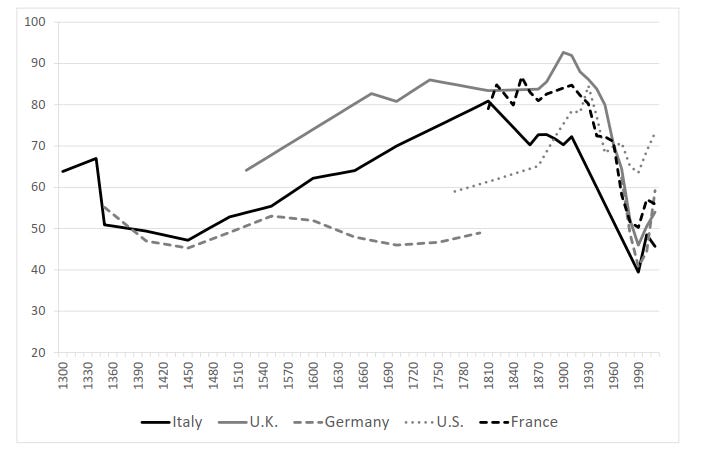
Oh, and by the way, it’s not true that, as Ward says at the beginning of his piece, “there are reams of data suggesting that many facets of human existence, wealth inequality for starters, have gotten much worse under capitalism.” In fact, the very data he refers to there (the World Inequality Database) show the opposite. Read my piece below.
Inequality today is no higher than in pre-modern times
·
Feb 19
Nobody denies, not even most anti-capitalists, that the modern era has made us all significantly richer in material terms than we were centuries or millennia ago. One of Karl Marx’s claims to fame was that, for all its faults, capitalism is materially impressive beyond belief:
No posts
Comments
Nothing yet. Say the first thing.
Sign in to join the conversation.