
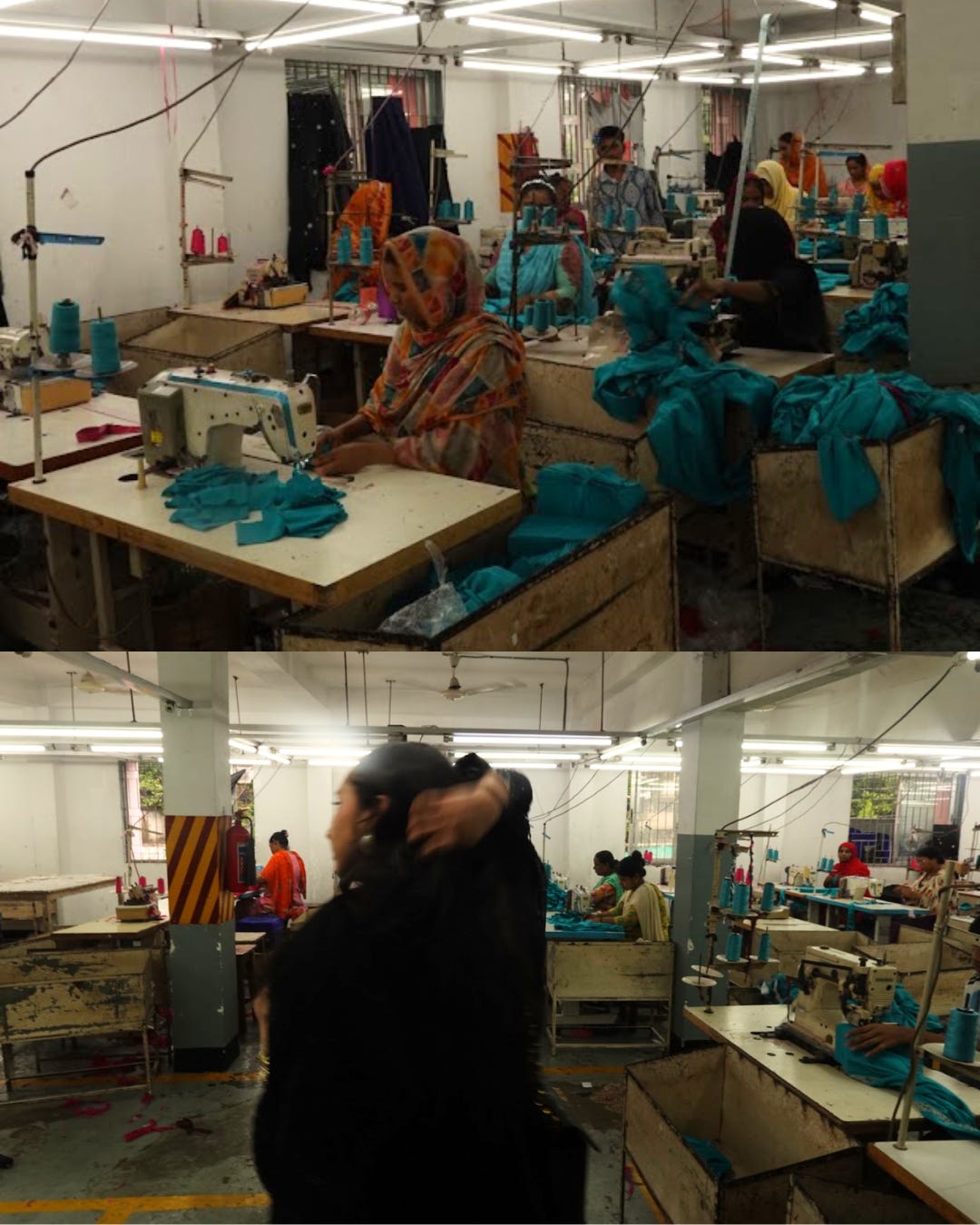
Hi, I’m Nabihah, a Bangladeshi-American living in New York. My family immigrated from Bangladesh in the early 2000s in search of better opportunities, but almost everyone back home still works in the country’s garment industry.
Growing up, I heard stories about how difficult their lives were, but they were always just stories. I had never witnessed their work with my own eyes. I’d read articles about garment workers, and every headline felt deeply personal because my own family worked in garments. Yet I couldn’t honestly speak to the realities they experienced. My understanding of the industry came almost entirely from secondhand accounts and distant anecdotes.
That really bothered me. I was forming opinions about an industry that had shaped my family’s life without ever setting foot inside it myself.
So in June 2026, after more than a decade away from Bangladesh, I booked a flight home to visit garment factories and see the industry for myself. This time, I was returning with a camera and an audience, hoping that if I could understand the reality on the ground, I might help others see Bangladesh’s garment industry through a more complete lens.
After a 39-hour journey from New York, I landed in Dhaka before taking a short domestic flight to Chittagong, the heart of Bangladesh’s ready-made garment industry. The first person I saw was my uncle, who works for a garment manufacturer in Chittagong.
My uncle is a brilliant man. He studied cybersecurity and information technology, spends his free time reading about startups, and dreams of building a software company in the United States. He’s been trying to obtain a green card for nearly fifteen years, so he hasn’t been able to fulfill that dream.
Every morning while I was in Chittagong, he would leave for work before I woke up and return late in the evening, working seven days a week. When I asked if he ever had a day off, he told me that sometimes he gets part of a Friday, but most weeks he works every single day.
He is someone with the talent and ambition to build technology, yet the circumstances around him had left him with few opportunities to pursue that dream. In countries like Bangladesh, countless brilliant people have ideas capable of changing the world, but many spend their lives working relentlessly simply because the pathways available to them are narrower than those afforded elsewhere.
When I arrived in Bangladesh, I had no plan for how I was going to get inside a garment factory and wanted to leave my family out for precautionary reasons.
So I posted a vlog traveling to Bangladesh and explained that I wanted to learn about the garment industry from the ground hoping it would reach the target audience.
It did. Within two days, the video had been viewed more than 1.6 million times. My DMs quickly filled with messages from factory owners and workers inviting me to visit their facilities. I responded to those located near where I was staying and was able to arrange meetings with two factory owners.
Before I go any further, it’s important to acknowledge that this is not an investigative report or a comprehensive study of Bangladesh’s garment industry. I’m not a journalist, and I don’t claim that two meetings can represent an industry that employs millions of people. This is simply my experience and my observations from the conversations I had, and the perspectives shared with me by the people who welcomed me into their work.
The first person I met was a factory owner who had discovered my videos online, and after seeing my post about traveling to Bangladesh, he invited me to his office.
The city was experiencing severe flooding that day, so I suggested we reschedule. I was far more interested in touring the factory than sitting in an office. But he insisted we meet first. When I told him our car had become stranded in the floodwater, he offered to send one of his company’s trucks to pick us up. A few minutes later, a large car arrived, I hopped into the back and made our way through flooded streets to his headquarters.
The office caught me off guard. It was modern, newly renovated, and sharply contrasted with the surrounding neighborhood. An employee escorted me through office cubicles to a conference room where the owner was waiting. As I walked through the office, I couldn’t help but notice how quiet it was. The employees were mostly IT and administrative staff rather than garment workers, but they looked exhausted. They weren’t speaking much, and the atmosphere felt noticeably heavy.
Then the owner walked in. He was much younger than I expected. For the next forty-five minutes, we spoke about his business. He explained that he had inherited the company from his father, who founded it years earlier. The factory manufactures ready-made garments for both domestic and international buyers, and he hoped to eventually launch his own direct-to-consumer clothing brand using his existing manufacturing capabilities.
When describing the factory, he told me it was “one of the better ones.” We spoke at length about entrepreneurship, and much of the conversation shifted toward my own startup. He was particularly interested in the American technology ecosystem and wanted to know how it might help him expand his business.
After our meeting, I spent time speaking privately with several employees. Several employees told me they experienced delayed or inconsistent pay, unexpected salary deductions, and long working hours that extended beyond the official end of the workday. Some also described being contacted outside of working hours and expected to remain available whenever needed. I was not able to independently verify these claims, but I kept hearing similar concerns from multiple employees…
Interestingly, many of those same employees also described the factory as being better than many others they were familiar with. Before I left, I asked if I could tour the production facility. The owner advised against it because of the flooding, warning that the roads were nearly impassable.
I decided to go anyway.
The factory was about thirty-five minutes from the office. By the time we arrived, I realized the owner was right. The entire area was flooded and as we approached the entrance, our car stalled in the water. We had no choice but to turn around and find another route. A nearby factory had an open entrance where the road was just passable enough for us to stop.
I stepped out of the car and asked the men standing outside if I could come in to film. They said yes and allowed me to go inside.
There was no way to reach the building without walking through the floodwater. I hesitated for a moment before stepping in. The water was murky, carrying dirt and debris from the surrounding streets. By the time I reached the entrance, my shoes were completely soaked but I tried to ignore it.
Then a smell hit me immediately. It was a dense mix of humidity, sour sweat, machine, and damp fabric that clung to the air. The floor was scattered with scraps of cloth and debris, and the building itself felt worn. Inside, rows of sewing machines stretched across a crowded room. There was no air conditioning. Most of the operators I saw were women, many of whom appeared remarkably young. The room was loud with the constant rhythm of sewing machines, yet strangely calm. One male supervisor moved between the rows, checking production as work continued uninterrupted.
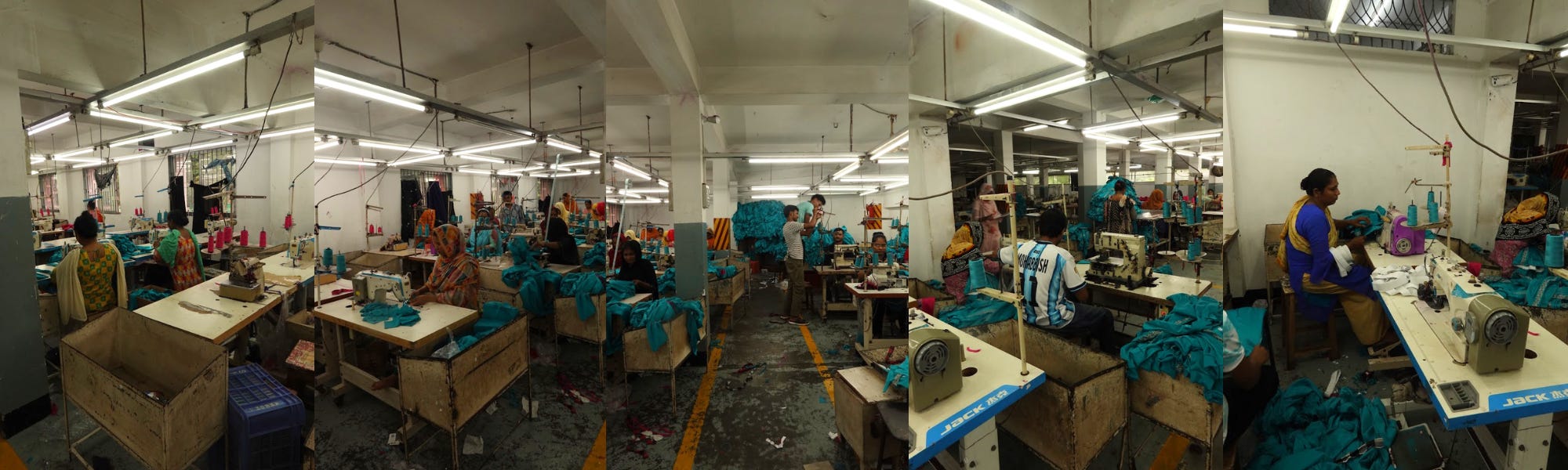
What surprised me most wasn’t the factory itself, it was how the people responded to my presence. As I walked through filming, many of the workers smiled at me. Some looked directly into the camera. No one appeared startled by my presence, and no one stopped working. The supervisor I observed wasn’t shouting or creating a scene. From what I could see, this was simply another ordinary workday.
After filming what I could, I thanked the workers and quietly walked back out into the floodwater. If you’re interested in seeing the footage, check out this reel.
The next day, I returned to Dhaka because the flooding in Chittagong was getting so severe, and scheduled a last-minute meeting with an executive at one of Bangladesh’s ready-made garment manufacturers. His company produces for both luxury fashion houses and large American retailers, and he has spent more than three decades in the industry.
We met over dinner in Banani, one of Dhaka’s wealthiest neighborhoods. After I explained why I had come to Bangladesh and what I had seen so far, he told me to be careful about how I tell this story.
He explained that, in his view, reducing Bangladesh’s garment industry to a single sweatshop narrative has consequences far beyond public perception. Bangladesh is one of the world’s largest exporters of ready-made garments, and millions of people depend on the industry for their livelihoods. He argued that when buyers lose confidence in Bangladesh as a manufacturing destination, whether because of political instability, negative publicity, or other factors, orders often shift to competing manufacturing hubs in countries such as Vietnam or India.
Then he told me something I hadn’t known before about any manufacturers. His company has invested years into meeting more than a dozen international certifications and compliance standards, making its factories among the most rigorously audited in the country. Every day, he personally visits his factories in Dhaka.
Then I asked him a question that had been lingering in my mind since visiting Chittagong: if his factories meet such high standards, are they really expensive compared to lower-compliance factories?
He said just a few dollars, and that honestly surprised me. If the difference was only a few dollars per order, why would foreign buyers willingly choose factories with weaker labor or compliance standards?
As dinner continued, I asked how he found customers and he told me he goes door-to-door to meet buyers. For more than thirty years, he has traveled the world meeting potential clients face-to-face. He told me he has visited dozens of countries because, in an industry built on trust, he believes relationships are still the most effective way to earn business.
Before we parted, he invited me to tour his factories in Dhaka. Unfortunately, my flight to Malaysia was leaving the following morning, so I couldn’t accept. But I will be returning again soon to tour.
I’ll admit I arrived in Bangladesh expecting to confirm what I already believed. I thought I would document the harsh realities of garment workers and expose an industry I had spent years associating with exploitation. Instead, I left realizing the story was far more complicated than I had imagined.
What I learned is that “Made in Bangladesh” is not a standard, but a country of thousands of factories, each operating differently. Some factories invest heavily in compliance, worker safety, and international certifications. Others cut corners, lumping them together under a single narrative, doing a disservice to everyone involved, especially the manufacturers that have spent years trying to do things the right way.
That realization fundamentally changed the way I think about accountability because the question isn’t whether a garment made in Bangladesh is unethical, it’s which factory made it, and who chose that factory.
Throughout my conversations, I kept returning to something the executive had told me. That the difference between producing with a highly compliant manufacturer and a lower-compliance one could be surprisingly small. If that’s true, then the conversation shouldn’t end with where a product was made, it should also include why a particular manufacturer was chosen in the first place.
As with every problem I encounter, my mind immediately started thinking about potential solutions. That night, I returned to my hotel room replaying the entire trip in my head. Out of everything I had seen, one detail I kept lingering on was the executive spending decades traveling from country to country, knocking on doors just to introduce buyers to his factories. What if one of the biggest barriers wasn’t quality, but rather, visibility?
Finding manufacturers is still remarkably opaque. It depends on industry connections, trade shows, and years of insider knowledge. For many emerging brands, the easiest manufacturer to find isn’t necessarily the best one, but the one they happen to know exists. Sitting alone in my hotel room that night, I realized that this was a problem SSQRD could actually help solve.
We’ve been helping people discover better brands. Why couldn’t we help brands discover better manufacturers?
If we could connect founders directly with ethical, high-compliance manufacturers, we could improve the beginning of the fashion supply chain, not just the end of it. It would make it easier for brands to build responsibly from day one, while giving world-class manufacturers the visibility they deserve.
We're now exploring this as the next chapter of SSQRD. If you're a founder searching for manufacturing partners, or a manufacturer that believes your work deserves greater visibility reach out. I'd love to learn from you as we build this.
Bangladesh is my motherland. It’s heartbreaking to see a country filled with extraordinarily hardworking and talented people be reduced to a narrative that rarely captures its full complexity. Bangladesh has been one of the foundations of the global fashion industry for decades. It deserves to be known not only for the challenges it has faced, but also for the manufacturers, workers, and innovators working every day to raise the standard.
And I hope SSQRD can play a part in telling that story. When I started SSQRD, the vision was never just to help people discover better brands. It was to make global commerce more accessible to everyone who participates in it, like the consumer searching beyond algorithmically promoted products, the independent designer trying to share their work with the world, and the manufacturer producing exceptional products without the visibility to reach global buyers.
The more I travel, the more convinced I become that commerce doesn’t have to be extractive. It can be reciprocal. It can create opportunity at every step of the supply chain instead of concentrating it in the hands of a few.
That’s the future I want SSQRD to help build. A fashion industry that is symbiotic instead of parasitic, where discovery creates opportunity not just for the brands we wear, but for the people who make them.
No posts
Comments
Nothing yet. Say the first thing.
Sign in to join the conversation.