
On July 10, 2026, SSQRD founder Nabihah Ahmad visited garment factories in Chittagong, Bangladesh, capturing footage of workers and documenting conditions that contradict the story Western fashion brands tell about their supply chains. What she found was a country whose garment manufacturing infrastructure is considerably more sophisticated, more regulated, and more invested in worker welfare than the brands sourcing from it are willing to pay for. The “sweatshop” narrative that attaches to “Made in Bangladesh” clothing in Western consumer culture isn’t invented. The conditions she documented exist and they’re real. But the narrative is incomplete in a way that misplaces the accountability almost entirely, and that misplacement is commercially convenient for the Western brands responsible for it.
She walked through contaminated floodwater to enter one factory. What she found inside, the smell, the overcrowding, the absence of ventilation, the workers who smiled at her camera with a familiarity that suggested they’d long since stopped expecting anyone to be disturbed by what surrounded them, was real and it was documented. And then she sat in her hotel that evening and processed something that reframed the entire experience: Bangladesh now hosts 280 LEED-certified green garment factories, more than any other nation on earth, with 52 of the world’s top 100 highest-scoring LEED-rated factories located in the same country. In 2025 alone, 38 new factories achieved LEED certification, the highest number in any single year in the country’s history, with 22 of them achieving Platinum status. The problem isn’t that ethical production doesn’t exist in Bangladesh. It’s that Western brands are choosing not to pay for it, and then allowing the resulting conditions to be understood as a Bangladesh problem rather than a sourcing problem.
*LEED stands for “Leadership in Energy and Environmental Design”, it’s the world’s most widely used green building rating system
Bangladesh is the world’s second-largest exporter of ready-made garments, with the sector generating $50 billion in export earnings by the end of 2024, representing approximately 84% of the country’s total merchandise exports. The industry employs approximately 5 million workers, 55% of whom are women, making it the primary source of formal employment for Bangladeshi women and a foundational pillar of the country’s economic development since the 1980s. The scale of the industry’s contribution to Bangladesh’s GDP and to global fashion supply is significant enough that the decisions Western brands make about which factories they source from have direct and measurable consequences for millions of people.
Chittagong, the country’s second-largest city and primary port, anchors the EPZ-based wovens and outerwear segment of the industry, with approximately 600 export factories concentrated in the area and Chittagong port handling nearly all of the country’s ocean freight. The city’s Export Processing Zones contain some of the most sophisticated garment manufacturing facilities in the world, established specifically to attract foreign investment and meet international compliance standards. What Nabihah found there wasn’t a uniform picture of exploitation, but rather a two-tier system whose existence Western fashion media has almost entirely failed to report.
The industry’s compliance infrastructure is genuinely impressive. Over 2,400 factories have been remediated under the Accord and the RMG Sustainability Council since 2014. International certifications including BSCI, WRAP, SMETA, ICS, GOTS, and the Higg Index are maintained across the highest-tier factories. Nine of the world’s top ten LEED-certified green factories are located in Bangladesh, a fact that receives essentially no coverage in the Western press despite being a more accurate representation of what the country’s garment industry is capable of producing when it’s resourced to do so. Bangladesh isn’t a country without the infrastructure for ethical production. It’s a country in which that infrastructure is unevenly distributed, and in which Western brands’ sourcing decisions determine which part of the distribution receives their orders.
What the standard Western narrative about Bangladeshi garment manufacturing misses, and what Nabihah found when she spoke to two factory owners in Chittagong, is that the industry has an internal hierarchy that’s poorly understood outside the country and that directly determines the conditions experienced by workers on the floor. The hierarchy isn’t a secret. It’s a feature of how the industry operates, and it’s one that Western brands navigate deliberately when they make sourcing decisions.
The highest-ranked factories operating at full international compliance standards maintain proper ventilation, pay workers on time and at the correct rate, adhere to regulated working hours, and hold certifications from multiple international bodies. They’re more expensive to produce in than their non-compliant counterparts, but still considerably cheaper than comparable facilities in Europe or North America. These factories actively court international clients, fly door-to-door to find new buyers, and invest in the client relationships that make compliance economically sustainable. Their business model depends on being chosen specifically for their standards, and they’re competing against factories whose business model depends on being chosen specifically for their price
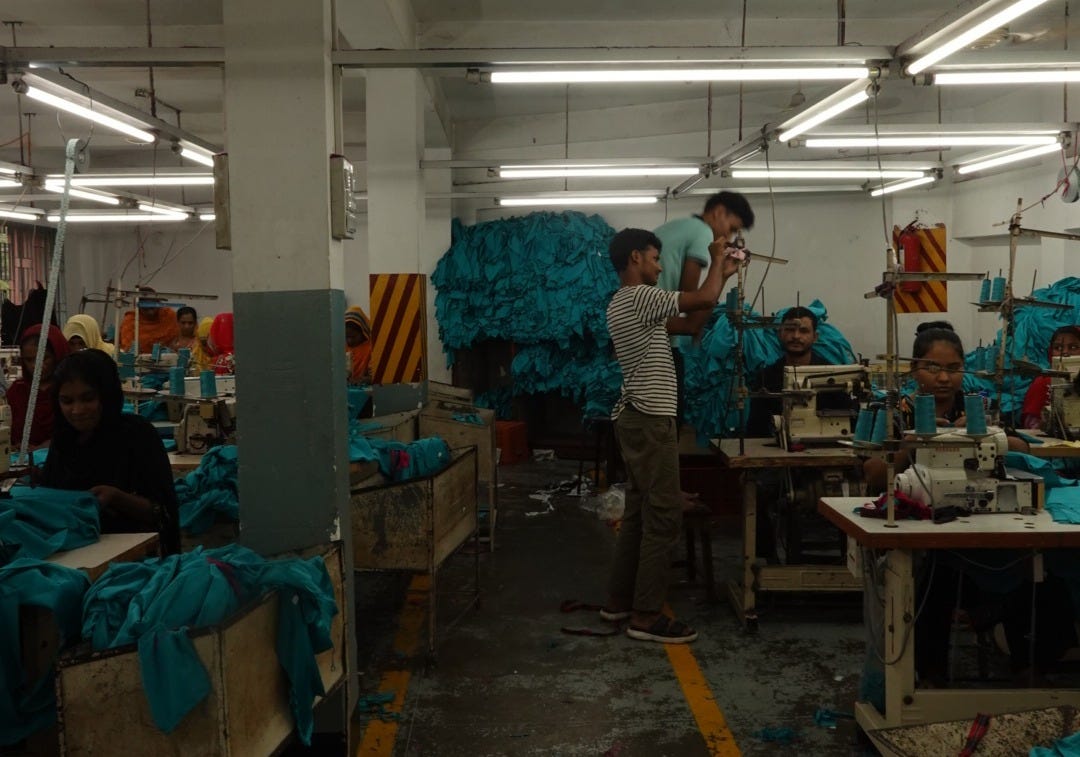
The second factory Nabihah spoke to operated on an entirely different model. The owner didn’t pay employees on time or in the correct amounts, and reserved the right to slash pay whenever he chose. Workers were expected to remain beyond their scheduled hours without additional compensation, and leaving at the contracted time was treated as a disciplinary infraction. The owner would call workers during their private time and require them to return to the factory at will. Some workers were scheduled seven days a week for twelve hours a day. The factory she toured had no ventilation and no drainage system. When it rained the day she visited, the water flooded the entire floor space, and she had to walk through contaminated water to enter. Inside, there was garbage throughout the production area, and the smell was acute. Every worker she observed was either a woman or a young person. They smiled at her camera, a familiarity that read less like warmth than like complete desensitization to an environment that should have disturbed any visitor
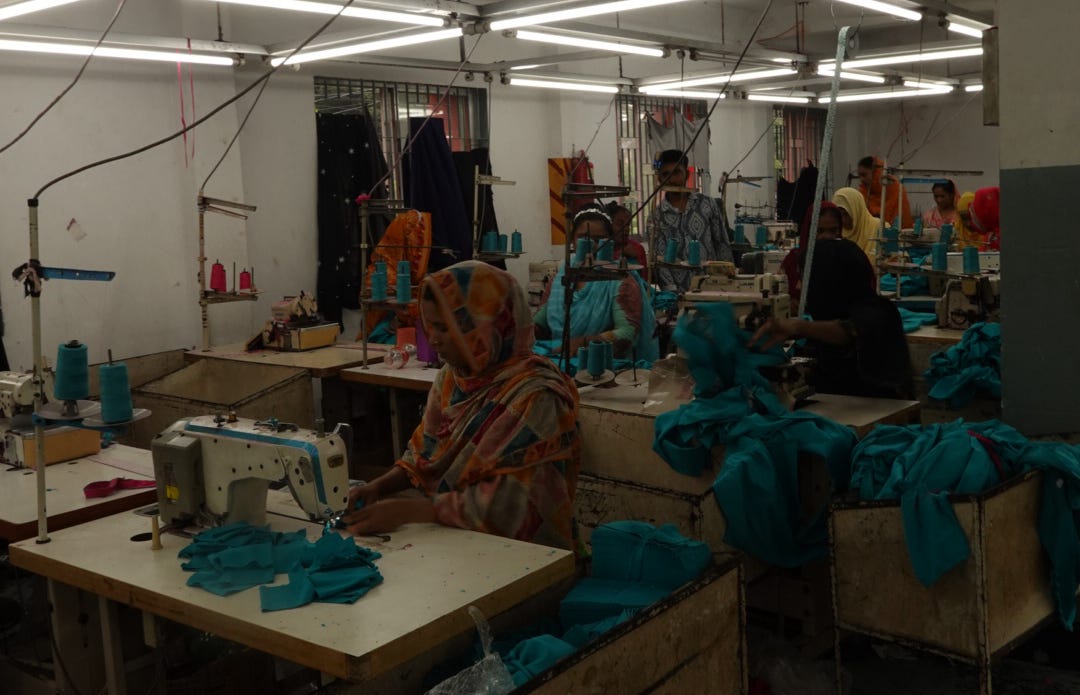
What the compliant factory owner told Nabihah stays with the piece as its central observation: the non-compliant factory’s garments are lower quality, because overworked workers under pressure to meet mass production quotas produce less precise work. The stitching is worse. The finishing is worse. The consistency across a large order is worse. And yet major Western corporations consistently prefer to work with factories like the second one, because the unit price is lower. Compliance costs money and brands are choosing not to pay it, they’re doing so with full knowledge of what that choice produces
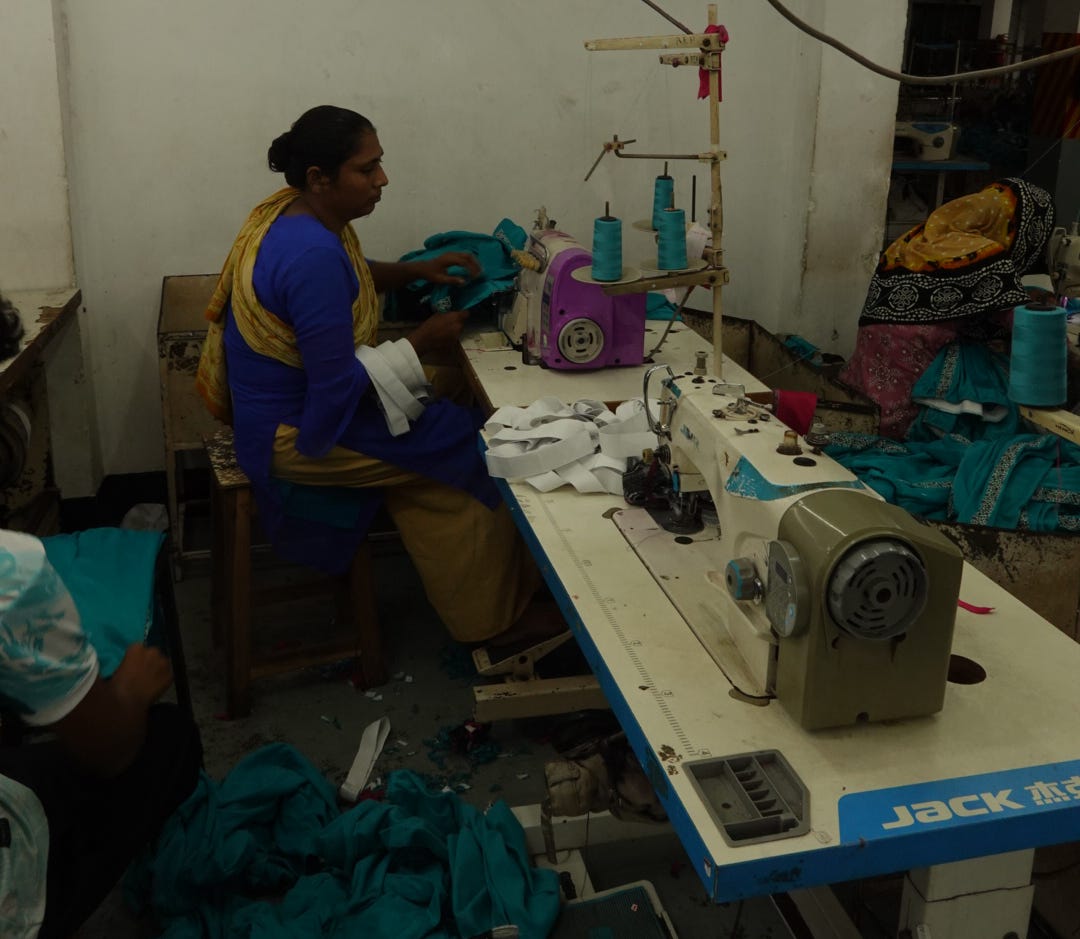
The Rana Plaza collapse on April 24, 2013, killed 1,138 workers and injured more than 2,000. It remains the deadliest disaster in the history of the modern garment industry. The building housed five garment factories producing clothing for Western brands including Walmart, JCPenney, The Children’s Place, and Inditex. Virtually all of these companies had supplier standards and employed auditing firms to inspect their factories on a regular basis. None of them identified the structural failures that caused the collapse, because the auditing systems they were relying on weren’t designed to identify them and because the brands hadn’t required anything more rigorous.
Three weeks after the disaster, a group of major brands signed the Accord on Fire and Building Safety in Bangladesh, a legally binding agreement between clothing brands and global unions that established an independent inspection program covering fire, electrical, and building safety. Inspection findings were made publicly available, and improvement plans for underperforming factories were implemented using funds committed by participating brands. The Accord brought crucial improvements to 1,600 factories and is widely credited with preventing mass casualty incidents in Bangladesh since 2013. The nine-story building’s collapse had been preceded by visible cracks in the walls the day before, and workers who flagged the danger were forced into the factories anyway under threat of losing wages. The Accord was the industry’s acknowledgment that self-regulation had failed catastrophically and that legally binding external oversight was the only framework that had any prospect of producing consistent results.
Yet a decade after Rana Plaza, major American brands including Levi’s, Walmart, Amazon, and Columbia Sportswear still hadn’t signed the International Accord, continuing to rely on the same category of corporate-led audits that failed to prevent the original disaster. About one-fifth of Bangladesh’s garment factories still haven’t completed the safety remediation required in the aftermath of Rana Plaza, more than a decade later, and the RSC has reported that the pace of improvement has slowed significantly. The brands that haven’t signed the Accord are the brands whose factories are most likely to be in that non-compliant fifth, and the brands whose workers are most likely to be in conditions similar to what Nabihah documented.
In November 2025, the Bangladesh Garment Manufacturers and Exporters Association publicly urged its members not to comply with newly proposed labor rights monitoring requirements set by the RMG Sustainability Council, which would have expanded oversight beyond physical safety to cover wages, discrimination, and forced labor. The industry body’s resistance to expanded monitoring reflects the same structural incentive the non-compliant factory owner operates on: accountability costs money, and the brands currently sourcing from those factories haven’t made accountability a condition of their orders. Until they do, the incentive to resist monitoring will remain stronger than the incentive to comply with it.
The problem Nabihah documented in Chittagong isn’t that Bangladesh lacks the capacity or infrastructure for ethical garment production. It’s that Western companies are consistently choosing the cheaper, less ethical option, and that choice creates a feedback loop that actively undermines the compliance infrastructure that does exist alongside the non-compliant one.
When a major brand places a large order with a non-compliant factory because the unit price is lower, that order finances the factory’s continued operation, subsidizes the owner’s ability to underpay and overwork his workforce, and makes it economically rational for him to continue avoiding the compliance investments that would raise his costs. The compliant factory, which has invested in ventilation, drainage, fair wages, regulated hours, and international certification, gets passed over precisely because of those investments. The market rewards the factory that cuts corners and penalizes the one that doesn’t, and it does so because Western brands are making a deliberate decision to prioritize margin over conditions. That decision is made in sourcing offices in New York, London, and Paris, and its consequences are experienced on factory floors in Chittagong.
The feedback loop extends further: as the compliant factory owner explained to Nabihah, non-compliant factories produce lower-quality garments because overworked and underpaid workers can’t maintain the precision and consistency that good production requires. Brands that choose non-compliant factories aren’t just choosing worse conditions for workers, they’re also, in many cases, choosing a worse product. But the cost difference is significant enough in the short term that the quality trade-off is accepted, and the worker welfare trade-off doesn’t factor into the calculation at all because there’s no mechanism requiring it to.
BGMEA reported that Bangladesh’s RMG exports reached $50 billion in 2024, generating enormous commercial value for the Western brands sourcing from the country. The portion of that value that flows back to the workers producing the garments is determined by which factories get the orders, and which factories get the orders is determined by which brands are willing to pay for compliance. The brands that aren’t are making a specific and documented choice about whose wellbeing they’re willing to trade for their margin, and they’re doing it while allowing the resulting conditions to be understood by Western consumers as a Bangladesh problem rather than a brand problem.
Bangladesh has built, largely without acknowledgment in Western fashion media, a manufacturing infrastructure that includes the world’s largest concentration of LEED-certified green factories, a post-Rana Plaza safety compliance system that has demonstrably prevented mass casualty disasters, and a workforce that’s among the most skilled in global garment production. Meher Garments Ltd. in Pahartali, Chittagong, holds a LEED Platinum certification with a score of 89 points, awarded for exceptional efficiency in energy and water usage alongside eco-friendly production systems. That factory is in the same city where Nabihah walked through contaminated floodwater to enter a factory with no drainage system and no ventilation. Those two realities coexist in Chittagong, and which one a garment passes through on its way to a Western retailer’s shelf is determined almost entirely by what the Western brand sourcing it was willing to pay.
The stigma that attaches to “Made in Bangladesh” in Western consumer culture isn’t without basis, but it misplaces the accountability in a way that serves the brands responsible for the conditions. The label doesn’t tell you which kind of factory made the garment. It doesn’t tell you whether the brand chose the compliant option or the cheaper one. It doesn’t tell you whether the workers who made it were paid on time, allowed to leave at a reasonable hour, or working in a building with adequate ventilation. Those distinctions are determined entirely by the sourcing decisions of Western brands, and Western brands have no structural incentive to disclose them because disclosure would make their choices visible in a way that’s commercially inconvenient.
Bangladesh is an incredible manufacturing hub with some of the best materials and most skilled workers in the garment industry. The ethical production infrastructure exists and it’s operating at a world-class level in factories across the country. The problem isn’t having ethical production: it exists in plenty across Chittagong and the rest of the RMG sector. The problem is which factories the foreign clients are choosing to work with, and why. That’s a Western brand decision, made for Western commercial reasons, and it produces conditions that Western consumers then associate with Bangladesh rather than with the brands whose logos appear on the finished garment.
SSQRD’s platform surfaces brands whose supply chain claims are independently verifiable, a standard that matters considerably more when the alternative is a “Made in Bangladesh” label that could mean almost anything depending on which factory the brand chose and why. The infrastructure for ethical production in Bangladesh is real and it’s extensive. What’s missing isn’t the factories, but the brands willing to pay for them.
No posts
Comments
Nothing yet. Say the first thing.
Sign in to join the conversation.