
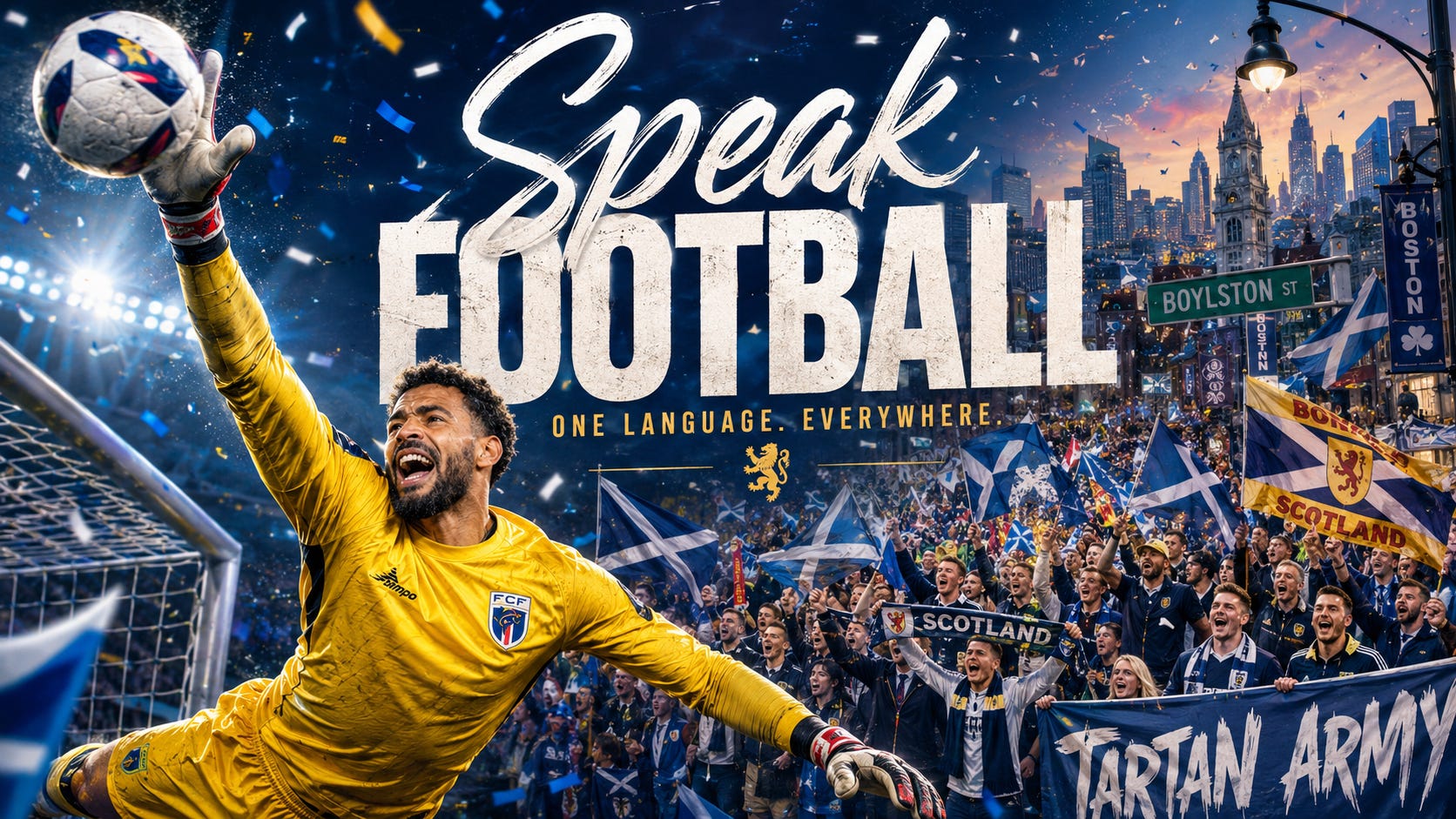
I’ve spent over forty years and a fair stack of air miles learning that you really only need two languages to get by almost anywhere on earth. Speak football and speak music, and you can strike up a conversation in a bar in Buenos Aires, a souk in Marrakech, or a diner in Kansas. Everything else — the menus, the customs, the small talk — you can busk. Those two you cannot fake, and you never need to. They are the closest things we have to a universal tongue.
In Buenos Aires I met people chatting about the talent of Fernando Gago and his ability to be the new Redondo, in Rio it was about how Diego and Robinho had the world at their feed (yes I am showing my age), and regardless of where I have been that ability to break the ice over football has been a consistent theme – and my daily excuse to my wife as to why I must watch ever more sport!
This past fortnight, the planet has been speaking football at full volume. And it has been glorious to watch.
The setting matters. A World Cup has landed in a United States that, by most accounts, is busy pulling itself apart along political lines — a country where the easy story this summer was supposed to be about who gets let in and who gets kept out. Instead, the loudest story has been about who gets embraced. The tournament didn’t paper over the divisions; it simply reminded everyone, for a few weeks, of something older and bigger than any of them. Football has been doing that since the year dot.
Because that is what the game has always been. Before it was a media-rights asset or a sovereign-wealth play or a content library — before it was any of the things I spend my working life valuing — it was a tribe. Every club, every nation, its own community with its own songs, its own grievances, its own people. The World Cup is just the moment all those tribes pour into the same place at once and discover, slightly to their own surprise, how much they like each other.
The evidence has been everywhere.
In Boston, five thousand of the Tartan Army — Scotland’s first World Cup in twenty-eight years — marched to Fenway Park behind their bagpipers, filled the old ballpark with renditions of Flower of Scotland, and so charmed the city that the Red Sox president, Sam Kennedy, wrote them a public thank-you, praising the “energy, passion, and pure joy” they’d brought and telling them they hadn’t merely visited Boston — they’d become part of it. Boston and Glasgow signed a sister-city partnership before the Scots had even left town. A baseball city, falling for a football crowd it had never met, despite them drinking the town dry!
I’ve loved the story in Lawrence, Kansas — a college town of a hundred thousand that, three weeks ago, likely could not have placed Algeria on a map — they adopted Les Fennecs as their home team. An artist laid out a giant Algerian flag on the university grounds; restaurant owners started cooking halal; one resident took an Algerian supporter she’d never met into her own home for the duration. What moved him at the unveiling, the artist said, wasn’t the flag or the artwork at all, but “the embrace of the community.” That is the whole thing in a sentence.
In Guadalajara, Korean fans turned away at the turnstiles for trying to carry tequila into the stadium did the only sensible thing: opened the bottle outside and shared it with the Mexicans next to them. The clips went round the world — Mexicans hoisting a Korean fan onto their shoulders, both sets singing Gangnam Style, an old chant resurfacing: “Coreano, hermano, ya eres mexicano.” Korean, brother, you’re Mexican now. A friendship first forged in 2018, when Korea’s win over Germany sent Mexico through — and still warm enough in 2026 to survive the two nations actually playing each other.
And on a Monday night in Atlanta, a forty-year-old goalkeeper named Vozinha — the nickname means Granny — kept Spain at bay for ninety minutes, made seven saves, and dragged Cape Verde, a volcanic speck in the Atlantic with barely half a million people, to a goalless draw with the European champions in the nation’s first-ever World Cup match. He began that day with around fifty thousand Instagram followers. He passed twelve million before the week was out — more than Ohtani, more than Dončić. A Brazilian streamer watching the game told his audience that, just this once, he wasn’t asking them to subscribe to anything; he was asking them to follow this man. And the whole watching world did.
Here is the part the industry keeps missing.
Vozinha is not famous for seven saves. Plenty of keepers make seven saves and trend for an afternoon. He is famous because the world fell for the story the saves were telling — a tiny island standing toe-to-toe with a giant and refusing to blink; a man who nearly quit the game, now weeping at the final whistle for the grandparents who raised him. The saves were the what. The pride, the impossible odds, the half-million people who suddenly saw themselves on the biggest stage on earth — that was the why ( thanks once again to Simon Sinek for the inspiration!). Everyone in football understood it instantly, because everyone in football knows what it is to belong to something improbable and love it anyway.
We who market this game spend most of our energy on the what. We sell the goals and the tackles and the saves, the highlight reel, the xG, the product on the pitch. All of it real, all of it necessary — and all of it the most volatile thing we own. The product loses. The product gets relegated. The product is sold, rebuilt, and sold again. If the goals are the only thing binding a fan to a club, you are one bad season away from losing them. But there is a reason why City fans kept coming whilst they were in freefall…and with Leeds and countless others when times were bad.
And on the rare occasions we do remember the why — when community actually makes it onto the agenda — we have historically shrunk it to fit a very small box. In my twenty-five years in the industry, “community” in sport has too often meant the foundation’s remit: the players visiting the children’s ward at Christmas, the half-term coaching clinic, the new all-weather pitch for the local school. Genuinely valuable work, all of it, and not a word against it. But look where it sits on the org chart — under corporate responsibility, filed beside the charitable giving and the sustainability report. A cost centre with a warm glow. We took the most valuable asset in the game and tucked it inside the one department whose job is to spend the money, not grow it.
The asset filed under charity
So let me put my flag in the ground, because this is the part that gets nodded at and then ignored: community is not the charitable layer bolted onto the side of the business, nor the soft, sentimental one draped over the top of it. It is the business — the entire relationship with every person who turns up, tunes in, or pulls on the shirt each week. It is the single most durable asset on the books, and almost nobody values it as one. Roger Mitchell rightly raises questions about models and the challenges in our space, my counter would be an incessant devotion to the community and the connection that drives us back to sports over and over again.
Form collapses; the community holds. Owners come and go; the community stays.
Think about what actually survives. A club drops two divisions and the community travels with it — the same songs, the same allegiance, the gate dented but not broken. That is, in the cold language of my day job, an annuity: a recurring, defensible, almost recession-proof revenue base that persists precisely because it was never really about the results. Cape Verde will not win this World Cup. It doesn’t matter. Twelve million people now belong to that story, and they are not going anywhere. That is the asset created in Atlanta — not a clean sheet, but an audience with a reason to stay.
None of which means scrapping the hospital visits — the opposite. That unglamorous local work is the proof that a club means it; it is the down payment on the trust everything else is built on. The mistake was never in doing it. The mistake was believing it was the whole of community — a box ticked once a season — rather than the visible edge of something that runs through every supporter who has ever sung your name. Community isn’t what the club does for the town twice a year. It’s the reason the town shows up every week.
The clubs and federations that grasp this stop selling the match and start selling the membership. They tell their people why they belong here — the history, the place, the identity, the improbable thing worth loving — and they let the goals be the bonus rather than the bond (personally I think Brugge, Benfica and Frankfurt remain amongst the best at this.)
So, your story
As you sit down to tell your own stories this season — your club, your league, your team, your brand — resist the easy stuff. The easy stuff is the highlight package, and the highlight package is a commodity; everybody has one. The hard, valuable, defensible stuff is the answer to a single question: why do these people belong with us — and would they still belong if we lost on Saturday? Answer it honestly, treat the answer as the growth strategy it actually is rather than a line in the responsibility report, and the goals take care of themselves.
I hate saying this as a Chelsea fan, but its true. Few clubs have the opportunity in front of them to build something really that resonates and that is Liverpool and Tottenham. Why? Well my belief is that in “You’ll Never Walk Alone” and “To dare is to do” they have something that is unattainable by many – an identity to live by that millions of neutrals around the world could live by. They have the amazing opportunity to build a community eco-system built on those tenents that could drive them like no other.
The whole world is in one room together for a few more weeks, speaking the one language that needs no translating, discovering that the tribe is far bigger than any of us thought. Football has known this since the year dot. It is the largest community on earth — and, on current evidence, the most generous.
Speak football. Everybody does.
Comments
Nothing yet. Say the first thing.
Sign in to join the conversation.