
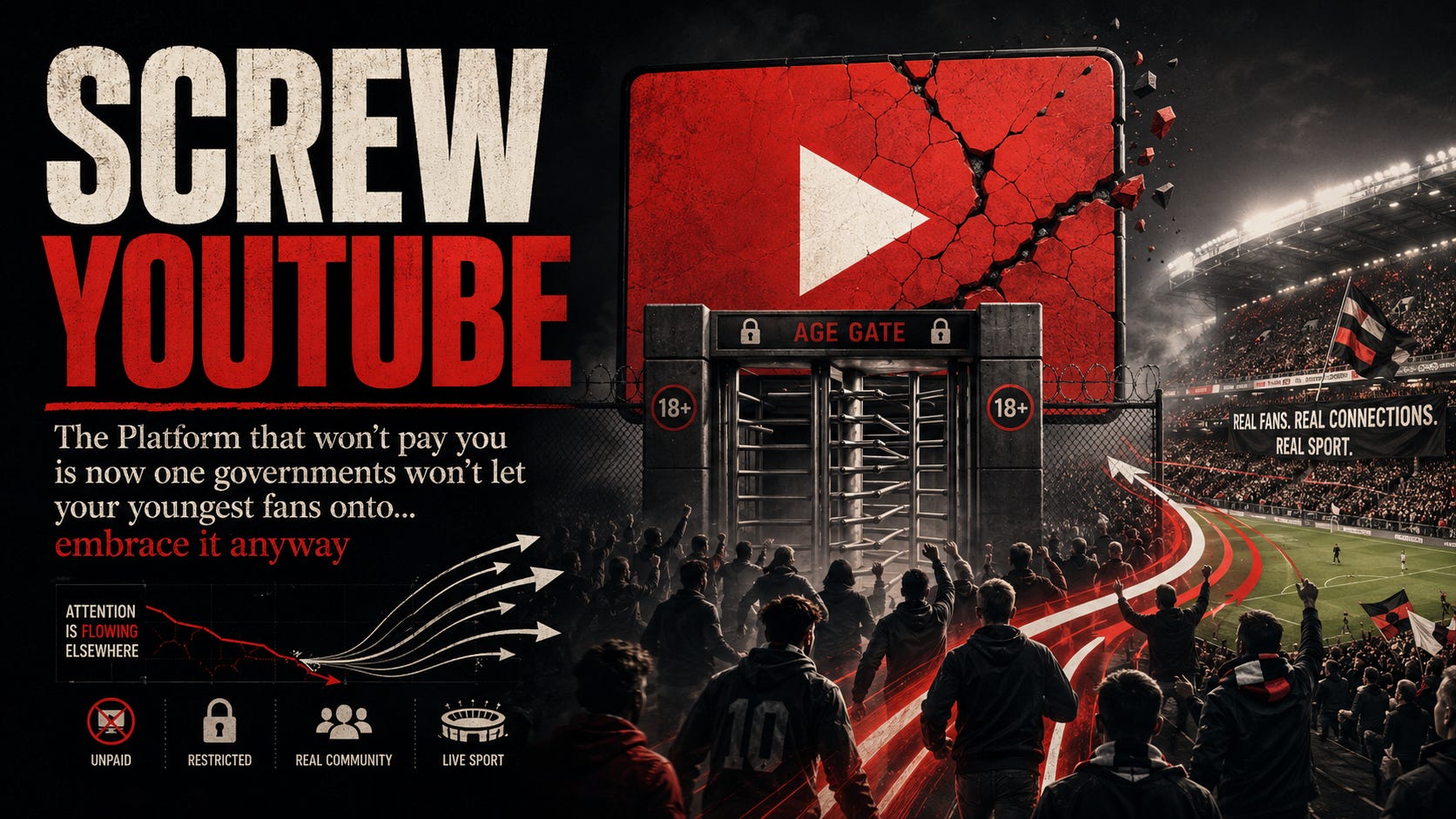
Screw YouTube. I wrote that headline to be ironic. Then, on Monday, the British government made it policy.
Keir Starmer announced that children under sixteen will be banned from YouTube, TikTok, Snapchat, Instagram, Facebook and X — to be clear this is not a content filter, but an account ban — and promised to go further than Australia, blocking livestreaming and stranger-contact features on top. Australia has been living it since December; reportedly around seven in ten under-sixteens are still finding their way onto the platforms, so enforcement is leaky — but the direction of travel is not in doubt. The European Parliament has voted for the same floor, France and others are moving independently, and the wave is now wide enough that you should plan for it rather than bet against it.
I lead with this because it detonates the single most popular piece of advice in my industry right now. The preaching I see on my timeline runs like this: sport has an ageing-fan problem, the young are on YouTube, therefore every club, league and athlete must pile onto YouTube to reach them. It’s a repeat of the prior commentary that everything should be short form – until people started to realise the length isn’t the issue.
However, that YouTube obsession argument now has a hole the size of a government underneath it, instantly giving credence to a message i have been a little preachy myself on - PEST analysis is underrated in today’s world.
The premise it breaks
Here is the uncomfortable mechanic. The reason the young are on those platforms is that the platforms were built to recruit and retain them — the addictive design, the early sign-up etc. Sport didn’t build that youth-acquisition machine; it piggybacked on it, treating someone else’s teenagers as a free distribution channel. And that machine is precisely what is now being legislated. Sport has been constructing its entire youth strategy on top of an audience the platforms assembled in a way that is, in two major markets, is about to be illegal.
In my last piece I argued that building your following on a platform you don’t own is building on rented land. This is worse. The landlord is now being told who he is allowed to let through the door — and the people he must turn away are the under-sixteens, the only audience the whole strategy was supposed to be about…
Before anyone reaches for the panic button: this is not a revenue cliff. Under-sixteens don’t have wallets. Sport makes its money from adults — tickets, subscriptions, hospitality, betting — and a fourteen-year-old was never the commercial story. The damage is slower and more serious than that. Under-sixteen is the age at which fandom is wired in for life. Cap that window and you are not losing this season’s income; you are losing the season-ticket holder of 2040. The platform was never going to pay you — and now it cannot even seed the fan who one day would have.
Note, too, what the bans actually target: accounts, not eyeballs. A teenager can still glimpse a logged-out clip. But no account means no algorithm learning what they love, no subscription, no relationship with the creator, no data, no way back to them. The ban doesn’t stop the young seeing your content. It stops the platform building the relationship you were there to build in the first place. Engagement collapses even where viewing survives.
If you take a step back it’s a real challenge because so many sports put their content behind a pay wall and now hope that social will capture the hearts of the youth and future audience. This basic premise becomes challenged if the audience isn’t allowed to see the content…
It never paid anyway
Strip the regulation away entirely and the case for treating YouTube as a destination still doesn’t hold, because the platform was never the till. Look at the accounts of the creators held up as proof that it can be. The biggest of them (Mr Beast) runs his media operation — the videos, the lavish streaming show — at a loss of around eighty million dollars a year apparently. The profit comes from a chocolate bar and other elements of his expanding business empire. The videos are the marketing budget; the business lives somewhere else. Music ran this experiment first: streaming pays a rounding error per play, so artists get known on the platform and paid on the road. The platform is the poster on the wall. The arena is the till.
The smartest new properties in sport already operate this way on purpose. The breakout short-format football leagues take under five percent of their income from selling broadcast rights and the bulk from sponsorship, and they give the content away deliberately — because the wider the reach, the more the attention is worth to the brands paying to sit inside it. They didn’t screw YouTube. They married it, then built the revenue somewhere the platform couldn’t reach in and take a cut. Reach is the raw material. Turning it into money is a separate machine you still have to build yourself. This is an age old model!
The More things Change – the More they Stay the Same.
None of this is new, which is the part that should sting the incumbents. Sport invented it. Football became the most valuable entertainment product on earth by being everywhere — free to air, in front of the largest audience that could be assembled, building the emotional dependency of entire nations one Saturday afternoon at a time. The mass audience came first; the money came after, because of its size. Then the pay-television cheque arrived and was so enormous it rewrote everyone’s memory, until a generation of executives believed scarcity itself was the business. For a fortunate few at the very top — the ones a technology giant will pay billions simply to gatekeep — it still is. For everyone else the platform is a channel, not a buyer, and the challengers giving their content away are simply returning to the land the incumbents forgot.
But — and here is the cautionary flag — the disruptors are also the most exposed. The free-streaming, livestreamed, influencer-fronted, deliberately youth-skewing model sits directly under Starmer’s specific shots at livestreaming and stranger-contact. The upstarts went back to this model just as the state began fencing off its under-sixteen corner. Disruption still matters — it remains how you build a modern audience, and incumbents who sneer at it are making the opposite mistake. But the disruptor who survives the next five years is the one who designs age-gating and a first-party relationship in from the start, rather than discovering, the morning the law lands, that their entire growth engine was built on a group they are no longer allowed to hold.
The only youth strategy they can’t switch off
If the platforms cannot legally deliver you the young, then the direct, owned, parent-mediated relationship is no longer best practice — it is the single youth strategy no government can switch off.
When I built the model for how to build Chelsea’s Commercial Plan during our bid in 2022, I didn’t focus on sponsorship (though they were $100m pa behind their peers), I build it around how do you design and eco-system where we become the default in a wide ranging scope of their lives in sports.
I was brought into another club to walk through this and their default position was therefore to segment a CRM more…but that assumes you have the data in the first place. The ecosystem is much broader and enabling than that. Your fan’s are connecting all day every day…just not with you, so take a step back and reconfigure what building fandom and connection really means because…
The clubs and leagues that hold a direct line to the young fan will own the next generation. The ones still renting that line on YouTube (or another social) will lose it — not to a competitor, but to legislation.
So, no — don’t screw YouTube. Use it shamelessly for the one thing it is still miraculous at: reach, at a scale and a price nothing else can match. Just stop mistaking it for the place the relationship lives, and stop assuming it will keep handing you the audience it was built to recruit. Because in the UK and Australia, governments have now decided that it won’t — and the rest are watching closely.
The platform is the funnel. The till — and now the relationship with the next generation — are your problem to build. Anyone telling you otherwise is either selling you something, or hasn’t read either the accounts or the news.
Comments
Nothing yet. Say the first thing.
Sign in to join the conversation.