
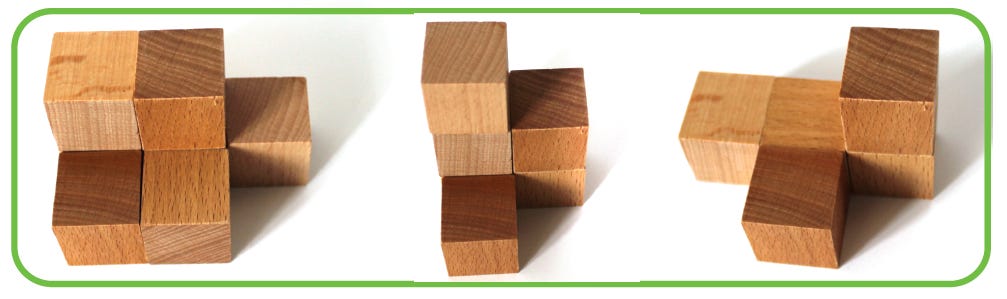
Stack a few cubes into a little tower — say five of them, with one tucked underneath at the back so it’s doing the holding-up but can’t quite be seen — and ask your child a simple question: how many cubes are in there?
Watch her count. Picture a moment like this one: she points a finger at each cube she can see, one, two, three, four, touching each in turn, careful and certain — and her finger never once travels to the back. “Four,” she says, and she’s not being careless. She counted every cube that existed, as far as she could tell. The fifth one, the hidden one holding the whole thing up, simply wasn’t in her world. It wasn’t that she forgot it. To her, it wasn’t there to forget.
That gap — between the cubes she can see and the cubes that are actually there — is one of the most important things a child ever learns to cross, and almost no one thinks to teach it on purpose.
Here’s what’s really happening, and it’s stranger than “she can’t count yet.” She can count perfectly. What she hasn’t yet grasped is that a solid thing has a back, and an inside, and parts of it are always hidden from wherever you happen to be standing.
This isn’t a failing of hers — it’s a genuine feature of how solids work, and Fröbel noticed it with unusual precision. Looking at a single cube, he worked out that you can only ever see three of its six faces at one time, and at most nine of its twelve edges.
Never all of it. Stand anywhere you like, turn it however you want — half the cube is always hidden from you. The whole of a solid can’t be seen at once; it can only be reasoned about. I’ve come to call the ones your child leaves out The Hidden Cubes — and learning to count them, the ones she can’t see, is the beginning of understanding space itself.
And children want this. Fröbel built his famous divided cube — the box of eight small cubes — precisely because he’d noticed something in every child he watched: a fierce urge, as one of his colleagues put it, “to take everything apart in order to look at what is inside.” Your child pulling a toy to pieces isn’t being destructive. She’s trying to solve exactly this problem — to see the hidden part, to find out what’s in there where she can’t look. The guessing game gives that urge something true to chew on.
So here’s the activity for this week, and you need nothing but a handful of identical blocks — wooden cubes, or any small boxes that stack. (Spielgaben’s cube sets are made for this, but any matching cubes do the real work.)
Build a small stack, and build it so at least one cube is genuinely hidden — one behind another, or one underneath propping up the rest.
Ask her to guess how many cubes are in the whole thing. Let her count what she sees and commit to a number.
Then — this is the part that matters — let her take it apart and count them for real. When she finds the extra one, the hidden one, watch her face.
There’s usually a small, specific surprise: where did that come from? It was there the whole time, holding everything up, and she’d looked straight past it.
Build it again. Guess again. She’ll start, slowly, to look for the ones she can’t see — to lean over, to check the back, to imagine the underneath. That leaning-over is the whole lesson arriving.
Don’t correct her first guess, and don’t count it for her. The wrong number is not a mistake to fix — it’s the exact edge of what she currently understands, and the taking-apart is how she moves that edge herself.
Your job is to build the stack and ask the question and stay quiet while the hidden cube does the teaching.
Which leaves a question, and it isn’t about her counting. It’s about you. We all judge things by the face they show us — the visible surface, the part that’s turned toward where we happen to be standing — and we all forget, constantly, that there’s a back we can’t see and an inside we’re only guessing at.
When did you last assume you’d seen the whole of something — a situation, a person, a problem — and then discovered the cube holding the whole thing up was one you’d never looked at? The child learning to count the hidden blocks and the adult learning to check the back of things are, I think, doing the same quiet work.
Thursday, paid members get the full version: the guessing game built across three age gaps — from a toddler finding a single hidden cube, to an older child working out how many cubes are inside a big solid block without taking it apart, which is the doorway to volume and real spatial reasoning.
Saturday, the framework beneath it: why “seeing the unseen” is a mode of thinking all its own, and the genuine split between how Fröbel and Montessori each teach a child to grasp what’s hidden — one by asking her to reason it, the other by making it visible.
— Jim
No posts
Comments
Nothing yet. Say the first thing.
Sign in to join the conversation.