
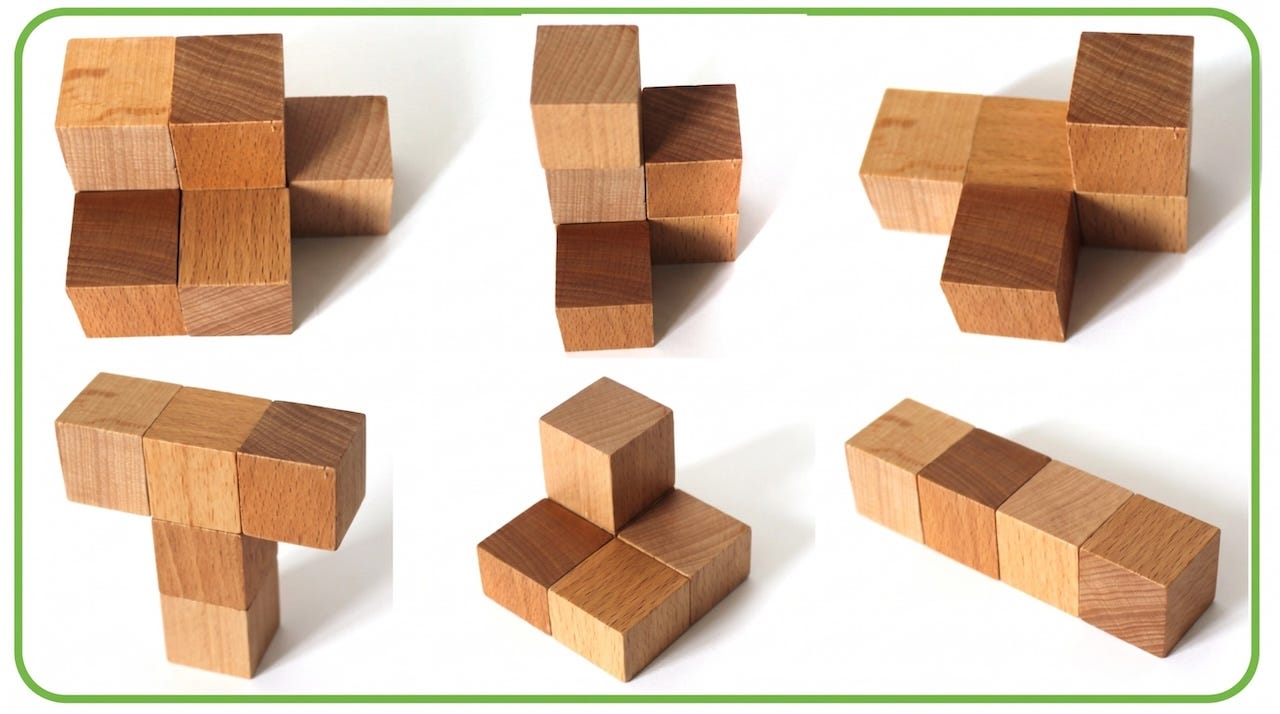
Tuesday your child discovered that a stack of cubes holds more than she can see — that there’s a hidden one at the back, holding the whole thing up. Today we build that discovery all the way out: the same guessing game, reshaped three times, so the youngest is finding a single hidden cube while the oldest is calculating the entire invisible interior of a solid block without laying a finger on it.
The idea in one sentence: Fröbel arranged his cubes so that a child moves from seeing a number, to counting a number, to reasoning a number she cannot see — and that last step, working out what’s hidden inside a solid, is the exact doorway to volume and everything that follows it.
Here’s the fact this whole week turns on, and it’s worth saying plainly to yourself before you teach it. You cannot see all of a solid at once. Fröbel worked this out precisely for a single cube: at any one moment, from any one position, you can see at most three of its six faces and nine of its twelve edges. Never the whole thing. Half of every cube is always turned away from you, hidden. This isn’t a limitation of children — it’s a limitation of looking, and the only way past it is to stop relying on your eyes and start reasoning. Teaching a child to count what she can’t see is teaching her the first thing that eyes can’t do and thought can.
And Fröbel built the cubes to make that reasoning countable. The Third Gift is eight small cubes forming one bigger cube — two by two by two. The Fifth Gift is twenty-seven, three by three by three. Those aren’t decorative numbers. A child who learns to see the layers — that a 3×3×3 block is three flat layers of nine stacked on top of each other — can count twenty-seven cubes in a solid block she’ll never take apart. That’s not counting anymore. That’s volume, arriving through her hands years before it arrives on a page.
Materials, all three ages: identical cubes — wooden blocks, or small boxes that stack cleanly. For the youngest, five or six is plenty. For the oldest you’ll want enough to build a 3×3×3 (twenty-seven), or you can reason about it with fewer. (Spielgaben’s Third and Fifth Gifts are exactly the 8-cube and 27-cube sets Fröbel designed for this, but any matching cubes work.)
What she’s learning: that a thing can be there without being visible — that “I can’t see it” and “it isn’t there” are two different statements.
The activity (10–15 minutes). Build a small stack with exactly one cube genuinely hidden — one behind another, or one underneath propping up the rest. Ask her to count how many cubes are in the whole thing. Let her count what she sees and commit to a number. Then take it apart together and count them for real. The hidden one appears, and that reveal is the entire lesson. Rebuild it — same stack — and ask again. Then build a new hidden-cube stack and repeat.
The Fröbel move underneath. This is the very beginning of what Fröbel called the Forms of Knowledge — the cube’s number becoming “the object of early mathematical recognition.” But at this age it’s not arithmetic; it’s ontology, really: the discovery that existence and visibility are not the same thing. Fröbel understood a young child’s fierce urge “to take everything apart in order to look at what is inside” — and this activity feeds that urge with a real question rather than a broken toy.
Comments
Nothing yet. Say the first thing.
Sign in to join the conversation.