
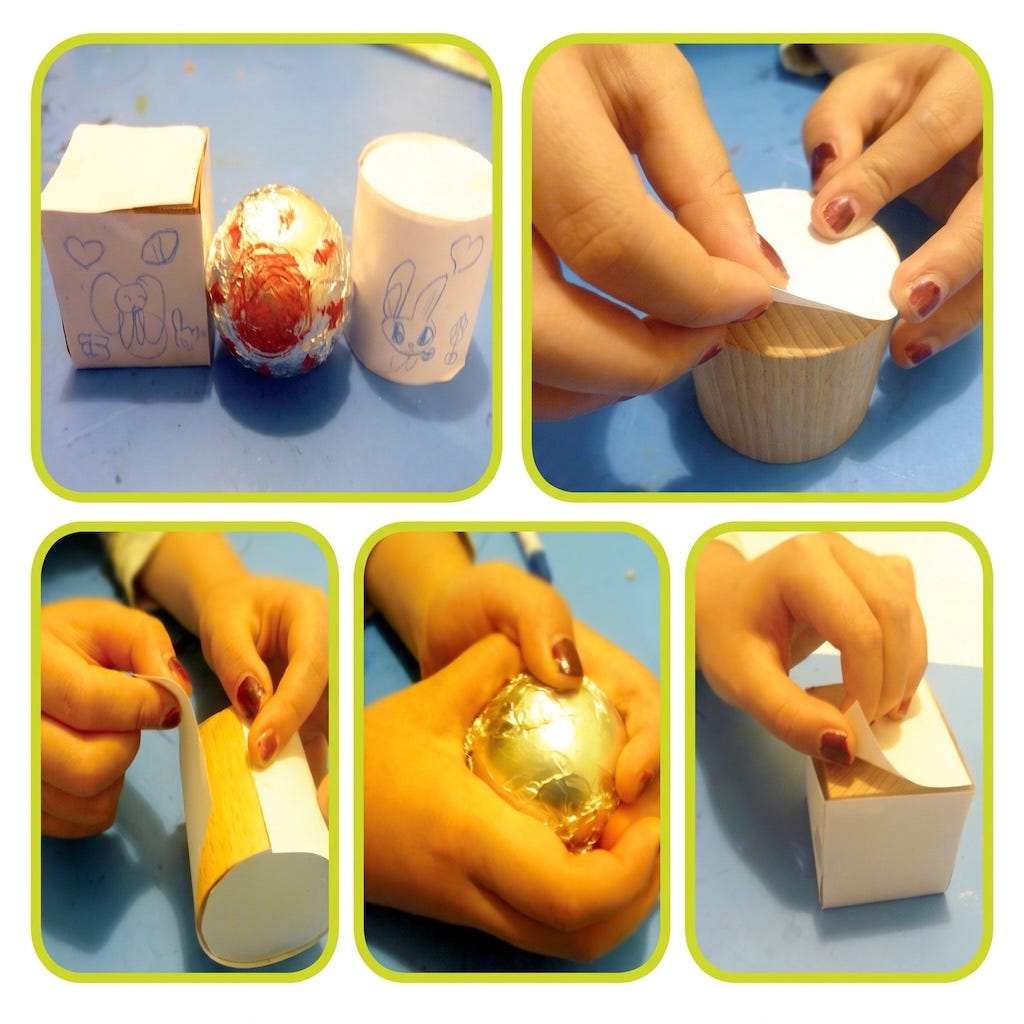
Tuesday your child discovered, with her hands, that a ball refuses flat paper. Today we build that discovery out properly — the same wrapping game, but reshaped three times, so a toddler and an eleven-year-old can work the same three shapes at the same table and each come away having learned something real.
The idea in one sentence: Fröbel didn’t just notice that the sphere, cylinder, and cube look different — he built a precise, countable comparison between them, and that comparison, run as a conversation rather than a lecture, is the actual mechanism behind everything Thursday does this week.
Here’s the comparison itself, because you’ll use it at every age today, just pitched differently. A sphere has one curved face, no edges, no corners. A cylinder has three faces, two edges, no corners — flat top, flat bottom, one curved side. A cube has six faces, twelve edges, eight corners. Fröbel had children work this out for themselves, shape in hand, counting as they went: “the maximum visible edges on the cylinder are one and a half, while it is possible to see nine edges on the cube at the same time.” That’s not incidental detail — it’s the whole method. Count what you can touch, and the abstract fact becomes something felt.
There’s a deeper reason Fröbel chose exactly these three shapes, and it’s worth having in your back pocket, because it reframes the whole week. He called the sphere and the cube opposites — the sphere is motion, the merest touch sets it rolling; the cube is rest, “solidity” itself, holding still under its own corners and edges. And he added the cylinder deliberately as the mediator between them — flat like the cube, but able to roll like the sphere. Two opposites and the shape that bridges them. Your child isn’t just sorting three random objects this week. She’s handling Fröbel’s most famous demonstration of what he called the Law of Opposites — the idea that a thing is best understood not alone, but against its contrast.
Materials, all three ages: a cube-shaped object (block, box), a cylinder (tube, tin, jar), a sphere (any ball), coloured paper, scissors, tape, a pencil. (If you own the Spielgaben set with the wooden sphere, cylinder, and cube on strings, that’s this exact comparison in miniature — a nice thing to know, not something you need.)
Comments
Nothing yet. Say the first thing.
Sign in to join the conversation.