
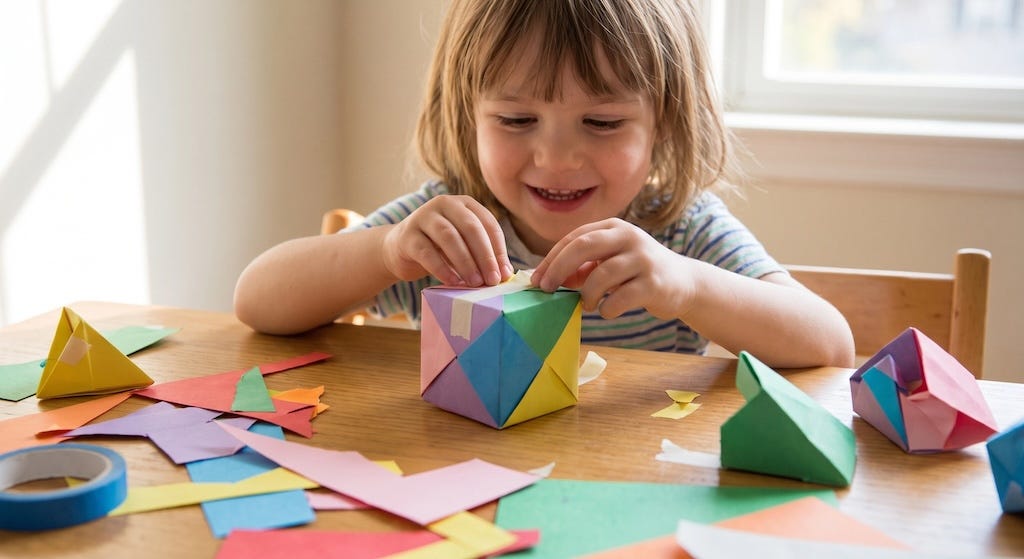
Tuesday your child tried to dress a cube in paper and found she could — six flat faces, six flat pieces. Thursday she learned to count why: to predict, before cutting, which shapes come apart into flat pieces and which one refuses. Today I want to show you that neither post was really about wrapping. They were both about a single motion — the fold between flat and solid — and that motion turns out to be the hinge that Fröbel’s entire method swings on, and the reason he thought play could shape a person at all.
Three questions get answered here. What was this week actually teaching, underneath the paper and scissors? Why did Fröbel build his whole sequence of materials around the movement between the flat and the solid — and give it a name he also used for growing up? And once you have that name, how do you look at any object, any activity, any afternoon, and know which direction your child is travelling?
Here’s the misconception, and it’s one that catches thoughtful parents precisely because it sounds like the sensible view. You think of “flat” and “solid” as two different kinds of activity. Drawing and cutting and folding paper are the flat, quiet, table activities. Building and stacking and construction are the solid, three-dimensional ones. Two categories, and a balanced week has some of each.
Fröbel didn’t see two categories. He saw one continuous motion between them, running in both directions, and he considered the travel — not either endpoint — to be the entire point.
Look again at what your child did this week. She took a cube — a solid — and turned it into six flat squares on paper. That’s a journey from three dimensions to two: from solid, to surface. Then, wrapping the pieces back on, she reversed it: flat paper climbing back up into a solid. Down and back. And the whole of Fröbel’s materials sequence is built as exactly this trip, at scale. The Gifts are solids — the ball, the cube, the cube divided. Then the Occupations walk the child down: parquetry tiles (flat surfaces — literally, in the source’s words, “a flattened form” of the solid Gifts), then sticks and string (lines), then pinpricks and beads (points). And then — this is the part almost nobody knows — the sticks-and-peas work and the clay send the child back up, rebuilding solids out of points and lines, “from non-dimensionality to the third dimension, which, in turn, deepens the child’s understanding.”
Down to take the world apart. Back up to build it. That trip is the week you just ran, and it’s the spine of everything Fröbel made.
Comments
Nothing yet. Say the first thing.
Sign in to join the conversation.