
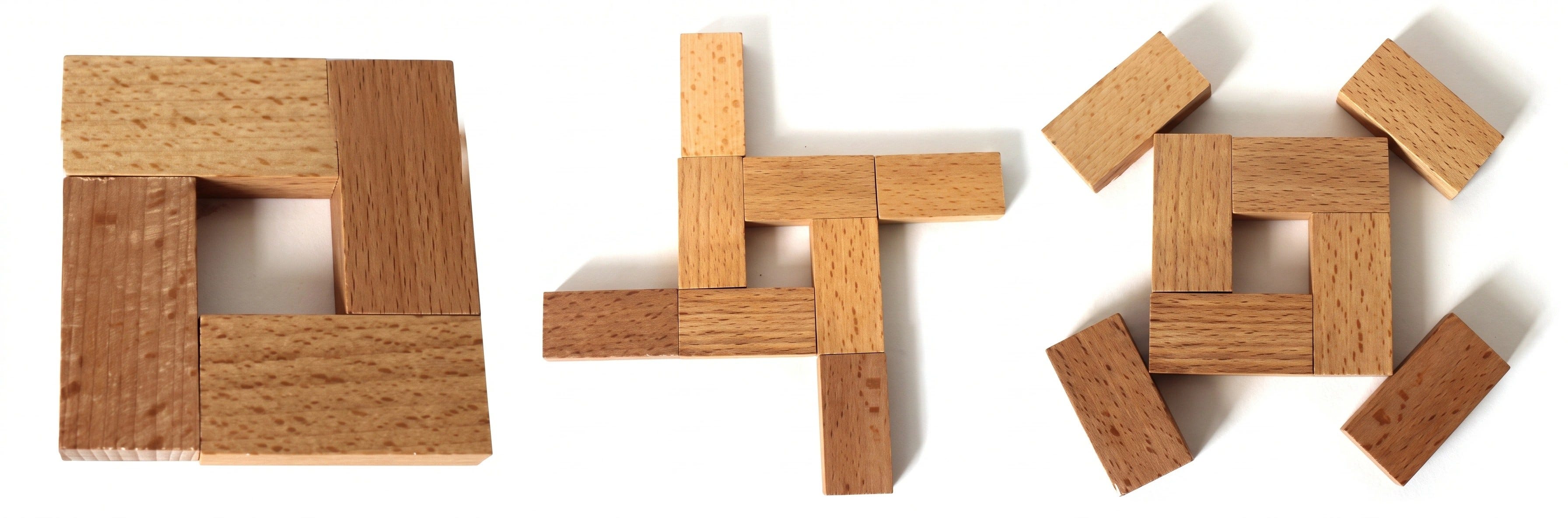
Make a small square in the middle of the table from four identical blocks — just a little square core, sitting still. Now give your child four more blocks and one instruction: place them around the square so it looks balanced. One up, one down, one left, one right. Then let her move them — always keeping it balanced — and watch a strange thing happen. She’ll make a shape, tilt her head, adjust one block a fraction, and go still when it’s right. She won’t be able to tell you what “right” means. But she’ll know it precisely when she sees it, and so will you.
Picture a moment like this one: a child who’s made a balanced cross of blocks around the square, then nudges one arm outward to match the others, leans back, and says — quietly, to no one — “there.” Not “done.” There. As if the pattern had a correct place it was always trying to reach, and she’d just helped it arrive.
That small word, “there,” is a child bumping into one of the oldest ideas about beauty there is — and Fröbel built an entire category of play around it.
Here’s what’s really happening, and it’s more than “making a nice pattern.” Fröbel divided everything a child could build with his blocks into three kinds: Forms of Life (things from the world — a chair, a dog), Forms of Knowledge (things that teach maths — halves, quarters), and Forms of Beauty — symmetrical patterns, made not by copying anything, but by arranging pieces in balance around a centre. And he was specific about how they’re made: not by adding more blocks, but by shifting and turning the same pieces around a fixed heart, until the arrangement balances. The variety doesn’t come from more. It comes from the same few pieces, moved into balance.
And balance, for Fröbel, always needed two things: a centre that holds, and opposites arranged around it. This was one of his deepest convictions — he called it the Law of Opposites. A thing is understood, and felt, through its counterweight: up needs down, left needs right, and between them sits a still centre that makes the opposition into a whole rather than a mess. When your child places one block up and then reaches, almost without thinking, to place its match down, she’s obeying that law with her hands. She’s discovering that a pattern feels beautiful precisely when every element has an answering element on the other side — and something unmoving at the core holding them all in relation. I’ve come to call it The Still Centre — the fixed heart a pattern turns around, the thing that has to stay put for everything else to feel balanced.
So here’s the activity for this week, and it needs eight identical blocks and nothing else. (Any matching cuboids or blocks work; Spielgaben’s Fourth Gift is the set this activity was drawn from, but a set of eight identical wooden bricks does the same job.)
Build the still square core in the middle — four blocks. Then give your child the other four and let her arrange them in balance around it: up, down, left, right. Once she’s made one balanced pattern, give her the real game: change it, but keep it balanced. Move all four to the corners. Then turn them so the long sides point outward. Then inward. Each time, the core stays still and only the outer four move — and each time, a completely different pattern, all of them balanced, all of them beautiful. She’s making Fröbel’s Forms of Beauty, and the rule that makes them work is the one she’ll feel without being told: whatever you do to one side, do to the other.
Don’t correct her arrangements or tell her which is “best.” The whole point is that she develops the eye for it — that internal sense of when a pattern balances and when it doesn’t. Fröbel thought this mattered enormously: he wrote that the eye becomes “a guardian, a controller of that which is formed by the hand,” and that nothing develops a child’s sense of symmetry and beauty like making balanced forms herself. Your job is to build the still centre, hand her the four moving pieces, and let her eye do the teaching.
Which leaves a question, and it isn’t about her patterns. It’s about you. A balanced pattern needs a centre that doesn’t move — and so, it turns out, does a balanced life. When everything around you is shifting, arranging and rearranging itself week to week, what’s the still square at the middle of yours — the thing you keep fixed, on purpose, so that everything else has something to turn around? Most of us have one and have never named it. Some of us have let it start to move.
Thursday, paid members get the full version: the symmetry game built across three age gaps — from a toddler simply matching one side to the other, to an older child discovering the different kinds of symmetry (mirror, rotational, the four-fold turn) and why some balanced patterns feel calm while others feel like they’re spinning.
Saturday, the framework beneath it: Fröbel’s Law of Opposites, why beauty and understanding both depend on a still centre with balanced opposites around it, and how the same principle runs through everything from a snowflake to a family.
— Jim
No posts
Comments
Nothing yet. Say the first thing.
Sign in to join the conversation.