
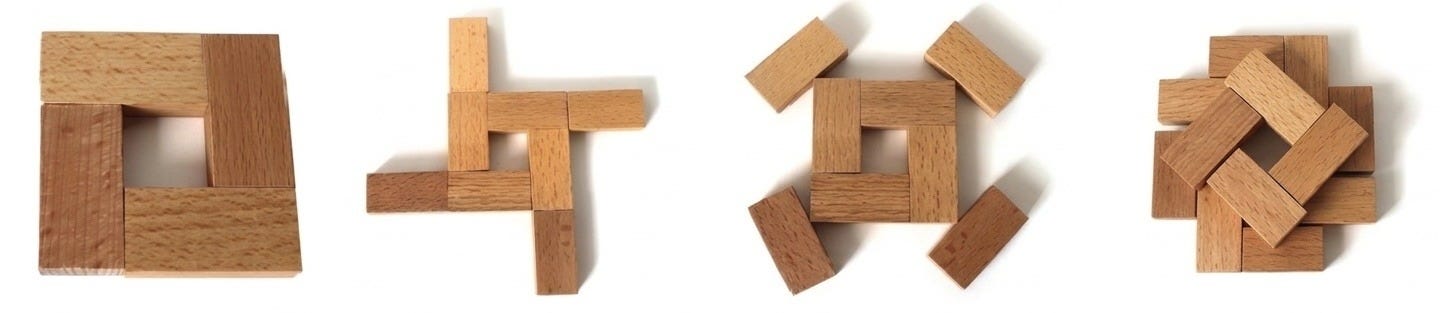
Tuesday your child arranged four blocks around a still centre and felt, without being told, when the pattern was balanced. Today we open up what “balanced” actually contains — because there isn’t one kind of symmetry, there are several, and they feel different. Some balanced patterns sit calm and still. Others, equally balanced, seem to turn on the spot, as if caught mid-spin. By the end of this your oldest will know why, and your youngest will have laid down the very first version of the same sense.
The idea in one sentence: Fröbel made his Forms of Beauty through two distinct motions — shifting and turning — and those two motions are, precisely, the two great families of symmetry: the mirror that reflects, and the rotation that spins.
Here’s the distinction to carry into the whole activity, because it’s the spine of all three ages. Fröbel’s own instruction for making Forms of Beauty names exactly two operations: you make them by shifting and by turning the pieces around a centre. That isn’t loose language. Shifting a piece and its partner to opposite sides of a centre gives you mirror symmetry — the left is the reflection of the right, like a face, like a butterfly, like the two halves of a folded page. Turning every piece by the same amount around the centre gives you rotational symmetry — no mirror anywhere, but the whole thing looks identical after a quarter-turn, like a fan, a pinwheel, a snowflake. Both are balanced. Both are beautiful. But mirror symmetry feels settled, and rotational symmetry feels like movement — and that difference in feeling is real, sourced in the two motions Fröbel built the forms from, and something a child can be led to notice with her own eyes.
Materials, all three ages: eight or more identical blocks or square tiles (the more, the richer the older child’s patterns), and a clear centre to build around. A coin or a small different-coloured block makes a good fixed heart. (Spielgaben’s cube Gifts and parquetry tiles are the sets Fröbel designed for this, but any matching blocks or square tiles do the real work.)
What she’s learning: the root of all symmetry — that a piece on one side calls for a matching piece on the other. Mirror symmetry, felt before it’s named.
The activity (10–15 minutes). Set the still centre. Then make it a turn-taking game: you place one block to the left of the centre, and ask her to “answer” it — to place its twin on the other side so the two sides match. You place one above; she places one below. You’re building a mirror pattern together, one answering pair at a time. Then swap: she places a block anywhere, and you answer it, so she sees the matching from the outside. Keep it slow, one pair at a time, and say the little rule out loud as you go: “one here… so one there.”
Comments
Nothing yet. Say the first thing.
Sign in to join the conversation.