
Strong female leadership has never felt foreign to Jewish life. It has always been there. I was raised by a single mother. My grandmother and her sisters lived full, meaningful Jewish lives. And I dread to think what would have happened to anyone who crossed my great-grandmother. I am living proof that Jewish continuity can exist, be sustained, and transmitted when women raise you.
That history shapes how I experience debates like this one. It framed my reaction to two Jewish Chronicle articles I read a week apart. The first profiled Rabbi Miriam Lorie and her work as an Orthodox rabbi. It stayed with me, not because it was provocative, but because it described something recognisable: serious Orthodoxy lived with care, courage, and visibility. The second, by Rabbi Jonathan Guttentag, responded by arguing that there is no room for women rabbis within Orthodoxy as it is currently defined.
What struck me most was not the disagreement itself, but the scale of it. At a moment when Orthodox Judaism faces real and pressing challenges, including retention, alienation, cost, trust, and relevance, it is notable that this question has taken on such weight.
Engaging with that question is not abstract. These are overlapping Orthodox worlds. Familiar names. Familiar institutions. Guttentag and I are not strangers; his child was in my class at school. Disagreement in that context is uncomfortable, but it is also a sign of a tradition still arguing from within itself.
Guttentag’s argument is serious and thoughtfully made. It is also, in my view, out of date and incomplete.
He frames rabbinic authority as a fixed halachic category with clear and immovable boundaries, writing that redefining rabbinic titles “does not renew Orthodoxy. It attempts to replace it while retaining its name.” It is not entirely clear whether this is meant as a collegial disagreement with Lorie’s work or whether it carries a familiar British undertone of politely but firmly restoring order. Perhaps it is both. Either way, the argument deserves engagement rather than dismissal.
One fact should not be ignored. Lorie’s session at Limmud was among the most popular of the festival. That matters. Judaism has never been sustained by texts and institutions alone. It has endured because it eventually listens to its people. The next generation is no longer quietly negotiating its relationship with Orthodoxy. It is articulating, clearly and publicly, what kind of Judaism it wants and how it intends to practise it.
Judaism is not static. It never has been.
Much of Guttentag’s position rests on the idea of an unbroken chain of rabbinic authority. That chain did once exist. It does not exist in the form being defended.
Classical semichah, the original form of rabbinic ordination transmitted directly from teacher to student, ended in the Land of Israel in the fourth or fifth century CE. Roman persecution, the dismantling of the Sanhedrin, and the collapse of centralized Jewish judicial authority made its continuation impossible. Maimonides states this explicitly in Hilchot Sanhedrin. What followed was not continuity, but adaptation.
The ordination rabbis receive today is not that original semichah. It is institutional authorization, developed in response to rupture. This does not weaken contemporary rabbinic authority. It explains it. Orthodoxy survived because it rebuilt leadership structures in exile. This is where Guttentag’s argument ultimately breaks down. The ordination he seeks to preserve is not the ordination originally given. It is itself the product of change.
Orthodoxy has never been preserved by freezing time. It has been preserved by responding to reality.
The agunah crisis is one example. It remains unresolved, but it is widely acknowledged as an injustice that demands halachic response. The normalization of halachic prenuptial agreements across much of the Orthodox world represents a new communal baseline. That shift did not abandon halachah. It applied it differently in response to lived harm.
Women’s Torah study is another. Advanced learning was once discouraged. Rabbi Joseph B. Soloveitchik argued instead that serious Torah education for women was essential in the modern world. That position reshaped Orthodoxy permanently.
There are many others. Adaptations to Shabbat observance in a technological age. Shifts in pastoral engagement with LGBTQ Jews, even where halachic prohibitions remain unchanged. These developments were not betrayals of tradition. They were its continuation.
Women have always been central to that story.
Miriam leads alongside Moses. Deborah judges and prophesies. Hannah, the mother of the prophet Samuel, models personal, silent prayer, from which the Talmud derives core laws of prayer. Her words shape the emotional and theological heart of the Amidah, Judaism’s central prayer. Bruriah appears in rabbinic literature as a learned interlocutor whose voice is treated with seriousness.
Female leadership in Jewish life is too often confined to figures like Hannah Szenes or Golda Meir, invoked safely as national icons or historical exceptions. It should be visible, trusted, and celebrated in the synagogue as well.
In early modern Europe, when formal institutions were limited or inaccessible, women sustained Jewish education in the home. Communal records and responsa literature make clear that Judaism survived not because women were peripheral, but because they were essential.
The liturgy itself tells the same story. Synagogue prayer combines patterns rooted in Temple sacrifice with frameworks developed after the Temple’s destruction. Piyyutim draw on surrounding poetic cultures. Medieval Jewish thought absorbed language and ideas from Islamic Spain and Christian Europe. None of this undermines Judaism’s divinity. It demonstrates how divine tradition has always been lived through human history.
The Ten Commandments may have been set in stone. Much of what surrounds them was shaped by time, place, and necessity. Judaism has always evolved, borrowed, and been enriched by the world around it. And when conditions were hostile, it adapted in order to survive.
That living Orthodoxy was first encountered when I lived in Israel, in communities that treated halachah as a compass rather than a barricade. In Religious Zionist settings, women were visible, trusted, and taken seriously, without anxiety about precedent and with the utmost respect for tradition. The same could later be seen in Modern Orthodox communities in the United States, where halachic seriousness coexists with institutional flexibility and where Orthodoxy asks not only what is permitted, but what sustains Jewish life.
Rabbi Miriam Lorie belongs in that context. She is not a symbol or a provocation. She is a practitioner. Having met her and davened in her shul, what is evident is not a rejection of Orthodoxy or Jewish tradition, but a deep commitment to it. Her leadership reflects a serious attempt to live fully within halachah while taking women seriously as religious actors and communal leaders. That is not a threat to Jewish values. It is an expression of them.
Trusting women in this way does not dismiss Jewish law. It embraces it.
Many people raised within British Orthodoxy carry both gratitude and harm. Some manage to recalibrate and rebuild a Jewish life without leaving altogether. Many do not. Too often, the message received is that there is only one acceptable way to be an Orthodox Jew, and that if it does not fit, the fault lies with the individual.
British Orthodoxy frequently insists that it honours women, yet its instincts tell a different story. Bat mitzvahs are a small but telling example. When families are pressured to move or minimise a bat mitzvah to accommodate a bar mitzvah at a popular United Synagogue congregation, that is not halachah speaking. It is hierarchy. And girls absorb that lesson early.
Sure, Manchester filled me with religious trauma, and yet somehow I was able to recalibrate and live a Jewish life despite those lessons, but how many people leave the faith because they think there is only one option if you want to be an Orthodox Jew?
My Manchester checklist of what counted as “proper Judaism” dismissed Limmud as something for the secular, not quite serious enough, not something you showed up to if you wanted to belong. I listened to that judgement and stayed away, wary of further ostracisation from the black hats who wrote the rules. I regret that now. It is telling that the spaces once written off by that checklist are precisely the ones drawing the most energy, curiosity, and commitment today.
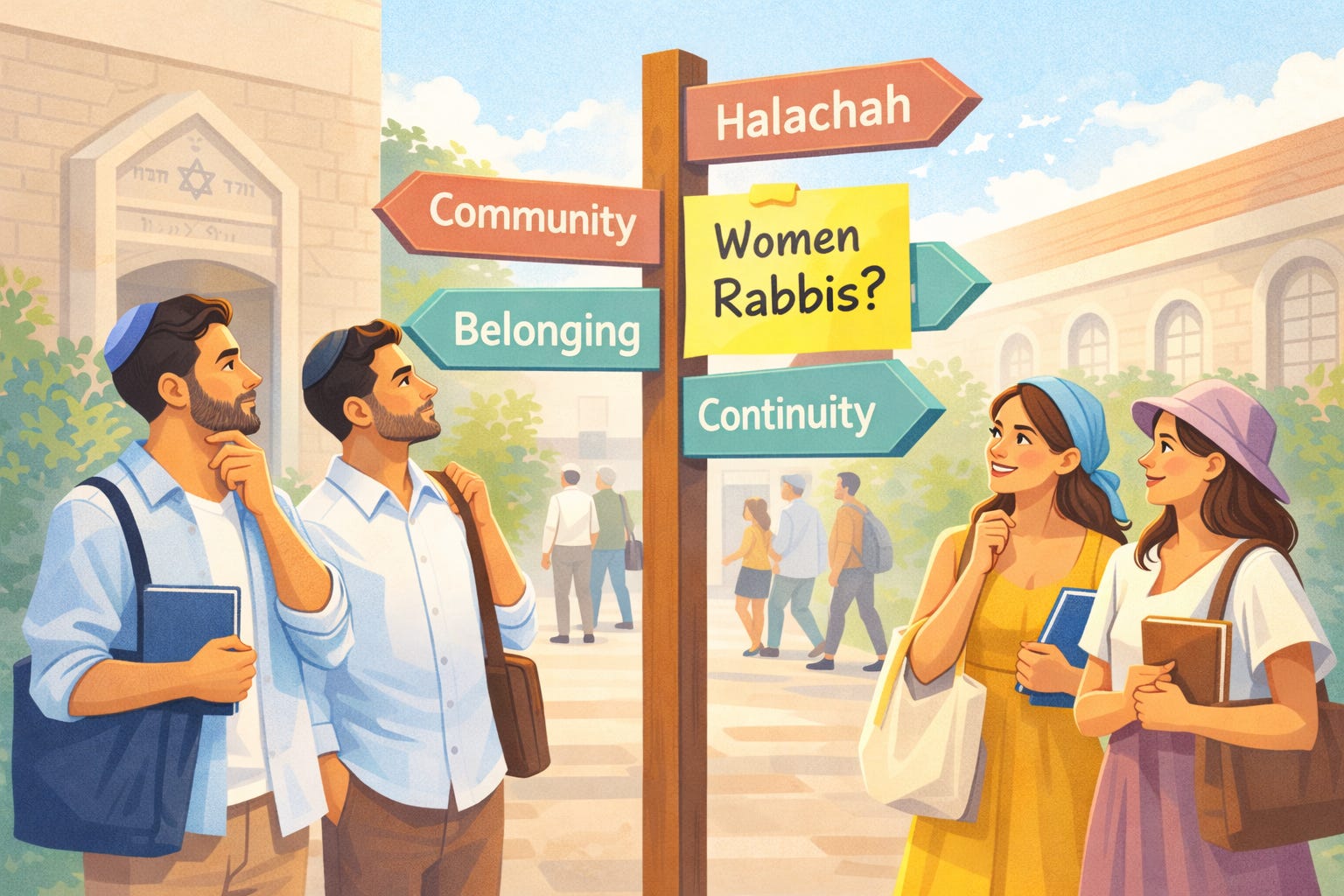
When Lorie says, “You can’t be what you can’t see,” it is not an empty slogan. It is an empirical observation. Visibility shapes belonging. Belonging shapes continuity. That is a claim male rabbinic leadership in the UK should take seriously.
Many committed Jews want to remain within Orthodoxy without rewriting liturgy or halachah. This is not a call for that. But without spaces that make room for women’s authority, the question becomes unavoidable: what does Orthodoxy look like for our daughters? For future female leaders?
Women are already trusted to shape Jewish minds and Jewish souls in classrooms and seminaries. There is no principled reason to panic when that trust extends to the pulpit.
There will be Orthodox rabbis who disagree with this. Some congregational rabbis will hold different views on women’s ordination while still respecting and welcoming women with semichah as serious and valued members of their communities. That coexistence matters. It reflects confidence rather than fear.
Judaism does not endure because it resists every change. It endures because it knows the difference between halachah and power.
If Orthodoxy chooses to spend its energy treating female rabbis as a threat, it will miss the real work waiting to be done. And if it cannot make room for women’s authority within its walls, it will not be the women alone who drift away. It will be the people who want to lead, who want to belong, and who will take their energy elsewhere.
No posts
Comments
Nothing yet. Say the first thing.
Sign in to join the conversation.