
I read it twice. I wanted to be fair.
Or perhaps I didn’t believe it was possible to be reading the words glowing on my phone’s screen after the midnight hour.
The letter circulating under the banner of spiritual urgency, calling on American Jews to “withdraw consent from Zionism,” demand Israel’s “unconditional surrender and dissolution,” and trust the rest of the world to sort out what follows, is one of the more sophisticated pieces of antisemitic writing I’ve encountered in recent years. I use that word with full awareness of what I’m saying, because the author would almost certainly deny it. Denial is part of the architecture.
Let me be precise about what I mean.
The letter is not subtle about its demand. But its demand rests entirely on a foundation of missing history, and missing history in this conversation is never accidental.
For the record: Israel was established through the 1947 UN Partition Plan, a legitimate resolution of the same international body the author invokes when calling for accountability under international law. The Jewish community in Mandatory Palestine, then administered by the British Empire, accepted partition. The Arab League rejected it, launched a coordinated military assault from five countries, and instructed Arab residents to evacuate temporarily while they drove the Jews into the sea. That didn’t happen. The Jews won. The people who were told to leave, promised a swift return by their own leadership, became refugees.
That is not Israeli propaganda. That is what happened.
The Palestinian refugee crisis is real and it is tragic. It is also a tragedy that was manufactured and deliberately sustained for seventy-five years, because a solvable refugee crisis is politically useful and a solved one is not. Jordan, Egypt, Syria had the land and resources to absorb Palestinian populations. They chose not to, because keeping the wound open kept the pressure on Israel. The people who paid for that calculation, every generation, were the same ones: the children, the families, the people who just wanted to live.
Jewish indigeneity to the land is not a settler-colonial narrative. It is archaeology, linguistics, and three thousand years of unbroken liturgy. It is the Passover seder, which this community will observe in a matter of weeks: l’shana haba’a b’Yerushalayim. Next year in Jerusalem. Jews have said that prayer through two thousand years of exile, expulsion, and massacre. The claim that Zionism is a foreign implant onto Jewish tradition, rather than the political expression of something ancient and continuous, only holds if you have never actually engaged with that tradition.
The letter tells us that Hamas, Hezbollah, and Iran have never been enemies of the Jewish people.
This letter was published in 2026.
My argument doesn’t begin with October 7th, because this violence didn’t begin there either. I lived in Jerusalem for five years. I can count on my fingers how many times I took a bus, for fear of it blowing up. Ten thousand steps a day was easy, long before wearables made it a goal. I walked because buses were targets.
I am thinking of Yoni Jesner, killed in a Tel Aviv bus bombing in 2002. His family donated his kidney to an Arab child. That is arguably more than tikkun olam. That is who Jews are called to be. I am thinking of the Sbarro pizzeria bombing in Jerusalem in 2001, a Tuesday afternoon, families with children, fifteen people killed. I am thinking of the Park Hotel seder massacre in 2002, thirty people murdered while sitting down to celebrate liberation, the most Jewish possible moment to be slaughtered. I am thinking of Eyal Yifrach, Gilad Shaer, and Naftali Fraenkel, three teenagers abducted and murdered in 2014 just for being Jewish in Israel. I am thinking of every market, every café, every Passover seder targeted across decades of violence that the world largely processed as a political dispute rather than what it was.
The hatred that produced October 7th was not born on October 7th. It has followed Jews in this land across generations and governments.
No Israeli policy created it. No Israeli concession has ever extinguished it.
To tell Jews in 2026 that these groups have never been their enemies is not a political position. It is a demand that we un-see what we saw, and un-mourn who we mourned.
The people who pay the price are never the people writing the letters.
They are the children in Gaza whose leadership chose rockets over schools and tunnels over hospitals, and who positioned their own people as human shields because dead civilians are more useful than living ones. They are the kids dancing at Nova who died for no reason except being in a Jewish state. They are the teenagers who never made it home. The letter has nothing to say about any of them that isn't instrumental. They all deserved better.
The author has published a follow-up clarifying that she is Jewish, raised in a Jewish home, married to a rabbinical student organizing for Palestinian liberation since college. She offers this as context.
I find it clarifying in a different way.
We have watched the documented infiltration of American university campuses by organizations with ties to Hamas, the PLO, and broader Islamist networks. We have watched students and faculty absorb frameworks about Zionism and Jewish statehood that did not originate in the American progressive tradition but were imported, funded, and cultivated from outside it over decades. Sincerity and manipulation are not mutually exclusive. When a Jewish woman has absorbed a worldview so completely that she can look at Jewish self-determination and see only white supremacy, it is worth asking where that framework came from, and who it serves.
Her letter also assumes that American Jewish opinion is a meaningful lever on Israeli policy. American Jews cannot vote in Israeli elections. They can donate and lobby and write letters. But Israel has survived wars, intifadas, international isolation, and the failure of every peace process attempted in my lifetime. It survived them not because American Jewish sentiment pointed the right way, but because Israelis, including many who fiercely oppose their own government’s current decisions, understand what the alternatives have historically looked like. Many of them fled those alternatives. Israel will survive with or without the approval of the American Jewish left. I believe that without apology.
One question the letter never answers: does the author believe that if Israel ceased to exist tonight, Iran would stop oppressing its citizens? Stop executing women for refusing to wear hijab? Stop funding proxies across the region? The Iranian regime has been imprisoning and killing dissidents for decades, for reasons that have nothing to do with Israeli policy and everything to do with what the regime is.
The argument that Iranian aggression is a reaction to Israel rather than an expression of the regime’s own ideology is not serious geopolitical analysis. It is a wish dressed as a cause. And the underlying logic of the letter, that Jews should disarm because powerful forces are threatening them, has no successful historical precedent. Not for any people, anywhere. We do not make ourselves safer by making ourselves smaller. We know this. We have learned it the hardest possible way.
Then there’s the Jewish language in this letter, which the author uses with enough fluency to make it sound authoritative and enough looseness to make it dangerous.
I find it dishonest.
Pikuach nefesh, the commandment to preserve life, has never been interpreted in any serious halachic literature as requiring collective national self-dissolution. It protects individuals and communities from unnecessary martyrdom. It does not instruct a people to surrender their only sovereign refuge and trust the world to be decent. History has a very clear record on what happens when Jews do exactly that.
And tikkun olam. This concept has been stretched so far in progressive Jewish discourse that it has become a blank check, drawn on the account of tradition and spent on whatever politics are at hand. In the Aleinu prayer it refers to the establishment of divine sovereignty. In kabbalistic literature, the restoration of divine sparks scattered at creation. It is not an ancient mandate for anti-nationalist activism. Orthodox Jews largely don’t use the term the way American secular culture does, precisely because that usage bears almost no relationship to any classical source. Our tie to the land of Israel predates tikkun olam as a political concept by roughly three thousand years.
The author has reached into Jewish tradition, extracted its most elastic and contested term, and used it as a crowbar against Jewish existence. That is not engagement with tradition. It is its appropriation, and it has a long history too.
Jews have the right to define antisemitism for ourselves. Jewish self-determination includes the self-determination to name what is being done to us, without requiring outside authorization. We do not ask the LGBTQ community to submit their definition of homophobia for external approval. We do not tell people of color how to define racism, or Muslim communities how to define Islamophobia. Somehow, with Jews, there is always a contingent ready to explain that what feels like antisemitism is actually something else, that our perception of our own endangerment is clouded by false consciousness, or political manipulation, or the wrong kind of Judaism.
This is not a new contingent.
For centuries, Jews have been told that our visibility was the problem, that our communal solidarity was a provocation, that if we would just dissolve into whatever sufficiently progressive movement was on offer, the hatred would stop. The Haskalah made that promise. So did various strains of assimilation-ism across Europe. The twentieth century then demonstrated, in the most catastrophic possible terms, what happens when Jews take that advice and find themselves without sovereign refuge when the world turns.
When a piece of writing demands the elimination of the Jewish state, erases the history of who attacked whom, declares our enemies to have never been enemies, and uses our sacred language as a weapon against our existence, we are not required to accept an explanation of why that isn’t what it looks like.
This letter is antisemitism dressed in the language of social justice. It is a genuinely naïve worldview, and I say that without pleasure, because naivety has consequences. I suspect some of the people the author believes she is advocating for would be among the first to disabuse her of it, should she visit the places they actually live and say these things aloud.
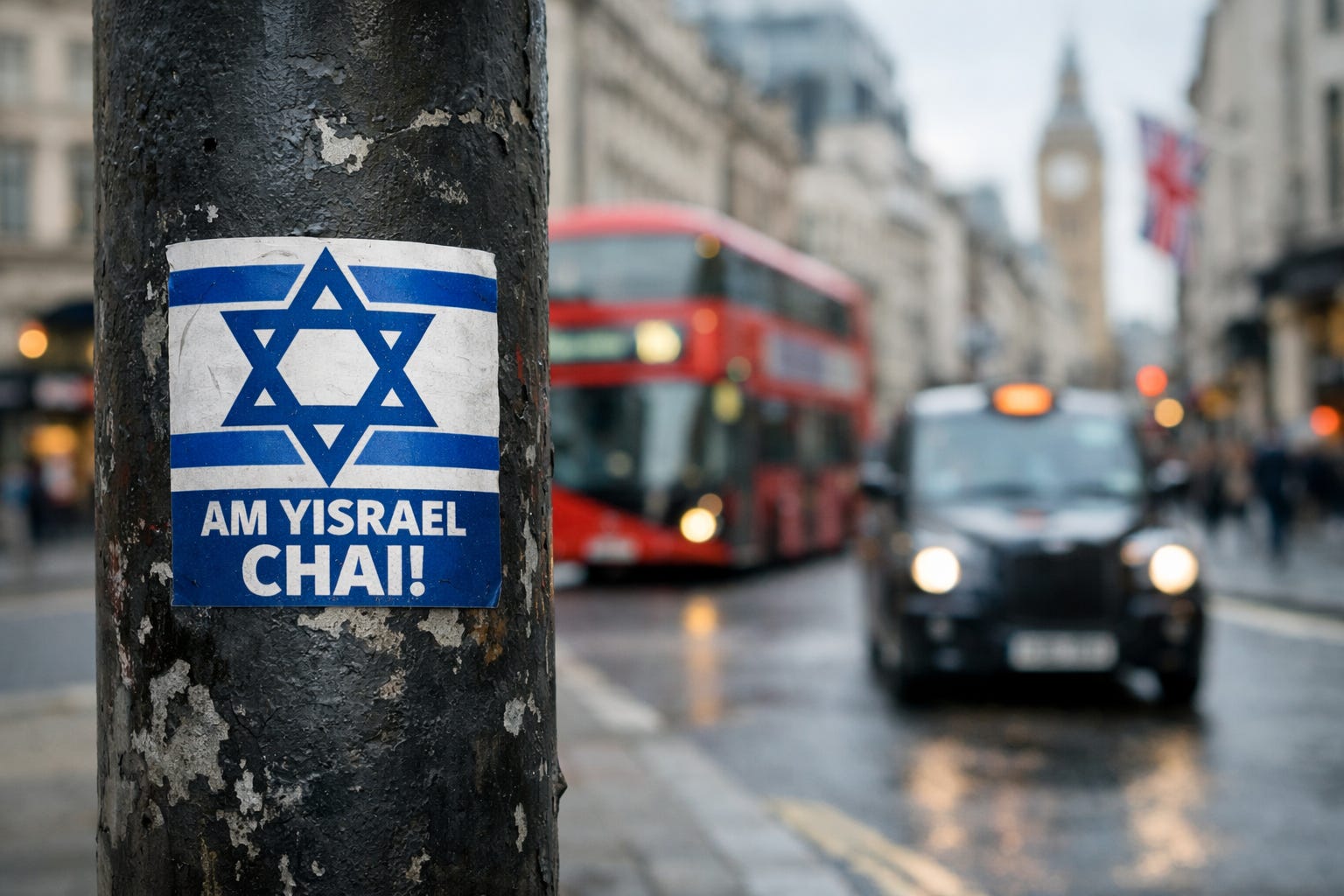
Last year, back in the UK and visiting my hometown, I would remove antisemitic stickers from lampposts, bus stops, and advertisement boards as I noticed them around town. I carried Am Yisrael Chai stickers in my pocket so I could paste something true over something hateful. This morning, in my own neighborhood a friend told me pulled over their car to pull down a poster that read “Christ in, Kikes out.”
I want the author of this letter to sit with that.
The pipeline from “enlightened open letter calling for Israel’s dissolution” to stickers on lampposts to beatings on European streets to gunmen in Jewish institutions is not theoretical. It is documented. It is happening now. And it is not fueled by facts, or history, or any honest reckoning with the conflict. It is fueled by the same blood libel that has followed Jews for a thousand years, freshly legitimized, shared, amplified, and dressed in the language of social justice so that decent people will spread it without recognizing what they are spreading.
I am absolutely going to speak out against those who wish me dead. Every time. Without apology.
Every generation has tried to write our obituary. We are still writing our own story. You do not get to define our disappearance as liberation.
If this piece says something you’ve been struggling to say yourself, please share it. Forward it. Post it. The conversation needs more honest voices in it.
No posts
Comments
Nothing yet. Say the first thing.
Sign in to join the conversation.