
Every Sale teaches us something. Of course, we spend time looking at the numbers. We analyse what worked well, what surprised us, and what we could improve before the next season begins. That’s part of running any business. Yet I’ve noticed that once the reports are closed and life slowly returns to its usual rhythm, the thing that stays with me is rarely a number, but a question.
As many of you already know, I’m endlessly curious about people. I love trying to understand why we make the choices we do, what catches our attention, what builds trust, and why two people can look at the same dress and walk away with completely different feelings.
Somewhere over the years I realised that marketing isn’t only about products or communication. At its heart, it is simply another way of studying human behaviour. Every campaign, every conversation and every purchase tells us something about how people think, what they value and how they make decisions.
This Summer Sale left me with one question that stayed in my mind long after it had ended.
Why does a tiny “%” symbol have so much power over us?
Nothing about a linen dress changes when a percentage appears beside its price. The flax has already grown, the fabric has already been woven, and someone has already spent hours cutting, sewing, and finishing every detail with care. The garment is exactly the same as it was the day before. Its quality hasn’t changed, its comfort hasn’t changed, and the years it may spend accompanying someone through life haven’t changed either. And yet, the moment we see 20% Off, something shifts - not in the dress itself, but in the way we look at it.
This isn’t really an article about pricing. It’s an article about the human mind, and about how easily our perception of value can change even when the value itself stays the same.
One thing I’ve realised over the years is that we rarely experience the world exactly as it is. We experience it through our own memories, emotions and previous experiences, which means two people can look at the same object and walk away feeling something completely different. The object hasn’t changed. What changes is the meaning our minds quietly give to it, often before we even realise we’re doing it.

Psychologists have been studying this for decades, and what they’ve discovered is surprisingly close to what many of us experience every day. Our brains simply aren’t designed to analyse every decision from the beginning. If they were, even choosing what to wear in the morning would become exhausting. Instead, our minds rely on mental shortcuts that help us make thousands of decisions quickly, using patterns we’ve learned throughout our lives instead of carefully calculating every possibility.
In his work on behavioural psychology, Daniel Kahneman describes two different ways our minds operate. One is slow, logical and analytical, while the other is fast, intuitive and almost effortless. Both are important, yet most of our everyday decisions are guided by that faster part of the brain. It notices familiar patterns, compares what we see with what we’ve seen before, and often concludes before we are even aware that a decision has been made.
When I first learned about this, I realised that we don’t choose things as rationally as we like to believe. First we feel, and only afterwards explain those feelings with logic.
The flax grows the same way whether someone buys the dress in April or during a Summer Sale. The fabric is woven with the same care, every button is sewn on by the same hands, and every garment goes through the same process before it reaches someone’s wardrobe. Nothing about the dress changes because a percentage appears beside its price.
The only thing that changes is us.
One day we quietly scroll past a dress that costs $240. The next day we see the same dress with a small note saying 20% Off, and suddenly we stop for a second look. We begin imagining ourselves wearing it. We calculate how much we’ve saved. We wonder whether our size will still be available tomorrow. The dress hasn’t become softer, stronger, or more beautiful overnight, yet it somehow feels different.
Why does our attention suddenly change? Why does the same object feel more desirable when its value hasn’t changed at all? Would we still feel the same if the dress had simply been priced twenty percent lower from the very beginning?
The more I explored these questions, the more I realised that psychologists and behavioural economists have been asking them for years. What they’ve discovered is both fascinating and deeply reassuring, because it reminds us that there is nothing “wrong” with us. Our minds are simply doing what they evolved to do: looking for opportunities, avoiding regret and trying to make the best possible decisions with the information they have.
And once we understand that, we stop judging ourselves for the choices we make, and instead we become curious about the invisible stories our minds are quietly telling us every single day.
One of the first things I discovered while reading behavioural psychology is that our brains rarely think in absolute numbers. We almost always compare. Whether we’re choosing a restaurant, buying a house or deciding between two dresses, we instinctively place one option beside another before deciding how we feel about it. In many ways, comparison is one of the brain’s favourite shortcuts because it allows us to make decisions quickly without having to start from zero every single time.
Imagine walking into a shop and seeing a linen dress priced at $240. If that’s the only number you see, your mind begins asking one question: “Does this feel worth it?” Yet if you see the very same dress with a note saying Was $300, Now $240, something interesting happens. Most of us stop thinking only about the dress itself and start thinking about the opportunity. Instead of asking whether the garment is worth $240, we begin thinking about the $60 we’ve “saved.”
Nothing about the dress has changed. The only thing that has changed is the story our brain tells us.
Psychologists call this anchoring, and it is one of the best-studied cognitive biases in behavioural science. The first number we see becomes a reference point, or an “anchor,” against which every number that follows is measured. Once that anchor is in place, it quietly influences how we perceive value, often without us even noticing it.
When I first came across this idea, I found it both fascinating and strangely comforting. It reminded me that we aren’t irrational when we respond to a discount. We are simply human. Our brains are doing exactly what they evolved to do - looking for context before making a decision.
There is another reason percentages have such a powerful effect on us, and it has very little to do with mathematics, but with loss.
Behavioural economists have found that, as humans, we tend to feel the pain of losing something more strongly than the pleasure of gaining something of equal value. In other words, the thought of missing an opportunity often feels more uncomfortable than the satisfaction of finding one. It explains why phrases like “Last Chance,” “Limited Edition,” or “Only a Few Left” catch our attention so easily. They don’t simply tell us that something is available today. They gently remind us that it may not be available tomorrow.
Looking back, it makes perfect sense from an evolutionary point of view. For most of human history, opportunities really did disappear. Food wasn’t always available, winters could be harsh, and resources were often limited. Our ancestors who recognised opportunities quickly had a better chance of surviving, and although our lives have changed dramatically, our brains still carry many of those same instincts today.
That doesn’t mean we are irrational. It simply means our minds are still wonderfully shaped by the world they evolved in.
This was probably the question I found myself asking most after our Summer Sale.
If every Son de Flor dress cost ten or fifteen per cent less throughout the entire year, would more women choose one? At first glance, the answer feels obvious. Lower prices should lead to more sales. Yet the more I explored what economists and psychologists have discovered over the years, the more I realised that the relationship between price and demand is far more interesting than I had imagined.
Price certainly matters, but it is only one part of a much bigger picture. Research consistently shows that when people make purchasing decisions, they also think about quality, trust, timing, identity, recommendations, previous experiences and the emotions they associate with a brand. Sometimes those things matter just as much as the number on the price tag.
Interestingly, price also carries another message. It doesn’t only tell us what something costs. It quietly tells us what something might be worth.
Think about wine for a moment. In blind tastings, people often struggle to tell the difference between expensive and inexpensive bottles. Yet when participants know the price beforehand, they consistently report enjoying the more expensive wine more. Brain imaging studies have even shown increased activity in the areas of the brain associated with pleasure when people believe they are drinking a more expensive wine, despite the wine itself being exactly the same.
Our expectations shape our experience. And that changes everything.
This is where things become especially interesting for companies like Son de Flor. When people ask why sustainable clothing costs more, they are usually asking about fabrics, local production, or fair wages. Those things certainly matter, yet there is another side of the conversation that receives much less attention.
The way we think about value.
Large fashion companies often build discounts into their business model from the very beginning. They produce enormous quantities, expect a significant portion of those garments to be sold during promotions, and plan their pricing accordingly. In many cases, the original price is never really intended to be the final price.
For smaller independent brands, the picture looks very different. Every percentage we offer comes from somewhere. It comes from the margin that allows us to work with local makers, to choose beautiful linen woven close to home, to spend time perfecting patterns, and to answer every email with the care we hope you can feel. There isn’t a hidden factory on the other side of the world quietly absorbing the difference. And yet... We also know that percentages matter.
Many women wait patiently for our Summer Sale, even when they already know exactly which dress they hope to welcome into their wardrobe. They aren’t waiting because the dress suddenly becomes more beautiful. They are waiting because the opportunity feels different.
I don’t think there is anything wrong with that. In fact, I think it reminds us of something very human. We all enjoy the feeling of making a thoughtful decision, and there is genuine joy in finally welcoming something into our lives that we have admired for months. Sales make that possible for many people, and we celebrate that with you.
What fascinates me isn’t that discounts work. It’s why they work. Because the answer tells us something much bigger than how we shop. It tells us how we assign value, how we make decisions, and how our minds quietly shape the world we experience every day.
As I kept reading about behavioural psychology, I realised our brains are incredibly good at calculating price. Yet, they are much less practiced at calculating value.
The two often feel like the same thing, yet they couldn’t be more different. Price is simply a number that someone places on an object at a particular moment in time. Value is different. It grows through experience, through memories and through the relationship we build with something over weeks, months or even years. One can change overnight. The other often takes years to reveal itself.
I sometimes think this is true far beyond shopping.
We see it in our friendships, where a simple conversation can become priceless years later. We see it in our homes, where an old wooden table slowly gathers birthdays, celebrations and everyday breakfasts until it becomes part of a family’s story. We even see it in ourselves, because some of the most meaningful moments in our lives never had a price attached to them at all.
Perhaps this is why I have always loved linen.
One of the things I find so comforting about natural materials is that they seem completely indifferent to our pricing strategies.
The flax field doesn’t know whether someone buys a dress in spring or during a Summer Sale. The seamstress doesn’t sew with less care because a garment may eventually be discounted, and the fabric doesn’t suddenly become softer or stronger because a percentage has appeared beside its price. Everything that makes that dress what it is - the craftsmanship, the quality of the linen, the time invested in every detail and the hope that someone will treasure it for years - remains exactly where it has always been. Only the price changes.
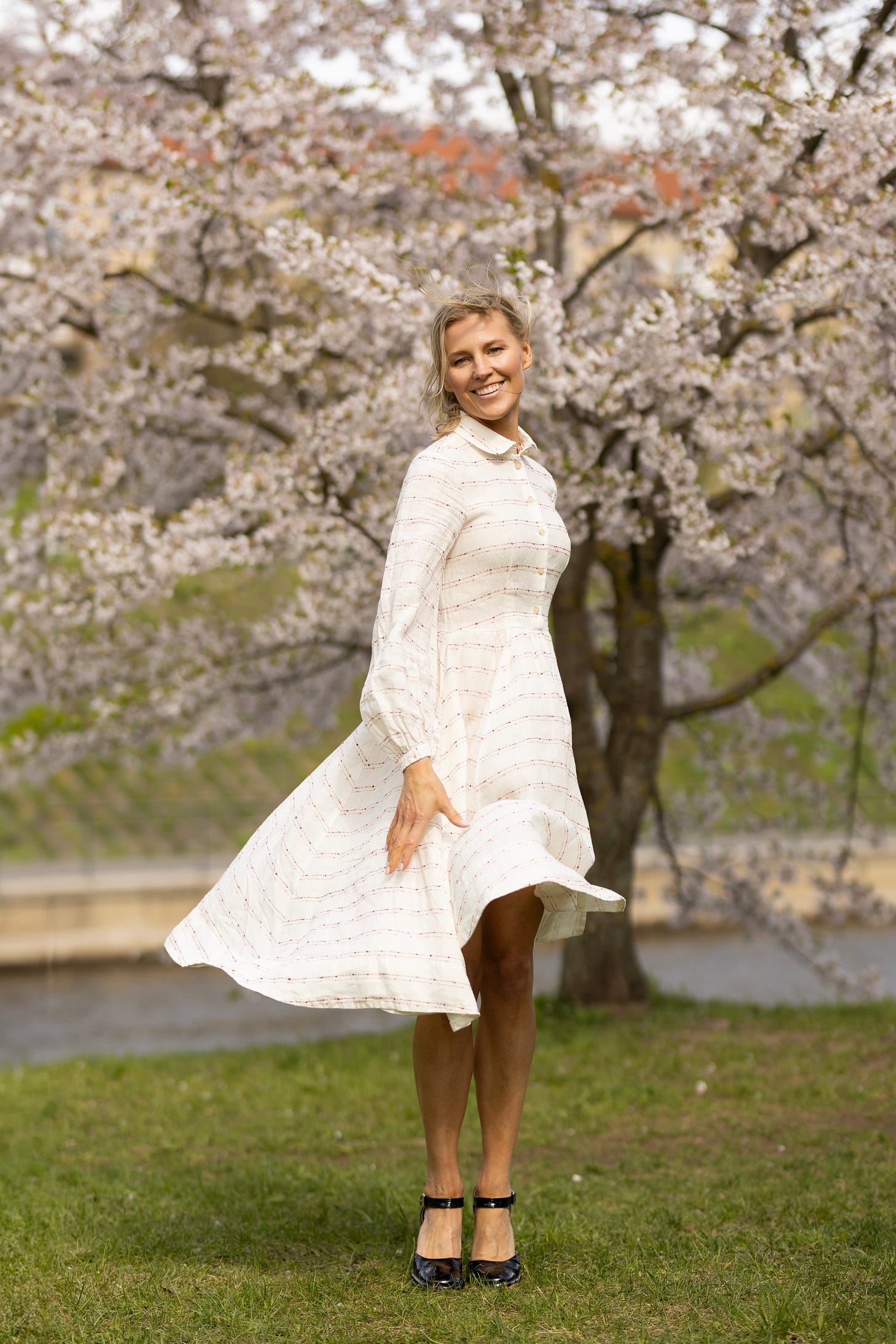
For me, that simple thought has become a beautiful reminder that price and value should never be confused with one another. They often travel together, yet they are not the same thing.
There is another question I have found myself asking recently - “When did we become so good at measuring savings and so much less interested in measuring use?”
We often celebrate saving $60 on a dress, yet rarely stop to think how many mornings, walks, holidays, conversations or ordinary Tuesdays that dress may accompany us through. We carefully calculate the percentage we receive today, while giving much less attention to the years that may follow.
Behavioural economists sometimes speak about cost per use, and I find the idea surprisingly refreshing. Instead of asking, “How much did this cost?”, we might ask, “How much life will I share with this?”
Imagine two dresses. One is bought with forty per cent off and worn three times before quietly disappearing into the back of a wardrobe. Another is bought at full price and worn two hundred times over the next ten years. Which one was actually the better investment? The answer becomes surprisingly obvious once we stop looking only at the price tag.
As a small business, this is a conversation we have quite often. Should we simply lower our prices throughout the year? Would that make our dresses more accessible? Would more women choose them? These are important questions, and I don’t think there is one perfect answer.
What science does tell us is that lowering prices doesn’t always create the result we expect. Research consistently shows that people don’t make purchasing decisions based on price alone. We also respond to trust, craftsmanship, identity, recommendations, emotion and the feeling that something has been made with care. Sometimes lowering a price by ten or fifteen per cent doesn’t change demand very much at all, because the decision was never only about money in the first place.

At the same time, we also know that sales genuinely help many women welcome a piece they have dreamed about into their wardrobe. We see that every summer, and it brings us enormous joy. We celebrate every dress that finds its home, because clothes are meant to be worn, loved, and lived in, never left waiting on shelves.
That is why pricing feels less like mathematics and more like stewardship. Our responsibility isn’t simply to find the highest or the lowest number. It is to find a balance that allows beautiful things to continue being made responsibly while remaining accessible to the women who value them.
By the time I finished reading about behavioural psychology, I realised that I had stopped thinking about percentages altogether. Instead, I found myself thinking about people. About how beautifully our minds have evolved to notice opportunity, to protect us from loss and to help us make sense of an endlessly complicated world. None of these instincts are mistakes. They helped our ancestors survive for thousands of years, and they still quietly guide us every single day.
Knowing this doesn’t make us immune to discounts. It simply makes us a little kinder to ourselves.
The next time a percentage catches my attention, I hope I won’t immediately ask whether the number is good enough. I hope I’ll first ask a different question -“Would I still love this if the percentage wasn’t there?” Sometimes the answer will be yes. Sometimes it will be no. Both answers are perfectly fine. The important thing is that the answer becomes ours, rather than one our brain quietly arrived at before we had a chance to notice.
Eventually every Sale comes to an end. The banners disappear from the website, the newsletters stop arriving in inboxes, and the little “%” symbol quietly fades away until another season comes around. Life returns to its usual rhythm, and the conversation moves on to new collections, changing weather and all the ordinary things that fill our days.
The dress, however, stays exactly where it has always been.
It waits patiently to become someone’s favourite companion, to travel through seasons, to be worn to family celebrations, slow Sunday breakfasts, long walks and ordinary mornings that slowly become extraordinary simply because they were fully lived. Years from now, I don’t think many of us will remember whether we bought that dress with twenty per cent off or at full price. We will remember how it made us feel, where it travelled with us and how often we instinctively reached for it when we wanted to feel most like ourselves.
That is the gentle lesson this Summer Sale left with me. Percentages are wonderful at capturing our attention. Stories are what stay with us.
And if there is one thing I hope we create at Son de Flor, it has never been dresses that feel irresistible because they are less expensive for a few days. It has always been garments that become part of someone’s life, long after every percentage has disappeared and the only thing left is the feeling of being at home in what you wear.
Yours Truly, Vaida { vaida@sondeflor.com }
No posts
Comments
Nothing yet. Say the first thing.
Sign in to join the conversation.