I. Two billionaires bought a country, and we let them
The United States is not a democracy anymore. I want to say that in the first sentence, because the rest of this story walks us through one of the means by which it happened, and I don’t want anyone reading the ending and thinking I am asking a question. I am not asking a question. The question is settled. The country was sold.
US Democracy was not sold all at once. It was sold the way a hedge fund quietly buys up a public company - slowly, over years, through stacks of paperwork and friendly go-betweens, until one morning the shareholders wake up and find that the board has been replaced and new owners are running the place. The shareholders are us. The board is the Supreme Court, the federal courts, and a big chunk of the executive branch. The new owners are a small group of billionaires who decided, sometime around the turn of the century, that voting was too messy for their purposes and that they would build a replacement.
And I want to be specific, in the first three paragraphs, about what kind of replacement they wanted, because the polite version of this story - the one that calls it “conservative philanthropy” or “the donor class” or “the right-wing infrastructure” - has been letting them off the hook for more than twenty years. The replacement they wanted is a country in which white men keep what white men have, and everyone else asks permission. Look at what their money has actually done. They gutted the Voting Rights Act, which protected Black voters in the states most determined to stop them voting. They overturned Roe, which protected women’s control over their own bodies. They have dismantled DEI programs that existed because, without them, hiring and promotion default to the people who already hold the jobs. They are passing state laws to erase trans people from public life and to pretend that gender outside the male-female binary is something a legislature can vote out of existence. I could go on but that would be a book.
Trans people are roughly 0.5 to 1 percent of the population. The legislative energy spent attacking them is wildly out of proportion to that share, which tells you the attacks are about something other than the policy question. They are about who gets to count as American. Every one of those fights, in every venue, costs women, costs people of color, and costs queer and trans Americans something concrete - a vote, a clinic, a job, a passport marker, a bathroom, a life. And every one of those fights leaves white men, and the wealth white men have accumulated across four centuries of American extraction, exactly where it was. That is not a coincidence and it is not a side effect. It is the product.
The Mercers, the Kochs, the Federalist Society’s donors, the Project 2025 underwriters - they are not just oligarchs. They are racist oligarchs, and they are misogynist oligarchs, and they are oligarchs who treat the existence of trans and nonbinary people as a personal affront. The oligarchy is the chassis. The bigotry is the engine.
This article is about two of these oligarchs. Robert Mercer and his daughter Rebekah did not act alone. The Kochs did their part. The Bradley Foundation did its part. Sheldon Adelson, Harlan Crow, Paul Singer, Barre Seid - they all did their parts, and Piece 4 will get to the ones who funded the takeover of the courts. But the Mercers are the single most documented case study of how a fortune generated by an algorithm gets converted into an operating system for capturing American politics, and they are the big money most directly connected to the machine that put Donald Trump in the White House twice. So I am starting with them.
Three things to keep in mind before we walk through how this was built.
First, none of this was illegal. That is the point. The rules that Citizens United set up after 2010 - the rules Pieces 4 and 5 will dig into - were designed to make it not illegal. The people who wrote those rules were paid by the same families that benefited from them. They built the door so they could walk through it.
Second, the Mercers are not interesting as people. Robert Mercer barely speaks in public. Rebekah Mercer runs a cookie company on the side (with terrible cookies for sale) and sits on museum boards. They are not Bond villains. They are something more dangerous than Bond villains - wealthy people with a clear set of beliefs, decades of patience, and a willingness to spend money on infrastructure instead of castles. The Kochs have been doing this since the 1970s. The Mercers are the version that won.
Third, I am not a journalist. I am a researcher in Arlington, Texas, and I am writing this on a laptop at my dining room table. Everything in this story is sourced to people who are journalists - Jane Mayer, Carole Cadwalladr, the team at ProPublica, the team at Mother Jones, the Cre8 No H8 archive compilation, the Information Commissioner’s Office of the United Kingdom, the U.S. Senate Permanent Subcommittee on Investigations, and the IRS Form 990s that any of you can pull up tonight on ProPublica’s Nonprofit Explorer. The documents are not hidden. They have been sitting there for ten years. We just stopped reading them.
II. The money machine - East Setauket, Long Island
Robert Mercer started his career as a programmer at IBM, where he spent more than twenty years pioneering computational linguistics. In 1993, already into middle age, he left for Renaissance Technologies, a quiet hedge fund headquartered in a campus of low brick buildings in East Setauket, Long Island, run by a former Stony Brook math professor named Jim Simons. Renaissance had three public hedge funds managing about $25 billion in assets, and one private fund, called Medallion, that was open only to Renaissance employees and that had averaged - according to multiple financial press accounts - roughly 66% returns per year before fees since 1988. That is not a typo. Sixty-six percent. Compounded. For decades. Your broker, if you have one, will tell you that 11 to 15 percent a year is a strong long-term return. Medallion did roughly five times that. Every year. For more than thirty years.
I want to be clear about what that number means. The Medallion Fund’s returns are not the returns of a brilliant stock picker. They are the returns of a piece of software that, by every available account, spots patterns in financial markets that no other software spots and trades on them at machine speed. The fund’s success is the success of an algorithm. Robert Mercer became co-CEO of that algorithm in 2009. His personal earnings from the Medallion Fund are estimated at $125 million to $500 million per year through the 2010s - a range so wide it tells you nobody outside the fund actually knows.
Sidebar: What is computational linguistics?
Computational linguistics is the field of study that teaches computers to understand and produce human language. Not just the words, but the patterns - how sentences are built, what words tend to appear together, how meaning changes based on context, how a question is different from a statement, how sarcasm works. It is the bridge between the way humans actually talk and the way computers actually compute. Robert Mercer was in this field at IBM from 1972 to 1993, in the years when it was being invented.
You use computational linguistics every day, probably without thinking about it. The field is what brought us Siri and Alexa, Google Translate, and the autocomplete on your phone. If you have ever asked your phone a question and it answered, you have used the field Mercer spent twenty years building.
A wild hair speculation: Cambridge Analytica’s claim to fame was psychographic profiling - the idea that, from someone’s Facebook activity, you could build a personality profile and then craft messages designed to push that specific personality’s buttons. Building those profiles requires reading enormous amounts of text - status updates, likes, comments, quiz answers - and pulling meaning out of it at scale. That is exactly the problem computational linguistics was built to solve. A person trained in the field, working with a team that had access to 87 million users’ worth of Facebook data, would have known precisely how to turn that raw text into the kind of structured personality scores Cambridge Analytica sold to political campaigns. Mercer was not Cambridge Analytica’s only technical influence, and the actual model-building was done by other people. But the man who funded the company spent twenty years at IBM learning how to extract meaning from human language using computers. That is not a coincidence either. It is a possible explanation for why the Mercer money landed at Cambridge Analytica rather than at a thousand other places it could have landed.
Two things are worth noticing about that fortune before we move on.
The first is that the IRS has been chasing Renaissance Technologies for years over a tax-dodging scheme involving the way Medallion Fund profits were reported - long-term capital gains rates applied to what the IRS said were really short-term trading profits. The dispute, which the Senate Permanent Subcommittee on Investigations examined in 2014, eventually settled in 2021 for a reported $7 billion in back taxes, interest, and penalties - one of the largest tax settlements in U.S. history. The fortune that bought American politics was, in part, a fortune that should have been paid in taxes.
The second is that Jim Simons, Mercer’s co-CEO at Renaissance, is one of the largest Democratic donors in the country. A Republican operative once joked, anonymously, to The Guardian that Simons and Mercer were “hedging the political system.” That is a funny line. It is also a confession. When a hedge fund’s two top executives can comfortably bet opposite sides of a presidential election with the loose change from their day jobs, the election is no longer the decision that actually matters. The decision that actually matters was made long before the polls opened, by the people who chose which two algorithms got to run the country.
That is what oligarchy actually feels like up close. The choice is not between left and right. The choice is which billionaire you want.
III. The Mercer family - capital with an opinion
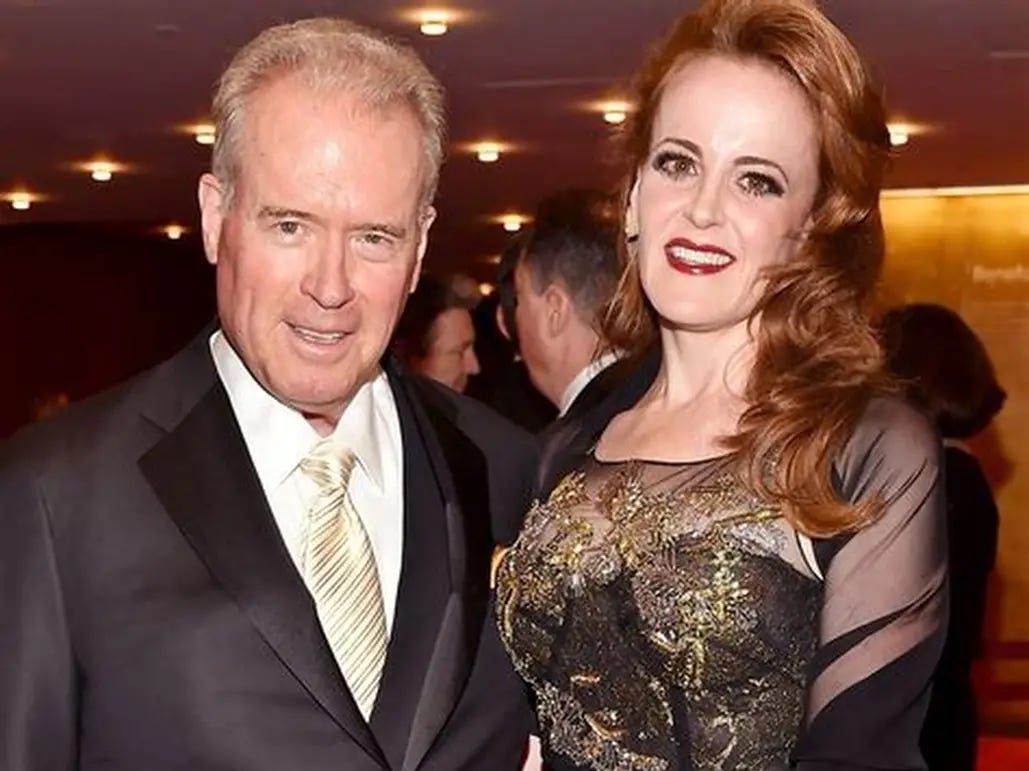
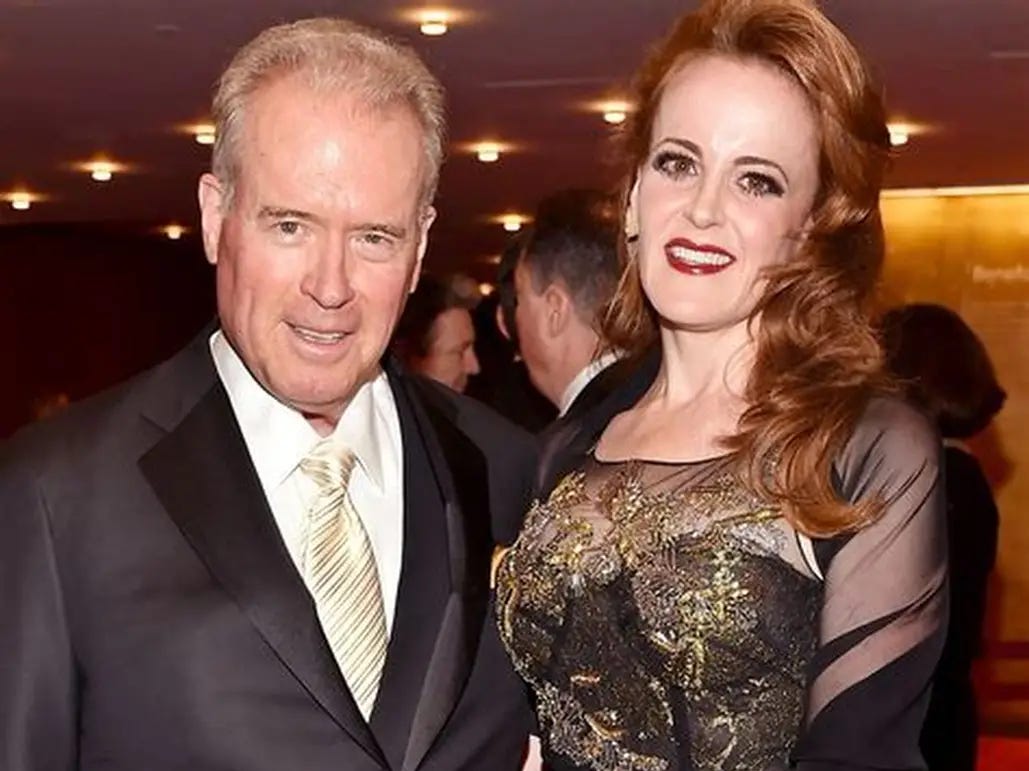
Robert Mercer is 79 now. He lives with his wife Diana in a sprawling Long Island compound and, when not at the office, reportedly enjoys electric model trains, of which he is said to own one of the world’s largest private collections. He owns a yacht called Sea Owl. He has spoken on the record perhaps three or four times in his entire public-facing career. He is reclusive in the literal sense, not the marketing sense.
He has three daughters - Heather Sue, Jennifer (”Jenji”), and Rebekah, known as Bekah. The three of them jointly own a New York cookie company called Ruby et Violette, which is the kind of detail you put in a profile when you have nothing to say. The Ruby et Violette cookie company is not the Mercer family business. The Mercer family business is the Mercer Family Foundation, founded in 2004, directed by Rebekah Mercer, and funded by the algorithm in East Setauket.
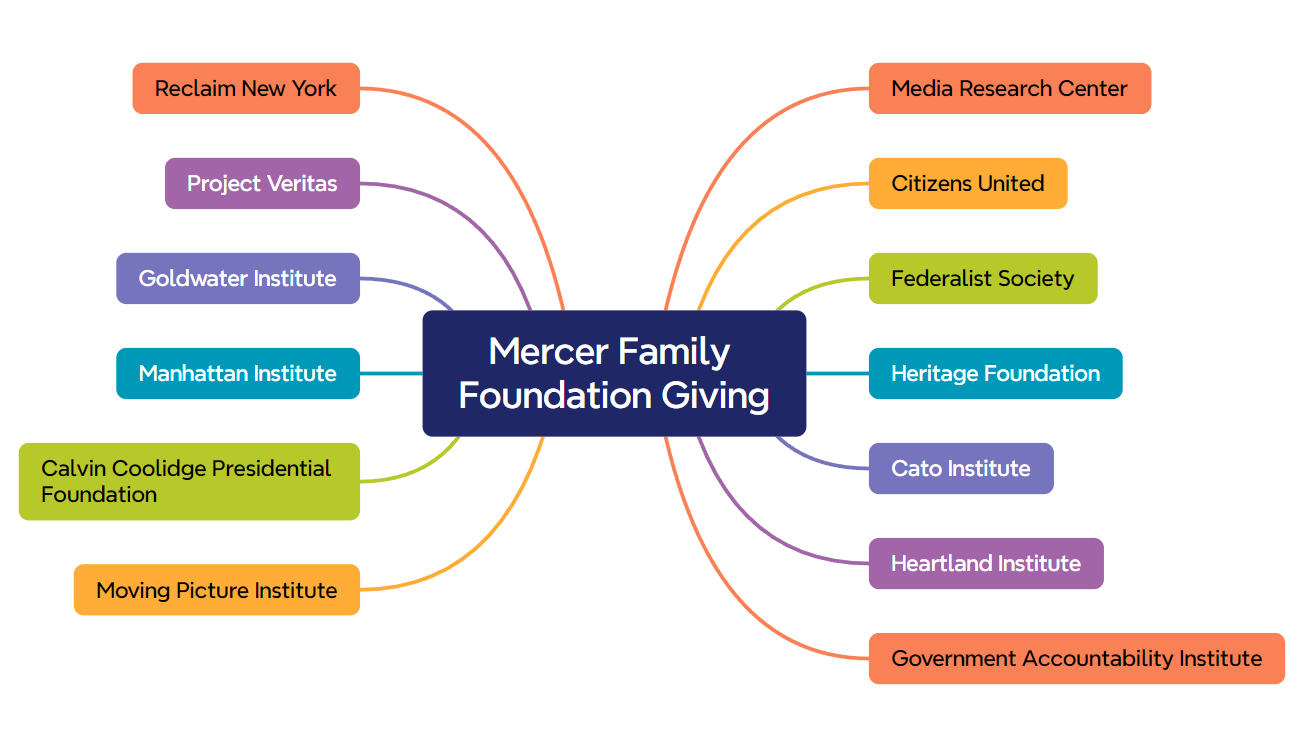
The Mercer Family Foundation is not a charity in any meaningful sense. It is a political weapon wearing a charity’s ballgown. You can read its IRS Form 990s on ProPublica Nonprofit Explorer the same way you read a company’s annual report - line by line, name by name, grant by grant - and watch a political plan unfold across twenty years. The recipients are not soup kitchens. The recipients are the Heritage Foundation. The Federalist Society. Citizens United (the organization, not the case). The Media Research Center. The Cato Institute. The Heartland Institute. The Government Accountability Institute. The Moving Picture Institute. The Calvin Coolidge Presidential Foundation. The Manhattan Institute. The Goldwater Institute. Project Veritas. Reclaim New York - which Rebekah Mercer founded and chairs.
Every organization in that list is a 501(c)(3) - a tax-deductible “public charity” - and the activities described across the rest of this story are, in plain English, partisan political work. The legal vehicle for that kind of work is a 501(c)(4), which forfeits donor deductibility precisely because it does politics. Put simply, 501(c)(3) organizations are tax-exempt with tax-deductible donations, while 501(c)(4) organizations are tax-exempt but donations are generally not deductible. How the Mercer Family Foundation and several of its grantees have justified holding charity status while functioning as the operations wing of a national political campaign is, to me, an open question I would very much like an IRS examiner to answer.
Read that list again. The Heritage Foundation. The Federalist Society. Project Veritas. The Calvin Coolidge Presidential Foundation, because apparently someone in the family is a Coolidge guy, which is its own diagnosis. The Mercer Family Foundation is what happens when somebody gives a private equity firm the IRS code for “charity” and tells them to go to town.
Between 2012 and 2014 alone, tax records show the Mercer Family Foundation gave nearly $3.6 million to Citizens United - the organization founded by David Bossie that, as Piece 5 will show, manufactured the lawsuit that took American campaign finance law apart. That is the most direct edge I can give you between the Mercer money and the case that defined this series. The Mercers funded the organization that filed the case. Read that sentence twice.
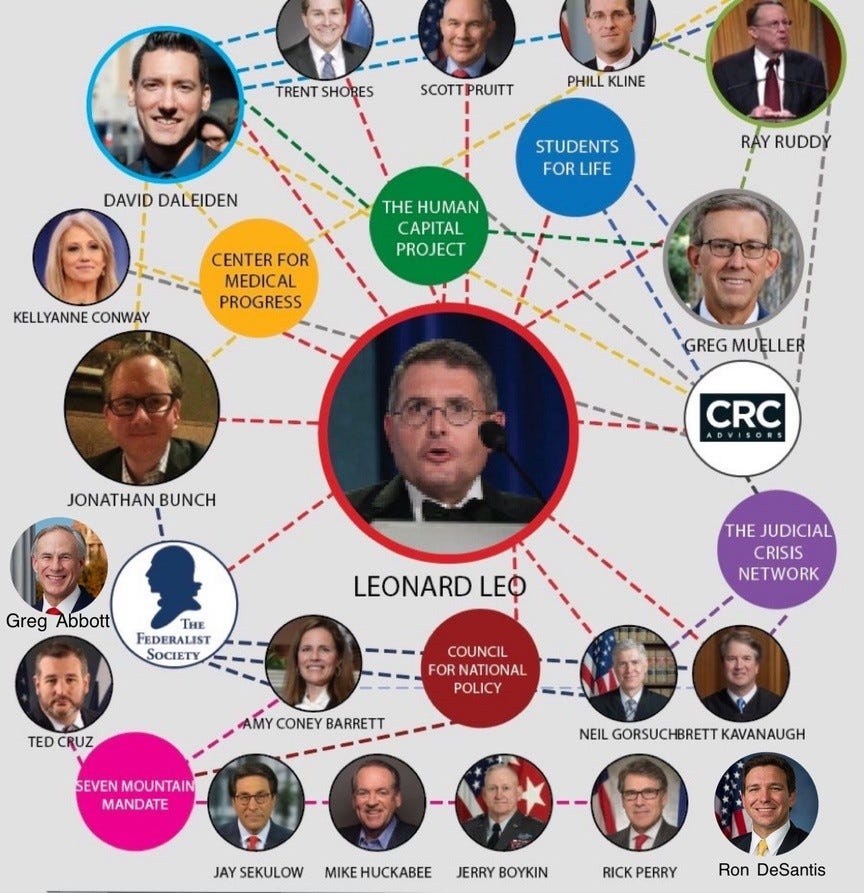
And here is the link that connects the Mercers to Piece 4 - my next article, on Leonard Leo and the people who built the Supreme Court that Citizens United landed in. Right Wing Watch documented in 2019 that the Mercer Family Foundation has been giving roughly ten percent of its yearly assets to the Federalist Society. Not ten percent of its grants. Ten percent of its total holdings. For years. The Federalist Society is where Leonard Leo spent thirty years building the pipeline that produced Justices Roberts, Alito, Gorsuch, Kavanaugh, and Barrett. The Mercer Family Foundation was - is - one of the biggest funders of that pipeline. The same fortune that paid for Citizens United Inc. also paid for the Federalist Society, which in turn built the Supreme Court that decided Citizens United v. FEC. That is not a coincidence. That is a closed loop. That is what oligarchy looks like when it has plenty of money and plenty of time.
I am going to keep coming back to that loop, because it is the connecting thread.
I have been over the Mercer-Breitbart investment in Bannon I, but I want to revisit it here from the Mercer side because the story changes when you stand on their porch instead of Bannon’s. Bannon needed money. The Mercers needed a platform. Breitbart in 2011 was a niche conservative blog. Breitbart in 2016 was the third most visited political news site in the United States and the editorial command post of the Trump campaign. That transformation cost the Mercers about $10 million.
Ten million dollars to remake the entire American information environment. The Iraq War cost about $2 trillion. The Affordable Care Act cost the federal government about $1 trillion across its first decade. A presidential campaign costs $1 to $2 billion. For about half of one percent of what one presidential election costs, the Mercers built a propaganda outlet big enough to help herd a national election. And the payoff - the judges they got seated, the regulations they got killed, the tax cuts they got passed - is worth more than anyone can measure.
This is not a complaint about how much money rich people have. It is a point about how cheap it is to take over a democracy once the laws have been rewritten to let private money speak louder than the public’s voice. The Mercers did not need enough money to own the country outright. They needed enough money to own the right pieces of it.
While we are doing the Breitbart accounting: Robert Mercer also funded Glittering Steel, Bannon’s production company, which served as the production partner for Cambridge Analytica’s super PAC video work. The Mercers funded the studio, the platform, the data company, and the super PAC, and the same people sat on multiple boards across all four. The “wall” between independent expenditures and campaign coordination that Citizens United required existed only in the FEC’s filing system. In operational reality there was no wall. There was one company with four logos.
Sidebar: What is the “wall” between independent expenditures and campaign coordination?
After Citizens United v. FEC in 2010, billionaires and corporations could spend unlimited money on political ads, as long as the spending was “independent” - meaning the spenders were not coordinating with the candidate’s official campaign. The legal idea was that an independent ad is more like free speech than like a campaign contribution, so it does not corrupt the candidate. That is the wall. On one side: the candidate’s campaign, which has strict limits on how much any one donor can give. On the other side: super PACs and dark-money groups, which can take unlimited money but cannot coordinate with the campaign.
In practice, the wall is a joke. The same consultants work on both sides. The same data is shared through “publicly available” workarounds - think about leaks. The same lawyers structure the strategy. The same families fund the studio that makes the campaign’s ads, the super PAC that buys them, and the data company that targets them. The Federal Election Commission, which is supposed to enforce the wall, has been deadlocked along partisan lines for most of the post-Citizens United era and rarely acts. If you want a one-sentence summary: the “wall” exists on paper, gets filed at the FEC, and falls down the moment anyone with money decides to walk through it.
V. The data weapon - Cambridge Analytica, SCL, and AggregateIQ
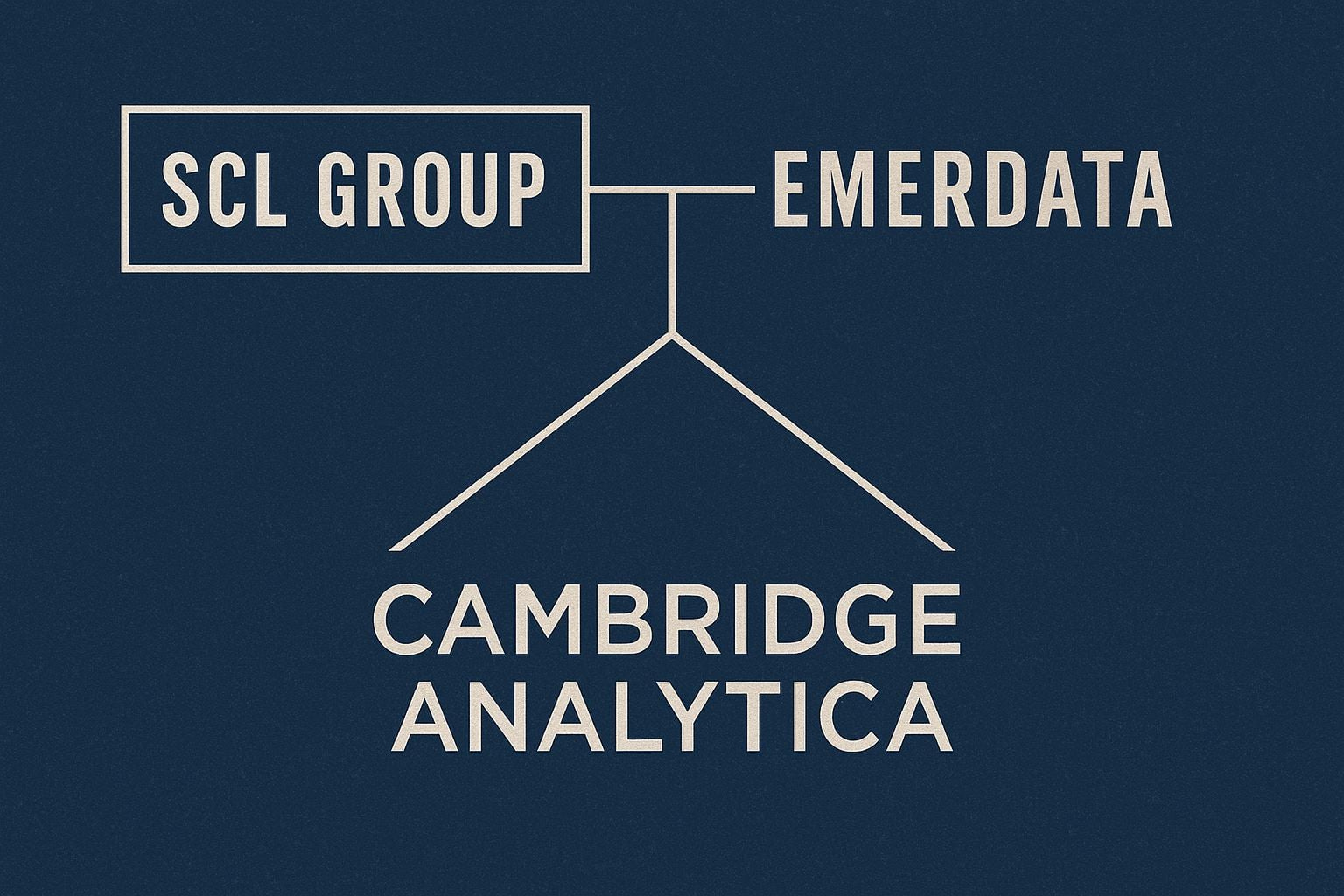
In the fall of 2013, Bannon introduced Robert Mercer to Alexander Nix and Christopher Wylie, the British executives behind SCL Group - a defense and intelligence contractor that had pivoted into political consulting. SCL Elections, the political subsidiary, wanted to enter the American market. Mercer wrote a check, reported by The New York Times at a minimum of $15 million, to create Cambridge Analytica Holdings as the American-facing arm of SCL. Rebekah Mercer joined the board. Bannon joined the board. The Mercers became the controlling investors.
What Cambridge Analytica did is now well-documented and need not be rehearsed at length. In 2014, working with a Cambridge University academic named Aleksandr Kogan, the company scraped personal data on roughly 87 million Facebook users through a personality-quiz app - users who consented for themselves, but who unwittingly handed over the data of every friend on their accounts. That data was used to build personality profiles for political targeting. The Federal Trade Commission, in 2019, issued a consent decree requiring destruction of the data and the resulting models. Whether the data was actually destroyed is a question the public has never been given an answer to.
The official cover story for this is that people answered a personality quiz on Facebook. A personality quiz. That is the line. A foreign-owned, Mercer-funded, Bannon-run political-warfare company built around a Cambridge professor’s personality quiz, deployed against 87 million Americans, harvested for the kind of psychological profiling that intelligence agencies spend decades building tradecraft to do. The personality quiz was called thisisyourdigitallife. I am not making that up. It is genuinely what it was called.
Now we come to AggregateIQ - AIQ - which the existing public record on the Mercer machine has tended to under-explain.
AggregateIQ was founded in Victoria, British Columbia, in 2013 by two Canadian IT specialists, Zack Massingham and Jeff Silvester. They had done work in Canadian politics. Christopher Wylie - the SCL whistleblower who later became the central source for Carole Cadwalladr’s reporting in The Observer - had previously tried to recruit Silvester to move to London and work for SCL. Silvester wanted to stay in Victoria. AIQ was the workaround. Wylie later told the UK Parliament that AggregateIQ was set up specifically to do work for SCL, and that SCL described AIQ as its Canadian office. Until February 2017, the phone number for SCL’s Canadian office, listed on SCL’s own website, redirected to AggregateIQ. In Cadwalladr’s reporting, AIQ was effectively “an internal department of Cambridge Analytica.”
Why does this matter? Because AggregateIQ is the company that built Ripon, the software Cambridge Analytica used to turn its Facebook data into political ads. Here is what that means in plain English. Cambridge Analytica had personality profiles on 87 million Americans, built from the Facebook quiz data. Those profiles were just spreadsheets, useless on their own. Ripon was the tool that took the profiles, decided what kind of ad each person should see based on their personality type, and then bought and placed those ads on Facebook, YouTube, and elsewhere - automatically, at huge scale, for pennies per person. Without Ripon, the Facebook data was a stack of paper. With Ripon, it was a weapon. Ripon - named, with full self-awareness, after the Wisconsin town where the Republican Party was founded - was the technical core of the Mercer political-targeting operation. AIQ was the firm that built it. Cambridge Analytica was the firm that licensed and ran it. SCL was the parent. The Mercers funded the lot.
A September 2014 agreement uncovered by Cadwalladr assigned AggregateIQ’s intellectual property to Cambridge Analytica. Here is what that means in plain English. A Canadian software company built a political-targeting weapon. The weapon was signed over to a British company’s American branch. That American branch was owned by an American billionaire. That same billionaire was also paying to keep Breitbart running. And Breitbart was about to hand its top editor to Donald Trump’s campaign. And the Cambridge University professor whose personality-quiz app was used to scrape the data that fed the weapon - Aleksandr Kogan - held a second academic position at St. Petersburg University in Russia, where he was in receipt of Russian government money for a research project on the exact same kind of psychological profiling Cambridge Analytica was selling to American campaigns. One billionaire family. Four countries’ worth of operations. One presidential election at the end of it. If you wrote that sentence in a novel, your editor would tell you to cut it for credibility.
AIQ then went on to help break a second democracy.
In 2016, the same Mercer-funded data operation that was targeting American voters for Trump also went to work in the United Kingdom. AggregateIQ was paid by the official Vote Leave campaign - the one Boris Johnson rode to power (with a little help from Epstein?) - and the UK Electoral Commission later fined Vote Leave for breaking campaign finance law in how it used AIQ. Brexit and Trump were not parallel events. They were connected events. The data infrastructure was the same data infrastructure. The capital came from East Setauket. When you hear commentary that calls Brexit and Trump “populist uprisings,” remember who paid for the uprising and where the algorithms ran. Populism is a word that flatters the voters. The voters were targeted.
VI. The 2016 cycle - one PAC, two democracies, no walls
In the 2016 Republican primary, the Mercers’ political vehicle was a super PAC called Keep the Promise I, which spent $11 million backing Ted Cruz. They also backed Ben Carson. They paid for Cambridge Analytica’s work on both campaigns - a practice that, in any other industry, would be called working both sides of a contract. When Cruz dropped out on May 3, 2016, and Donald Trump emerged as the presumptive nominee, the Mercers did what hedge fund managers do. They rebalanced.
Ivanka Trump and Jared Kushner approached the Mercers shortly after Cruz’s withdrawal. By August 2016 the deal was done. The Mercers’ super PAC, which had been called Keep America Number 1, was renamed Make America Number 1 and pointed at Trump. Steve Bannon became campaign CEO. Kellyanne Conway, who had been running the Mercer-funded pro-Cruz operation, became Trump’s campaign manager. Cambridge Analytica’s services transferred from Cruz’s data operation to Trump’s data operation. Glittering Steel, Bannon’s production company, made the ads. The Government Accountability Institute - the Mercer-funded research shop co-founded by Bannon and Peter Schweizer in 2012, whose Clinton Cash book Rebekah Mercer executive-produced - provided opposition research designed to be laundered through mainstream media outlets.
Campaign Legal Center documented in October 2020 that Cambridge Analytica was simultaneously billing the Trump campaign and the Make America Number 1 super PAC - the precise coordination structure that Citizens United’s “independent expenditure” doctrine is supposed to prohibit. The same vendor billing both sides of the wall is not independence. It is camouflage. The Federal Election Commission, deadlocked along partisan lines, did not - and could not with any effectiveness - act.
Sidebar: How the FEC was broken on purpose
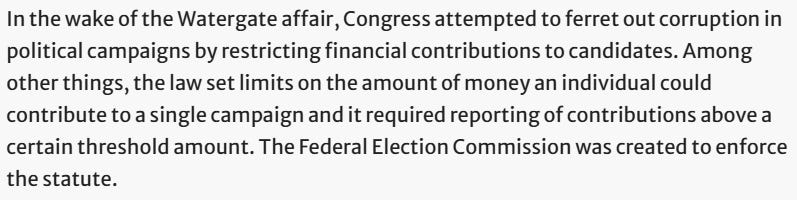
The Federal Election Commission was created in 1974, in the aftermath of Watergate, to enforce campaign finance law. It has six commissioners, by statute split 3-3 between the two parties. Any enforcement action requires four votes. The structure was meant to force bipartisan agreement. It has been weaponized to do the opposite.
Beginning in the mid-2000s, a bloc of Republican-appointed commissioners began voting as a unit to block enforcement, block investigations, block rulemaking, block digital-ad transparency requirements, and block foreign-interference probes. Former Republican FEC chairman Trevor Potter, a McCain ally, has said publicly that the agency became “a graveyard for enforcement” because of commissioners who “do not believe in campaign-finance law.” The substantive-deadlock rate climbed from roughly 4% in 2006 to over 30% by 2014, and has been chronic since.
Republican Senate leadership made it worse. Beginning under Bush and accelerating under Obama, Republican leaders blocked nominees who favored enforcement, installed commissioners who opposed regulation on ideological grounds, and kept seats empty to prevent a quorum. From 2019 into 2020, the FEC went more than a year without enough commissioners to legally meet. The agency was, by Republican design, unable to act at all.
Underfunding finished the job. For two decades, Republican appropriators kept the FEC’s budget essentially flat while campaign spending exploded, digital advertising transformed politics, and foreign interference multiplied. The agency was asked to police a battlefield with a flashlight that the same battlefield’s owners controlled the batteries to.
The FEC is not a story of bureaucratic decay. It is a story of an institution that was strategically disabled by the political party that benefited most from disabling it. It is one piece of a longer pattern - the same pattern that disabled the IRS’s 501(c)(4) oversight after the 2013 Lerner episode, gutted the Voting Rights Act in Shelby County in 2013, and stacked the federal judiciary through the Federalist Society pipeline. That broader story is the subject of a companion piece I am working on. For now, the point is narrower: the regulator that was supposed to constrain the Mercer machine had been deliberately broken before the Mercer machine arrived.
I want to pause and name what we are looking at, because the technical details can blur the moral picture if you let them.
One billionaire family - the Mercers are American, but Cambridge Analytica’s parent company was British, AggregateIQ was Canadian, the academic who built the Facebook scraper was Russian-born and based in Britain, and the data targeting was built across three countries - paid for the propaganda platform, the data operation, the opposition research shop, the production company, the super PAC, and the campaign staff that put Donald Trump in the White House. The wall between independent spending and campaign coordination - the legal fiction the whole post-Citizens United system rests on - did not exist in this operation. The same vendors worked for both sides of the wall. The same people sat on both sides of the wall. The same money paid both sides of the wall. The same strategy ran both sides of the wall.
The Federal Election Commission found no violation. The Department of Justice, under Trump-appointed leadership for most of the investigation, declined to prosecute. The Mercers were never interviewed by Robert Mueller. Mueller’s investigation did establish, in Volume V of the Senate Intelligence Committee’s bipartisan report, an “intersection” between Cambridge Analytica and Russian intelligence-linked operations. What that intersection actually meant has never been publicly answered, in part because Cambridge Analytica collapsed into bankruptcy in May 2018 - and its assets reportedly moved to a successor company called Emerdata, led by a Mercer sister, that had been quietly set up several months before the scandal broke. The data did not disappear. The data moved.
The pattern, if you are taking notes, is the pattern this whole series argues for. The system was designed to launder. It laundered. The agencies that were supposed to catch the laundering had already been captured upstream by the same families that benefited from it.
VII. The 2018 break - Fire and Fury, and what stayed standing
In January 2018, Michael Wolff’s book Fire and Fury quoted Bannon calling the June 2016 Trump Tower meeting with Russian lawyer Natalia Veselnitskaya “treasonous” and trashing the Trump family. Rebekah Mercer put out a public statement cutting the family’s ties with Bannon. Robert Mercer sold his share of Breitbart - reportedly to his daughters - and stepped down as Renaissance co-CEO in late 2017. The Mercer-Bannon partnership was over. The cleanest version of the cleanest political story in this series ended in a paragraph in a celebrity tell-all.
I am supposed to find this funny, and I do find it a little bit funny, but I want to be careful with the laughter. What did not end in 2018 was the machine. The Government Accountability Institute kept publishing. Reclaim New York kept organizing. The Mercer Family Foundation kept writing checks - to the Federalist Society, to Citizens United Inc., to the Heritage Foundation, to Project Veritas, to dozens of other groups. The Make America Number 1 super PAC kept spending. Rebekah Mercer, in 2020, co-founded the right-wing social media network Parler, which became one of the main organizing platforms for January 6. Robert Mercer’s wealth kept piling up inside the Medallion Fund.
The machine was always the point. The people running it were replaceable. Bannon was useful in 2016 because Bannon could broker the platform the Mercers wanted to own. In 2018 Bannon was a liability because of his mouth, and so the Mercers fired their broker and kept the building. By 2024 the same building was supplying staff to a second Trump administration through different middlemen. The Mercer money was no longer the most visible money - Elon Musk’s $250-million-plus into Trump’s 2024 run crowded out everyone else’s photo op - but the Mercer-built institutions were still the institutions. The Heritage Foundation, which the Mercers had been a top-tier funder of since the early 2010s, produced Project 2025. The Federalist Society, which the Mercer Family Foundation had been giving roughly ten percent of its yearly assets to, supplied the judicial picks. The conservative legal movement that Leonard Leo built on Mercer money - and other money - was now staffing the executive branch.
The check from 2011 did not stop paying out. It is still paying out.
So just to be clear about where we stand: the family whose money funded the lawsuit that broke campaign finance, funded the propaganda outlet that broke political journalism, funded the data company that broke voter targeting, funded the legal society that broke the Supreme Court, and funded the social network that helped break the Capitol on January 6 - that family still exists, still has the money, still writes the checks, and is not, to my knowledge, currently facing any consequences worth mentioning. Just so we’re on the same page about how this story ends.
VIII. The closed loop - why this is the piece on oligarchy, not on philanthropy
Let me put the Leonard Leo connection on the table directly, because Piece 4 is going to take Leo’s network apart in detail and I want this story to draw the line cleanly.
Leonard Leo, while running the Federalist Society as its executive vice president, raised more than $460 million between 2005 and 2021 for a network of groups that exist to influence who sits on the federal bench - the Judicial Crisis Network, the 85 Fund, the Concord Fund, and BH Group, among others. In April 2020 he became the sole trustee of the Marble Freedom Trust, the group that received the single largest known political donation in U.S. history - $1.6 billion from electronics magnate Barre Seid. Leo’s network paid for the ad campaigns that got Justices Gorsuch, Kavanaugh, and Barrett confirmed. Those three justices, plus Justices Roberts and Alito - whose 2005 nominations Leo also helped shepherd through a dark-money network he was already building - are the five-vote majority that handed down Dobbs v. Jackson Women’s Health Organization in 2022 and Trump v. United States in 2024. The Roberts Court is the Leo Court.
The Mercer Family Foundation gave the Federalist Society roughly ten percent of its yearly assets - year after year - the whole time Leo was building the machine that produced the Roberts Court. The Mercer Family Foundation also gave nearly $3.6 million to Citizens United Inc., the group that manufactured the case, in the three years right after the decision came down. The same fortune funded the propaganda layer (Breitbart), the data layer (Cambridge Analytica), the opposition-research layer (GAI), the super PAC layer (Make America Number 1), the legal-movement layer (Federalist Society), and the lawsuit layer (Citizens United Inc.). That is not a donor portfolio. That is a one-family takeover.
Robert and Rebekah Mercer did not take over the country alone. Charles and David Koch put more money in, and earlier, and bought more think tanks. Sheldon Adelson put more money into individual races. Harlan Crow built a private friendship with a single Supreme Court justice that the rest of the Mercer network would have considered amateur hour. Barre Seid wrote the biggest single check. Leonard Leo and James Bopp Jr. - the lawyer who is about to dominate Piece 4 - built the legal scaffolding without which none of the money would have mattered. The oligarch project is a team project, not a solo act, and pointing at any one family as the villain misses the shape of the thing.
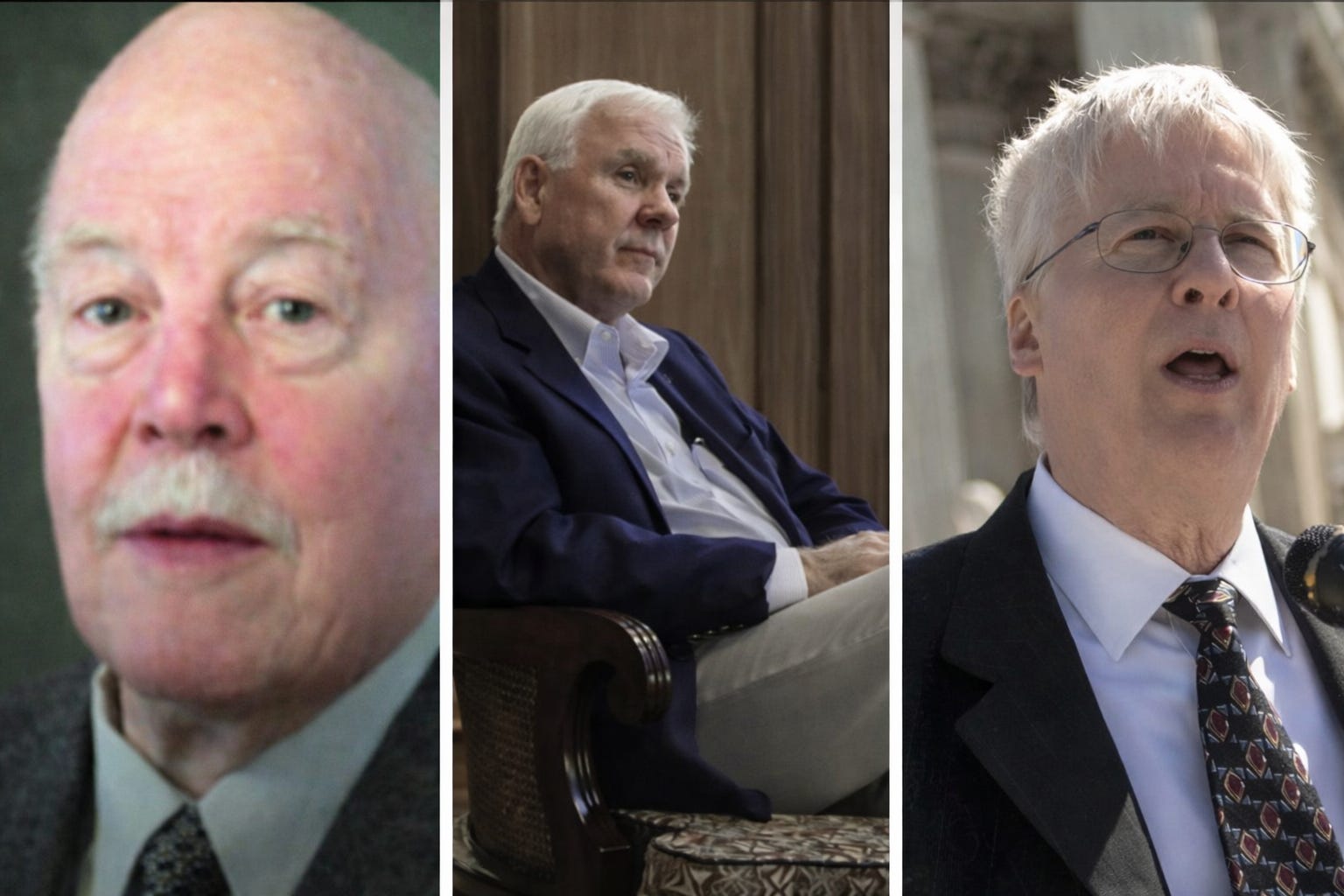
Barre Seid, Harlan Crow, James Bopp Jr.
And the team is older than most readers think. The plan did not start with Citizens United, or with the Mercer money, or with the Federalist Society. It started in August 1971, with a confidential memo from a corporate lawyer named Lewis Powell to the U.S. Chamber of Commerce - two months before Richard Nixon nominated Powell to the Supreme Court. Powell argued that American big business needed a long, many-fronted push to take over the universities, the law schools, the courts, the think tanks, the media, and the policy world. Every group this series digs into - Heritage (1973), the Federalist Society (1982), the Bradley and Olin and Scaife and Koch funding networks, the State Policy Network, the dark-money charity setup - is downstream of the Powell memo. The Mercer money is third- and fourth-generation money aimed at targets Powell named more than fifty years ago. I am working on a separate companion article, The Long Plan, that follows that fifty-year project from the Powell memo to today. For the purposes of this story, the only thing we need to know is that what looks like a sudden takeover starting around 2010 is actually the harvest of a plan that was put in the ground in 1971.
The Mercers are the cleanest case study because they are the most thoroughly documented case study. The 990s are public. The Cadwalladr reporting and the Jane Mayer reporting and the Senate Intelligence Committee report and the ICO report are all sitting in the open record. We know what they did because journalists did their jobs. The Mercers are not the only ones who did it. They are the ones we caught doing it.
IX. What this means, said plainly
I want to close this article without metaphor.
The United States used to work, imperfectly, as a representative democracy where the votes of citizens decided who was in government. It does not work that way anymore. It works as a mixed system, where a small number of fortunes worth hundreds of millions of dollars pick the candidates, write the policy papers the candidates run on, fund the media outlets that boost the candidates, build the data tools that target the swing voters, pay for the legal setup that protects the donors from the law, and confirm the judges who interpret the laws their own lawyers wrote. The voters still vote. The vote is real - for now. But the vote is now downstream of decisions made by a few dozen people the voters cannot name and could not vote out even if they could.
That is the definition of oligarchy. It is not name-calling. It is the word for a setup where political power follows concentrated private wealth. Aristotle would recognize it. The Founders worried about it. The Progressive Era was built to keep it from coming back. The post-1976 Buckley v. Valeo ruling weakened the guardrails. Citizens United v. FEC, in 2010, took the rest of them down. The Mercer machine and the Koch machine and the Leo machine and the Adelson machine and the half-dozen other machines that run alongside them are the working layer of an oligarchy that the 5-4 majority on the Roberts Court made legal and that the dark-money setup this series describes put into motion.
Buckley v. Valeo
I do not know how to undo this in a paragraph. I do not think it can be undone by any single election, because the system was built to survive elections - that is the whole point of taking over the courts and the agencies, which last longer than any one president. I do think it can be undone in principle, because every previous time a small group of rich Americans built this kind of power, it eventually got broken by some combination of laws, court rulings, organizing, and time. The Gilded Age ended. The robber-baron monopolies were broken up. The New Deal happened. The Voting Rights Act passed.
But the breaking is going to require us to first see the thing as it is. Not Republican versus Democrat. Not conservative versus liberal. Citizen versus owner.
And I want to say one more thing, because I said it in paragraphs 3 and 4 of this article and I want it ringing in your ears at the end too. The men who paid for this takeover did not just buy a country in the abstract. They bought a country shaped to their preferences. Those preferences are racist. Those preferences are misogynist. Those preferences treat queer and trans Americans as a problem to be legislated out of public life. The Voting Rights Act did not get gutted by accident. Roe did not get overturned by accident. DEI did not get dismantled by accident. Trans Americans are not being targeted by accident. Every one of those outcomes was paid for, on purpose, by the same donors who paid for the rest of what is in this article. The oligarchy is the chassis. The bigotry is the engine. If you forget the second sentence, the first one does not make sense.
In the next article I am going to walk you through how Leonard Leo and James Bopp Jr. built the Supreme Court that received the Mercer-funded Citizens United lawsuit, and how they turned a narrow legal question into a doctrine that broke the country. In the article after that I am going to walk you through Citizens United v. FEC itself - what the case was, what the Court did to it, and what the country has looked like since.
I will end this one where I started it. The country was sold. You did not consent to the sale. Neither did I.
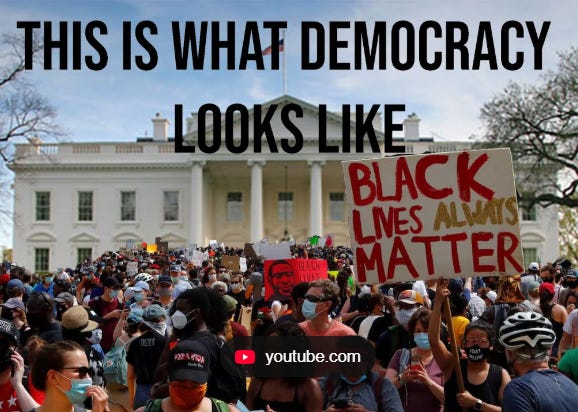
Whoever told you that this is what democracy looks like was lying to you, or was being lied to.
· Piece 3: The Mercers and the Dark-Money Architecture (this article)
· Piece 4: The Court - Leo’s Judge Pipeline and Bopp’s Litigation Ladder (forthcoming)
· Piece 5: Citizens United - The Convergence and What It Unlocked (forthcoming)
I am a researcher in Arlington, Texas. I am not a journalism outfit. Everything in this series is documented in the linked primary sources. Corrections are welcome at the email address on this Substack.




Comments
Nothing yet. Say the first thing.
Sign in to join the conversation.