
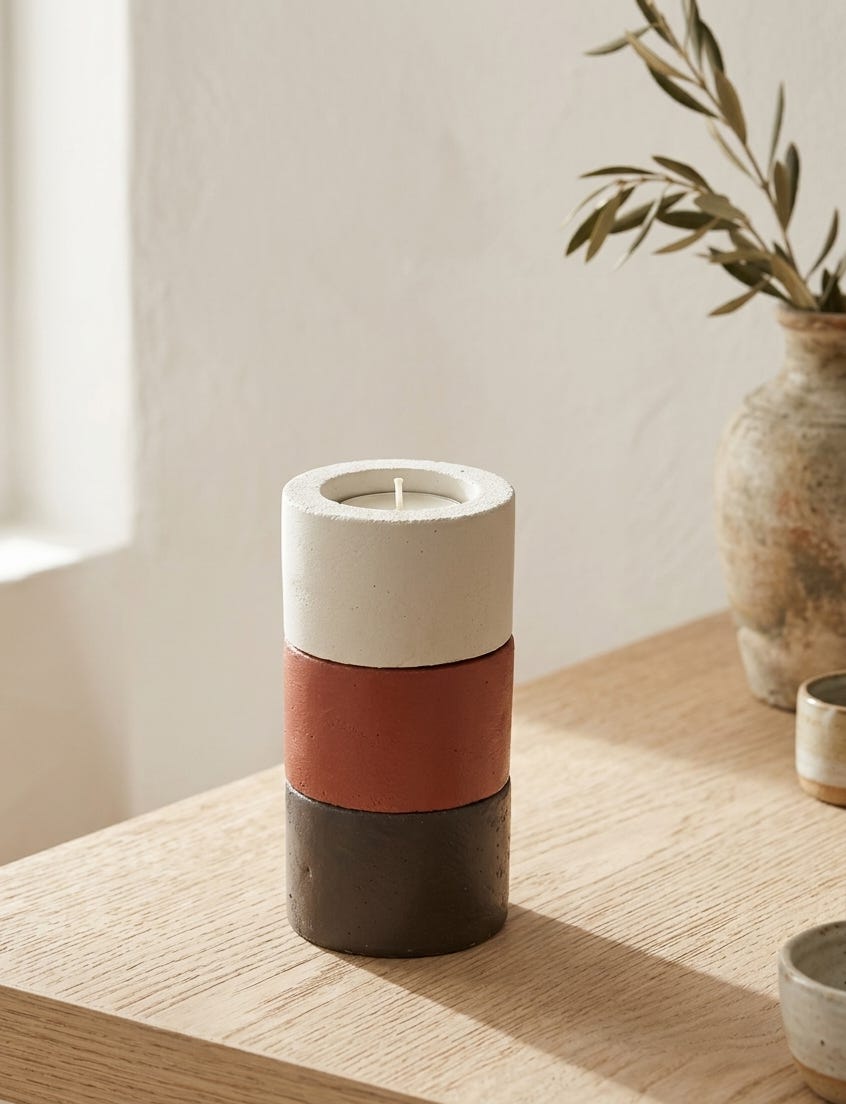
Most of what we make asks for a wall, a shelf, a corner of a room willing to be anchored. The candle holders ask for none of that. They ask for a hand.
They started as a simple question: why does an object have to stay one shape. Each piece is made to work alone — a single small cylinder, one colour, a tealight inside. But they are also made to stack. Three together become a single banded column, white giving way to terracotta giving way to near-black, one object instead of three. Separate them again and you have three quiet, individual holders, scattered across a table or a shelf or a windowsill, each one complete on its own.
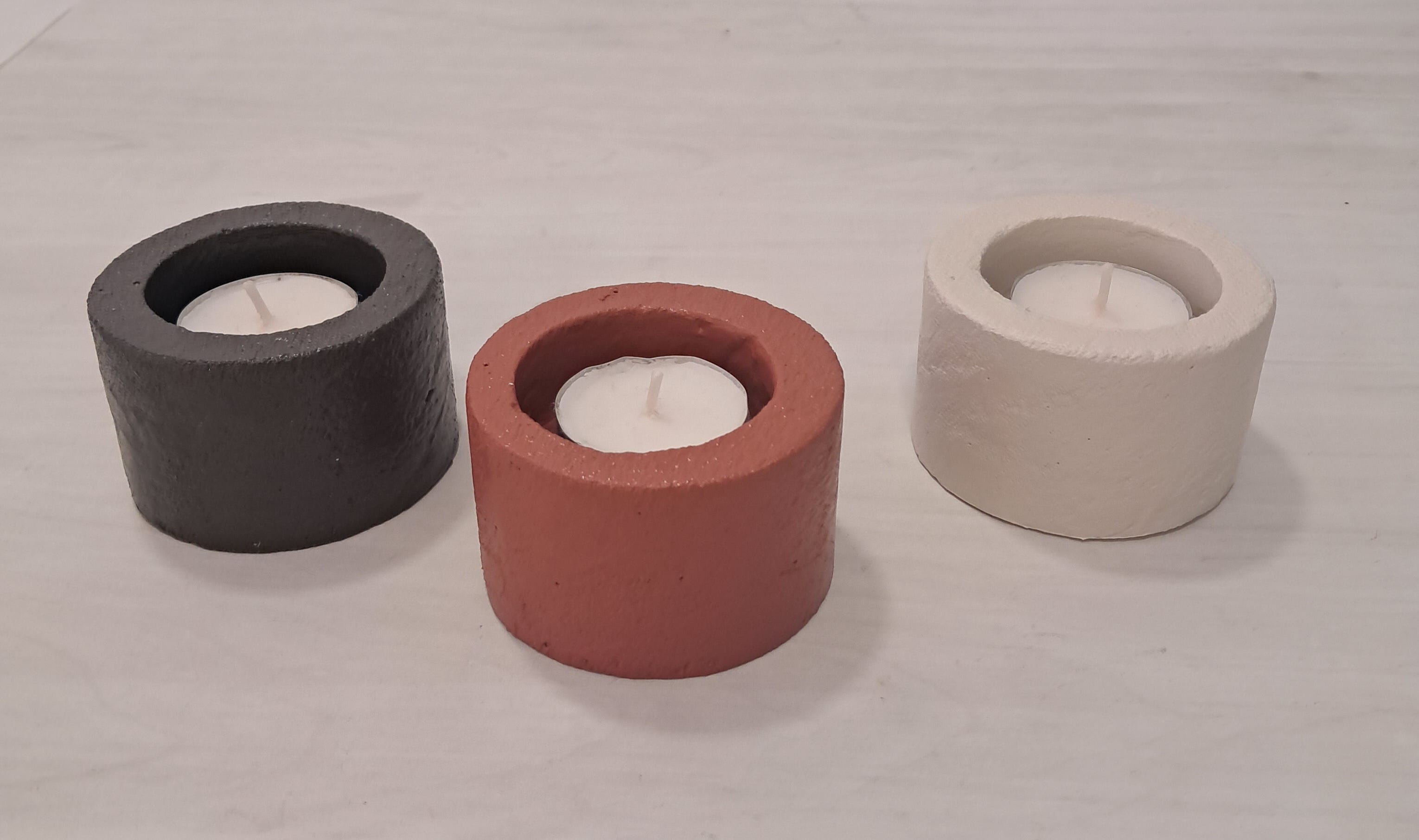
Nothing about the piece changes. Only the arrangement does.
We like objects that refuse to settle into a single use. A shelf candle holder for an ordinary Tuesday. A grouped column for a dinner that matters. The same three pieces, doing two completely different jobs, depending only on whether you feel like building something tonight or leaving things simple.
There is something honest about working at this scale. A wall relief can be quiet about its size — it commands a certain amount of space and that is simply what it does. A candle holder this small has nowhere to hide. Every decision is felt in the hand before it is felt anywhere else. Getting a colour transition to feel inevitable rather than decorative is harder in five centimetres stacked into fifteen than it is across a metre of wall.
And then there is the part we cannot design at all. The piece is only finished once someone lights it — stacked or scattered, it doesn't matter. That decision belongs to whoever's table it ends up on.
A few are already in the studio, in Palamós, ready.
Le même objet peut avoir plusieurs vies. El mismo objeto puede tener varias vidas.
→ The shop sinopiadecor.com/shop
→ Anell sinopiadecor.com/product-page/anell-tealight-set-reshaping-collection
No posts
Comments
Nothing yet. Say the first thing.
Sign in to join the conversation.