

Vladimir Putin began the current Russian invasion of Ukraine in 2022, calling it a ‘Special Military Operation’.
Sometimes a part of the human anatomy becomes enlarged not like a muscle after exercise, but due to injury.
The narcissistic mind, compared with others, makes its presence more felt. The narcissistic mind is loud. Not only loud, but it can also be interesting, creative, intriguing and persuasive. It will get its way. Its influence will begin locally but expand. It will seek a wider audience. It will gain territory. The space for other minds will decrease. It will speak, and its words will be written down. Its face will become known. It will dominate. In extreme cases, it will oppress. It might attack. It might establish itself in places it has no right to be.
At the same time as its expansion and domination, the narcissistic mind will generate a rationale for its expansion. There will be ideas. There will be performances and works. There will be a job title. There will be mobilisation and enemies to defeat. A workforce. Or an army.
The child with the inflamed mind
When we read in psychology about the need for the narcissistic mind to be expansive and dominant, we come across two main explanations. One focusses on a very early developmental transition from a symbiotic relationship with a primary parent. The other focusses on later experiences of parenting that rely more on words.
When the child was an infant, the care they received seemed often perfect. Emotions were managed by hands and a voice that appeared to be extensions of self. The wishes and needs of the infant’s mind could not be distinguished from those of the intimate, holding comforter. They seemed to be the same. But from around six months after birth, this has to change. A revelation is coming that is not entirely welcome. That god-like all-providing part of themselves – the part that was able to manage their fear, hunger and distress – the part that had a different voice? It turns out not to be part of ‘self’ or ‘me’ at all. It is someone else. It is a parent. A new reality has to be accepted: the infant learns that they are vulnerable, and on this other mind – this parent - they have to depend.
Are the conditions right for the infant to come to terms with this bomb shell? As they are placed on the ground to begin exploring their physical territory, they have to do something harder within. They have to start defining the boundaries of their own mind and that of others. The parent too has to be ok with this transition. They have to be not too affected by depression, fear or their own narcissistic needs. If the journey out of this non-reality of idealised care was too rocky, then the ability to redefine the boundary of this single mind is left compromised. The reality that the infant is vulnerable in relation to this separate mind, is denied. Instead, some of those god-like qualities are claimed in the mind of the infant. The minds of others will from this time be dismissed.
The boundary of every child’s mind starts out porous. It is made to be impacted and shaped. But the shaping and impacting done by each parent is different. Research into priming experiences in narcissism points towards a parental style that is not only emotionally neglectful, but also intrusive1,2. The parent seems to know too much about the mind of the child, or they assume the right to decide its contents. There is no privacy of desires. The half-built walls of the child’s mind, to the parent, are not seen and respected. When this impacting and shaping of the mind is intolerable, it expands and solidifies in self-defence. Like a wound, this calls not for shrinking, but inflammation. The mind invisible in the dark, begins to shout. The mind intruded upon becomes rigid. The mind condemned, becomes, over time, elaborate and indispensable.
The loud, confidant and indispensable, in a world full of need, becomes valued, promoted and followed. But the inflammation is now a symptom of infection – expanding not through exercise in the service of values, but as a radical defence. Over time, the inflamed mind takes a form that bears no resemblance to the small self that still exists deep within. This hidden self is still an infant who turned away from any meeting of minds. Gradually, the pushing out and the hardening become a way of life. Others will come to see this as a personality – with its weaknesses and its strengths. The person is single-minded, admits no mistakes and remains cool under fire. But really, they are impossible to really know – to get close to. The apparent personality – this fortress – is a persona.
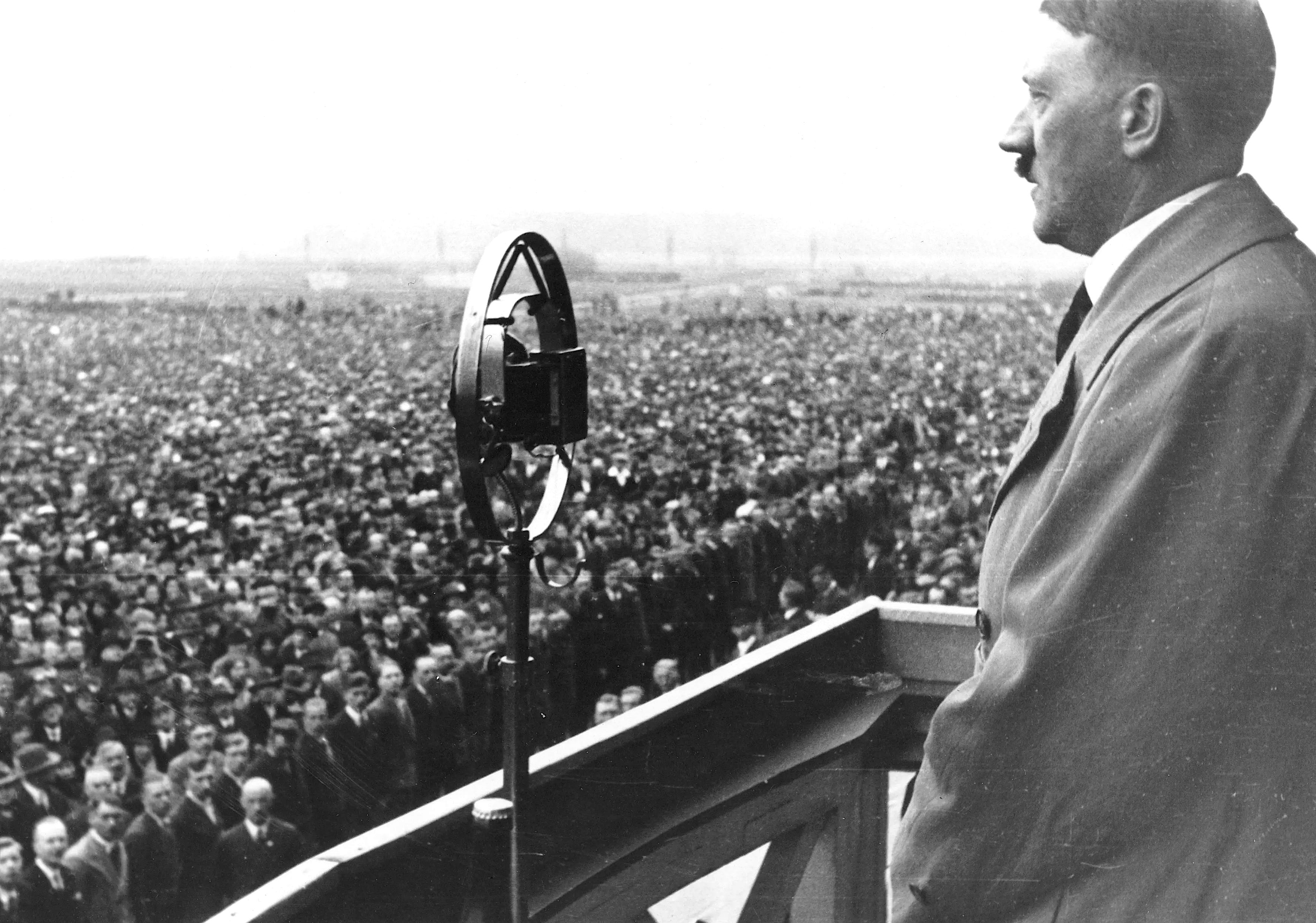
Adolf Hitler addresses crowds during WW2
In the narcissistic adult, the boundary of the self is expanded and imposing. But it remains vigilant for anything that looks like threat. In the words of one author,
“One of the major ways to defend a sensitive perimeter [of the self or mind] is to turn the tables on the environment, to take the offensive … In the most extreme cases, the sense of self can be maintained only by invading and diminishing the self-esteem of others... It is as if there may never be enough room for the self if there are any other selves in evidence.”3
In narcissism theory, the inflated “balloon-man”3 self is a protection against feared takeover of the mind. The narcissistic adult is “extraordinarily sensitive and responsive to the narcissistic elements in other people. Indeed, in evaluating their fellow man they see only balloons. The author says that such a life is a “perpetual collision course.”3 We are working towards the idea of narcissistic violence.
In the social adult world such tendencies in the extreme may draw a person towards roles like gang leadership, but also political leadership. Alongside the perpetrator face of narcissism there is a performance face. I have described previously how performance can look like Elvis the singer, and Brando the actor, but also like Winston Churchill the intellectual. Aggression is often easier to see in the gang leader than in the singer, actor or narcissistic politician. But this is in part because violence for the gang leader is an item on their job description. Elvis hired a hit man. Lennon and Brando used their fists. Churchill resolutely sent armies to die in Turkey while those around him shook their heads. The recent Netflix series on rapper Sean Combs brings to the surface a buried thread of violence over time. Noshpitz states that “A very high percentage of violent acts arise from, and are intimately associated with, narcissistic wounds.”3 But can this “cutting down others” as a “matter of survival”4 really extend to nations being invaded? Can the territory of one inflamed mind really become an actual neighbouring country?
Research shows that grandiose narcissism is attracted to leadership1. Narcissism is attracted to power and admiration and often replaces emotional connection with intellectual performance. Politics ticks these boxes. Autocratic leaders through history have shared “severe character disorders that are consistently similar across borders and cultures.”5
One narcissism author has said about territory that “In a curious way, the ruler may feel himself to be his country, not merely its head or its voice, but literally to be the whole nation.”3 So, what happens when that self needs to exist on a greater scale? In response to a threat that is not national, but personal? What happens when there is a personal need to condemn, in response to a sense of failure or guilt. Or a need to play a saviour role? What if there is just a perpetual need for more power? The grandiose narcissistic leader, compared with others, is more likely to go to war5 and is more likely to extend a war6. By itself, the chaos of war can be arranged to serve the grandiose leader well. It can make the high volume and sheer certainty of the authoritarian mind look like an adaptive response7. It hides the chaos and division that would still fester, in peace time, as a consequence of this same compulsive mind.5
I’ve written before about a difference in the experience of being with a severely psychotic person and a severely narcissistic person. The more we hear from the mind of the psychotic person, the less we are convinced of their version of reality. The more time we spend with the severely narcissistic person, the less convinced we become of our own reality. When we are then separated from them and access independent minds, we can be released from this spell. One way to test the extent to which an invasion was simply feeding a narcissistic need is to look at what happens when the leader is gone. After the fall of Nazi Germany, wrote Hannah Arendt, “the allies searched in vain for one self-confessed and convinced nazi… When the illusion fell, so did the fanaticism.”7
What if there is an extreme need to demonstrate with finality the existence of a mind? What if the threat to this personal sovereignty of mind is imagined easily and perpetually? What if narcissistic injury “has the quality of a bone in the throat” so that “the pressure for action to remove the discomfort is unrelenting”3? If we go to the extreme, what will create for this leader the ultimate evidence of the existence of their mind, with its wishes and its perspectives? Is it a whole nation acting together, in line with one set of wishes? Gun in hand, ending life and destroying social order only to demonstrate, simply and tragically, the potency of this one mind?
The saddest thing about the severely narcissistic leader is one of the saddest things about the history of planet earth. It is the realisation after their time, that the domination and human cost was not really prompted by shared needs or a vision for the future. When the narcissistic leader is gone, the magic effect of their mind on its followers vanishes like a quick acting drug leaving the nervous system. Or like a balloon, bursting.
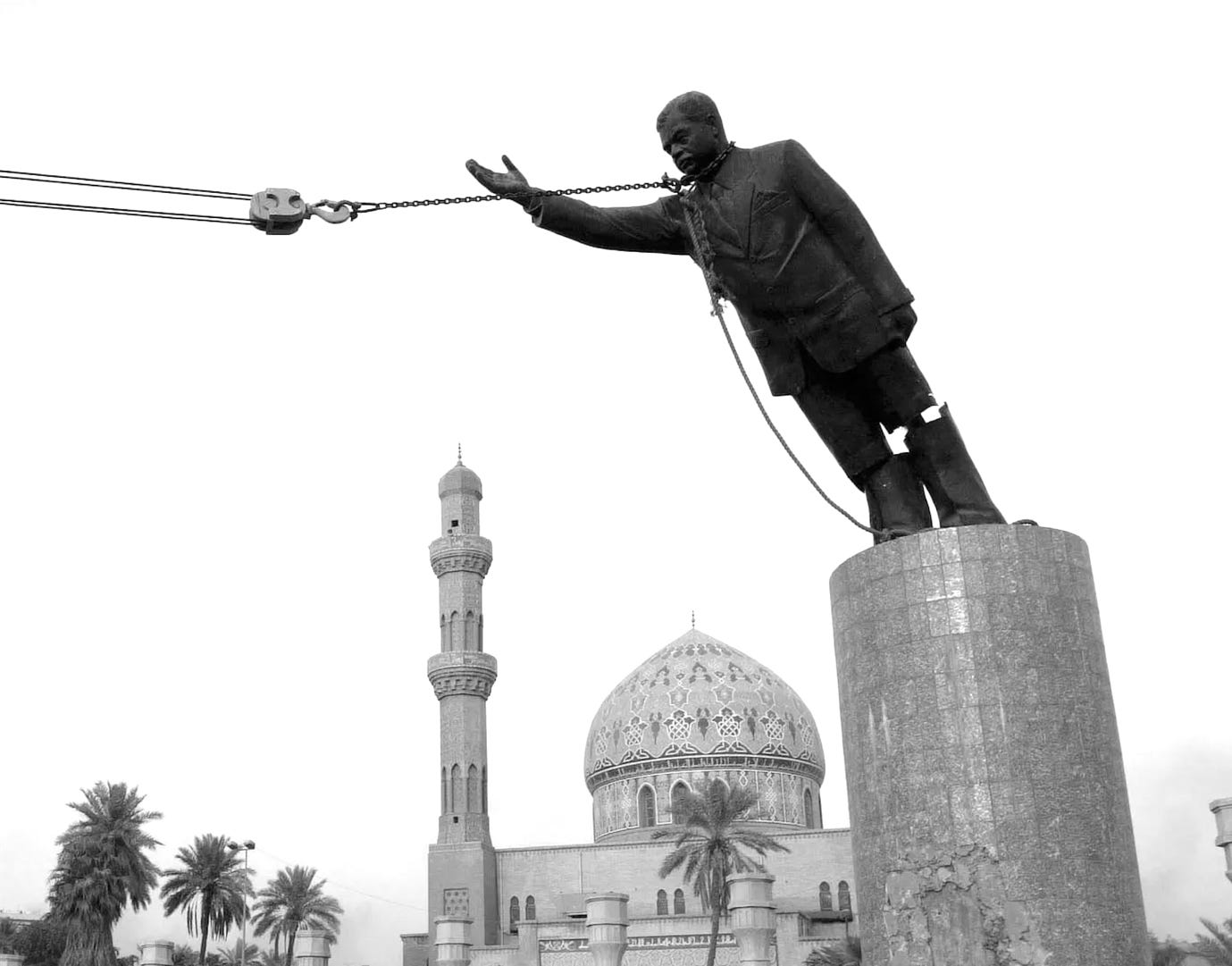
The statue of dictator Saddam Hussein is pulled down by US marines (2003)
Disclaimer: All views expressed are my own unless otherwise stated, and do not necessarily reflect the views of any institution I have been employed by. The content here is for information and should not be interpreted as advice.
1. Schyns, B., Lagowski, U. & Braun, S. (2022). Me, me, me: Narcissism and motivation to lead. Zeitschrift fur Psychologie, 230 (4) 330-334.
2. Paris, J. (1985) Boundary and Intimacy. The Journal of the American Journal of Psychoanalysis, 13(4). 505-10.
3. Noshpitz, J.D. (1984). Narcissism and Aggression. American Journal of Psychotherapy 38(1)
4. Cowan-Jenssen, S. & Goodison, L. (2009). Narcissism: Fragile bodies in a fragile world. Psychotherapy and Politics.
5. Khorram-Manesh A and Burkle FM Jr. Narcissistic sociopathy in global autocratic leaders: Arrested development, obsessive demand for power, and the emergence of unlawful hybrid wars. Disaster Med Public Health Prep. 17(e263), 1–5.
6. Harden, J. (2023). Looking like a winner: Leader Narcissism and War duration. Journal of Conflict Resolution. 67(5). 783-808.
7. Arendt, H. (2017). The Origins of Totalitarianism. Penguin.
Comments
Nothing yet. Say the first thing.
Sign in to join the conversation.