
Warning: This article contains references to trauma and violence.
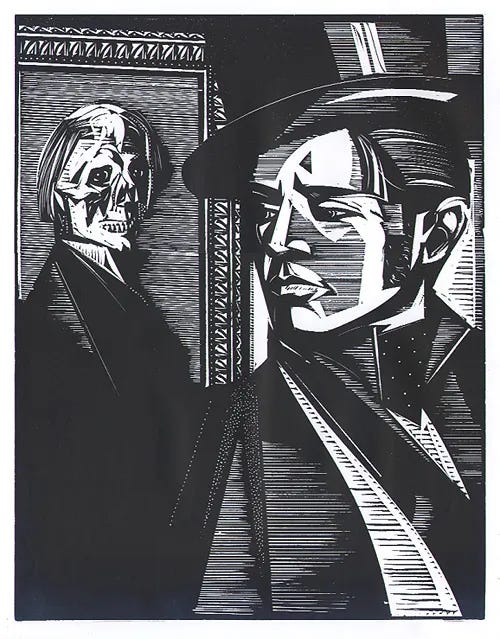
We most often read about dissociation in victims. It is sometimes experienced as a feature of PTSD. Dissociation is a loss of awareness, but there are different kinds and different levels of dissociation. In the treatment of personality disorders, we sometimes find that clients lose their connection to time or place or even who they are. But most often, we find a disconnection to emotion – to what their emotional mind and the emotional body are telling them in that moment. These difficulties can get in the way of relationships, emotional regulation and even physical health. But this article is not about the health impacts of dissociation. It is about how the narcissistic perpetrator makes use of their own dissociation in order to carry on doing what they are doing. In order to move from the one-off act to the compulsive and prolific. My case study is a famous man. But he is fictional. His name is Dorian Gray and he lives in Victorian London.
Spoiler alert: If you want to experience this novel as a whole with all its plot turns and twists you might want to read The Picture of Dorian Gray1 by Oscar Wilde before coming back to this analysis of how it deals with dissociation and narcissism.
In London, Dorian Gray was known initially for one thing: extraordinary physical beauty, magnetism and an air of innocence. He came from money. But the author is keen to insert that this man is a survivor of childhood adversity. Gray lost both his parents early. As an adult Dorian has “hateful memories” of a Grandfather Lord Kelso. This carer “hated and desired to keep at a distance” this grieving grandson. When we join Gray at 18, he is only faintly narcissistic. He is bad at respecting other people’s time. He is an admired pianist. He enjoys the idealisation of a painter called Basil, for whom he models.
But the painter has a friend, Henry, who will quickly view Gray as a project – a man to shape and corrupt. Henry points towards unrestricted pleasure and emotional disconnection from others as a way to live. He strategically devalues some emotional experiences as “sterile” to disqualify them as evidence of how to live. Others are glorified as “exquisite”. The plot of the story of Dorian Gray centres around one portrait of Gray which, by some magic, allows Gray to live hedonistically without being affected physically. Instead, the picture over time betrays the effects on his soul of his mistreatment of others and himself.
Gray falls in love with a young actress, Sibyl. Their love appears innocent enough but is partly based on Gray idealising the woman night after night from a theatre seat. He wants to “place her on a pedestal of gold”. After realising that he wants to marry the talented actress, Dorian takes the risk of bringing his two upper class friends to see her perform in her dingy east end theatre. But the event is, for Gray, humiliating. Sibyl, having pretended to love on the stage, has found the real thing in Dorian. For the sake of authentic love, she sabotages her art without warning during Romeo and Juliet. Henry and Basil now think him a poor judge of her talent. Gray’s reaction is the first time we see him brutally using a narcissistic strategy. He deals with humiliation in himself, by finding a reversal, and backstage he humiliates Sibyl. His feelings for her may have been based on idealism, but they were feelings that he now buries deep in order to take refuge in power and judgment: “I loved you because you were marvellous, because you had genius and intellect … you are nothing to me now”. Through tears she begs him: “you are acting.” But yes, Gray has learned to dissociate from feelings. “With his beautiful eyes, [he] looked down at her, and his chiselled lips curled in exquisite distain”. Sibyl, his first victim, ends her life within hours.
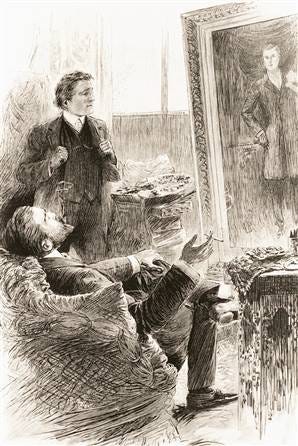
Gray and Henry view the portrait before it is hidden away
Gray now faces a choice. He can experience shame. He can regret the impact he had and can have. Or he can deny and dissociate from such feelings and learn to do this more reliably. But whilst he is wrestling with this choice, his counsellor is the devil-like Henry. Dorian notices that he has begun to change: “I must admit that this thing that has happened does not affect me as it should. It seems to me to be simply like a wonderful ending to a wonderful play … a tragedy in which I took a great part, but by which I have not been wounded.“ There is now some mental gymnastics happening. The death of this woman is not sad, or shameful, but ‘beautiful’. Henry observes: “suddenly we find that we are no longer actors but spectators in the play…We watch ourselves, and the mere wonder of the spectacle enthrals us.” Dissociation is not always experienced alone. Like an anti-therapist, Henry helps Gray to disconnect from himself – treating his emotions as unreality and the external world as an ever-providing source of distraction at any cost.
In Dorian Gray, the experience of emotional dissociation diverges from that of a non-narcissistic victim of trauma. It becomes for Gray a strategy for living. His need to perfect this strategy will become more important, the more shameful acts he commits. First, the portrait that starts to display the state of his soul must be hidden in the dusty school room of his big house. The hidden portrait, and not the physical emotional adult, will feel the shame. Apart from this supernatural spine of the story’s plot, the rest might be the modern territory of Jeffrey Epstein and his peers. At one point Gray will use compromising evidence to blackmail a man into covering up his crime. Almost everything is here, from the celebrity perpetrator playbook.
Yes, Gray may have learned as a child to dissociate. He is now biased towards making this adult choice perhaps because vulnerable feelings for him had already been traumatic. And yes, he is now coached. But these facts make him no less guilty. Because he knows what kindness and cruelty are. And because as an adult, he chooses his influencer. He makes a choice at a place in his mind where dissociation from feeling meets denial. What is the difference between these two? Denial too can be automatic and unconscious. Denial too can be a trip fuse switch in the mind. But unconscious denial is perhaps dissociation from facts. The two can work together.
Having made his choice, Gray begins a “search for sensations that would be at once delightful and possess that element of strangeness that is so essential to romance.” Romance? Perhaps. But this sounds like a dressing up of techniques to distract from vulnerable inner experience. He moves between music, art, and jewellery. “Everything he collected in his lovely house, were to be to him means of forgetfulness, modes by which he could escape…from the fear that seemed to him at times to be almost too great to be borne.” But when strangeness and delightfulness become the main criteria for choosing what to do, over-riding real-life consequences, then perpetrator behaviour can follow.
“It was rumoured that he consorted with thieves…and knew the mysteries of their trade…men would whisper to each other in corners or pass him with a sneer…as though they were determined to discover his secret … Some of those who had been most intimate with him appeared, after a time, to shun him…Women who had wildly adored him and for his sake had braved all social censure… were seen to grow pallid with shame and horror if [he] entered the room.”
What prevents Gray’s behaviour being exposed? His charismatic persona and intellectual performance, untouched by feeling, functions as evidence to the world against the rumours about his behaviour. “Even those who had heard the most evil things about him…could not believe anything to his dishonour when they saw him.” And the “whispered scandals only increased, in the eyes of many, his strange and dangerous charm.” In any case, “civilised society…is never ready to believe anything to the detriment of those who are both rich and fascinating.” This begins to sound a bit familiar. Like the splitting in modern society around a public figure who provokes opposing feelings.
Soon, “the very sharpness of the contrast [between his persona and his true self came to] quicken his sense of pleasure.” Ultimately, “there were moments when he looked on evil simply as a mode through which he could realise his conception of the beautiful.”
And so, when Dorian’s old friend Basil the painter comes to challenge Mr Gray about his behaviour with some harsh realities, the conversation is high risk for both. Like the forensic psychologist playing both judge and therapist, Basil presents a list of those who have been hurt. After all the acts and rumours of acts, he has one question: “you must give me some answer.” But Gray responds with contempt, and then, with the help of dissociation from feeling, he murders his friend. When moving to the door, “he did not even glance at the murdered man. He felt that the secret of the whole thing was not to realise the situation”.
The evening after murdering his friend, Gray is a dinner guest, “exquisitely dressed and wearing a buttonhole of Parma violets.” “His manner as he bent over his hostess’s hand was as easy and graceful as ever. Perhaps one never seems so much at ease as when one has to play a part…He himself could not help wondering at the calm of his demeanour, and for a moment felt keenly the terrible pleasure of a double life.”
For most who suffer with dissociation, it starts as the desperate mental refuge of a child. But some turn this injury into a strategy – whether for good or bad. The paramedic can switch off feeling under the flashing lights of the ambulance. Some, like Dorian Gray, pursue distraction, exploitation and abuse. In order to see behaviours finding their consequences, we need to take a broader view across time. In the last lines of this supernatural thriller, Gray is found in the locked school room in evening dress. He is “withered, wrinkled, and loathsome of visage” lying dead with a knife in his heart.
What would happen to a Dorian Gray today? He would be gracing the screens of our TVs and devices. He would mix with the other people who do the same. Consumers would be split between the idealising and the suspicious. What does this novel teach us about the wealthy or celebrity narcissistic perpetrator? It suggests that charisma and idealisation are far from being evidence that someone is not a high-risk individual. In fact, narcissism contains a kind of dissociation that is specifically hidden by charisma and charm. It suggests that those drawn to fame and idealisation need around them people who are specifically non-narcissistic like drivers need car insurance. It suggests that wealth should have no bearing on the extent to which a person is subject to the detailed and unfeeling attention of the law (or protocols or employment beaurocracy).
Somehow this book offers a unique portrait of the mind of the narcissistic perpetrator. And Oscar Wild captures so much of how we understand narcissism today: the childhood neglect and judgment, the cutting off from feeling, the use of intellectual performance and distraction from feeling, the denigration of others especially in moments of embarrassment or humiliation, and the charismatic persona. The book offers a plausible window into the mind of a public figure who descends from vulnerability to narcissism to perpetrator behaviour to compulsion and cover up. Wilde is well aware that his main character is narcissistic, making references to this term within the story. He mentions also in passing that Gray once posed for his artist friend, staring into a lake, posing as the Greek Narcissus. But this sophisticated description of narcissism contains in itself a mystery. The first edition was published in 1890. That was 15 years before Freud’s book On Narcissism. How then did this author know so much? Did Freud birth this concept of narcissism, or was it Wilde?
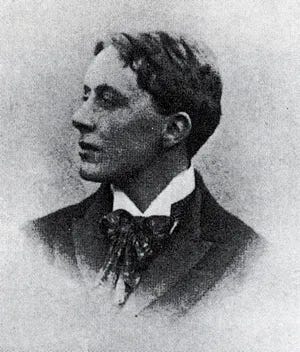
John Gray, a Victorian poet whose name was used by Wilde for the main character apparently as a compliment
Disclaimer: All views expressed are my own unless otherwise stated, and do not necessarily reflect the views of any institution I have been employed by. The content here is for information and should not be interpreted as advice.
Notes
1. Wilde, O. (2007). The Picture of Dorian Gray. Vintage Books
Comments
Nothing yet. Say the first thing.
Sign in to join the conversation.