
A scientist, a historian and a theologian… almost everyone I mentioned this do said,” walk into a bar!” It does sound like the first line of a joke, but Stanford Carpenter, the “provost” of Comicpalooza University asked me to moderate a panel of the three because of its complexity. He says I have a “flexible brain.” I’m still not sure what that means but there I was with yes, Scott Soloman, a scientist, Julian Chambliss, a historian, and Reverend Doctor Sakena Young-Scaggs, the theologian. They had been asked to talk about imagination.
A phrase often associated with imagination is “flight of fancy,” because our imaginations do lift us into flight, away from the weight of the here and now, to what could be, might be. The reason that colleges are so eager for prospective students to visit their campuses is because the data show that campus decisions are often based on whether a student can imagine themselves there We often associate imagination with children but we all do it all the time. We hide it under the word “to see.” Can I see myself in this house, at this job, with this person? If we can’t “see” it, we often do not do it.
That is a good thing too. One of my favorite things about imagination is that it engages many parts of the brain at once; it is considered a complex “whole brain” process driven by a network of interacting regions, depending on what one is imagining. It colors what we expect, what we hope, what we fear. How we plan for our families, our country, our cosmos.
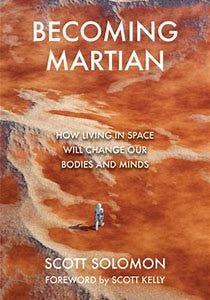
Our panel conversation was anchored by Scott Soloman’s new book, Becoming Martian: How Living in Space Will Change our Bodies and Minds.
At the start of session, I asked how many people in the audience of about 45 people wanted to go to Mars. About 20 people raised their hands. Most were smiling, excited at the prospect. At the end of the session, all but one had changed their minds.
Mars quickly became a metaphor for how we see ourselves in the universe, how we envision our futures.
The US has been future oriented country since the first Europeans came to North America. One trait that most of us have shared is optimism. It is how people of other countries have defined us. The future, for us, has always been brighter. We have traditionally valued progress. Progress is, well, progressive—it is perceived as unilinear, progressing in one direction and we have traditionally seen that as always good.
This is starting to change. Young adults now are not so optimistic, the first generation who expect their lives to be worse than those of their parents. In response to AI and huge power plants, we are seeing public push back. Progress, it seems, is not always good anymore.
NASA announced in 2018 that we are going to Mars. Since then, billionaires, competing with each, are developing private space exploration.
Adults do not imagine out of whole cloth; we use narratives we already know to explain where we are going. The most important narrative is that of the frontier. We are a frontier nation, ever pushing to the next thing, the next land. The story includes adventure, bravery, “discovery,” and danger. We grew up hearing that space was the final frontier. Science fiction has helped us to imagine it.
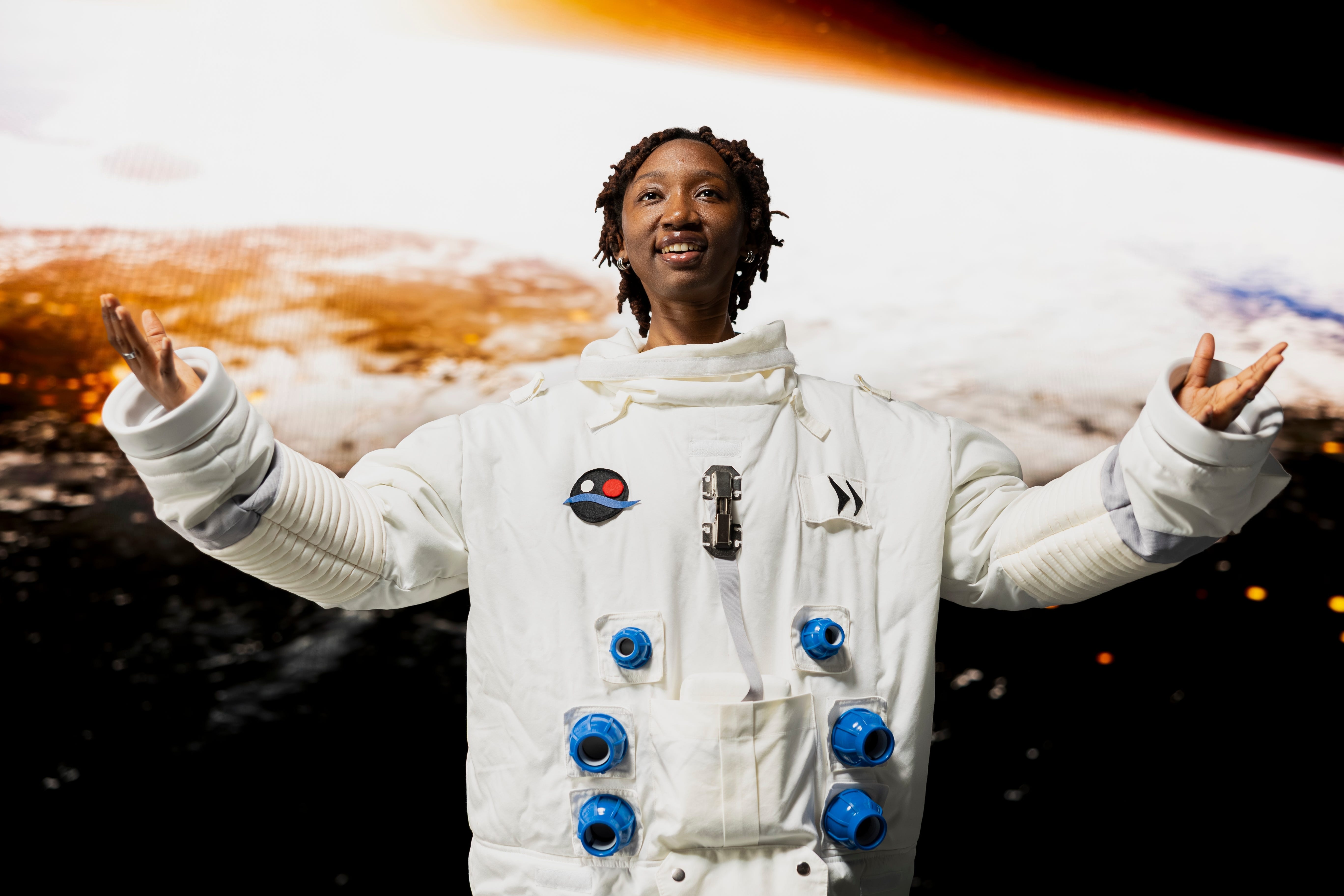
But going to Mars is full of problems. It has an extremely harsh climate and landscapes. The picture we are running with this article? That would never happen. She could not just be out in the open with like that, with no head or neck protection. She could not even be outside very long at all, not with the currently developed protections.
As for the planet, the historian kept reminding us of what has happened when humans arrive at new places—we have rarely been good guests, or considered ourselves guests at all, but arrive full of plans to dominate. Already there are plans to mine Mars’ rare metals and to harvest its ice to manufacture methane in addition to drinking water.
Another important and related narrative is that of Immigration. Those who leave to go to Mars may never see their families again, very much like the people who traveled to the US. This country, for better or worse, is a country dominated by immigrants. The idea of leaving home to begin anew is deeply woven into our public imagination.
But other scientific factors are troubling.
Many of us are “specist,” biased toward our own species. The term is more often used in the context of animal rights, but it works here. We assume that we are such a superior life form that people just like us will survive and inhabit the other planets, that we would not have to change in dramatic ways. Our present bodies cannot survive on the surface of Mars. So, some changes are expected to happen quickly, adjusting to living underground, with zero gravity. Even if they could come back, after endless periods of no gravity, reentry to earth’s gravity would be unimaginably painful. Women will have to have C-sections. Children born on Mars might not survive here.
Other changes would evolve over time. Martian immigrants would look and behave differently. They would have to. The historian reminded us that we humans like to arrange beings into hierarchies. Would we consider them human? Would they be better than us, a new superior group? Or would we consider them inferior and so we would try to subordinate or even enslave them.
Who Gets to Go to Space?
In one scenario, we would be leaving a ruined planet, the Earth that we are rapidly destroying.
This is when the entry of billionaires changes the scenario.
Who gets to go? Who gets left behind? The scientist noted that NASA’s flight crew have been increasingly diverse. Social class was not a deciding factor. The crew members worked hard for years to earn their seats. So far, the billionaires have a different roster. They, their wives and friends, celebrities have gotten to go. It seems almost like a joy ride. Gayle King’s fear seemed most appropriate—because yes, they could die. But if space travel becomes the new playground of the wealthy and famous, can ordinary children still dream of space?
Sex in Space
NASA and their counterparts in other countries have refused to investigate sex in space, fearing taxpayers’ ire at supporting it. The billionaires are showing no such inhibitions, and it is easy to imagine wealthy couples paying to be members of the higher than a mile high club. Still, it is a legitimate question: If we cannot reproduce in space, there is little chance of establishing a self-sustaining settlement. Or do we just keep sending people off into space? The ones we highly treasure or the ones we want to be rid of?
Heaven in Space
What does space travel mean for heaven? Where is it? If we go to Mars, does our conceptualization of heaven move or change? Rev. Young-Scaggs said that the Spirit is everywhere, even on Mars, so that space travel does not disrupt her sense of the afterlife. The audience became thoughtful. Pew Research reports that 70 to 76% of Americans believe in heaven so, statistically speaking, three quarters of the audience did. A group of them surrounded her after the session and the organizers had to nudge them away from the stage so that the next panel could start. They were asking about the fits with their specific beliefs. The Judeo-Christian scripture is very oriented toward Earth and earthlings. If we meet other beings, will we regard them as blessed beings whom God loves? Or, as the historian reminded us again, will we regard them the way Europeans first regarded other peoples they “discovered”, as outside of God grace and protection?
Some conservative Christians, some in the administration, have taken up the matter and pre-decided that aliens are demons. There was evidently some consideration that aliens were angels, but the received perception seems to have settled on demons. That would place anyone we find solidly outside of God’s grace and excuse any effort to eliminate them. Alien genocide, or exactly what Europeans did to Indigenous Americans.
As space travel accelerates, how and what we imagine predicts how we will perceive what and, potentially, whom we find. Imagination leads us to choose, to allow, but also to eliminate possibility.
Comments
Nothing yet. Say the first thing.
Sign in to join the conversation.