
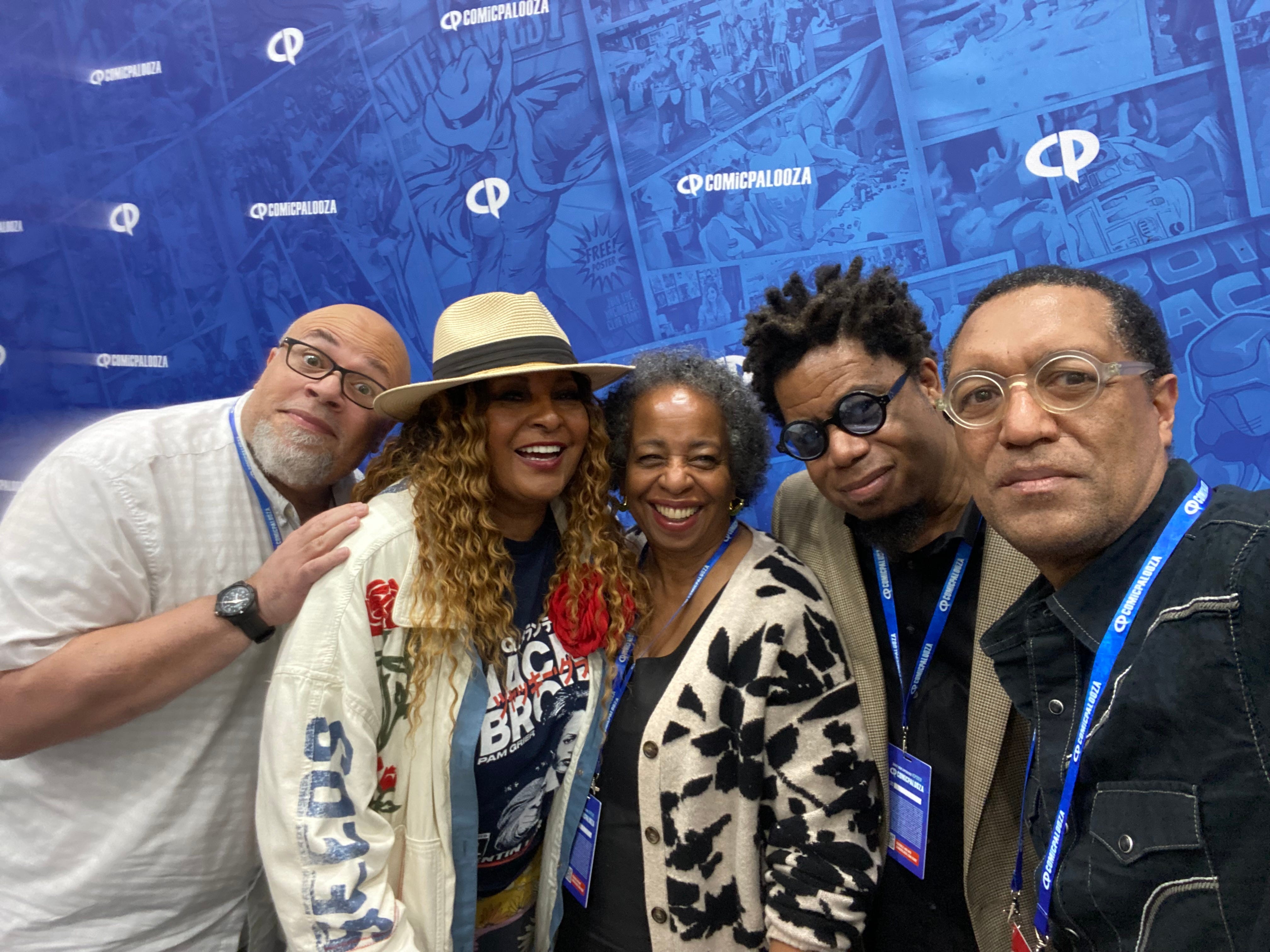
Left to right: David Walker, Pam Grier, Sheri Parks, David McGee, Stanford Carpenter
I was the moderator. Pam Grier was the Queen.
Recently, I moderated and participated in panels for the 2026 Comicpalooza in Houston. Comicpalooza University invites academics to take attendees on deeper dives of the popular culture images, icons and activities they love. One of the most highlighted figures of the conference was Pam Grier, the face of Blaxploitation films. I was to moderate the panel, Can You Dig It? Blaxploitation Now, Then and Forever!
The other panelists were cultural anthropologist and “Provost” of Comicpalooza University Stanford Carpenter, comic writer and historian David Walker, and fine art painter David McGee, whose Avenging Angels series was inspired by Pam Grier’s Blaxploitation characters.
We were not a panel of strangers.
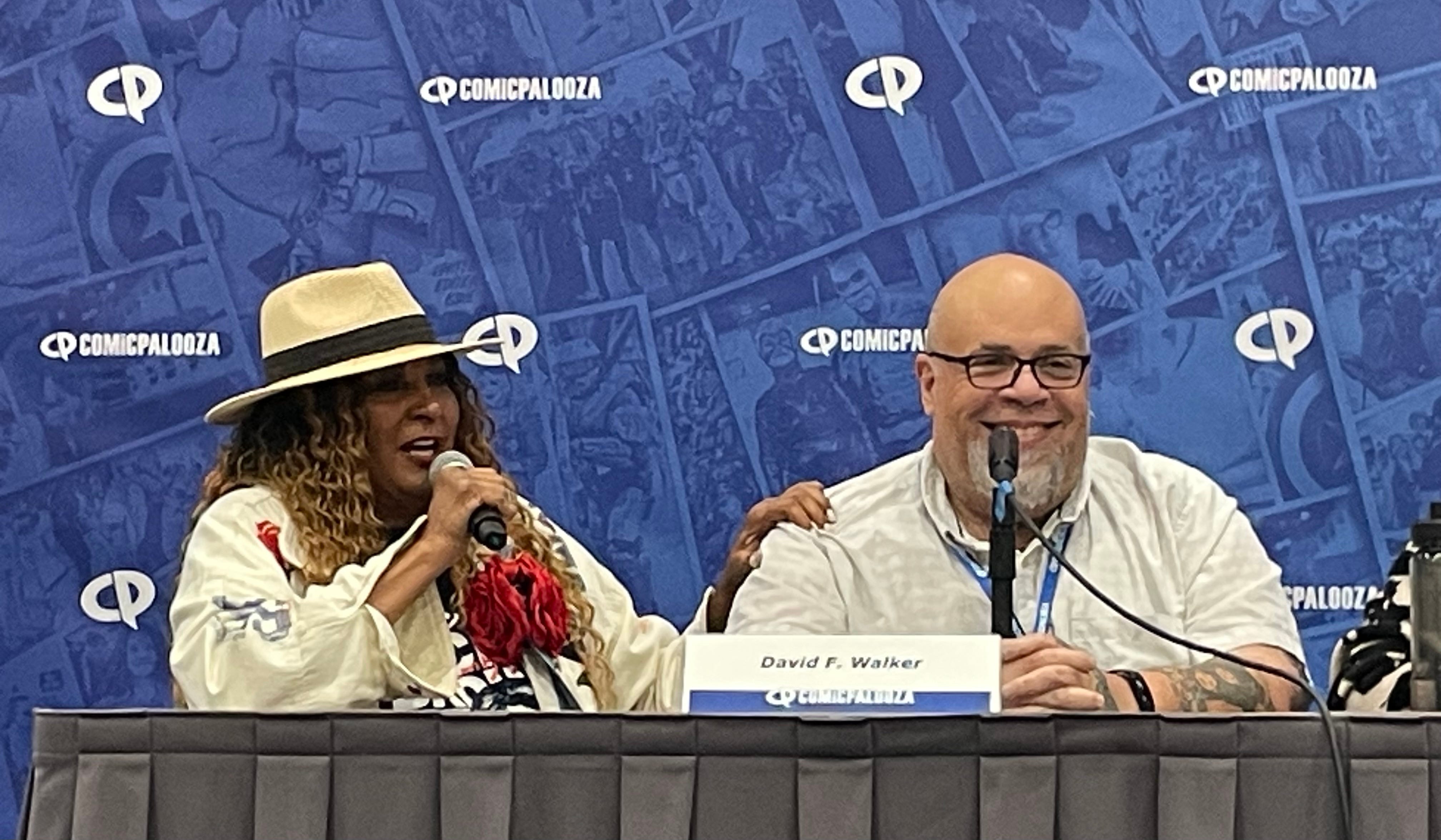
David Walker and Pam Grier knew each other, and he had interviewed her before. Stanford, David Walker and David McGee, all knew each other and Stanford had interviewed David McGee for the opening of a related exhibit. I have known Stanford for years. The first appearance of my Fierce Angel figure grew out of collaboration with him.
David Walker is a comic writer, whose titles include reinterpretations of Shaft, the iconic male figure of the Blaxploitation period.
Walker is also a popular culture historian. His new book is Black Film: A History of Black Representation in the Movies. In his chapter “How Black People Saved Hollywood” Walker describes how the film industry was in free fall in the wake of television’s rise to market saturation. After they saw that Black people would still go to movie houses to view films together, the studios quickly started producing more. It is thought that Blaxploitation saved MGM.
Walker explains that “exploitation” was a term already in use in the film industry, meaning any film that targeted a specific demographic rather than the general audience. So “Black Exploitation” was at first not an unusual use of the word. It was, however, the first to seep into general usage and to become the portmanteau that we use today. Grier said that the term did not come into general usage until the appearance of female leads. Both agree that the term was applied by the studios rather than the Black actors and directors.
The morning of the panel, Pam Grier was signing photos on the other side of the arena. Stanford suggested that I go over and meet her. There was a line of fans, so I stood by until I could get the attention of the assistant. He brought me over and introduced me as the moderator later that afternoon. She looked me up and down and said, “A moderator. Good luck with that.” I stepped closer and told her I had grown up next door to her aunt, Mrs. Ailene Withers. She took my hand and we chatted. We were then just two Black women. I glanced at the line and realized that they were delighted to wait and watch us since it meant that they got to linger in her presence. Many made plans to come to the panel.
As a moderator, my job is to make room so that each panelist gets to speak. At the panel, Pam took the mic before the standing room only audience settled. She engaged the audience and we began officially with me introducing and inviting Stanford, David McGee and David Walker to talk about how Pam Grier and Blaxploitation had affected their lives and their work. She had already signaled that she would not be handled and I respected that. She respected me back, repeatedly seizing the conversation but then looking at me and throwing it back, saying, “back to you.” I described it later as if we were a tag team.
She loves to get a rise out of people. We had seen two articles from just the week before in which she talked about having three-day orgasms, so we had expected a raucous ride. She didn’t bring it up with me, although she did the next day on another stage. She did test me, saying that people of all genders and sexualities found her image sexually appealing. She looked over at me to check my reaction, as if to say, “Did I get you?” I chuckled and we were cool. I circled back periodically to make sure the others could speak as they wished. Afterwards, she held my hand again, as she spoke with fans. Two Black women, cool with each other.
Freedom
Pam Grier’s characters were free. They did what they wanted, with or to whom they wanted, at a time when Black people had to be very careful. (Still do.)
David Walker observed the contemplative aspect of Grier’s violence. She stops and thinks, considers the person, the situation. Of course, she still shoots them anyway, but it is a considered choice. In many scenarios with female characters, such consideration would lead to relenting. Pam Grier’s characters did not relent.
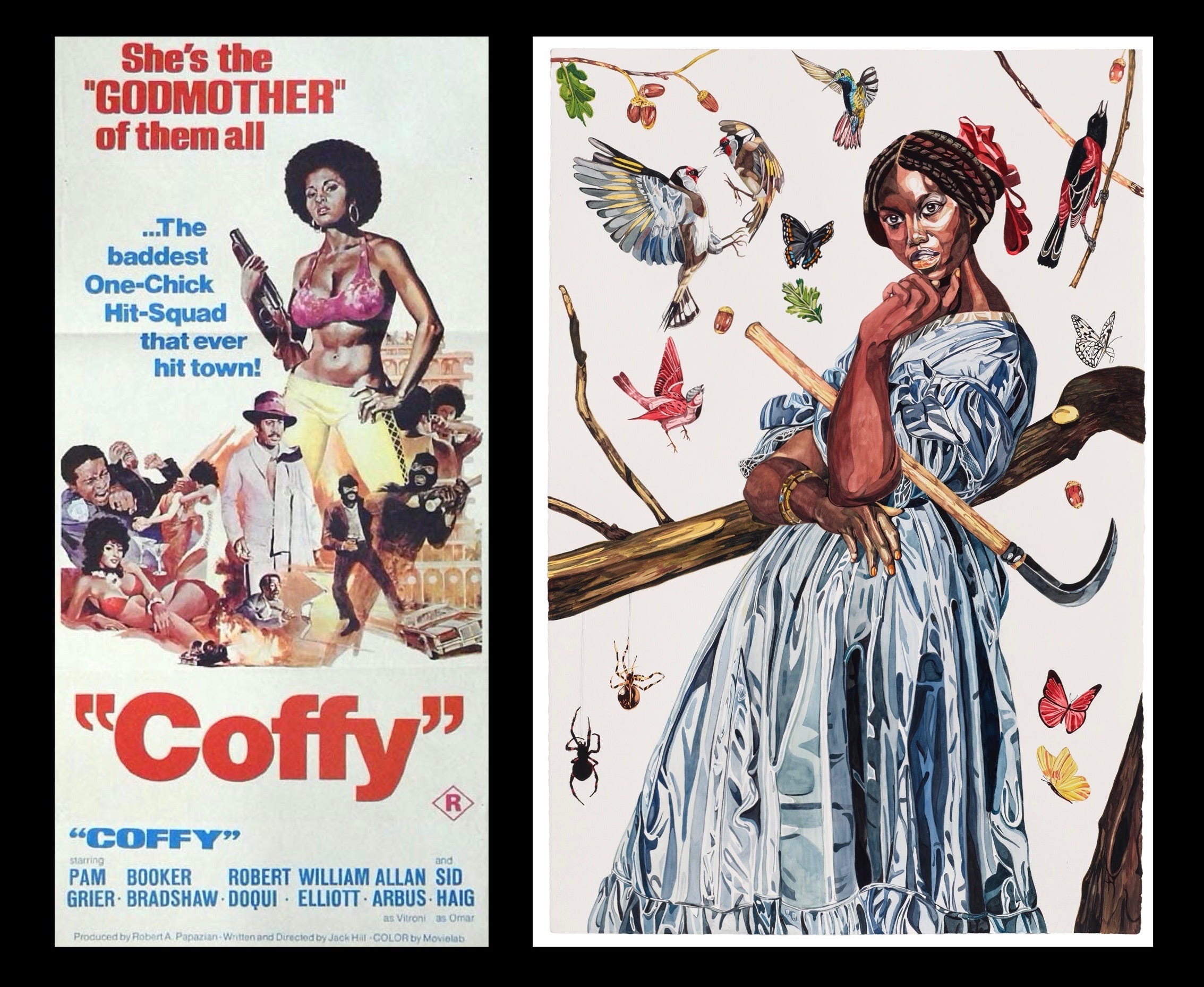
Left, movie poster of Pam Grier as Coffy. Right, David McGee’s The Nutcracker. Compilation by Stanford Carpenter
Artist David McGee has painted a series of Black Women who are gorgeously dressed, often in period costume, who might look harmless except for the expressions on their faces and the weapons in their hands. Pam Grier was his muse. His Avenging Angels are shown in that moment just before; as they are contemplating violence, unworried about the aftermath. Obliviousness to consequences is a type of freedom. Taken to extreme, freedom can be construed as madness, operating outside of ordinary social strictures. About his painting The Nutcracker, McGee said in an interview, “In the facial expression of the woman, I did want to show madness. She is looking off in space, like she is a little ‘off. ‘She is on the verge of doing something, but you don’t know what she’s going to do. She can no longer be wounded by anybody’s actions. She’s made her mind up. But in order to get to this place, you have to be mad, and she shows it. No matter what happens around her, the subject is in the cosmetics of her face.” (emphasis his)
Stanford Carpenter explained the historical importance, that Grier is the foremother of all of the White action-adventure female heroes. The character Ellen Ripley played by Sigourney Weaver in the Aliens movies (1979-1997), was considered groundbreaking, presenting a strong action female hero. But it was ground that Pam Grier had already broken almost a decade before. Ripley was also praised for being non-sexual. Pam Grier was very sexual, but she carried her own sexual agency, even more groundbreaking for the time. Her characters were aware of the male gaze, but it did not define her.
Taking control of the stereotype: The violent gangster, the “hypersexualized” woman and man were racist stereotypes, who became proud, openly acting out through Blaxploitation. It is a recognized strategy to take your opponent’s negative idea of you, invert it and ratchet it up to the point of absurdity, ramming it in their faces, taking control. Was Blaxploitation absurd? In a way, yes. Like all stereotypes, there was a germ of truth. There and are Black gangsters, closer to the lives of everyday people than it appears to the outside. Black women do often carry a sensuality that is different. But we know that during the same time period, American law enforcement was declaring war on Black people and had successes in campaigns determined to subdue them.
Black Power
Records acquired by the University of California, Berkeley in 2021 show, during the same period, Black people who spoke of Black Power were seen as so dangerous that they represented the greatest threat to American security. Virgie Hoban writes that FBI Director J. Edgar Hoover sensed that the “status quo was beginning to crack” and that he blamed Black “extremists.” Hoover said in The Washington Post in July 16, 1969 (A3), “The Black Panthers, without question, represents the greatest threat to the internal security of the country.” He was using his belief to justify the FBI’s “no holds barred” COINTELPRO covert and illegal campaign, the same tools used against Soviet agents at the height of the Cold War, to try to “discredit, disrupt and destroy” the Black Panthers, Malcom X, Elijah Muhammad and Martin Luther King.
Was showing images of intelligent and violent Black people revolutionary?
It is important to see the films clearly amidst the cultural landscape of the time.
Pam Grier was depicted in films as shooting her way to vigilante justice by ending the lives of an ongoing line of bad and racist White people, wiping out entire criminal organizations of them. Only in the movie theatres could Black people act in such freedom with impunity, showing how art provides a safe space to rehearse otherwise dangerous ideas.
Let’s put this context. Black people were still being lynched for doing much less or nothing at all. The last documented lynching was in 1981 in Alabama.
They were in dangerous times, and they were portraying dangerous images. Showing intelligent Black people in films was still very new and not particularly popular with general audiences. Showing them using their intelligence in ways outside of polite society, as opposed to board rooms, made them safer to produce but potentially more dangerous in the eyes of both Black and White people.
Blaxploitation arrived on the heels of the Black Power political and academic movement and the two were intertwined in the lived reality of Black families where Blaxploitation and Black Power lived side by side in homes. Stanford’s politically active parents took him as a child to his first Pam Grier movie. Within the larger Black culture Blaxploitation sat at the nexus of Black Respectability Politics and Black Power, forces that are still at odds today. Walker describes the efforts of the Hollywood NAAP to stop Blaxploitation productions.
Lust and admiration and fear
“She’s the ‘GODMOTHER of them all…The baddest One-Chick Hit-Squad that ever hit town!”
No one had ever seen movies like them before. They were foundational, culturally and personally, for each of us. All three Black men of the panel saw Pam Grier as a singular figure in their creative imaginations. Everything about her was supercharged. She was sexy and violent. Her explosive energy combined with controlled intelligence and contemplation was a deeply intriguing mix.
We had shared stories of our first encounters with what would come to be called Blaxploitation. The three men spoke of that which David McGee called a combination of “lust, admiration and fear.”
Me? I was terrified. I and the boy I was sitting next to in the movie theatre were 13 years old. It was my first date, the kind when your parents drove you to the theatre and picked you up afterward. He was my first—to hold my hand, to kiss me, although I was clearly not his first. He picked the movie. It was violent, yes, but also so sexually explicit, the women so full of sexual power, that I spent half the movie watching him watch the movie with rapt attention. I was trying to figure out what it all meant, why he had brought me here. What did he expect of me? Studies suggest that early media experiences set up young men’s sexual expectations. But I was a good girl. My budding sexuality was heavily surveilled and policed by my family, their neighbors and friends. I could not even imagine being like her. The relationship only lasted a few weeks longer, after a White girl got down on her knees and did another thing for him that I had never heard of. (No need to pity young me. I broke up with him, and some solace came when his father told him that he had just made the biggest mistake of his life, that he would never come across another woman such as me, but again positioning me as the good girl, future wife.)
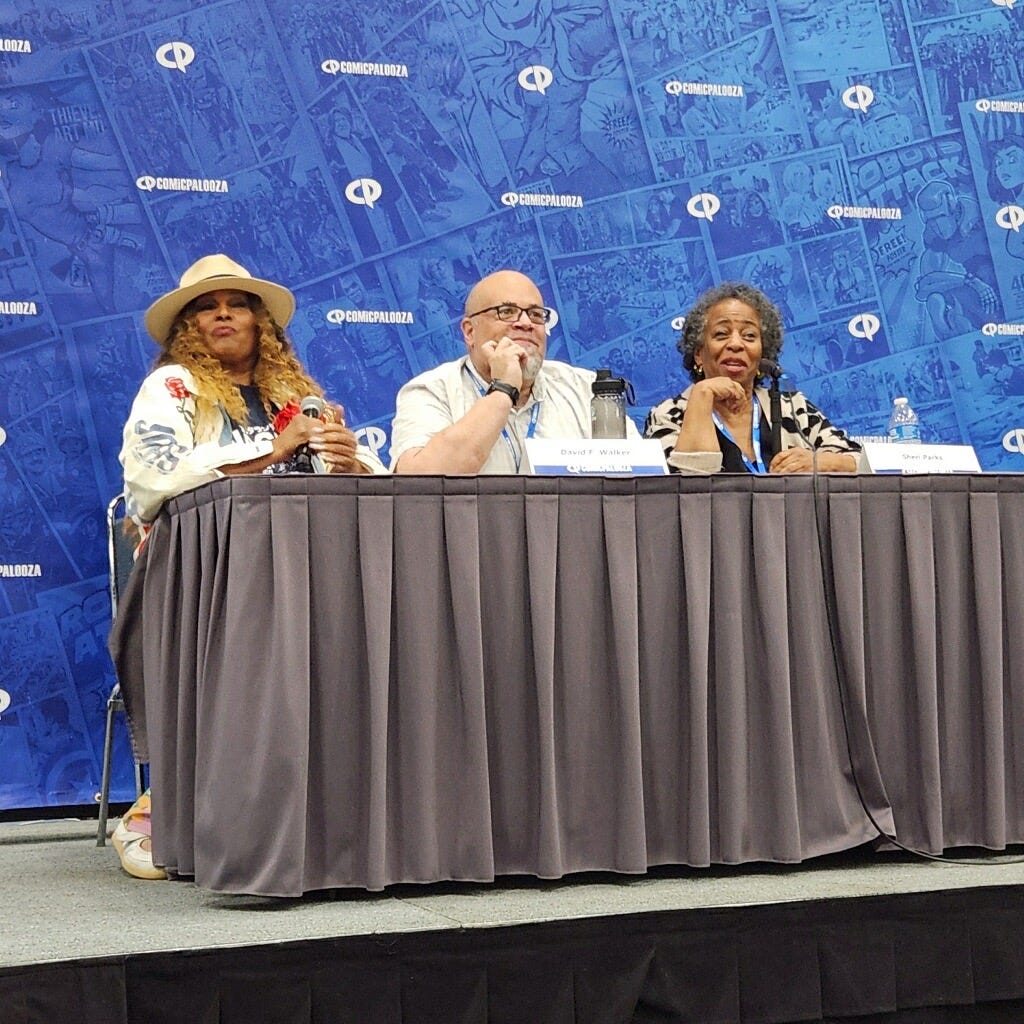
Grier said that she had wanted to “normalize female sexual intelligence and power.” She asked, “What was real freedom?” She had no role models, no templates. She said that the women of her family were “conservative, Catholic, African American hypocrites, hated gays.” So, she said, “I had to figure it out myself. I wasn’t planning on it. I said, ‘Just be yourself and see how it plays out.’”
Blaxploitation Now and Forever!
In his Avenging Angels painting series, David McGee takes the attributes of the Pam Grier character to new figures and circumstances. McGee’s paintings are directly or indirectly inspired by Pam Grier and her ability to rip through social conventions to her own power, intelligence and sensuality.
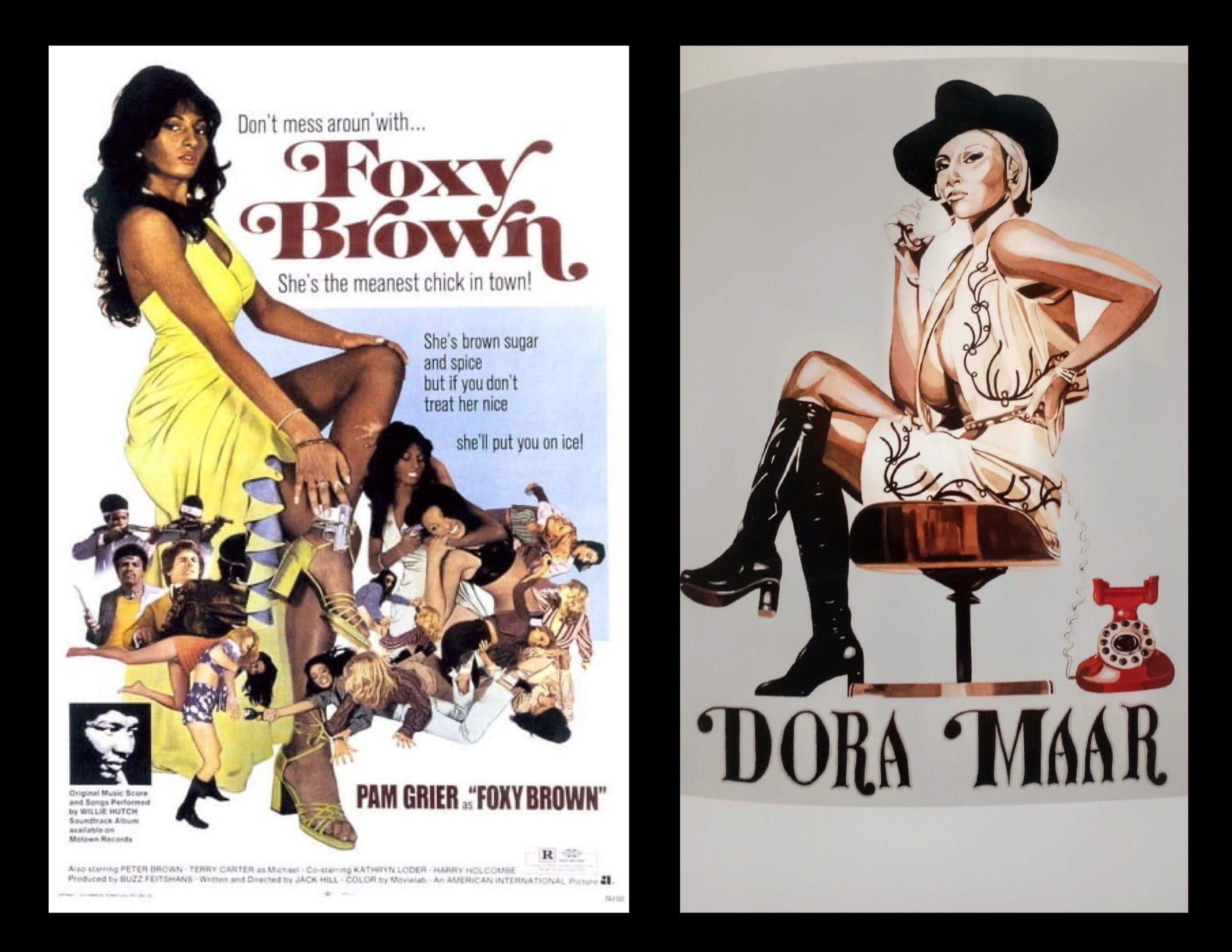
Left, movie poster of Pam Grier as Foxy Brown. Right, David McGee’s Dora Marr. Compilation by Stanford Carpenter
Dora Maar was an artist of the Surrealist period in her own right, but she is best known as the long-suffering muse and lover of Pablo Picasso. Although she was considered his intellectual equal, he treated her cruelly. She was the model for his Weeping Woman painting. When he left her for a younger woman, she suffered a mental collapse and retreated from public life. McGee frees her by association in his painting of a woman who looks and poses like Pam Grier in the iconic Foxy Brown role but is labeled as Dora Maar.
Blaxploitation was not a discrete period of time, as the reinterpretations of David Walker and David McGee show. Do you get to the vast cultural and financial phenomenon ($30 Billion a year globally) hip-hop without Blaxploitation? Rappers often refer to them in their lyrics. Hip-hop journalist Aaron Williams wrote that although Blaxploitation movies were released before he was born, “the aesthetics, characters, references, and tropes are so recognizable because I indirectly grew up on them through hip-hop.”
Blaxploitation burst onto the public imagination at a turning point in US history, when bold Black action characters could be publicly imagined as violent, intelligent, openly sexual, and most importantly, as triumphant. Hundreds of film were produced, even as federal and local law enforcement was brutally putting down much more subdued action in the streets. In doing so, Blaxploitation challenged both White supremacy and Black Respectability Politics and kicked open the door for a new style of Black agency and creativity.

Comments
Nothing yet. Say the first thing.
Sign in to join the conversation.