
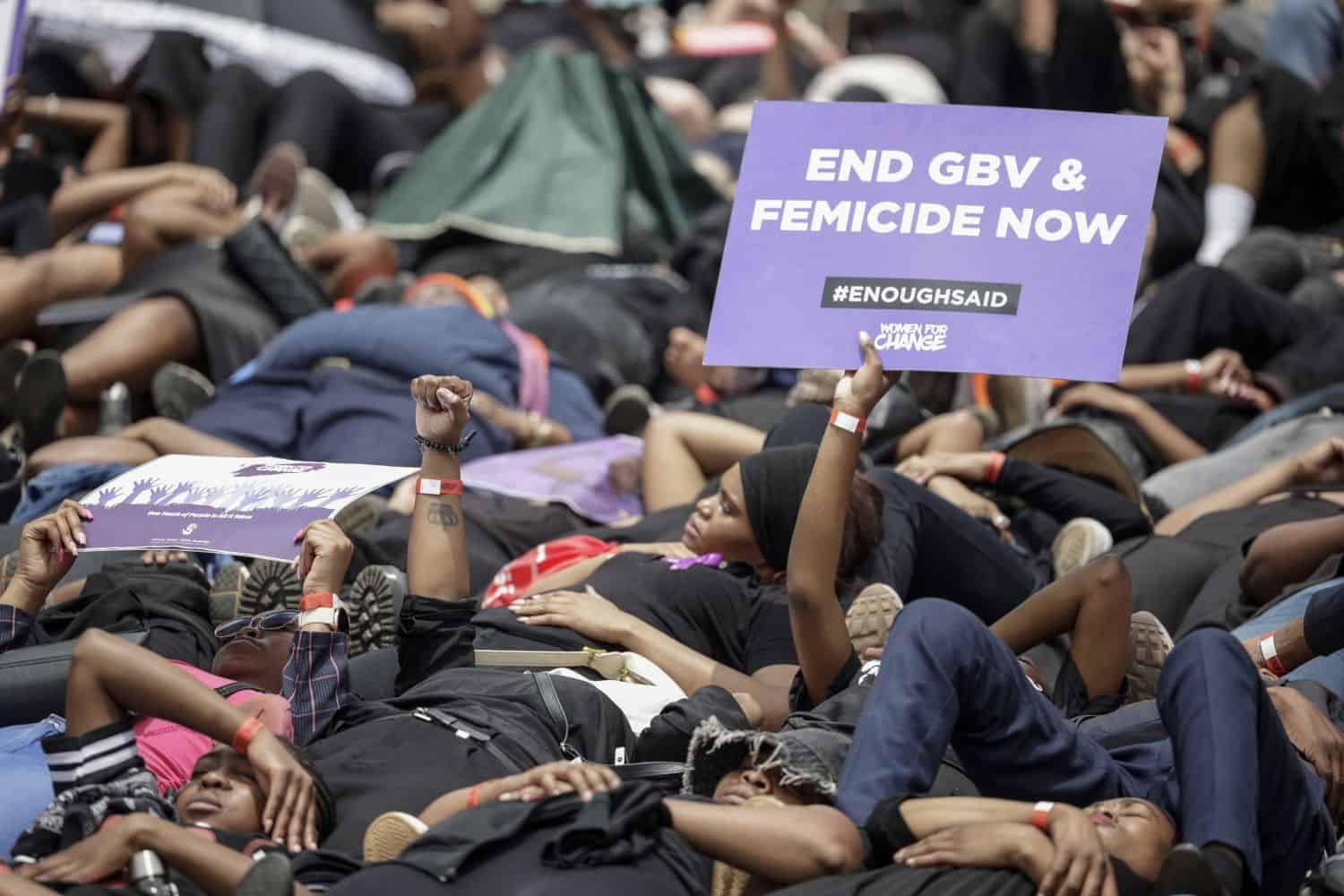
#TotalShutDown, November 21, 2025: South African women protest Gender Based Violence (GBV) by laying in the street in memory of women and girls who have been killed
South Africa is witness to some of the world’s highest levels of gender-based violence. Femicide, the killing of women and girls, is an officially declared national disaster.
South Africa already has stronger specific laws protecting women against violence than the US.
South Africa already has stronger women’s rights and freedom of expression laws than the US*.
None of them have stopped women from being killed, injured or silenced in extremely high numbers. None of them have made it easier to act or speak out at the local level.
Despite a national legal framework, violence is deeply ingrained within gender norms, power dynamics and an acceptance of male violence and dominance. The yearly levels of femicide are five times the recorded global averages, among the highest in the world. An estimated 15 women a day are killed in gender-based violence. Over their lifetimes, the percentage of women who have experienced sexual or gender-based violence is 35.8%, according to the first national gender-based violence study, co-supported by UN Women. (The violence is so common that it is often represented by the acronym, GBV.)
As many of us in the US despair over the stripping away of US legal supports for women and minorities, South Africa gives us a lesson about the limitations of lasting social change via the law. How South African women are simultaneously pushing for stronger legislation while also quietly moving in ways to protect and organize themselves serves as a model.
Of Marches and Laws
Marches have been effective at the national level. South African women have been marching for decades. Some would count back to the Apartheid era Women’s March in 1956 but, just as in the US, Black women publicly focused on race issues first, coming to call out intra-racial gender problems more recently, within the last decade, with massive rallies since 2018, when more than 40,000 women, girls and gender non-conforming people in cities across the country held the first #TotalShutdown.
The wheels of government have ground slowly. In 2020, the country launched a National Strategic Plan. In May 2024, the South African president signed a bill to establish the National Council of Gender-based Violence and Femicide.
On November 21, 2025, South African women converged on the G20 Summit and brought their country to a standstill with massive protests. The message: Declare gender-based violence and femicide a national disaster. They chanted: “Senzeni na?” (“What have we done to deserve this?”) and” “Zizaw’ujik ‘izinto” (“Things will turn around, “lyrics from a well-known gospel song.). They lay on the ground in silence, in memory of the murdered women and girls.
Educational institutions observed 15 minutes of silence, some retailers paused operations and the actions caught international attention. More than one million signatures were gathered.
South African President Cyril Ramaphosa has just appointed members of the National Council of Gender Based Violence and Femicide (on July 31, 2026) “to leverage the classification of gender-based violence and femicide as a national disaster to challenge harmful attitudes and practices, advance women’s economic empowerment, strengthen law enforcement and scale up survivor centered support.”
“Femicide” is not a term that we use much in the US, obscuring that the killing of women, usually by their male familiars—partners, ex-partners and relatives—is a particular type of crime, grounded in systemic beliefs and patterns about women and their “place” in a society. Femicide is its very own specific species of betrayal, when an intimate says in one breath that he loves you and wants to see you dead by his own hands.
According to UNWomen, “It will take a significant change in how society views and values the lives of women.” Laws are, of course, very important. At their best, laws are crystallizations of the values of a society. They are not only designed to guide behavior and punish violations but also to announce and stabilize norms, set up expectations so society moves smoothly. Violations should be aberrations of expected behaviors, that are suppressed and corrected.
The practice of gender-based violence is buttressed by strong attitudes and historical practices. Seventy percent of South African society believes that women should “obey” their husbands. Fifteen percent believe a husband has the right to “punish” a wife. Law enforcement is inconsistent at best; discovery and enforcement systems are not in place. In 44% of cases a perpetrator is not even identified. A culture of silence prevails
The best results of social change come from a mix of national legislation and local action. But what about when laws fail? What if they are out of sync with societal attitudes? Or, as in the case of the US, a powerful unrepresentative group dismantles them? Even with regime change, it will take years to undo the US damage. South African women show us strategies for when the laws fail and what we can control in the meantime. South African women remind us of the strategies used before the laws, before the rallies and speeches in the US. Many of the US Civil Rights activists who sat around those early private dinner tables for secret conversations are gone now.
The Role of Analysis in Social Change
Analysis is the first step of opposition.
As I have written before here on Substack, as important as large rallies are for attracting attention and galvanizing advocacy, they can only move social change so far. The process requires next steps. It is essential that South African women and their allies name and analyze the beliefs and behavior systems that are killing them. That is why feminist scholarship is so important in the human systems analyses that they are conducting. It uncovers and identifies what has been hidden, reclaims what has been lost—and finds the opportunities.
Systems have nodes or pivotal points, at the nexuses of converging patterns. If you find and push one, you can create ripples that reverberate throughout the whole system.
That is why advocates are pushing for economic empowerment, so women can leave and still provide for themselves and their children, who also suffer from witnessing violence. It also puts both women and men on notice that women have choices. The power dynamic shifts. Marriage in the US was fundamentally changed after women gained more economic freedoms. Are there other system opportunities?
Yes. One of the differences between Black and White feminism is a concern for men. South Africa has a 32% overall and a 40% Black unemployment rate. While it may not immediately change attitudes, men who are employed are much less domestically violent.
Black Feminism in Action
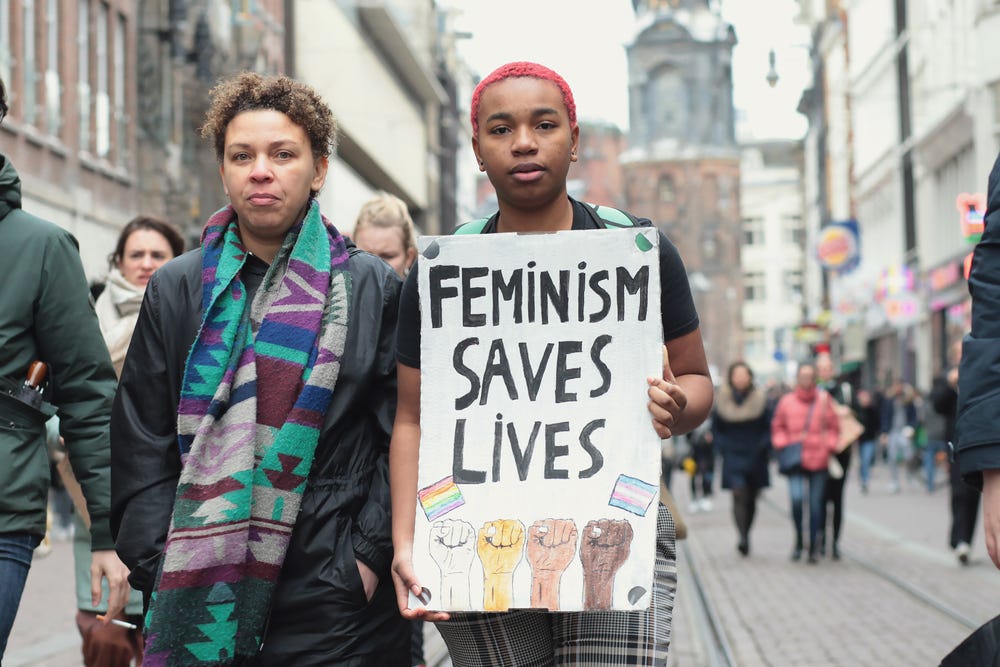
As founder Elizabeth Glenn and the members of USAfrica Collaborative planned the 2026 Pan African City Symposium and Exposition (PACSE) at Nelson Mandela University, our South African partners immediately said that physical safety of women had to be of paramount concern, both as a topic and as a logistical worry for the conference.
In the US, when you send out a call for presentations or papers, you blast it out everywhere you can think of to assure a good return. The South African women warned us to be more discreet. Silencing women’s voices is a prevalent oppressive tool. In addition to family or local control, it is common for employers to warn women about speaking out. Women report that their employers pressure them to not attend anti-gender violence meetings and protests. During the national protests, women reported that their supervisors at work advised them not to participate. Even academics must often work on gender issues under the radar. Women who have spoken up anyway have experienced backlash from employers, in direct contradiction of the national laws. (I would love to recognize our participants by name for their brilliance and their bravery but to do so could create unwanted exposure and blowback.)
Most of the women who were attracted to the conference had been working in isolation, only sometimes aware of others; they were happy to find and meet them. We created a temporary, liminal space, between alone and wholly public. In our age of social media, it is easy to forget the necessity of physical space. As I chaired sessions, engineers, architects, and academics were speaking of work that they could not present anywhere else. After we realized what it meant to them, that nobody had encouraged them before, that we emboldened them, we nodded and smiled a lot more during the presentations. It mattered to them.
They demonstrated the lasting power and permanence of books, especially well researched and deeply considered books. Many of them had been reading in secret. They had found them, respected them, as the books had given voice to their quieted thoughts. Their papers and presentations were poignant. They were risking their reputations and their physical safety. They were practiced at working under the radar.
The South African women’s responses to each other, to us, to the space. were visceral. I have chaired a lot of sessions. This was the first time that participants asked if they could hug me. Several hugs turned into longer embraces as women trembled or cried in my arms. Private, even secret thoughts and feelings were being loosed.
When they realized that I was a Black US feminist, that I knew the people they were quoting, that I was a friend of the late bell hooks, that I knew Kimberlé Crenshaw, the responses were emotional. One quoted me before she realized I was sitting there. Patrick Gzanka, when a woman quoted you and your interviews of the mothers of intersectionality for your edited book, Intersectionality: Foundations and Frontiers, I told her I had worked closely with you before, that I knew the women you interviewed. I told her that I would tell you about her. Your work was so important to her that she began to shake. (Only later did I tell her I was in your book too.)
That is not to say that they borrowed US Black Feminism, or Womanism, whole. They took it and fitted it to their location. I saw a binary essentialism—that women do what women do, and men do what men do—that would make most Western feminists uncomfortable. Theirs is a muscular femininity. One woman argued that women should use their natural position and strength in the family to foster change
Emotion—both in the work and the way they carried themselves—played a much more prominent role than in the West. An engineer and graduate student reported on her quiet interview study on women’s emotions and the engineering workplace. Many interviews were conducted in secret. She included her own experiences. A supportive-meaning man in the audience began to advise her to hide her feelings, that she could not cry and be an engineer. She rejected his advice and said that she would not hide her tears, that her tears were important information. As a supervisor, her tears had consequences and the men had learned that her tears were a sign of coming changes and that she could cry and be hard too. Her job, she said, required her to “train” them to see her as a whole person. There was a pragmatism to our work. When an undergraduate engineering student voiced her fears, the discussion immediately shifted to comfort and to advise her
The point of PACSE is to make a difference. We did. We helped to make a lasting community. The women have kept in touch with each other and with us, already excitedly planning for next year, which will be in South Africa again. Now that we have gone semi-public, will we have to move a little differently? Maybe, but now even more major institutions and organizations are also stepping up beside us so I believe we will be just fine.
*First introduced in 1923, the beleaguered US Equal Rights Amendment is still in play. It was passed by both houses of Congress in 1972 and sent to the states for ratification. The final three states ratified it by 2020, years after the 1982 deadline. Several states have tried to rescind their earlier ratifications, so the amendment is now hung up in the courts. The new global gender-based violence initiatives are being driven by the big global South countries: Brazil, India and South Africa.
Comments
Nothing yet. Say the first thing.
Sign in to join the conversation.