
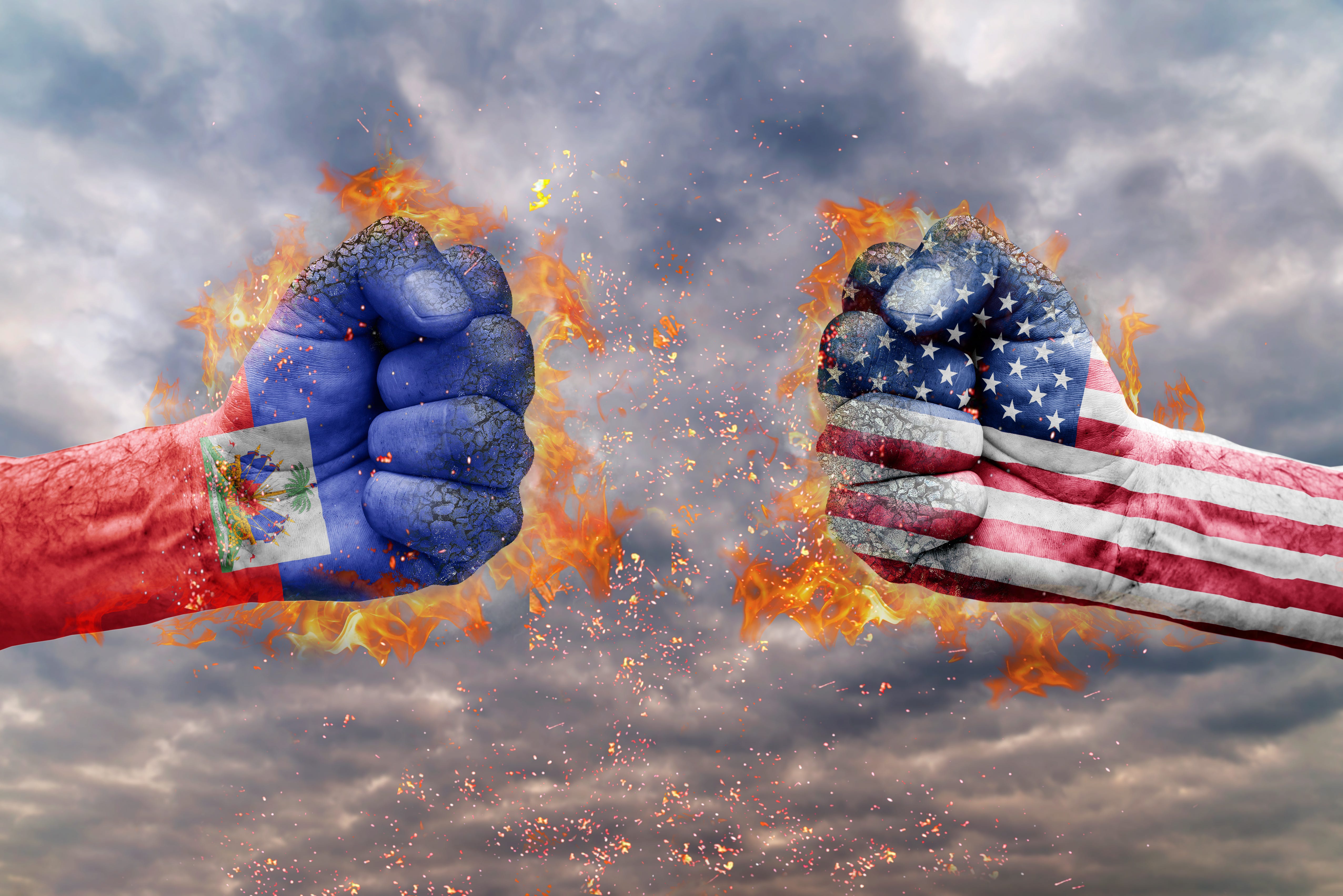
Recently, 350,000 Haitians who had been living and working in the US have been stripped of their temporary legal status and are now subject to detention and deportation, just weeks after the Supreme Court sided with the Executive Branch in a dispute over the Temporary Protected Status (TPS) program. TPS allows people from selected countries to live and work in the U.S. because of dangerous conditions in their “home” countries. Many were born in the US and have never lived in the countries to which they must now go. The US is their home country. The “home” countries their families fled have not recovered from the crises that caused them to flee.
While the directive is for people who fled from both Haiti or Syria, the public discussion has largely focused on Haiti. People from Haiti have benefited from TPS since 2010 because Haiti is in the midst of a humanitarian crisis. The US State Department has classified the safety level of Haiti as a Level Four Threat and has issued a Do Not Travel warning that conditions are not safe due to political instability and resultant gang violence and food insecurity. Commercial flights from the US have been banned. The US government has therefore simultaneously declared Haiti to be dangerously unsafe yet safe enough to deny asylum seekers. While the gangs and the government play their roles in the conditions, as have natural disasters and disease, the US has played a strong role in creating them as well with occupation, isolation, trade restrictions and support of government officials who favored US interests.
Cutting off our noses to spite our faces
That is what the ancestors would call it when you are trying to hurt somebody else and end up hurting yourself.
The truth is that immigrants shore up essential parts of the US economy. Sixty-nine percent of Haitians in the US are in the workforce, higher than the 62% of the general public who are employed.
They pay taxes. Supporters have started posting online charts showing the billions of dollars in taxes and other contributions of Haitians to the US economy and labor force. Certain industries such as direct health care will be especially hard hit. According to the American Immigration Council, there are more than 112,000 Haitian healthcare workers in the country but it is not clear how many of them are here on TPS. Nursing associations across the country have issued warnings that the deportations will interrupt health care. Haitians are disproportionately likely to staff elder care facilities, from the head nurses to the aides who roll grandma so she doesn’t get bedsores. It is unclear who will do those jobs now. Amazon does not collect ethnic information, but some supporters have suggested that the company might also be affected.
Why Haiti?
Haitian advocates have called the actions political theatre to appeal to a far-Right base. If so, it follows a centuries old pattern of US presidents using Haiti as a stage for their own domestic and political agendas, usually at the expense of the Haitian people. The harm is enabled by the US idea that Haitian lives are less valuable than the lives of US Americans. The recent rhetoric of Haitians as barbaric, for example the false claim that they were eating their neighbors’ pet cats and dogs, is deeply woven in US rhetoric. As with many aspects of the way Black people are regarded in the US, slavery is the root.
Slavery is a virulent disease that is still seeped into the bones, the muscles and the nerve endings of this society. The regard and treatment of Haitians is a vivid example. Despite much evidence to the contrary, it has been politically expedient for Haitians to be seen as barbarians.
The Haitian Revolution as Racial Shock
The Haitian Revolution (1791-1804) is properly grouped along with the French Revolution and the American Revolution, in what is now called The Age of the Revolution. It was a war fought for freedom and equality, with all the trappings of war—generals, strategies, battles, flags, and horses. Haitians were victorious against the French, British and Spanish, with help from the US, because of their military structure, with more than 200 underground officers, and strategies that were well planned and executed.
The war was, at the same time, a slave revolt. The French had brought almost 800,000 enslaved Africans to the colony they called Saint-Domingue; the Africans outnumbered the French 10 to 1. Saint-Domingue grew to be the most profitable colony in the Western Hemisphere. Trying to forcibly control so many people, the French were particularly brutal to the slaves, hastening the Revolution that would turn Saint-Domingue into the new nation state of Haiti, the first in the world to abolish slavery.
“My name has become a horror to all those who want slavery…I have avenged slavery.” -- Jean-Jacques Dessalines, Haitian military leader
Dessalines’s use of the word “avenge” rather than “revenge” is telling. While both words describe causing injury to someone in response to the injury they have done to you, revenge is simple payback. Avengement includes the concept of justice, often for other people. “I have avenged America” speaks to a larger, more impactful action. It may seem like hyperbole, but the Haitian Revolution shook the Western world and informed both sides of the US Civil War.
The Revolution terrified the bejesus out of slave owners in the US. I have never understood why a tribe would invade a country or enslave a group of people and then assume that they would not try to kill you. I am taken by the extreme levels of delusional entitlement it takes to invade, kill, colonize, brutalize and enslave a people and not expect them to kill you. It was only by imagining that the enslaved humans were so inferior and so beaten down that they could never stage a successful revolution that those who enslaved other human beings could rest.
They were wrong.
In the US, the level of the delusion that slavery could be peaceable was countered by the sheer number of slave insurrections. They were hardly uncommon. By some estimates, there were more than 300 slave insurrections in the US colonies and nation. It is important to note that the bar to be counted as a resurrection is high—public, violent and involving 10 or more people. If we shift to Dessalines’ word of avengement, of action seeking justice, it is easy to see that number to be a woeful underestimation. Perhaps the best illustration is with the justice seeking actions of enslaved women. Delusionally entitled European Americans enslaved African women and forced them to cook their food for them. The practice of herbalism and roots, to heal or hurt, was common African knowledge. Researchers have begun to document the poisoning of enslavers by the women they enslaved. Fatima Suarez is exploring revenge poisoning after sexual violence, but like the larger insurrections, the documentation is limited to those that became public. If there were a death and a visible cause, women were charged and brutally punished as witches.
In a mind experiment, another Black woman and I recently imagined the many ways to also use food to quietly avenge slavery in ways that stopped short of death but would have been impactful, such as preventing the beating of another slave by making the enslaver suddenly sleepy enough to need a long nap, or to experience any number of digestive discomforts from indigestion to explosive diarrhea. (We laughed at that one.) The even stronger practice of roots could easily conjure more dire and longer lasting physical or mental conditions.
Haitians wanted to astonish the world. They did.
In viewing the successful war, we miss the larger phenomenon if we focus only on the battles. With a broader lens, it becomes clear that the Haitians were also waging the psychological warfare, a type of ethical terrorism. It is also clear that they knew exactly what they were doing and that they were successful. Dessalines knew that his name alone was a horror. He also knew that he had avenged slavery, not for Haiti alone but for America. Dessalines was revered in Haiti as a hero but portrayed by Europeans as barbarous and violent, as described in a new book on him by historian Julia Garfield.
The Haitian Revolution shook the Western world. French had to admit that the enslaved were capable of the same--actually better--analytical planning and tactics. Revolution leader Henri Christophe wrote to British abolitionists Thomas Clarkson and William Wilberforce, expressing his hope that the people of Haiti would “soon astonish the world by their knowledge.”
Frederick Douglass expressed that they succeeded. When he was later serving as the U.S. minister and consul general to Haiti, Douglass addressed the World’s Columbian Exposition in Chicago in 1893. He said that the Haitian Revolution was “a surprise and a startling astonishment to the world.”
Haitians and the US Imagination
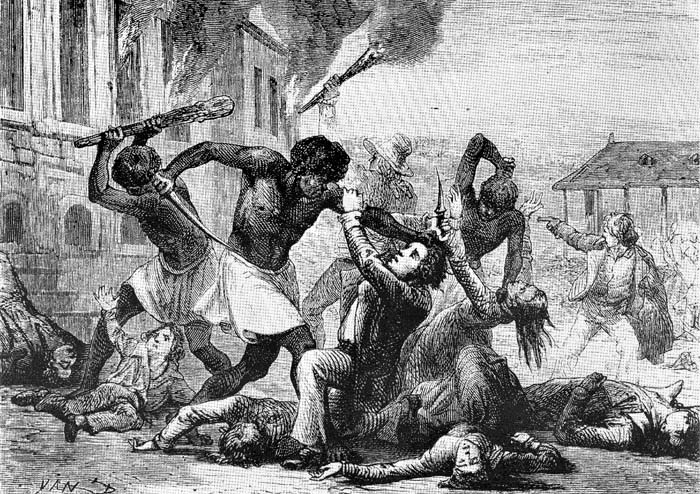
File:Haitian Revolution - Blacks murdering white civilians.gif - Wikimedia Commons
Fighting was brutal on both sides of the Haitian Revolution. Both sides killed women and children. Europeans killed any rebelling slave, including women and children. Haitians killed any European, including women and children. The French killed 200,000-350,000 Black men, women and children. In addition to the 57.000--75,000 French soldiers, the revolutionaries killed 25,000 White men, women and children. British losses and injuries totaled 100,000 including the wounded and diseased. The French killed many more people and lost.
Philippe Gerard, in an article in the Journal of Genocide Research, wrote that the French “atrocities were numerous and ranged from mass executions of colonial troops and rebel cultivators (particularly by hanging and drowning) to less numerous, but more cruel, forms of punishment (such as burning at the stake and the use of man-eating dogs).”
Yet depictions at the time portrayed Haitians killing Europeans, not as warriors but as murderers of unarmed men, women and children. Haitians did kill almost any European they found but the numbers belie the popular narrative.
Haiti as US Political Stage
Both Haiti and the US were founded on the premise of equality for all, but slavery made the US dream a lie. The contradictions showed and from the beginning of both countries, US administrations flip-flopped on Haiti; each new US president brought a new stance.
President George Washington sent humanitarian and financial aid to the French after the 1791 rebellion. President John Adams (1797-1800) provided military aid to Toussaint Louverture fighting against the US’s British foes and opened trade.
President Thomas Jefferson (1801-1809), who wrote the language of US freedom and equality, reversed course and began the political and economic isolation of Haiti that continues to this day.
The Haitian Revolution and the US Civil War
It is not outlandish to ask if the US Civil War would have happened without the Haitian Revolution. Slaveowners were shocked at its success. Abolitionists were also surprised but delighted. Historian Matthew Clavin documents how the Revolution impacted the US in his book, Toussant Louverture and the American Civil War. Slaveowners were shocked at the Haitian success. Both sides used the Revolution for their own purposes. The Haitian Revolution and Haiti as the first nation to abolish slavery fed directly into the US pro and anti-slavery narratives. Clavin argues that abolitionists were radicalized by the rebellion and spoke of “American Toussaints” who fought the Civil War to bring the US in line with its stated ideals of equality and freedom. Proslavery factions mounted a counter campaign depicting the formerly enslaved as violent barbarians who killed White men, women and children.
The United States has a long history of using Haiti as if it were just a tool in US political strategies. The main focus was and is the US, rather than the people and country of Haiti. The US contributed to Haiti’s long-term instability through diplomatic isolation after its slave revolt, a 19-year military occupation that centralized abusive state power, financial control, and support for repressive dictatorships during the Cold War.
Fearing that a successful Black slave rebellion would spark uprisings among enslaved people in the American South, the U.S. refused to recognize Haitian independence for nearly 60 years. President Thomas Jefferson and other leaders imposed economic restrictions and isolated the young republic, preventing it from establishing normal global trade and financial ties.
Although France recognized Haiti as a country in 1825, the US did not recognize Haiti until 1862, by President Abraham Lincoln in what historians perceive as an anti-slavery strategy. After the Revolution and other wars, France was in financial difficulty and sold the US the Louisiana Purchase. France also required Haiti to pay reparations for “lost property” during the war. French banks floated high interest loans that sent Haiti into deep debt. France did not pay reparations to freed slaves.
Modern Haiti and the US
In 1915, President Woodrow Wilson ordered U.S. Marines to invade and occupy Haiti. US forces seized the national bank’s reserves, transferred them to New York, and rewrote Haiti’s constitution to allow foreign land ownership. The occupation centralized political power in Port-au-Prince and created a domestic military force (the Gendarmerie) that later dominated and abused the population.
The US militarily occupied Haiti until 1934. According to the Council on Foreign Relations, the US controlled security and finances, imposed racial segregation, forced labor and press censorship, and deposed presidents and legislatures that opposed US occupation--because President Woodrow Wilson was wary of German influence in the Caribbean.
The US has been accused of meddling in Haiti’s presidential elections since. During the Cold War, the U.S. backed the brutal dynastic dictatorships of François “Papa Doc” Duvalier and his son Jean-Claude “Baby Doc” Duvalier. Washington viewed the Duvalier regime as a reliable anti-communist ally, providing economic and military aid despite systematic human rights violations and corruption.
The U.S. welcomed the election of Jean-Bertrand Aristide in 1990, although policy shifts and deep unease with his populist reforms led to diplomatic friction. A 1994 U.S. military intervention restored him after a coup. Subsequent U.S. backing of specific political factions and heavy reliance on foreign NGOs over direct state-building further weakened Haitian democratic institutions and public infrastructure.
The US is Haiti’s biggest export partner with 82% of exports coming to the US, but the agreements have been criticized as deeply unequal. The relationship between the countries continues to vacillate based on who is in office, peaking during the Obama administration.
Owing Up to US Harm
As the US invaded Iraq in 2003, Secretary of State and General Colin Powell told President George W. Bush that ”If we break it, we own it,” referencing the “Pottery Barn Rule,” the retail store policy that if a customer broke an in-store item, they were required to pay for it. Powell meant that if the US “broke” a country by intervening in its affairs, as the US repeatedly has done with Iraq,* Haiti and a host of other countries, the US bore a responsibility to work with their people and help to restore and repair it.
It is time to understand and own up to the roles that the US has played and continues to play in creating the inhumane conditions that Haitians have fled, to take responsibility and respond to the actual people rather than the politically motivated, manufactured stories, to offer asylum to the people fleeing the conditions we had a strong hand in creating.
After breaking so much. It’s the least we can do.
*In 2003, the US invaded Iraq, saying that the country held weapons of mass destruction. The conflict dragged on for 8 years and killed an estimated 500,000 Iraqi people, including 180,000 to 200,000 civilians, and more than 4500 US military personnel. The reason had more to do with the US political landscape and an emotional need to something, anything, after the 9/11 terrorist attacks. No evidence of the weapons was ever found. The US has never apologized, providing context for the current conflicts.
Comments
Nothing yet. Say the first thing.
Sign in to join the conversation.