
Diverging Assessments Delay Ethiopia’s Debt Restructuring Prospects
Ethiopia’s Megaproject Push Leaves Legacy of Debt and Overexpansion, Officials Concede
The Exit Exam Built to Protect Standards Faces a New Cheating Challenge
EEU Signs 3 Bln Birr Deal to Rebuild Power Infrastructure in Three Regional Cities
MPC Expected to Hold Credit Cap as Inflation Rebounds Despite Falling Money Market Rates
Signal
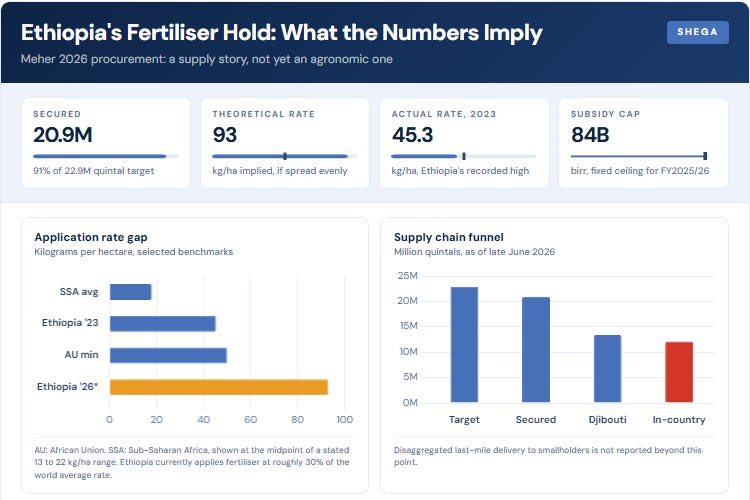
Against the backdrop of one of the most severe commodity supply disruptions on record, Ethiopia’s Ministry of Agriculture reported last week that 20.9 million quintals of chemical fertilizer had been secured for the 2026 Meher season, against a target of 22.9 million. Some 13.4 million quintals had arrived at the Port of Djibouti, with 12.1 million transported into the country as of late June. The subsidized farm-gate price held at 4,972 birr per quintal, and distribution was described as broadly on track. Global urea prices, by contrast, roughly doubled over the February-to-April window, driven by the Strait of Hormuz closure, which effectively collapsed tanker traffic through a corridor that carries approximately one-third of globally traded fertilizers. The government’s framing of its procurement outcome as a near-seamless result in an exceptionally adverse external environment is, to a point, defensible. The more instructive inquiry is into what the numbers actually imply for Ethiopian farmers.
Why It Matters
Begin with the agronomic arithmetic, which the briefing conspicuously avoided. The 2026 Meher season targets the cultivation of 22.3 million hectares. The 20.9 million quintals of secured fertilizer converts to nearly 2.09 million metric tonnes. Distributed uniformly across planned hectarage, which implies a theoretical application rate of roughly 93 kilograms per hectare. On its surface, this appears almost adequate. The government’s own blanket recommendation for cereal crops is 100 kilograms per hectare, combining NPS and urea in prescribed proportions. Read More.

Aman & Partners LLP published the first edition of its Business & Investment in Ethiopia: Legal Guide. Prepared as a practical starting point for business, investment and advisory work in Ethiopia, the Guide addresses selected legal and regulatory considerations relevant to market entry, operations, compliance, risk management and exit. Access the full guide.

Inconsistencies between IMF and creditor assessments of the Ethiopian economy is proving a hurdle in Ethiopia’s efforts to secure debt treatment under the G20 Common Framework, according to the Paris Club’s 2025 report. Read more.

Ethiopian officials have acknowledged that decades of state-led megaproject expansion left the country burdened with massive debt and underutilized infrastructure, prompting a shift toward a more commercially driven approach to public investment. Read More.

The Ministry of Education introduced a series of changes aimed at reshaping higher education, including the return of a mandatory exit exam for undergraduate students. In 2019, a new phrase entered the vocabulary of university students across Ethiopia: the exit exam. Read more.
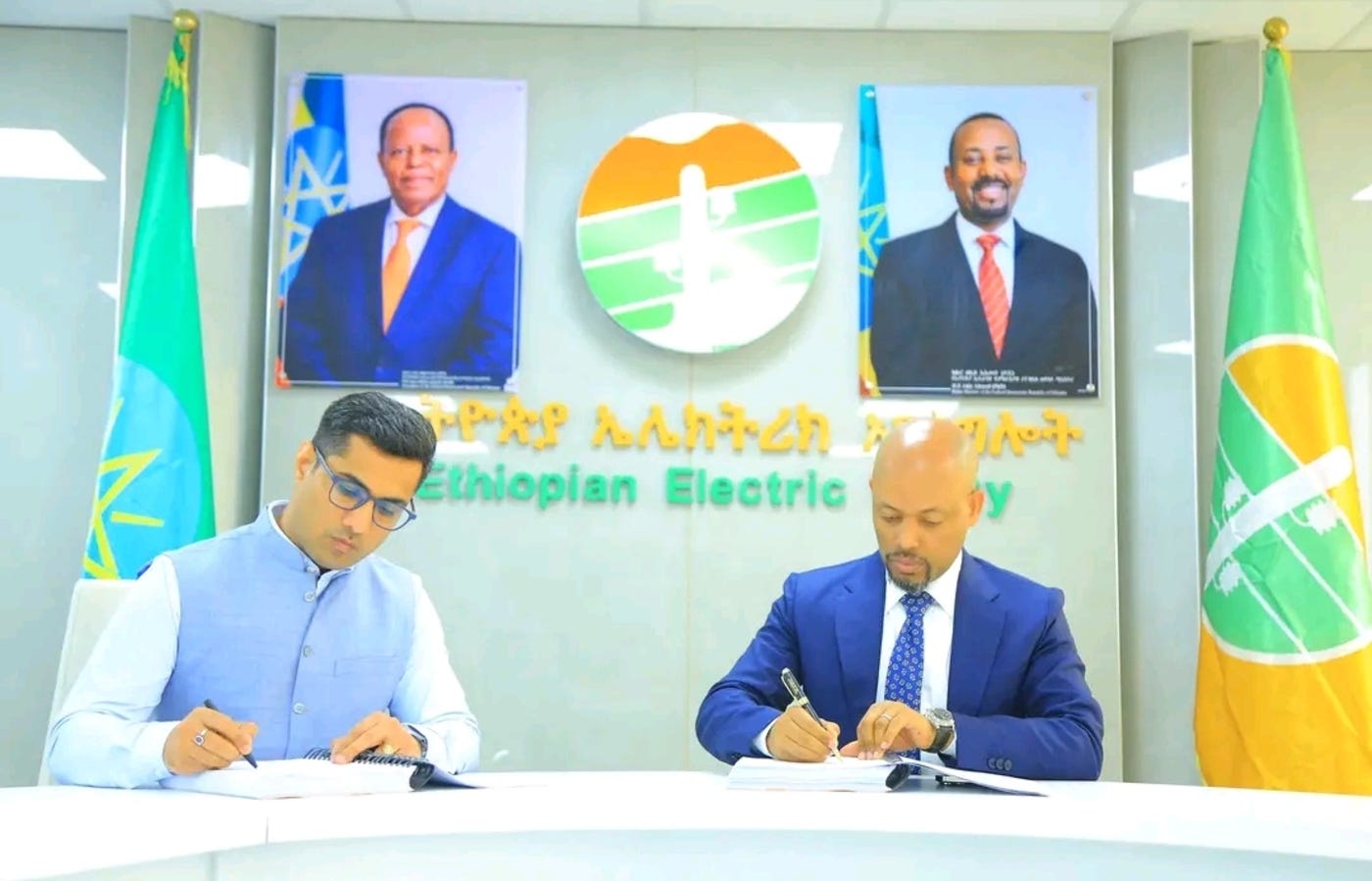
Ethiopia has signed a 3 billion birr agreement to rehabilitate and modernise electricity infrastructure in three regional cities, as the country seeks to improve the reliability of power distribution while expanding access to electricity.
The agreement was signed between Ethiopian Electric Utility (EEU) and engineering and procurement firms Alfa and Capital for a power network rehabilitation project covering the cities of Ambo, Nekemte and Assosa. Read more.
The National Bank of Ethiopia’s (NBE) Monetary Policy Committee (MPC) is expected to maintain its current monetary policy stance at its meeting next week, with market observers anticipating no immediate changes to the country’s bank credit growth cap despite renewed calls from industry experts to ease lending restrictions for key productive sectors. Read more.
No posts
Comments
Nothing yet. Say the first thing.
Sign in to join the conversation.