
Eleanor Sanghara Güstard inherited an old Nikon F50 from her late father. When the lens cracked, she kept shooting through it. Those “poor images” became a methodology for navigating her position between Britain and India, whiteness and brownness.
In today’s essay, Eleanor traces a lineage of South Asian photographers who use technical strategies, from blur and opacity to degradation, to work against the colonial demand for clarity. From Umrao Singh Sher-Gil’s pioneering work from the 1890s through the mid-20th century to Sutapa Biswas and Al-An deSouza’s contemporary work, she shows us how unreadability becomes a site of autonomy.
Thank you, Eleanor. Enjoy everyone.
Please consider supporting Shade Art Review with a subscription. This is a reader-supported publication. Subscription income supports this work, the contributors, and Shade Podcast production. If you're unable to subscribe for the 83p weekly, please like and share this piece to help it reach a wider audience. Shade Art Review takes hours of work. I deeply appreciate your emails of support; however, financial contributions make it possible to continue publishing.
I have never made the jump to invest in a high performance digital camera. For the past ten years, the old Nikon F50 film camera I inherited as a hand-me-down from my late father is what I’ve stuck to using. Nothing fancy. I did have to replace the lens once because it started forming hairline cracks, until finally, it did crack beyond repair.
In that time between being cracked and fixed, I still could, and did, use it. It was a counter intuitive way of working. But these poor images I was producing, within the testing grounds of an ill-endowed practice, has grown to become a methodology for articulating my own mixed position. A position sitting in-between whiteness and brownness, Britain and India. In-between a complex set of conflicts and harmonies that have existed across time.
It was only after I began processing the images and filtering through the blurred, fuzzy ones to discard, that I realised I was engaging in a sort of photographic writing-of-the-self, using the erroring of my lens. These images were neither a document nor an abstraction, but caught somewhere in-between.
This is how I have been using the camera for a while now: bending the rules of photographic legibility, resolution, and completeness as gestures towards an otherwise future.


However, the lens is not innocent. It is important to recognise the roots of photographic practice as a Eurocentric tool implicated in the colonial project. In the 19th century, the camera birthed a new racialised form of looking. Colonised subjects were captured, rendered in-focus, disseminated, and consumed in Western scopic pleasure and control.
As a girl, I remember sitting in my Auntie’s living room in Birmingham, fixated on the pictorially perfect black and white photographs hung on the wall behind her sofa. Demurely seated men, women, and children. Hands resting on laps. Neatly folded legs. A wall filled with our Punjabi ancestors, situated against the backdrop of the British Raj. My Auntie could never really recall where she got these images from, or who exactly we were looking at. But she insisted on keeping them displayed as an antidote to homesickness for our visiting loved ones who had recently migrated from India to England. I loved these pictures because they gave me a tender urge to hold on tight to a place, that at that time, I had never actually been to.
It is only since returning to look again and again at my Auntie’s living room wall, that I have been able to unsettle, recode, and set these images free to be read in the present space. Meticulously staged and developed, these figures were facing the exposure of a camera for the very first time.
As forms of colonial trophy image-making, they are reminders of which voices become absent from photographic production.
Punjabi photographer Umrao Singh Sher-Gil always resurrects the nostalgic familiarity of my Auntie’s photographs for me, but recasts the beauty of these perfectly rendered bodies as unstable.
What can it mean to produce one’s own images?
As one of the earliest examples of Indian subjects depicted through an Indian photographer’s own lens, Sher-Gil’s work bridges the gap between colonial documentation and the textures of lived experience.
Free and slippery bodies.
Experimenting with stereoscopic lenses and unusual selenium toning techniques, Sher-Gil ruptures the flow of imagery that was being produced at the time. He creates counter-images to the British idea of what constituted beautiful portraiture and the types of representation the camera was built for.
Destabilised, multiply positioned, obscured forms of self-capture. These images are not a coming out of visibility, or a writing of himself out of the frame, but open up a new space of refusing capture. A technical complexity that troubles the unwanted gaze. That unsprings the trap.
The very act of picking up the camera becomes an act of liberation. A disobedient act so something new, something different can emerge.
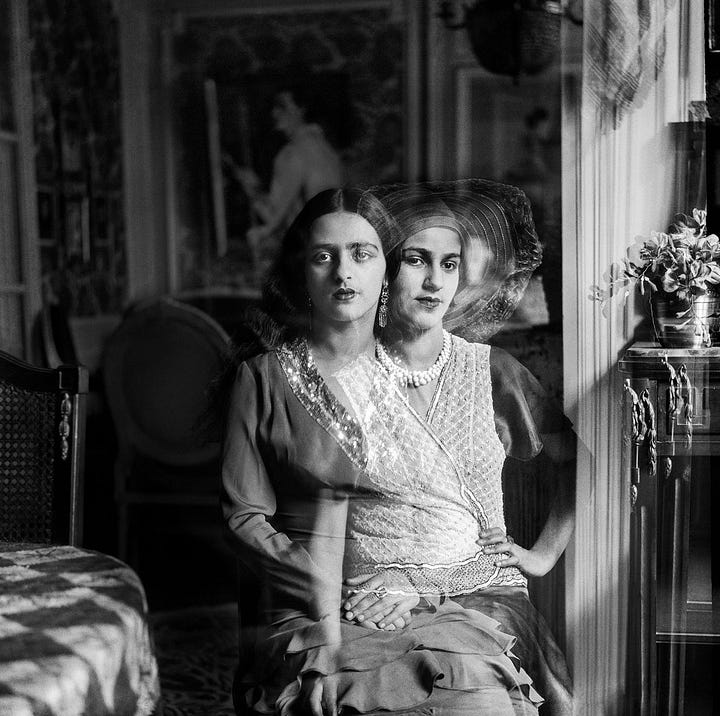
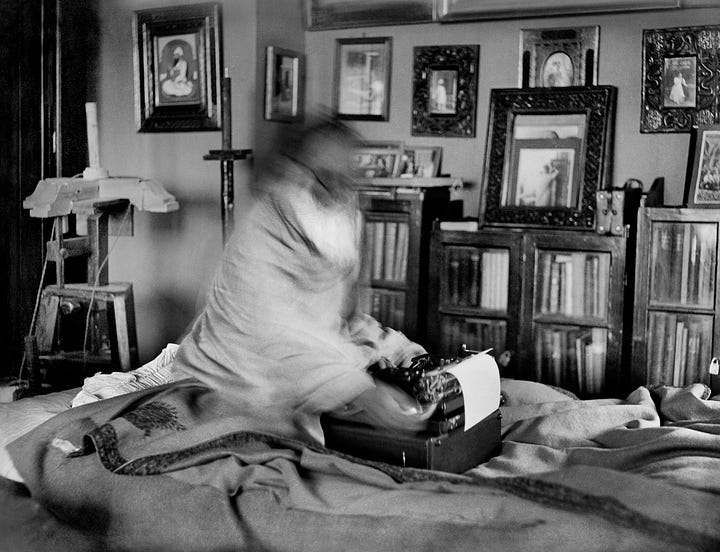
Roland Barthes famously described the photograph’s ability to issue a “certificate of presence”. But a presence that we are so used to equating its’ value with its’ legibility. Departing from this view of photography to one that foregrounds how precious the slips, leakiness, and gestures of unreadability are in an image, allows us to query what is really meant by making visible, and who this visibility is actually for.
Obfuscations in an image are a “creative source of disorderly power to embrace the possibility of living otherwise,” Tina Campt says. It is this stretching of veils over images, deciding what and what not to make easily accessible to the viewer, that I recently re-encountered in the work of Sutapa Biswas and Al-An deSouza, two South Asian lens-based artists who I saw shown side by side for the first time last year in Tate Britain’s exhibition The 80s: Photographing Britain. I immediately viewed their work as contemporary continuations of what Sher-Gil was trying to achieve in 19th century India; South Asian photography mobilising negation as “disorderly power”.
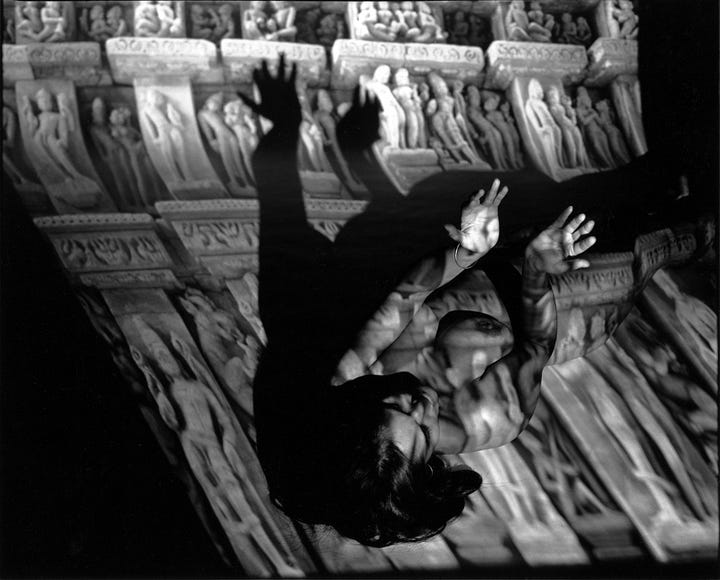

South Asian photography in general, I feel, is still rarely afforded dedicated space within exhibition making, and for me, Sutapa Biswas’ Synapse Series lifts this neglected genre out of its habitual curatorial framing as simply just documenting diasporic life. Biswas is investigating photographic form, function and apparatus as it meets, reacts with and relates to her brown body. Her visually complex images — stone surfaces of erotic Indian art projected across her naked form — complicate the focal capabilities of the lens. Half in light, half in shadow, she self-disrupts with these ‘synapse blocks’ or blind spots to resist being readable. I struggled to linger on her body, bound to her only briefly, before rerouting my gaze elsewhere within the photographs. She decides what is shadowed, exposed, overexposed and concealed. She denies being positioned clearly, withholding from us these photographic default codes of visual comfort.
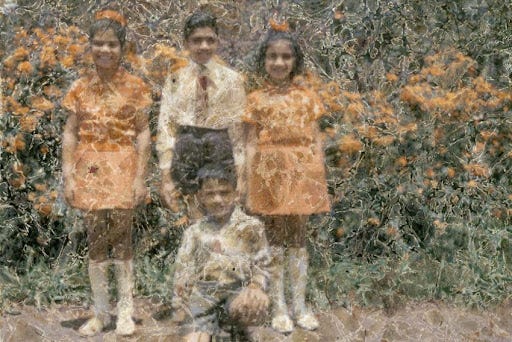
Al-An deSouza struck me to be similarly conjuring a restless photographic terrain. I became compelled to relook at The Lost Pictures, a series of deSouza’s childhood photographs from the 1960s that he left out in his home to collect everyday grease, dust, water spots and his own bodily debris. The mottled figures are ungraspable. Elusive. Guileful. The original images of himself and his family have been reproduced, in real time, putting their transforming bodies in negotiation with the inevitable opacities of image-production.
Biswas’, deSouza’s and Sher-Gil’s work prompts me to reach for Erica Scourti’s concept of Dark Archives; information that evades classification, which cannot be located, retrieved or seen. These shadowy spaces of negation and invisibility in photographs demand a greater critical, intentional, but tender viewership. They make us work really hard. They make us recognise more deeply the ways we can and should be seeing. They make us see that photographs aren’t the incontestable documents of our past, but are complex artefacts, holding onto unseen stories and encrypted, expansive lives.
Eleanor Sanghara Güstard is a Punjabi-British cultural producer, artist, writer, and curator. She is currently the Engagement Producer at Arnolfini, having previously worked at Hauser & Wirth, Tate, and Central Saint Martins.
Comments
Nothing yet. Say the first thing.
Sign in to join the conversation.