
(Barcelona) — I am sitting in Barcelona airport, people-watching.
The man on my left is lecturing his female companion. She nods patiently as he continues his monologue. Business travellers are glued to their phones. Families juggling backpacks and passports are trying to keep up with their children who race through the terminal.
And suddenly, all I can see are little girls, doing everything, everywhere, all at once.
One marches purposefully towards her boarding gate, a tiny backpack bouncing behind her. Another is explaining something of enormous importance to her weary parents with the absolute certainty that she is right. A third twirls in sparkly trainers, utterly unconcerned by who might be watching.
All of them possess what I can only describe as swagger.
They occupy space without apology, ask questions, laugh and cry loudly and occasionally throw tantrums while embarrassed parents attempt damage control.
All of them in some way or another remind me of my granddaughter. She definitely has swagger. At two years and a few months, she is already plucky, funny, determined and entirely capable of holding her own in an argument.
Going anywhere with her - the supermarket, a playground, a restaurant - is to enter a magical world where every object is extraordinary and has to be picked up and examined, curtains invite games of hide-and-seek, stairs are meant to be jumped on and flowers elicit a repeated “wow”.
She doesn’t walk, she strides.
I have seen that same spark and sassiness in little girls everywhere: in Karachi and Cairo, Jakarta and Brussels, and now here in Barcelona. The bright eyes, the curiosity and the delight in discovery. And the swagger.
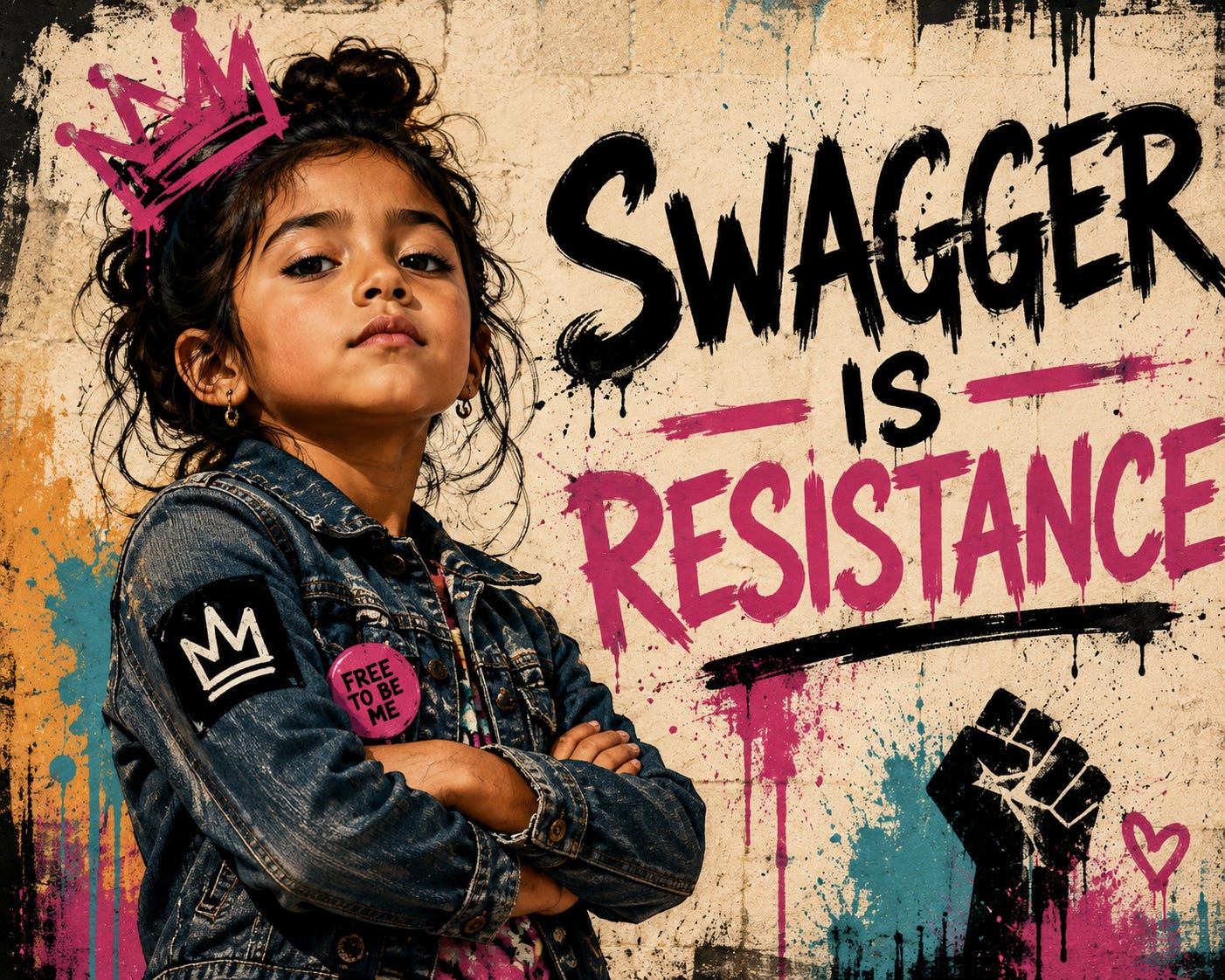
Miraculously, that joy and love of life is also present in girls living amid war and upheaval. Girls in Gaza navigating a landscape of death, displacement and trauma. Girls in Sudan whose lives have been upended by a brutal conflict and girls in Lebanon, Iran and Ukraine living with uncertainty and fear. It is a resolve that lives within girls in Afghanistan who are denied the simple right to go to school so they read and learn in secret.
For all of them, swagger is resistance and a refusal to surrender.
Elsewhere, a different question arises. Why do so many girls gradually lose that sense of certainty? What happens between the little girl who confidently raises her hand in class and the young woman who hesitates before speaking in a meeting?
Why does the child who runs freely become the teenager who worries constantly about how she looks, how she sounds and whether she is taking up too much space? Why do some ambitious young women, despite education and opportunity, end up accepting lives constrained by expectations they once might have challenged?
The change is often so gradual that we barely notice it. Yet it is a quiet, daily tragedy.
Research suggests that girls begin absorbing assumptions of what is allowed and not allowed at an astonishingly young age. Long before adulthood, many have already learned that brilliance, leadership and authority are qualities society more readily associates with boys and men.
The lessons come from many directions. From classrooms and playgrounds, social media and popular culture. From politicians who talk endlessly about women while rarely listening to them. And from workplaces that celebrate diversity in principle but remain uncomfortable with women who are outspoken, ambitious or unwilling to conform.
And for girls who are Black, brown, Muslim, migrant or otherwise viewed as “different”, the pressures can be even greater.
Swagger is about dignity, agency and a conviction that your voice deserves to be heard and that your dreams are legitimate. That you have every right to an education, to freedom, to safety, to opportunity. That you belong and that you matter.
Parents and grandparents play a crucial role in nurturing that belief - and I am fortunate that mine did. Teachers, mentors and friends are important. But regardless of where we live, the responsibility of building societies that reward swagger lies with all of us.
It is a collective obligation.
No posts
Comments
Nothing yet. Say the first thing.
Sign in to join the conversation.