
(Brussels) – The European Union’s Brussels-based press conferences are usually humdrum affairs. There is a bit of journalistic theatre, some jousting between reporters and EU spokespersons and, occasionally, a nugget of useful information.
Last November, however, one of those routine briefings took an unexpected turn when Italian journalist Gabriele Nunziati asked a straightforward question about the EU, Israel and Gaza.
“Since the EU says Russia should pay for the reconstruction of Ukraine, does it also believe Israel should pay for the reconstruction of Gaza, given that it has destroyed much of the territory and its civilian infrastructure?”
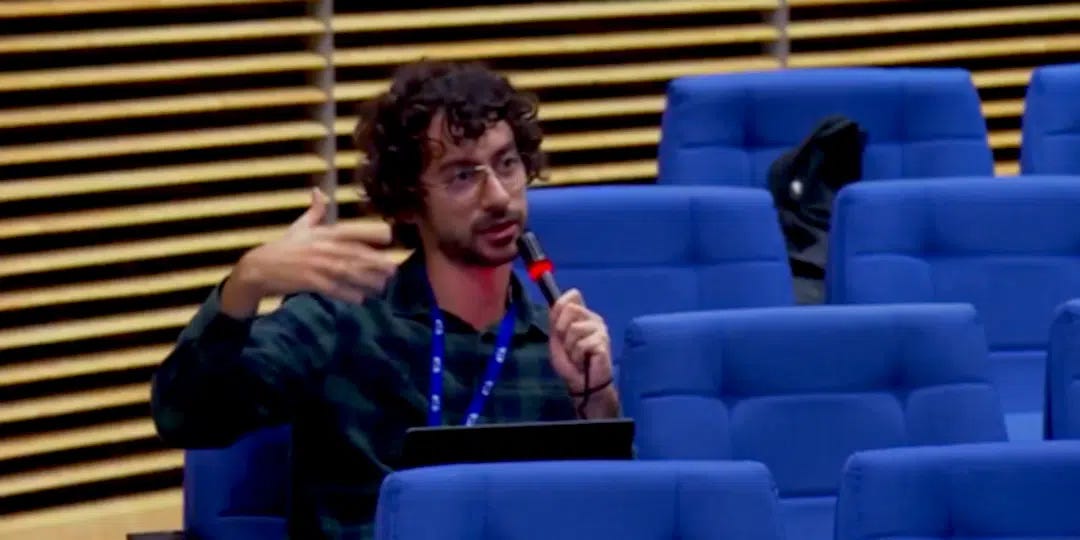
The spokesperson paused, described it as “an interesting question” and moved on. In Brussels, that is usually the end of the story.
This time, it wasn’t.
A few days later, Nunziati was dismissed by his employer, the Italian news agency Agenzia Nova, which reportedly deemed his question “technically incorrect” and “out of place”. His dismissal sent shockwaves through journalistic circles and the video clip quickly spread online.
Tomorrow, June 9, Nunziati will appear before a labour court in Rome to challenge his dismissal.
His law suit is being supported by Amnesty International, journalists’ associations and press freedom advocates who see the case not as an isolated incident but as part of a wider and deeply troubling trend of restrictions on the right to report in Italy - and mounting pressure on those who cover Palestine and Gaza.
“I am seeking justice,” Nunziati told me. “Journalists across the world were shocked when I was fired because such an act is unacceptable in a democracy.”
His first thought, he said, was for younger colleagues on precarious contracts and the chilling effect such a dismissal could have on their willingness to ask difficult questions.
The experience led to what he describes as “very tough days”. But once the initial shock subsided, he decided he had to fight back. Unable to afford a lawyer himself, he eventually found support from a journalists’ union willing to cover the legal costs.
Nunziati is not alone in feeling the heat.
Across Europe, lawyers are being called upon to defend journalist’s right to ask questions, UN experts need lawyers to defend their right to speak, activists need lawyers to defend their right to protest, and migrants need lawyers to defend their right to seek protection.
We are no longer dealing with isolated cases. What is at stake is the shrinking space for dissent in Europe.
Increasingly, governments, institutions and powerful interests are seeking to define which opinions are acceptable, which forms of solidarity are legitimate and which voices deserve to be heard.
The real question is whether Europe’s political elites still believe that rights are universal, or whether they are available only to those who remain within increasingly narrow boundaries of acceptable opinion.
Fortunately, courts remain available and lawyers continue to push back against this authoritarian drift, defending the principle that governments, institutions and political leaders remain accountable to the law.
Back in November, the Commission spokesperson was right to describe Nunziati’s question as “interesting”.
She could also have pointed out that in past years, the EU has not shied away from demanding compensation from Israel when European-funded projects were destroyed in the occupied Palestinian territories.
The truth is that Nunziati’s question touched a raw nerve.
It went to the heart of Europe’s credibility and its persistent double standards when confronted with Israel’s genocidal conduct in Gaza and the accelerating ethnic cleansing of Palestinians in the occupied West Bank.
For years, I have reported on European efforts to support civil society activists in authoritarian countries. I listened to European leaders urge governments around the world to respect international law, protect independent institutions and safeguard fundamental freedoms. Those interventions were important - and still are.
Ironicallly, today, some of the most important battles for the same principles are being fought on Europe’s own streets, in its courtrooms and inside its institutions.
And increasingly, some of the most important defenders of those principles are not politicians, but the lawyers willing to challenge power, defend dissent and insist that the law applies equally to everyone.
No posts
Comments
Nothing yet. Say the first thing.
Sign in to join the conversation.