
A common point of bewilderment today among many of Trump’s “establishment” critics is the all too tepid response to Trump’s increasingly brazen shattering of democratic norms. True, he started this during his first term, but in his second, Trump seems to relish the weaponization of his presidency to go after his enemies, and to brandish his corrupt dealings, all under the Trump banner (e.g. cyber currency, Mideast business dealings, 747 gift from Qatar). Not only does Trump conduct himself with impunity, but Fox news and other mainstream media outlets barely cover these breaches at all. (And when left leaning media do, the interest seems to wane quickly).
Here may be the source of the puzzlement: the left intelligentsia continues to view and characterize MAGA as a political movement, without grasping its transcendence into a new dominant cultural order. MAGA rose as counter-establishment partisan drive during Trump’s 2016 campaign and subsequent first administration; however, by the 2024 election, it became evident that MAGA was but the eye of a full-fledged cultural shift, in some ways akin to Mao’s Cultural revolution.
For those who might be offended by this analogy, allow me to explain. For sure, during the social chaos of the decade-long Great Proletarian Cultural Revolution in China, turmoil, bloodshed, and hunger ruined millions of lives. What enabled Mao to solidify state power was his mobilization of the younger generation of Chinese to ostracize hundreds of millions of Chinese elders, many of whom were humiliated and murdered, others driven to suicide. Student gangs and Red Guards regularly denounced and physically attacked common citizens showing any sign of “bourgeois” propensities. During one of the great tragic episodes of the 20th century, Chinese society was viciously torn asunder and restructured under a totalitarian state.
Thank heavens, nothing anywhere near that horrific has happened on American soil. Nonetheless, the astonishing manner in which the 80-year old post WWII order has been turned on its heads merits the comparison. The concept of “culture” usually composes five main elements: values and beliefs, symbols, language, and rituals, and each of these have shifted markedly in the last 10 years. The rejection of “woke” progressivism has not only seeped deeply into much of the electorate, but the demonization of the traditional bastions of knowledge has led to a devastating hollowing out of both public and private American Institutions. The U.S. is losing its grip as the most desirable place the world intelligentsia chooses to study, work and make vital contributions.
Of the many aspects of the new emergent culture, one frightening leitmotif is the assault and attempted redefinition of the present-day concept of masculinity. As exposed in the recent mini-series, Adolescence, millions of young men are regularly following influencers ranting about their perceived loss of status in contemporary society. Many of these voices in the “manosphere” advocate an almost cult-like call to action for a retrograde return to the masculinity of a bygone era. Facing bleak prospects, working class men without a college degree have been especially drawn to these movements where they can air their grievances. In a chilling development, their pent-up acrimony is often expressed as a misogynistic scorn directed at high functioning women, or other elites, from whom they feel left behind.
Moreover, there is a new generation of young men who were children when Trump first ran for office, and whose political imaginations were ignited by his rise to power. As expressed in a recent article in the Free Press,” they have no memories of belonging to—or being accepted by any party or cultural milieu except Trump’s. And for them, Trump is not just a disrupter, an excuse, a historical symptom, or an accident.” He represents a role model for a new cultural order in which EVs and wind and solar energy are “effete” solutions adopted by “girly” men, while “real men” rely on “big beautiful clean” coal and gas-guzzling combustion cars. Part of this “bro boasting” is leveling humiliating scorn at progressive leaders; the vitriol directed at former President Biden in social media provides a shocking demonstration of this alarming trend.
Other characteristics of this new ascendant American culture include: first, a nationalism which fears immigration, and makes a clear distinction between true “heritage” Americans and other citizens; second, a traditionalism which distrusts and ultimately rejects modern expertise and a globalized economy; and finally, a flat-out rejection of the contemporary progressive framework which aims to temper human biases and tribal urges by defining new respectful behavioral norms more attuned to a pluralistic society.
Note that many of these cultural elements conveniently function as the supportive pillars of a totalitarian state, such as the focus on societal order and the control of a new common narrative. And, in a corresponding parallel, these same themes having been gaining momentum in the populism movements in Europe.
In their now critically acclaimed book from many years ago, The Fourth Turning, authors Strauss and Howe described how cultural change often moves in 100 year cycles, swinging like a pendulum between different values, priorities, and ideologies, especially during periods of crisis following an unraveling.
It would be foolish to try to predict the full impact of the MAGA cultural movement on our nation's ability to address urgent challenges at home and abroad. Therefore, I am not eager to offer a normative assessment of this cultural shift. However, I believe we should be circumspect and ask the following questions: will this new cultural ethos provide a conducive environment over the next 50 years for addressing our gravest threats: a) managing climate change; b) crafting a stable and more peaceful international order; and, c) developing an AI infrastructure that is trustworthy and safe? In addition, with the menace now facing our democracy, will our nation’s deep-seated capacity for self-improvement prevail.
Radwell is the author of “American Schism: How the Two Enlightenments Hold the Secret to Healing our Nation” winner of last year’s International Book Award for Best General Nonfiction. He serves on the Advisory Councils at Business for America, RepresentUs, and The Grand Bargain Project, and is a frequent contributor as a political analyst, and speaker within both the business community and on college campuses both in the U.S. and abroad. This is the sixth entry in a 10-part series on the American Schism in 2025.
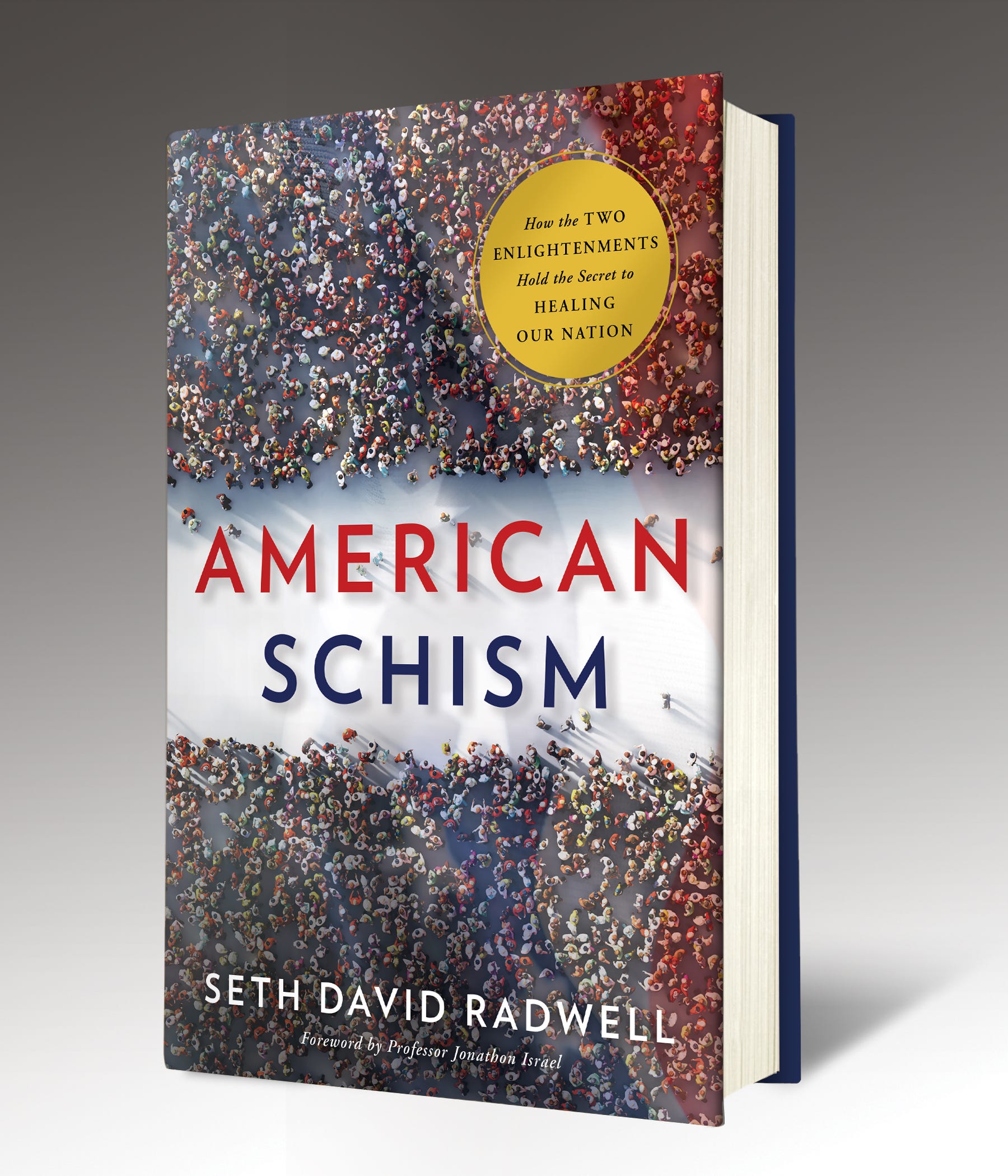
Most Recent Amazon Review - 5/24/25
5.0 out of 5 stars - Seeking to unify and repair by embracing a contentious past with clear seeing and rational analysis!
In order to make sense of the current assault on our Democracy, its institutions, the rule of law, and common decency, we must understand the root causes of the deep cultural malaise that has seized our political process. If you are struggling to understand how the pursuit of a more perfect union is being torn asunder and why by a convicted felon and his supporters, read the American Schism. You will discover the important distinctions our Founding Fathers debated arising from the European Enlightenment. The foundational principles and core values that shaped our Constitution and Federalism spin a fascinating tale. You will understand the motivations, fears, and hatred necessary to implement the multifaceted destruction of Democracy and get away with it in real time in this very moment. American Schism reveals the factors and vulnerabilities that are allowing our system to be transformed into an all-powerful plutocracy, driven by greed. An authoritarian dictatorship combined with a White Christian Nationalist agenda is obliterating any remnants of civility remaining in our consciousness and commitment to enlightened self-interest or the well-being of the commons. Seth David Radwell takes the reader on a deeply informative journey of discovery.
No posts
Comments
Nothing yet. Say the first thing.
Sign in to join the conversation.