
https://www.chicagotribune.com/2025/08/03/opinion-democrats-schism-abundance-agenda/?share=nnc22cianbmaacn0ngdm
Much has been written of late about the fate of the Democratic Party after its poor performance last November, and with its damaged brand and lack of a coherent strategy. Over the last several years, the party’s primary unifying focus has been assailing Trump and MAGA, while lacking an articulate compelling message or prescriptive platform. Not only has this left the party adrift, but Trump has been all too eager to fill the resulting vacuum, imprinting his “evil” characterization of the party.
While myriad efforts both within and adjacent to the party are scrambling to advance a winning strategy for 2026, we can already detect competing agendas. The left flank of the party has a resolute hold on the identity issues it keeps front and center despite persuasive evidence that this strategy alienates working class voters. In contrast, the center of the party has been coalescing around what some call the “abundance agenda”, following the launch of the bestselling book by Ezra Klein and Derek Thompson. The thrust here centers on an insightful reckoning – how can the Democratic Party represent itself as the problem-solving party of the working class when their track record exhibits innumerable failures in major cities across the country. Accordingly, the abundance strategy focuses on enabling government to undertake the “big things” it accomplished yesteryear by liberating it from a maze of bureaucratic obstacles.
Perhaps the most credible advocate of this revitalized spirit is Josh Shapiro, the charismatic governor of Pennsylvania. His “Get Stuff Done” approach has already resulted in some tangible wins such as the rapid reopening of I-95, and the expansion of school breakfast programs. In fact, many Democratic leaders in the center recognize that their rapprochement with the progressive wing in recent cycles has resulted in the party estranging its working-class base. But in my view the Democratic Party has a more fundamental conundrum based on a contradiction that lies at the heart of progressivism itself.
As described in detail in Mark Dunkelman’s recent book, Why Nothing Works, the reason why our government today cannot build the big things it did in past eras (e.g. the interstate highway system, the social security system) is because of this very conflict: On one hand, many progressives deliver a clarion call for government to undertake large-scale solutions to the most pressing current policy problems, such as building green energy infrastructure and affordable housing. But at the same time, these same advocates demand controls which often stymie government from getting anything done.
Ever since the Vietnam era, a distrust of the Establishment has taken root and grown deep, manifested in a fear of yielding broad powers without adequate controls and limitations. Nonetheless, these two instincts underlying progressivism are at cross purposes: It is hard to have it both ways. How can government solve big problems if it is intentionally designed with defuse power, easily and frequently obstructed or contested. What is remarkable is that these two opposing impulses frequently operate simultaneously. Millions of young people today call for administrative solutions to the climate crisis, while demanding bodily autonomy free from government intervention.
As I describe in the original American Schism, the pendulum has vacillated throughout our entire history between eras characterized by these opposing impulses. At times, centrally designed Hamiltonian solutions (designed by elites) dominated, such as after our founding, in the New Deal and post WWII periods, and again through LBJs great society programs. In other epochs, such as when the Federalist party lost influence in the early 19th century, when reconstruction failed and during the dawning of the Gilded age, the Jeffersonian demand for curtailed central power reigned supreme.
Since the Reagan era, the wariness of big government has taken hold on the right. But often overlooked is that progressive reformers in recent decades, fearful of the sins of power-hungry leaders like Robert Moses, have demanded controls on government which often lead to unwieldy processes and box-in government action. Many of these check points such as mandated constituent input in the policy development process are warranted. But as a result, government today at all levels feels more like a vetocracy where almost any citizen or corporate-sponsored interest group stifle progress at every turn, often via the snail-speed adjudication of the legal system. Even when a major project does get completed, the number of involved commissions, in addition to the lawsuits brought by opposing constituents result in skyrocketing costs and years of delay. Perhaps, most ironically, the consequent gridlock has over time eroded faith in public institutions and created the opening for MAGA-style populism.
It is this dynamic that is already clashing within the Democratic party; the centrists’ call to tackle big problems may find itself at loggerheads with the fear of elite-designed solutions within the progressive wing. Moreover, such clashes could impede a cohesive and compelling Democratic Party revival.
Dunkleman argues for a moderate adjustment in favor of giving more leeway to the state based on+ the belief that we have leaned too far in hamstringing government. However, our history demonstrates that attempts at moderate “adjustments” usually overcorrect, and result in pendulum swings. How any possible Democratic revival manages this underlying contradiction in its roadmap may determine whether the party can once again attract the populist voters it used to carry.
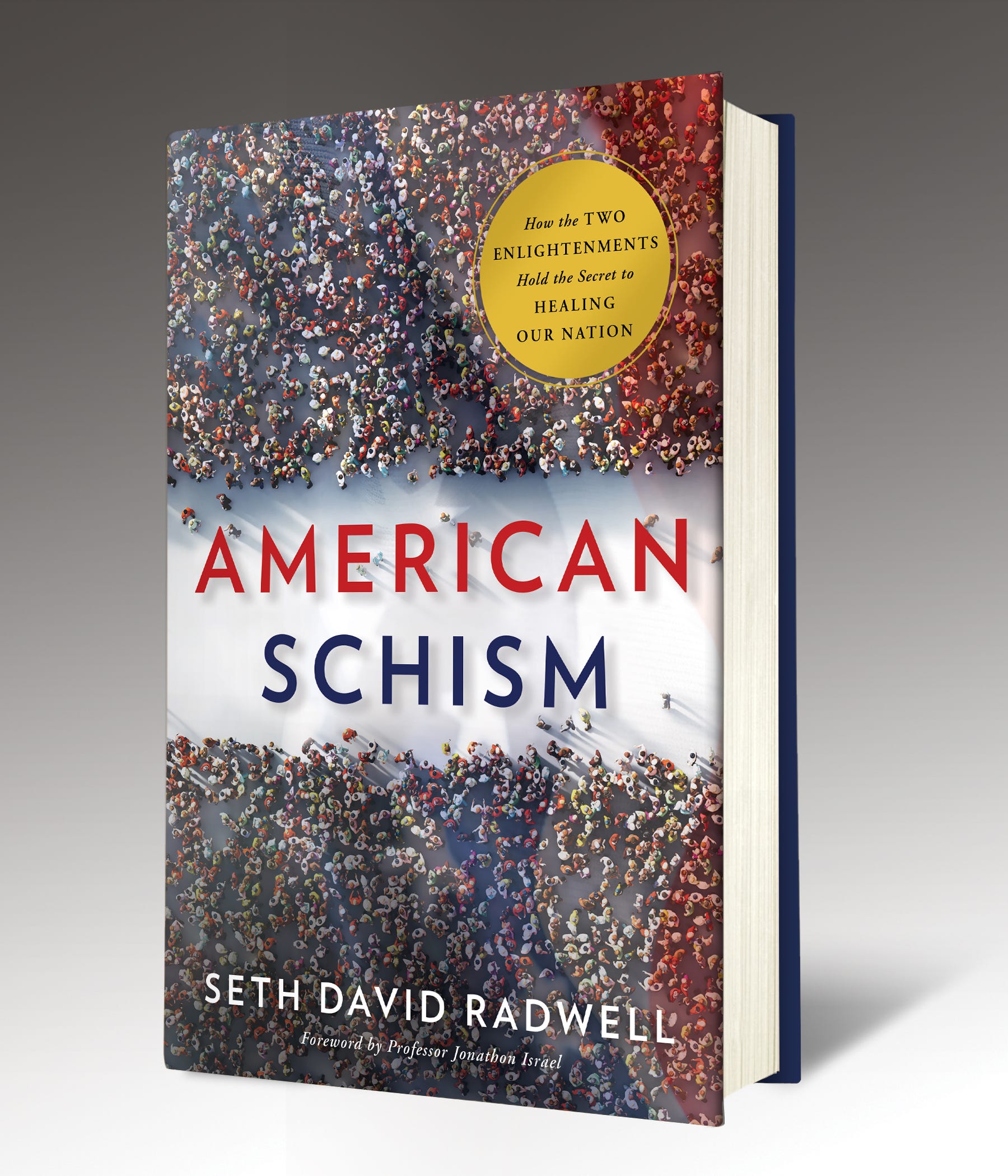
Radwell is the author of “American Schism: How the Two Enlightenments Hold the Secret to Healing our Nation” winner of last year’s International Book Award for Best General Nonfiction. He serves on the Advisory Councils at Business for America, RepresentUs, and The Grand Bargain Project, and is a frequent contributor as a political analyst, and speaker within both the business community and on college campuses both in the U.S. and abroad. This is the sixth entry in a 10-part series on the American Schism in 2025.
Most Recent Amazon Review - 5/24/25
5.0 out of 5 stars - Seeking to unify and repair by embracing a contentious past with clear seeing and rational analysis!
In order to make sense of the current assault on our Democracy, its institutions, the rule of law, and common decency, we must understand the root causes of the deep cultural malaise that has seized our political process. If you are struggling to understand how the pursuit of a more perfect union is being torn asunder and why by a convicted felon and his supporters, read the American Schism. You will discover the important distinctions our Founding Fathers debated arising from the European Enlightenment. The foundational principles and core values that shaped our Constitution and Federalism spin a fascinating tale. You will understand the motivations, fears, and hatred necessary to implement the multifaceted destruction of Democracy and get away with it in real time in this very moment. American Schism reveals the factors and vulnerabilities that are allowing our system to be transformed into an all-powerful plutocracy, driven by greed. An authoritarian dictatorship combined with a White Christian Nationalist agenda is obliterating any remnants of civility remaining in our consciousness and commitment to enlightened self-interest or the well-being of the commons. Seth David Radwell takes the reader on a deeply informative journey of discovery.
No posts
Comments
Nothing yet. Say the first thing.
Sign in to join the conversation.