
In distilling lessons from my research on American Schism, I often refer to a secret sauce or magic formula that citizens deployed at times in our history to productively bridge major societal divisions. To be clear, during these periods the rifts endured, but relying on the formula’s specific ingredients steered us to better outcomes as compared to other eras when this formula was abandoned. In the former moments, we often forged new policy solutions, in the latter, we more regularly experienced episodic violence.
One of the three key elements of this magic formula is what I label deep empathetic listening (stay tuned to this series for future discussion of the other two elements). Sounding simple but too often forsaken today, this form of listening is not easy work. It is analogous to a routine practice from the high school debate club of a bygone epoch: first, constructing a rational argument for a particular point of view through research and critical thinking, supported by data and carefully vetted sources. Then, perhaps a week later, undertaking the same, but from the opposing point of view. However, with current communication methods and social media platforms, today critically researched data is sparse while sanctimonious outrage omnipresent. (Is it surprising that our contemporary civic discourse has collapsed?)
I have thus taken refuge during the chaotic first 100 days of Trump 2.0 to heed my own advice. Specifically, I have been engaging Trump supporters to better understand their perspectives. Hardly a homogeneous group, many core MAGA enthusiasts have emerged from the wreckage of 40 years of elite-designed globalization wherein the fruits of the promised economic prosperity accrued solely to the top 1%. I have alluded frequently in this series to the pent-up acrimony that Trump successfully weaponized from the previously stifled rage which accumulated as millions of Americans lost trust in our governing institutions. As opposed to crafting better public policy in response to their suffering, the leaders of both political parties displayed nothing but disdain to the millions of Americans left behind (quite literally adding insult to injury).
Trump receives cult-like adoration amongst large swaths of Americans for finally putting a stop to the carnage. Moreover, I have often explicated in this series why such rancor was justified. How can we possibly blame those who have so appallingly suffered? After all, globalization did not simply transpire, it was championed by the same bipartisan leaders that reaped its rewards while insulating themselves from its costs. In my view, these Trump supporters must be vindicated since their reactions are rational given devastating policy that has led to hallowed out rural areas, few prospects for young non-college education citizens and an opioid crisis. What is particularly disturbing is that despite how much has been written about this in recent years, many elites have yet to recognize much less come to terms with their own track record of policy failures.
At the same time, because elite – populist feuds have been commonplace throughout our 250-year history, to understand our present social polarization, earlier episodes merit close examination. This very dynamic animated the original American Schism wherein the Federalists and the Jeffersonians represented opposing forces, each vying for power. Scrutinizing how the derivative tensions from this founding era subsequently evolved across different points of our history can shed much light on our current crisis. One particularly insightful historical antecedent starts with the Gilded Age in the late 19th century when the grievances represented by the Farmers Alliance and the People’s party were stridently expressed. These bottom-up movements did in fact lead to systemic changes, albeit a few decades later in the early 20th century Progressive Era. Analagously, in the face of the Great Depression, FDR-era reforms represented another pendulum shift from Wall Street to Main Street.
As a former CEO and marketing executive myself, I have more recently been engaging members of the business establishment who support Trump to better appreciate their particular viewpoints. I have heard some very lucid accounts that characterize Trump’s approach as a needed strategic recalibration to redefine American power in an era of global uncertainty. While conceding the disruptive nature and recognizing the risks, these supporters argue that Trump’s path is required to contain the China threat and push Europe to shoulder its own defense. Further, they believe that shrinking the Federal government and pushing the locus of control down to the states is consistent with the model of Jeffersonian government envisioned by some of our founders.
Space here does not permit me to fully delineate their arguments, but suffice it to say that many of these Trump supporters are people I greatly respect and admire, despite my disagreements with many of their views. But having had many of these conversations, one glaring contradiction stands out to me like a sore thumb. Namely, most of the administration's concrete actions are simply not consistent with the professed objectives of the very plan these followers describe. Instead of reorienting the institutions or building anew the foundations necessary to chart this new course, the actions so far observed seem much more intent on delivering Trump’s frequently promised retribution. There has been scant indication via word or deed that the administration’s goal is to remake or reconstitute our American institutions -- in fact the entire focus has been in tearing them down and in relishing in the resulting indignation within elite circles. Conversely, traditional conservative values require a healthy respect for institutions, a willingness to acknowledge that the accumulated knowledge contain therein is not easily replicated and should be challenged but not trampled upon. In a sentence, so far Trump 2.0 empirically resembles something much closer to a 1930s Stalinist purge of non-loyalists than a 1950s Eishenhower-led rearchitecture of the post-WWII U.S. military.
I have asked my interlocutors how Trumpian-style retribution accomplishes the agenda they claim he is following. I have not as of yet heard any satisfying response. Perhaps if I see the Trump administration act more like a playwright than a critic, building something new in the wake of all they have destroyed, I might be more sympathetic to their arguments.
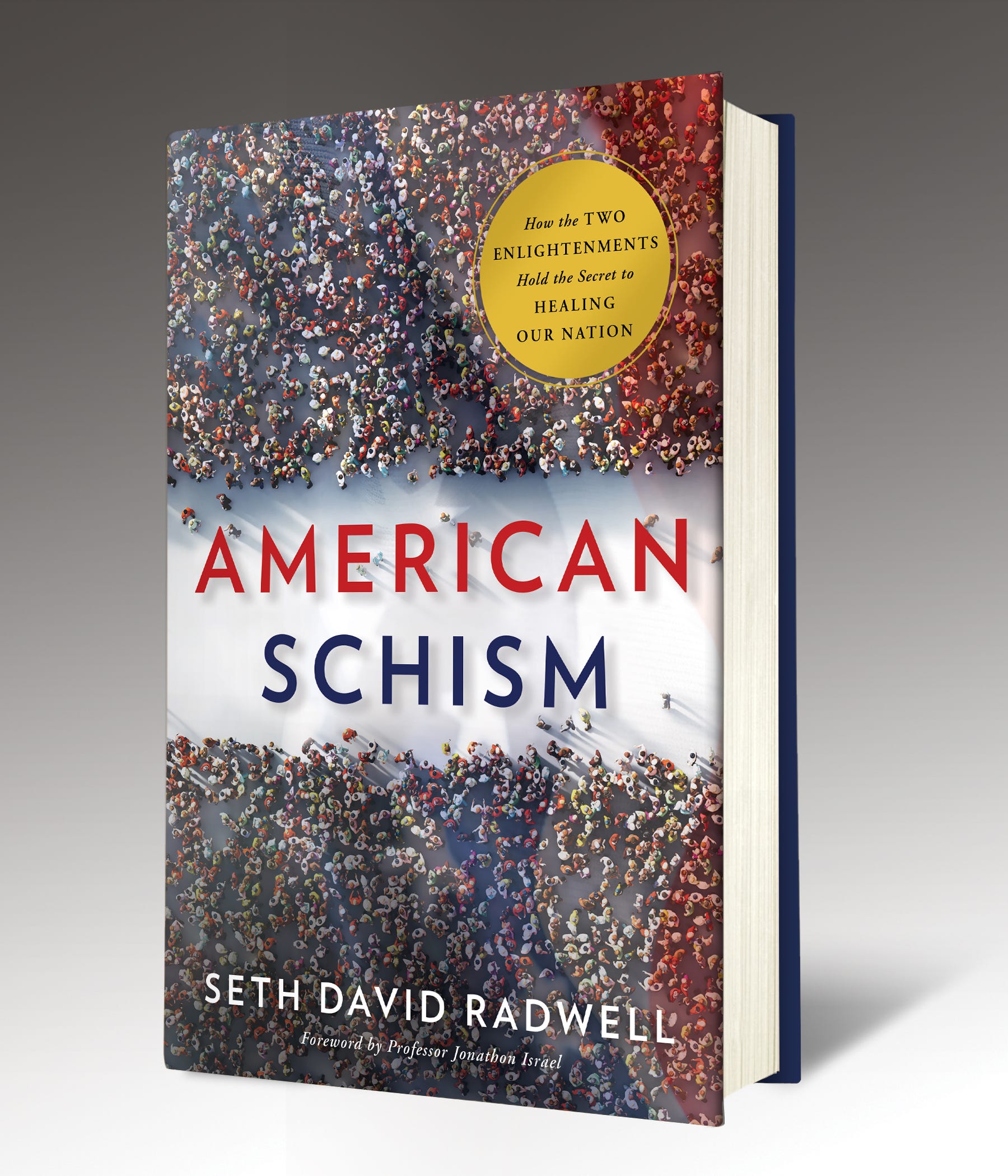
Radwell is the author of “American Schism: How the Two Enlightenments Hold the Secret to Healing our Nation” winner of last year’s International Book Award for Best General Nonfiction. He serves on the Advisory Councils at Business for America, RepresentUs, and The Grand Bargain Project, and is a frequent contributor as a political analyst, and speaker within both the business community and on college campuses both in the U.S. and abroad. This is the fifth entry in a 10-part series on the American Schism in 2025.
Most Recent Amazon Review - 2/20/25
5.0 out of 5 stars Enlightening Journey Through America's Political Divide
Reviewed in the United States on April 3, 2025
What the movie "Batman Begins" is to understanding how it all began for Batman, American Schism is to understanding how our country arrived at the two dominant camps in modern American politics. Seth David Radwell takes you by the hand through time--from before the American Revolution in France and Europe to present day U.S. to help frame and understand the ever-present tussle between the two angels on America's opposing shoulders. This book is indispensable to understanding why we are the way we are. Read it to get smarter. Read it to be empowered.
No posts
Comments
Nothing yet. Say the first thing.
Sign in to join the conversation.