
e& (EAND) has released the earnings results for Q2 2026 last Friday. Before we dive deeper into the release and update our outlook, we recommend revisiting our initiation of coverage post, as this article is meant to be a quick update and will not explain many elements in detail:
OUR THESIS: Dominant and a diversified conglomerate trading at a 30% discount to its historical valuation driven by consensus estimates pointing to a contraction, while the core business has better growth rates and a better margin profile than at any point in time during the last 4 years.
Here is how the results turned out compared to the street’s estimates going into Q2 2026:
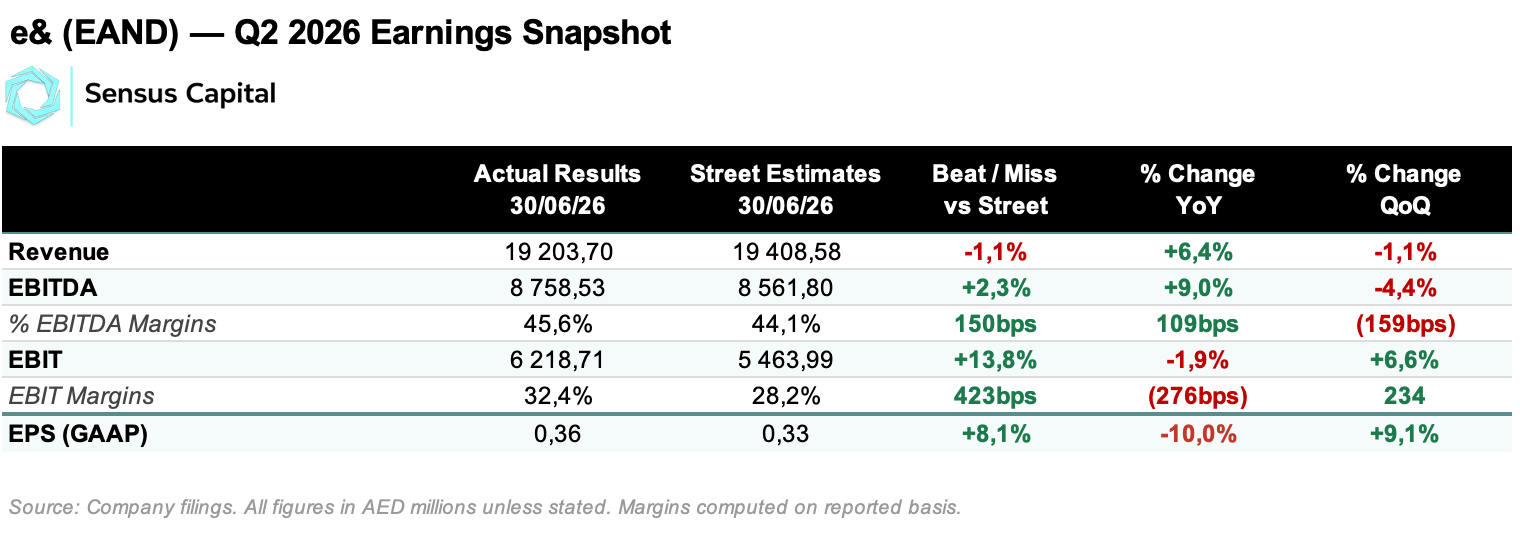
What is noteworthy here, is that the top-line miss can be largely dismissed, as the street was attempting to model the revenue impact from two ongoing consolidations: Telenor Pakistan (still lapping the first full quarters of consolidation) and UPC Slovakia, a new in-market acquisition completed for EUR 95M on a cash-free, debt-free basis.
It is more important that the company delivered a better than expected margin performance (outpacing revenue growth at EBITDA 9% YoY compared to 6.4%), something that has been the core element of the negative sentiment surrounding the stock (expectations of a combination of higher CapEx and regional conflict hurting margins).
The margin beat has also allowed the management to raise their EBITDA growth guidance, but more on that later.
On the group-level, results are consistent across the board:
Revenue increased by 8.7% YoY, driven primarily by growth within the telecom business
EBITDA growth outpaced revenue growth at 9.8% YoY, with margin reaching 46.8%. Pure telecom margin reached 48.3%
CapEx intensity ratio was 18.9%, rather on the higher range of expected results, but still in line. Excluding spectrum and licenses fees, intensity ratio is 15%, below full year guidance (again: the margin pressure is not going to be as severe as the street is modeling). On the allocation side, international remains the main investment focus with an intensity ratio of 28.5% and having 75% of total CapEx allocated to it.
Net debt ratio is 1.17x, slight increase, driven by a payment of tax and dividends for FY2025 done in Q2 2026. Total debt is still stable at 67bln. Post-Vodafone divesture, we expect net debt ratio to significantly improve already next quarter.
Subscriber base reached 251.5 million (yes, quarter of a billion) growing 30.4% driven by the consolidation of Telenor Pakistan and UPC Slovakia.
Operating expenses grew 12.2% YoY, driven by consolidation expenses and higher D&A as the company is undergoing a network revamp (hence also the higher CapEx). Notably, staff costs grew just 1.9% despite the consolidation of new assets, a sign of operating discipline and potential efficiencies utilised within the company. Main cost drivers were D&A and Network costs.
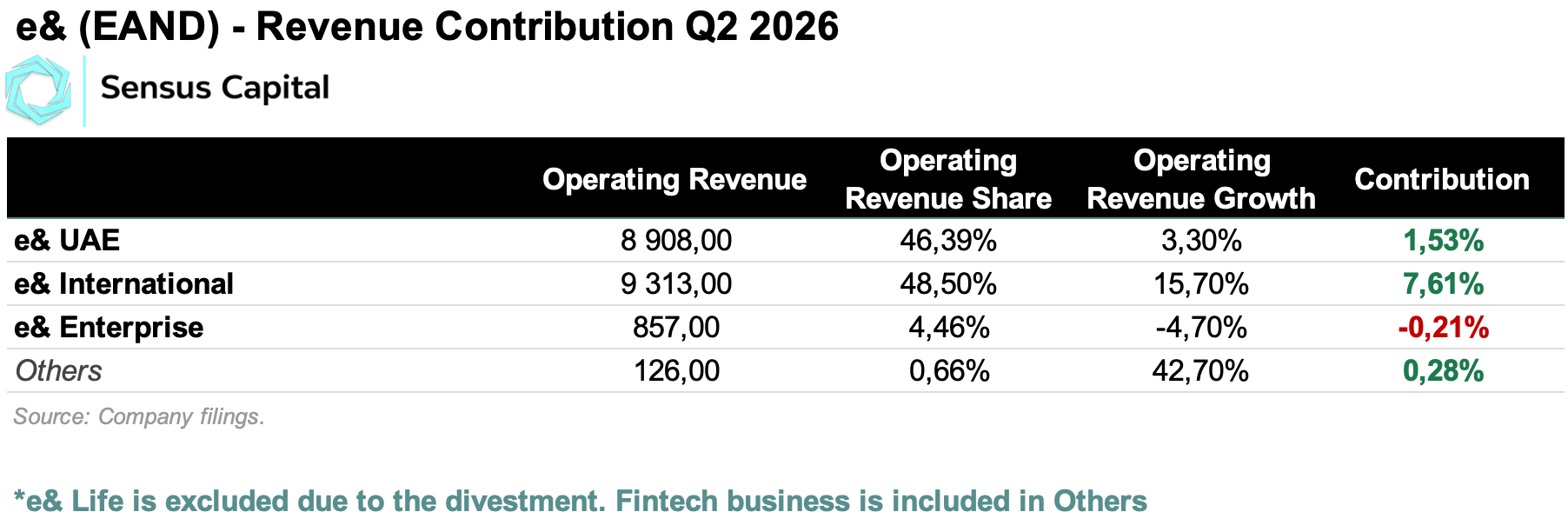
In particular, management has been happy to show off their diversification results, as the international segment is now the largest contributor on the Operating Revenue level.
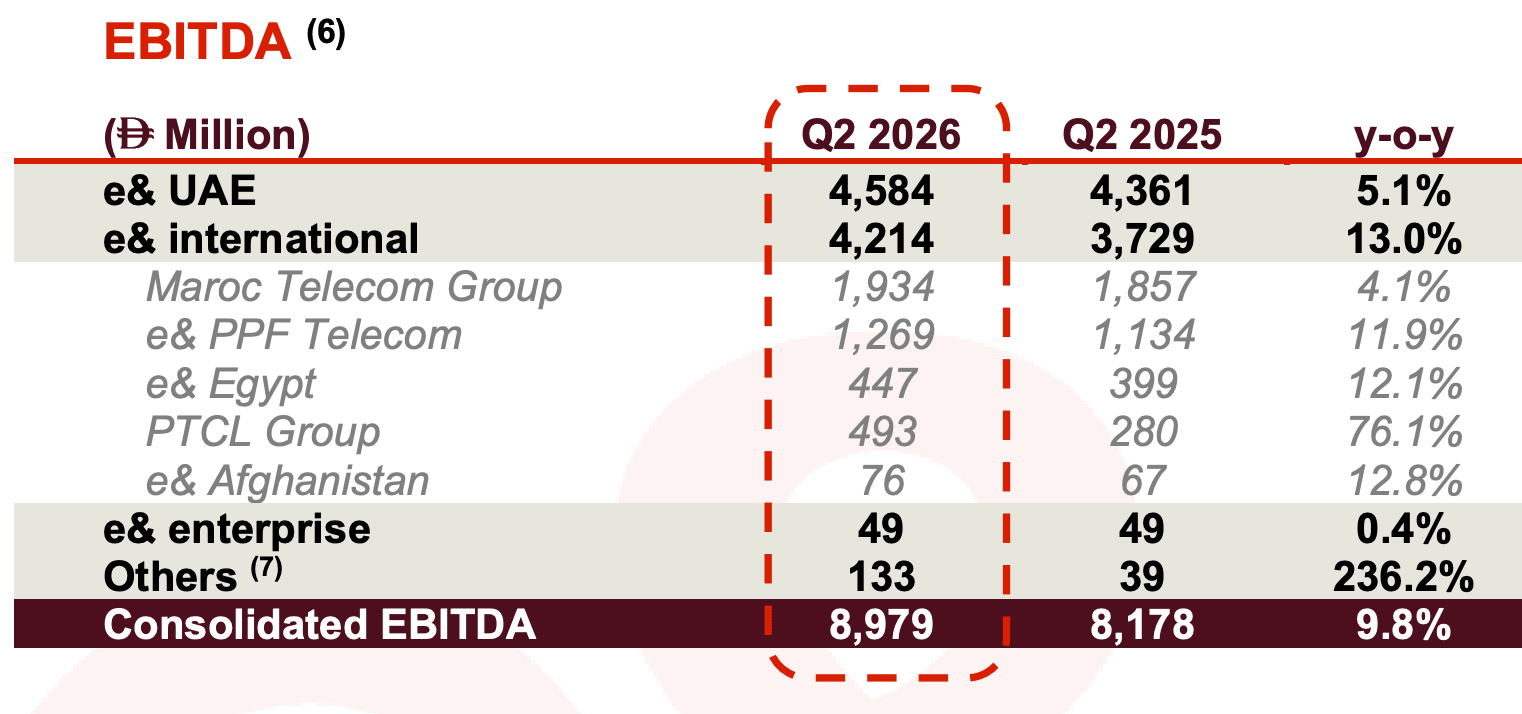
On the EBITDA side, across all telecom segments EBITDA growth outpaced revenue growth. Major highlight is e& international, which continues to deliver on an element of our thesis, which argued that the new acquisitions within the international segment are structurally higher margin telco businesses.
Revenue increased 3% YoY to 8.9bln → this is an element we would flag. Q2 2026 is the quarter that was hit the most by fear and disruptions of business in the UAE, yet the segment still grew 3% YoY. We expect a return to the historical average of 5% growth, driven by core inflation and demographic trends in the country.
Mobile revenue 2% YoY 3.2bln
Fixed revenue 2% YoY 2.9bln
Other revenue 6% YoY 2.8bln
EBITDA margin improved to 51.5% compared to 50.6% a year ago → UAE still remains the main cash cow of the company.
CapEx intensity ratio at 10.3%, slight increase compared to last year at 9.2%
Subscribers grew 6% YoY to 16.5mm, driven by demographics and market share gain (and this was supposed to be the quarter where we would see mass exodus of expats from the country).
Mobile: ARPU of 72, down from 77 a year ago. → driven by a decreased number of social gatherings and events in the quarter, and closed schools due to the regional situation (based on our observation) & mix shift (based on management’s commentary)
Fixed: ARPU of 475, up from 470 a year ago.
Revenue increased 16% YoY to 9.3bln.
EBITDA margin 45.2% compared to 46.3% last year.
CapEx intensity ratio at 28.5% (20.4% excluding spectrum & license fees) compared to 22.6% (and 19.8%) a year ago.
Subscribers grew 32% YoY → second quarter of YoY lap with Telenor Pakistan acquisition.
Diving deeper into each region within the international segment:
Maroc Telecom Group:
Revenue increased 6% to 3.6bln → remember, internationally, this is the toughest market for the company to compete in
EBITDA margin 52.9% compared to 53.8% last year (!!) → still a very profitable international segment despite all of the competition and management has confirmed that further recovery is on the way.
CapEx intensity ratio at 22.4%, flat YoY
Subscribers grew 3% YoY to 77mm
e& PPF Telecom Group:
Revenue increased 13% YoY to 2.8bln → in CC, the growth was still double digits at 10%
EBITDA margin roughly flat at 45.2%
CapEx intensity ratio 17.5%, slightly up compared to last year.
Subscribers grew 3% YoY to 15mm
e& Egypt:
Revenue increased 16% YoY to 1.3bln → major green flag for the thesis specific to Egypt
EBITDA margin slightly decreased to 34.9%, compared to 36.2% last year.
CapEx intensity ratio at 86.4%, major jump due to newly purchased licenses and spectrum fees, adjusted it is 27.1%
Subscribers grew 11% YoY to 44.5mm → another green flag
PTCL Group:
Revenue increased 67% YoY, due to Telenor acquisition, excluding it, revenue increased 11.2% YoY to 1.4bln
EBITDA margin improved to 36.1% compared to 34.3% (Telenor is a margin accretive acquisition)
CapEx intensity ratio at 16.4%, down from 28.1% last year
Subscribers nearly doubled due to the acquisition to 76.7mm
In short, every international segment delivered in line with or ahead of our thesis expectations. The UAE, in what should have been the toughest quarter for the domestic business, proved more resilient than consensus feared. This sets up the guidance update, which is the most important part of this release.
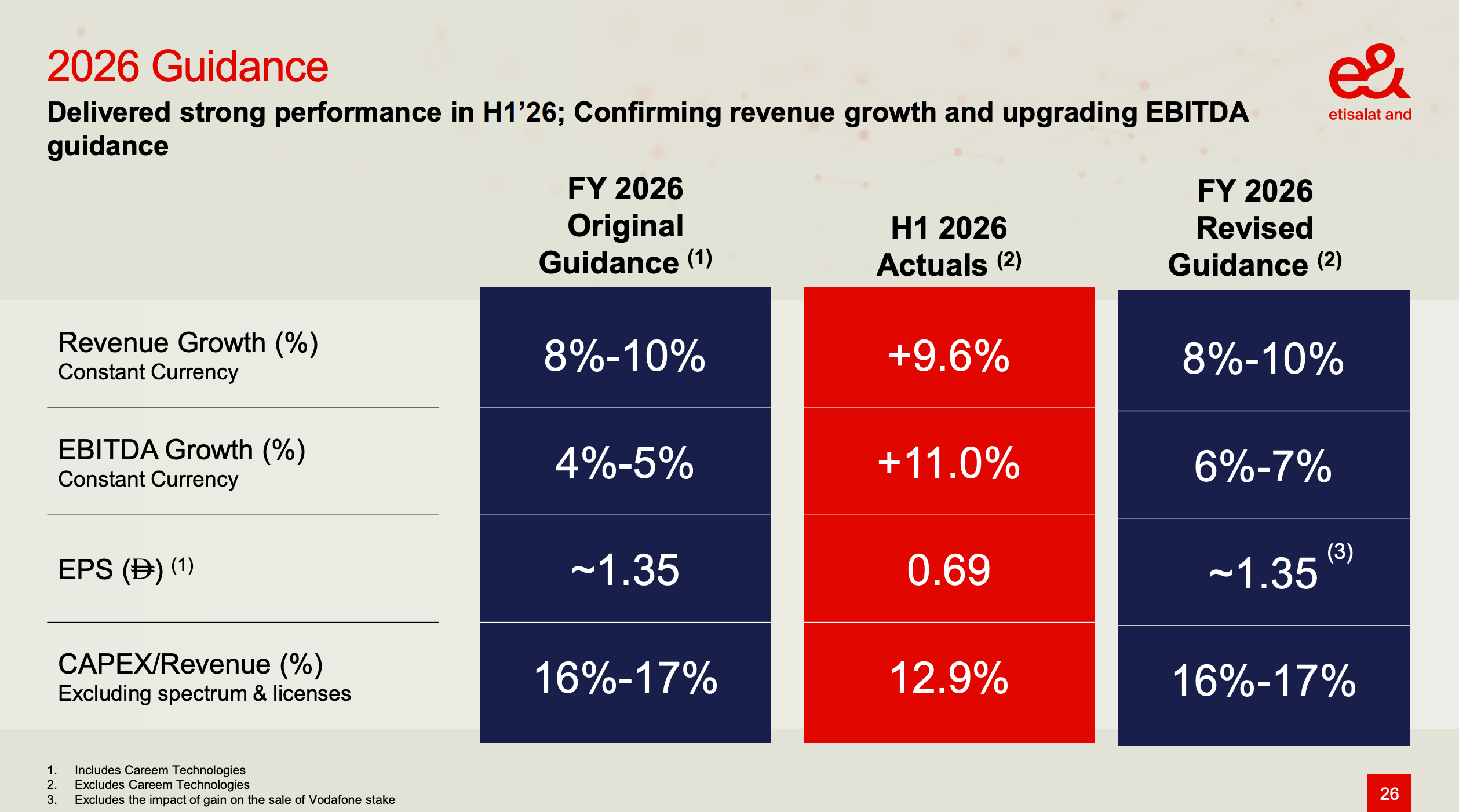
The management kept the guidance consistent for all metrics but one - EBITDA growth. There, given the strong outperformance in H1, the company has raised the growth target to 6%-7% range, up from 4%-5% range previously.
This still implies a slight margin contraction YoY, however, much less pronounced than is currently forecasted by the street.
The quarter is aligned with our expectations and although it was a beat relative to where the street was at, we were initially more optimistic.
Therefore, we do not see any material revisions needed to our initial projections outlined in our initiation of coverage report. For us to change our stance, we will need to wait for the management’s commentary about FY2027, in particular, how the margin recovery will look like. Currently, we are expecting the inflection to begin only in FY2028, but given the Telenor acquisition (higher margin than the existing Pakistan business) and the recovery underway in Maroc Telecom Group, we could see the margin recovery come into play sooner than expected.
Furthermore, management might decide to put the cash generated from the sale of Vodafone stake to good use, but there has not been any clear hint as to what it may be just yet.
In our initial report, we based our PT on the following assumptions:
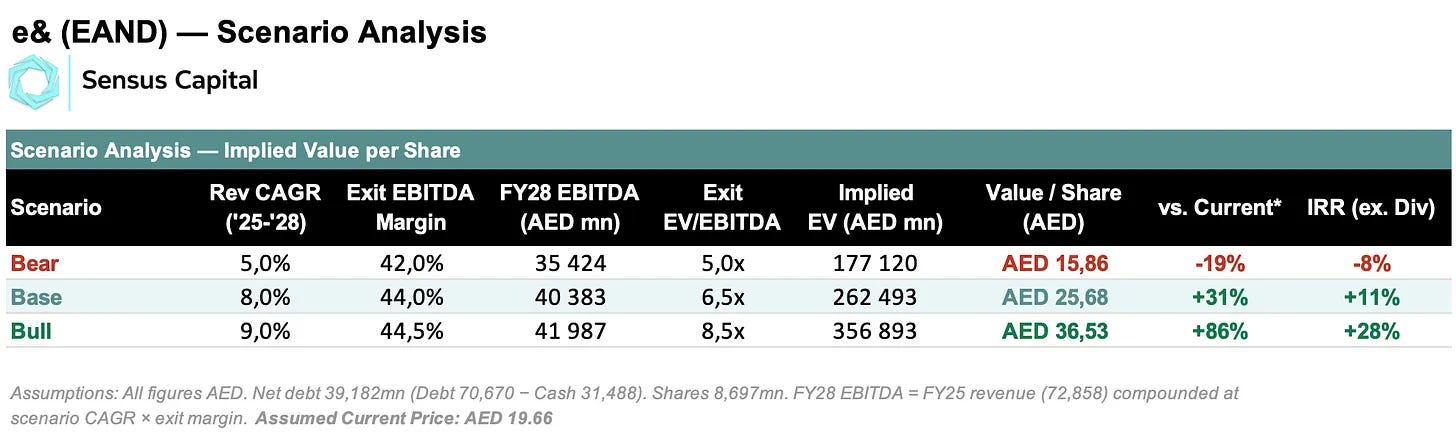
We maintain our FY2028 price target of: AED 27.95.
Thank you for reading this update until the end. We aim to provide short-form, quick updates for all of the companies under our current coverage. Some deeper dive updates will be available only to our paid subscribers.
Full Disclaimer: The content published by Sensus Capital Research (”Sensus”) is provided for general informational and educational purposes only and reflects the personal opinions and analysis of the author as of the date of publication. It does not constitute investment, financial, legal, or tax advice, nor a recommendation, offer, or solicitation to buy, sell, or hold any security or to adopt any investment strategy.
Sensus is not a registered investment adviser, broker-dealer, or financial analyst in any jurisdiction, and nothing in this publication should be construed as personalized advice. Any views expressed are not tailored to the specific objectives, financial situation, or needs of any individual reader.
The author may hold, and may buy or sell, positions in the securities or instruments discussed at any time without notice.
No posts
Comments
Nothing yet. Say the first thing.
Sign in to join the conversation.