
Earnings season has started and we are getting ready to hear some updates on the names we have covered in the past.
Before each print, we re-visit the thesis and note what to look for. It makes analysing the release faster and makes it easier to judge whether the thesis still holds, has improved, or deteriorated.
Today, we will go through four names we have in our coverage: Dynatrace $DT, ACM Research $ACMR, Klaviyo $KVYO, and Zeta Global $ZETA.
The complete list of our current coverage you can find here:
For readers new to our coverage, links to the full initiations are included under each name. We recommend reading those first for the complete picture, this guide assumes familiarity with the businesses.
This post is free for all subscribers, but the immediate earnings review and update of the models (if needed), will be accessible to our paid subscribers, with a delayed release for the rest.
In short, we believe that AI remains a demand driver for Dynatrace’s core product offering. Its core focus is to enable enterprises to better monitor their cloud workflows and infrastructure. Adoption of AI agents expands their TAM, as every agent deployed needs to be monitored (did it hallucinate? did it provide the correct response? which sources did it use? did it change any of the underlying data? etc.)
The initial AI-panic sold the stock off, which created an opportunity for creating a position in this high quality name.
One of the key elements of the thesis is the transition to DPS pricing model for the company. To quote our initial report:
DPS customers’ consumption growth outpaces SKU-based customers by 2x. In Q3 FY2025, on-demand consumption revenue contributed 150 bps to subscription revenue growth. Customers on DPS can start using a new capability (logs, security, AI observability) without a new procurement cycle, which removes the friction that historically slowed cross-sell in enterprise software.
On the financial side, the company remains in excellent shape:
Large ACV deals are still ramping
New product adoption is still early
DPS consumption is turning into a flywheel
For context, below is how the most recent release looked:
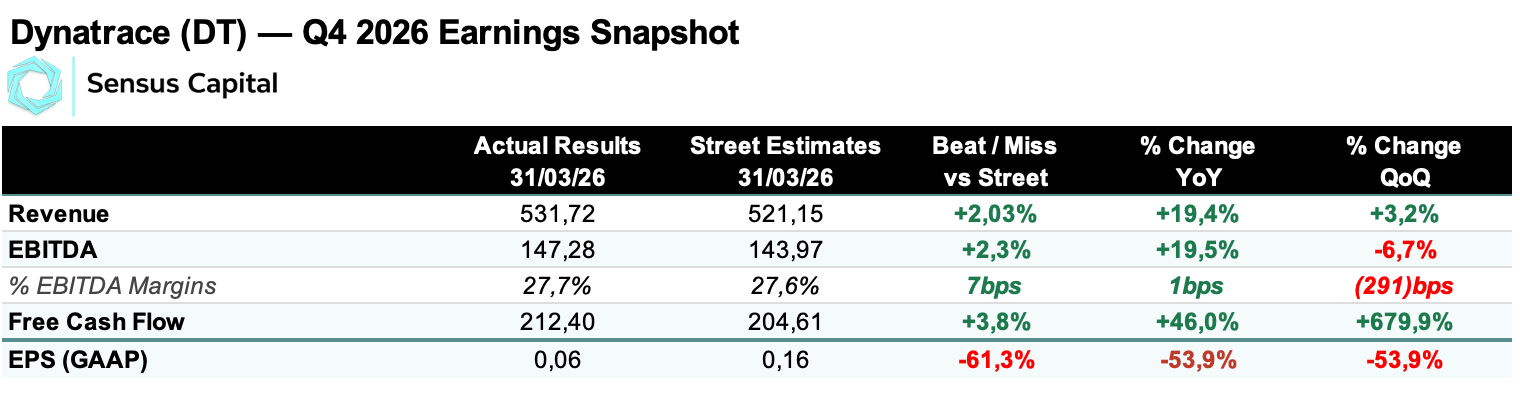
A beat on the top-line and a very healthy FCF margin expansion. Dynatrace has been focusing on making their core business more profitable, while sustaining 15% YoY revenue growth. Previous quarters delivered on it. For the next one, both the street, and us, will be looking for more of the same.
Consensus:
Revenue ($MM) of 549.4 15.1% YoY
Adjusted EBITDA ($MM) of 159.96
Free Cash Flow ($MM) of 303 15.6% YoY
Meaning, the street expects slight revenue deceleration, but still above 15%, together with some margin pressure (due to DPS transition).
Sensus Estimates:
Revenue ($MM) of 548.9 15% YoY
Adjusted EBITDA ($MM) of 165
We don’t like to get super detailed on quarterly estimates, as most of it is just “crystal ball” number guessing. However, on the top-line 15% YoY for us is key, and we are expecting slightly better than expected margin performance.
The key as always will be guidance, and that’s what the market will react to the most. Management needs to continue beating and raising, otherwise, short-term volatility will be there.
In our initial reports, we always outline the watching points we are using to evaluate the thesis. For Dynatrace, we are looking at three areas:
Enterprise adoption through ARR per new logo and ACV deals count
DPS adoption and NRR trajectory
Profitability expansion
In particular, our optimistic stance rests on:
AI observability demand is being mispriced at zero. Consensus models largely treat Dynatrace’s AI-related revenue as immaterial or speculative. We believe AI observability is already contributing to the growth rate (logs at $100mm+ annualised, nearly all 7-figure deals include AI workloads) and will become a primary growth driver over the next 2-3 years.
NRR has a path to re-acceleration. Consensus treats 111% as a ceiling. We believe it is instead temporarily compressed by the DPS pricing transition. A return to the 113-115% range is realistic and would materially improve the revenue growth rate.
The stock bounced up from the lows of sub $35 (the point at which we got bullish on it). Management has been active in the buyback market before the blackout period, and the activist investor who since then took a stake in the company has been helping with the flows and price stability.
What matters most is the business performance. Dynatrace was, is and always will be compared to Datadog $DDOG. Its differentiation was always in the form of a “more profitable, stable company” tackling largely the same market. Datadog’s growth has been much more impressive, therefore, Dynatrace cannot afford to be left behind.
Guidance needs to show that DPS transition will deliver what the management has promised.
We have a call scheduled with the Dynatrace IR team following the release, and will incorporate any additional context into our paid earnings review.
ACMR has not yet received a standalone initiation report, but it is planned on the calendar soon.
For full disclosure, it was part of our portfolio with a cost base of roughly $16 per share, and we held it all the way until our PT of $61. Needless to say, the stock has continued running ever since.
At current levels, we do not see sufficient margin of safety to revise the PT materially higher. Our belief is that the market is getting too excited about the AI hardware build-out within Asia (in this case China in particular) and is already pricing in expectations of great results for several quarters to come.
However, ACM Research is a name we intend to re-enter at a sensible price, therefore, we will still be keeping a close eye and provide updates on its earnings to our paid subscribers in more detail.
The main core thesis behind ACMR is that ACMR does not need to “win” any new Chinese customers to ride the “beef up the tech” wave in China. It already has long term contracts and relationships with the key players covering everything from foundry to NAND design.
It is clear that the authorities want homegrown products and players, which will remain a major tailwind for the next 3 years for the whole sector.
Since a year ago, the thesis has only gotten stronger in both timeline and scale, as the build-out is picking up pace in China.
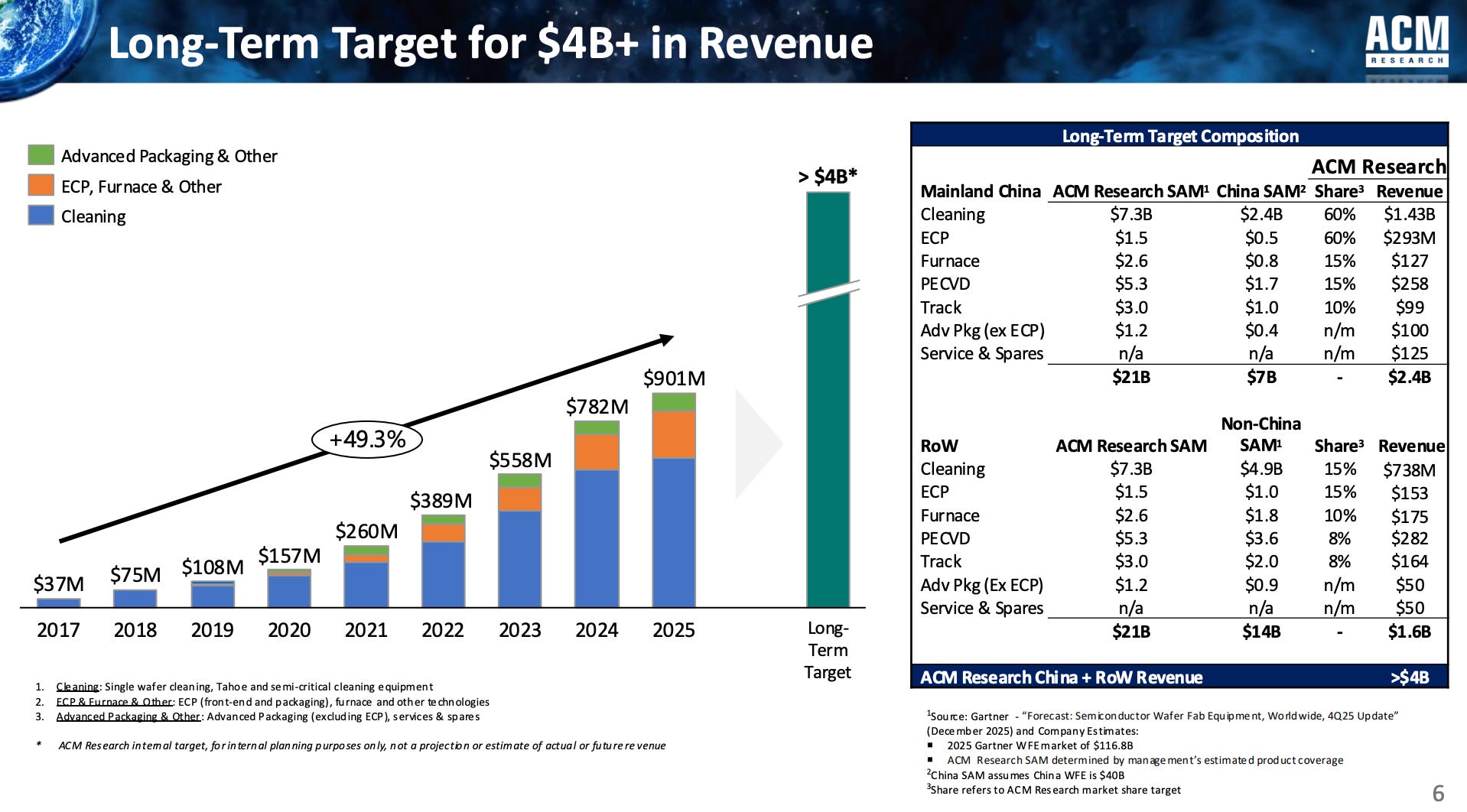
Aside from the financial performance, ACM Research got the market excited through some key product breakthroughs (it is helpful to compare each breakthrough with a market opportunity demonstrated in the image above):
It has shipped its first plasma-enhanced chemical vapor deposition (PECVD) silicon carbonitride (SiCN) system to a leading semiconductor manufacturer → this is a push towards advanced packaging market.
Panel-level horizontal plating (515x510mm format) is gaining traction with multiple customers in Asia, with production orders expected this year
Ramp up of single-wafer SPM production to deliver 15 to 20 units by year end → this is much better than the market leader and is targeting the cleaning space
Vertical furnace tools are in evaluation at multiple customer sites → targeting the Furnace market
In short, ACM Research is rolling out new products in all of its key product families that help them win contracts away from the established players in the market.
Financially, last quarter was a win as well:
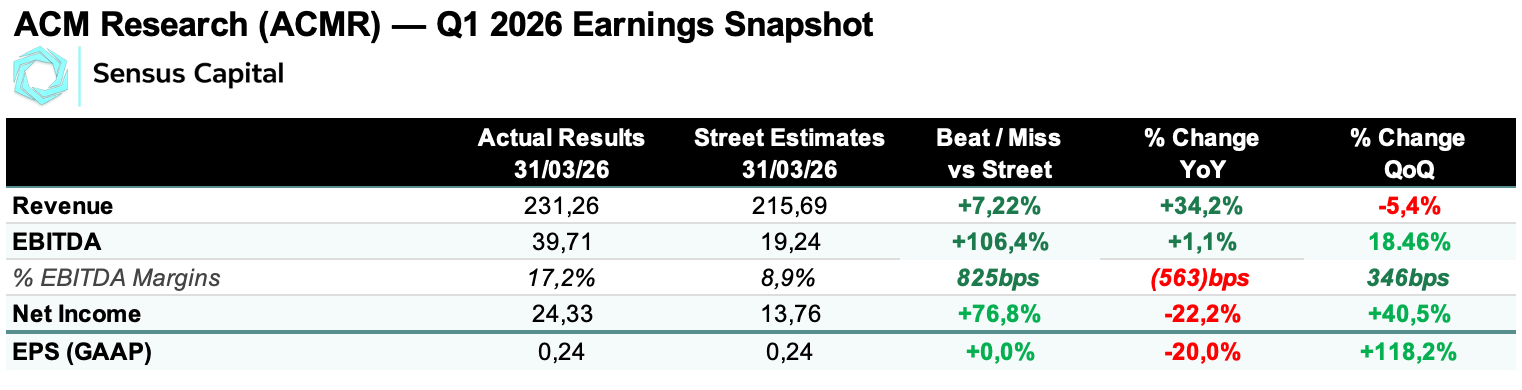
Important to note that a significant portion of revenue/shipments was caused by the delays from Q4 of last year.
Consensus:
Revenue ($MM) of 269.24 25% YoY
Adjusted EBITDA ($MM) of 32.93
Net Income ($MM) of 23.69
The expectations are for another quarter of impressive revenue growth with compression on the margin front driven by a different product mix.
Margin compression is not too worrying, as it will return towards the mid-point of the management’s long-term guidance (they guide for gross margin of 42-48% and recently it has been trending in the 46% level).
Another interesting pattern (which also explains the run-up in the share price) is the amount of upward revisions that took place over the last 6-7 months:
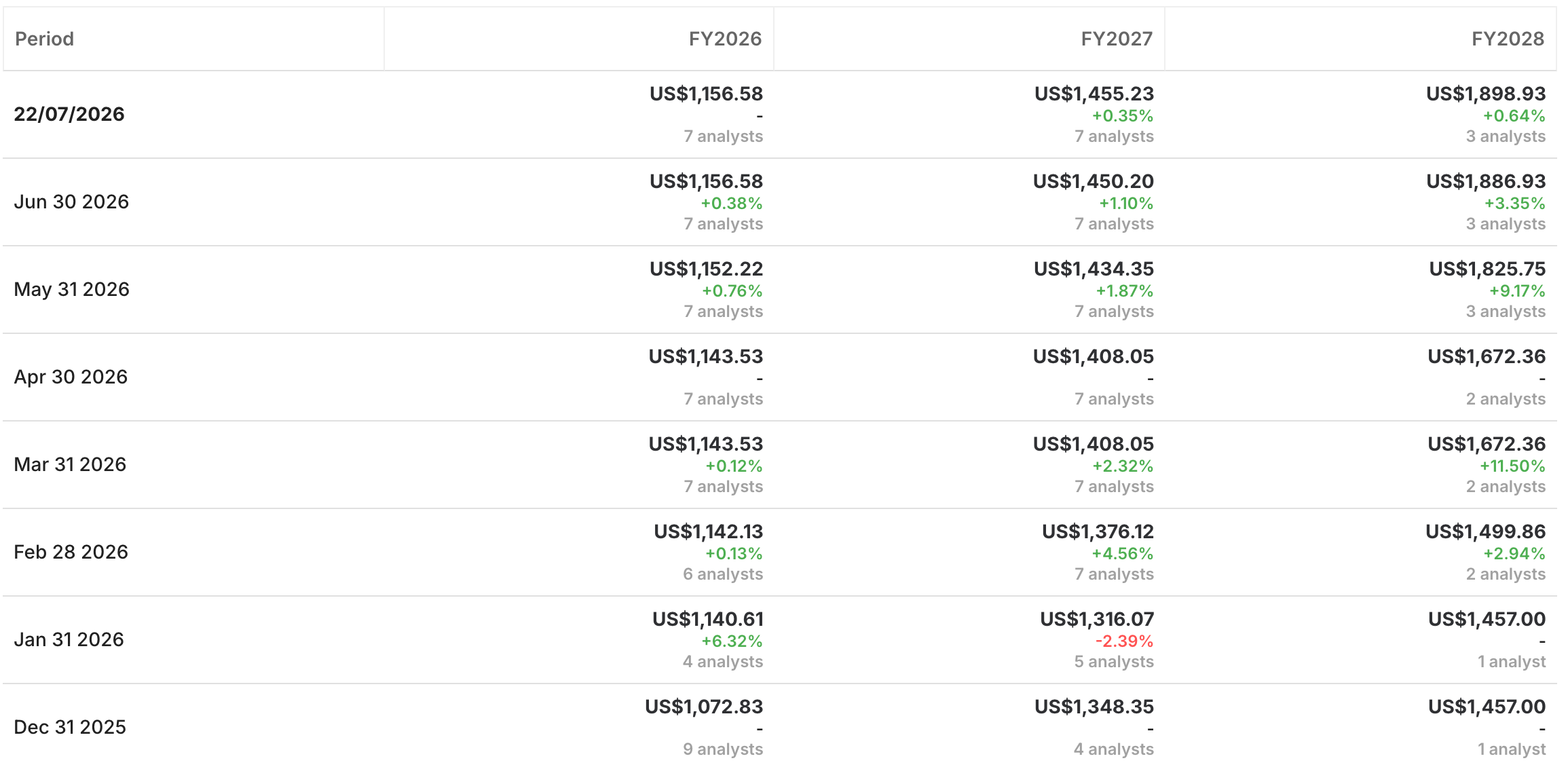
The market might be pricing in a bit too much excitement here. Our initial PT of $61 (set in December 2025) was hit, and the stock has continued rallying since (driven by the hardware excitement).
We are still cautious about revising the price target upwards, but will analyse the upcoming earnings release in much greater detail and provide the update in a timely manner.
Given the investors’ enthusiasm over the company’s prospects, the quarter alone will not have much of an impact on the stock price. Outlook and comments on customer wins will be key, as it is all about “what’s next?” and “how much of the market can ACMR gain and how quickly?”
Last quarter demonstrated that the company is ready to compete with the “big boys” and win contracts for more advanced chip production lines.
Importantly, the ceiling for the production technology is still much higher (due to overall market’s capacity and know-how lagging the US counterparts), and this translates into several more “renewal” cycles possible in the short to medium term, as opposed to already shipping the most advanced tech, which would make renewal rather improbable as it would require significant efforts to improve output.
If we had to narrow down our focus areas on a “napkin”, we would write the following three bullet points:
Shipments growth?
Outlook on the market and competition?
Updates on the international shipments?
We have outlined our thesis behind Klaviyo pretty well in our initial post covering it:
The “builder” DNA of the leadership team is expected to shift from growth to operating leverage in FY2028. We forecast improvements in profitability and arrive at $356.4mm in Adjusted EBITDA by FY2028 as we expect benefits from AI-driven internal efficiencies to start having an impact.
In the current technological era, it is important that the management actually knows the product and the market inside out. Klaviyo, with Andrew, is a perfect example of it.
We believe that just like with Dynatrace, AI is a tailwind for Klaviyo. It has spent years building out the toolbox for the entire GTM, customer acquisition and retention for thousands of global e-commerce stores and brands. Through this adoption, it has collected proprietary data (the data is technically the customer's, but migrating entire workflows tied to the full sales stack carries meaningful switching risk) and integrated itself deeply into each of the workflows its customers have. The core focus of Klaviyo was always to build for a non-tech user, and that focus is now paying off: adoption has been increasing, customers are growing faster, Klaviyo is getting more global and scaled.
Next 2-3 quarters will be key to either prove us wrong and show that AI will disrupt the moat of the business, or prove us right and show that Klaviyo will thrive in the future’s world.
For context, below is how the most recent release looked:
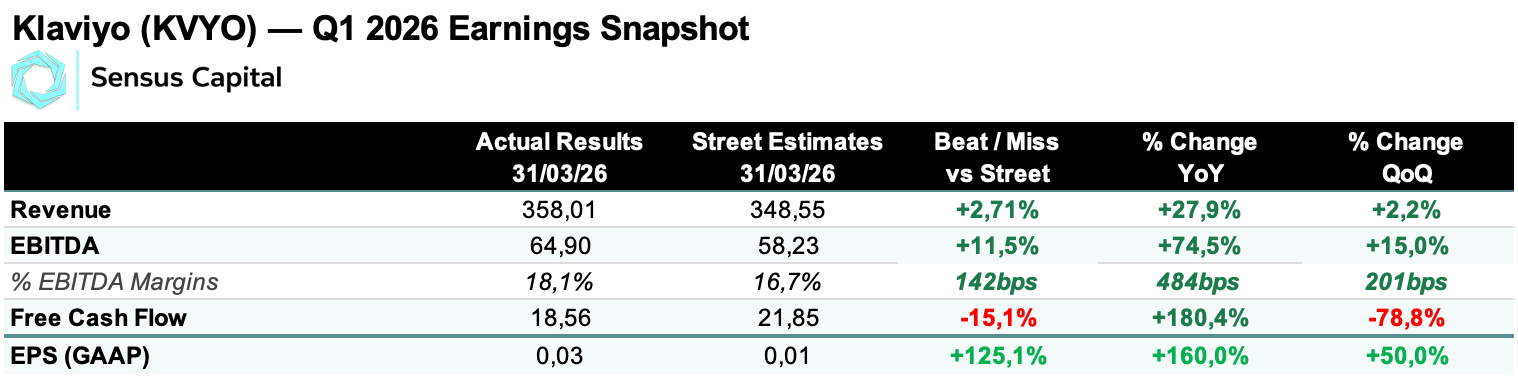
Again, it does not look like a company getting disrupted by AI, but the negative sentiment will, as mentioned earlier, require a few more quarters to fully dissipate.
Consensus:
Revenue ($MM) of 362.1 23.5% YoY
Adjusted EBITDA ($MM) of 56.8
Free Cash Flow ($MM) of 62.89 6.1% YoY
The street expects another quarter of 20%+ growth, but the margin is expected to remain tight due to higher attach rates of the SMS module (lower margin segment).
Sensus Estimates:
Revenue ($MM) of 355.3 21% YoY
Adjusted EBITDA ($MM) of 49
Since we see Klaviyo as the most “potentially disrupted” player out of the four we are covering today, due to the fact that Shopify still has a larger control over the value chain and we need a few more quarters of persistent positive customer behaviour to ease concerns, we are more conservative than the street.
We have summarised it pretty well in our initial post, and the following three watch points still hold:
International Dominance: With EMEA and APAC currently growing at 42% YoY, we expect international markets to contribute a larger share of the total revenue mix, providing a critical hedge against the U.S. consumer weakness.
The Enterprise Shift: The continued 30%+ growth in customers with $50k+ ARR suggests that Klaviyo is winning the larger brands from the legacy marketing clouds.
Product Cross-Sell: We are closely monitoring the attach rates of the newer modules, targeting an increase from mid-20% range towards 35%+ as WhatsApp and RCS integrations mature.
On top of that, we will be closely listening to the plans and perspectives the new CFO will share, as her previous role, CFO at CyberArk, is something that looks like a potential catalyst to us if she executes the same playbook.
Our thesis behind Zeta is similar to Klaviyo, after all, both companies are disruptors in the MarTech space.
If put in one sentence, we are optimistic on Zeta as:
Zeta Global has a durable competitive advantage through its proprietary CDP containing 245 million+ deterministic profiles and its native AI architecture, which together create a data moat that new entrants and generic AI tools cannot replicate.
Klaviyo focuses on e-commerce and attempts to move more into a marketing stack + CRM. Zeta is pushing deeper into the enterprise marketing platform, by relying on the data infrastructure offering.
Marigold’s acquisition was a step in the right direction. Profitability has been continuously improving, and the top-line growth, even on organic terms, is beyond impressive.
Management is on a streak of beat-and-raise quarterly results, something that we see as rather simply a game, but nevertheless they will need to deliver and raise their guidance once again, if they want to avoid the stock getting hit with a fresh wave of selling.
For context, below is how the most recent release looked:
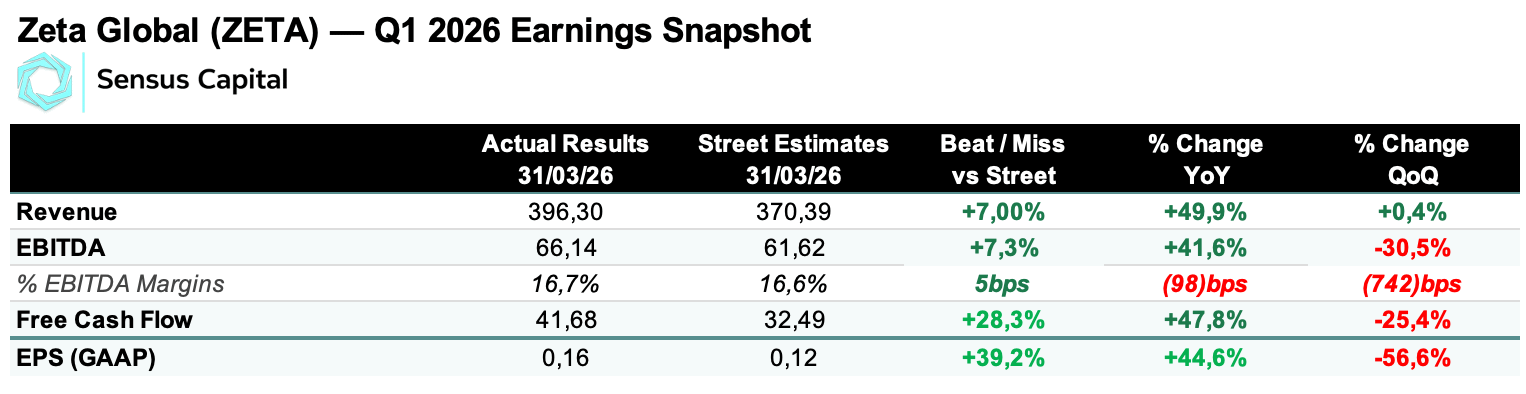
It was a second quarter of Marigold’s consolidation (so, you can tune down the 50% YoY revenue growth rate). The management has insisted that the slight margin compression is due to integration of Marigold, so that is something that needs to receive positive updates on next quarter.
Guidance will be key, as always.
Consensus:
Revenue ($MM) of 420.61 36.4% YoY
Adjusted EBITDA ($MM) of 86.44
Free Cash Flow ($MM) of 54.21 36.6% YoY
Still a lap quarter comparison-wise with Marigold’s acquisition. Key element is profitability. Zeta must beat expectations here for the momentum to remain positive.
We are also sure, that the street will ask for more insights on the Palantir partnership.
Sensus Estimates:
Revenue ($MM) of 405.5 31.5% YoY
Adjusted EBITDA ($MM) of 100
Here, we actually aim to hear better profitability than expected from Zeta. Management has hinted at it for several quarters now that the inflection is coming. They do not have any substantial CapEx need and they indicated that their token economics are profitable as of now.
A short-term profitability miss will still be fine, as long as the guide will be optimistic.
One area that will for sure receive lots of attention is the transition to Palantir’s Foundry.
Management has indicated that the transition will be initially cost neutral, and contribute positively to the operating margin in FY2027. The idea is to create a “one-two combo” situation, as the new partnership is expected to optimise OpEx and also boost up the pipeline conversion.
By the time earnings come out, management would have already had a decent enough observation period to share further insights into the impact and update the guide accordingly. Any quantified pipeline or conversion uplift tied to Foundry would be an indication that the collaboration is working well.
On top of that, the previous watching points we have outlined still hold, and in fact, management has claimed during the IR conferences they are confident in hitting them:
Sustained 20% organic top-line growth for the next 3-4 years
Continued expansion toward 200+ Super-Scaled customers by H2 FY2027
Margin improvement
Thank you for reading the entire post. We will get back with you with individual earnings analysis once they are released. As a paid subscriber, you will receive the analysis within 24H.
Full Disclaimer: The content published by Sensus Capital Research (”Sensus”) is provided for general informational and educational purposes only and reflects the personal opinions and analysis of the author as of the date of publication. It does not constitute investment, financial, legal, or tax advice, nor a recommendation, offer, or solicitation to buy, sell, or hold any security or to adopt any investment strategy.
Sensus is not a registered investment adviser, broker-dealer, or financial analyst in any jurisdiction, and nothing in this publication should be construed as personalized advice. Any views expressed are not tailored to the specific objectives, financial situation, or needs of any individual reader.
All investing involves risk, including the possible loss of principal. Past performance is not indicative of future results. Forward-looking statements, projections, price targets, and scenario analyses are inherently uncertain, are based on assumptions that may prove incorrect, and should not be relied upon as fact.
Information is drawn from sources believed to be reliable, but Sensus makes no representation or warranty as to its accuracy or completeness and accepts no liability for any loss arising from its use. Readers are solely responsible for their own investment decisions and should conduct their own due diligence and consult a licensed financial professional before acting.
The author may hold, and may buy or sell, positions in the securities or instruments discussed at any time without notice.
No posts
Comments
Nothing yet. Say the first thing.
Sign in to join the conversation.