
ACM Research Inc ($ACMR) is a name we have followed for a while now. We got very bullish on the company back in late 2024, when the stock was trading at around $16 per share, following the hype cool-down of early 2024 and of 2022, two “go go” moments for the company’s stock that pushed it above $30 per share at the time.
We saw a name that lost the previous attention it had, while none of the core business drivers got impaired. We built a position and subsequently exited it once the stock hit our 3-year PT of $61 back in February of this year.
We continue being optimistic about the company. But we also have been around long enough to know that the market loves to get overly optimistic about the stock (2022, early 2024) and just as easily moves on and dumps the stock back into very attractive levels.
Today, we will outline our detailed thesis behind the company and determine at what price we are willing to enter, and how we foresee the next several years playing out for the company and for the stock.
Before looking at the company itself, in this particular case, it is very important to understand the dynamics at play within the industry. Taking a position in ACMR is essentially betting on the Chinese semiconductor industry. This is a market that has lots of strong tailwinds driving excitement behind it, but it also has some degree of nuances that need to be kept in mind.
We have discussed these dynamics in our 2026 Outlook report, and since then, the developments have progressed quicker than expected.
In particular, we argued that the narrative around Chinese technology was about to shift from “low-cost manufacturing” to “total technological independence”. 2026 marks the inaugural year of China’s 15th Five-Year Plan (2026-2030).
The plan explicitly prioritises “high-level sci-tech self-reliance” and the development of “new quality productive forces” in core areas like integrated circuits and high-end industrial machinery.
China has made AI and tech self-sufficiency a national priority.
To achieve that, they need to bring their chip industry, which still lags its Western peers, up to speed. The wafer fab equipment (WFE) localisation rate is projected to nearly triple from 16% in 2024 to 42% by 2027. The figure for 2025 came in at around 25%.
This translates into an anticipation for the domestic Chinese WFE revenue to grow at 37% CAGR over the same period. The industry is getting lots of money and attention in China.
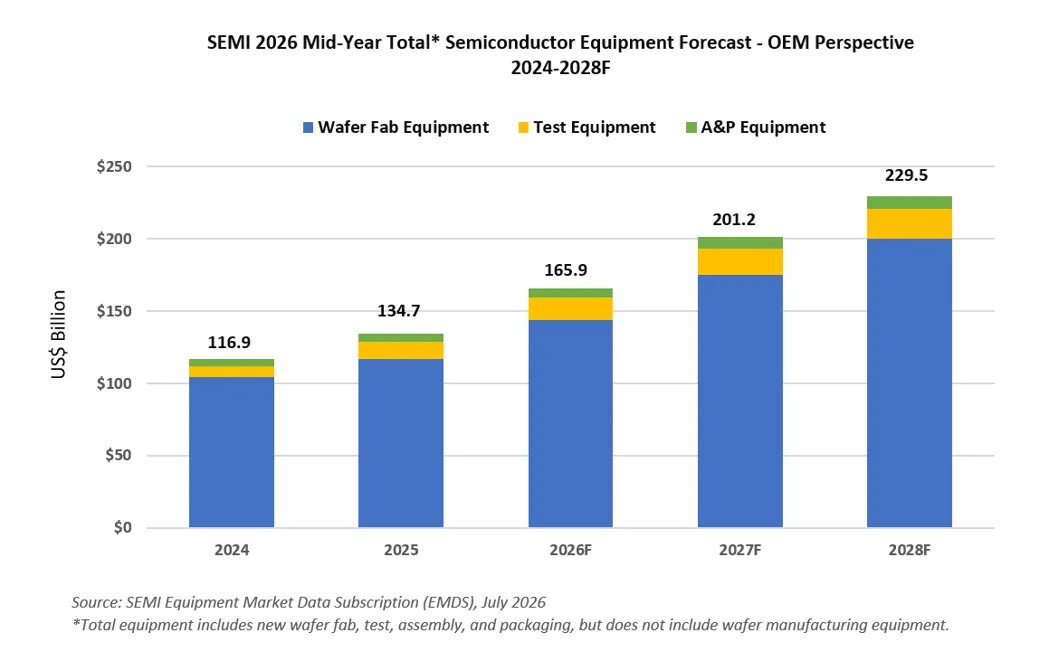
In 2024, China already accounted for a record $104bln in WFE sales, and is expected to maintain its leading position through 2027.
Again, the country wants to become independent in the chip world, and despite all the spending to-date there is still significant room left to invest to properly catch up.
Now, this was the set-up going into 2026, what has happened since then?
Well, the thesis started playing out at an even faster pace than expected.
Revenue across key suppliers (which we will cover in more detail, but the following names in particular: NAURA Technology Group, Piotech, etc.) grew significantly, pointing at an industry-wide inflection.
AI became the focus point even more than before, driven by an increased step up in investment/build-out of infrastructure and better performance of the Chinese models (which are now comparable to the Western peers and are gaining adoption in the global consumer space).
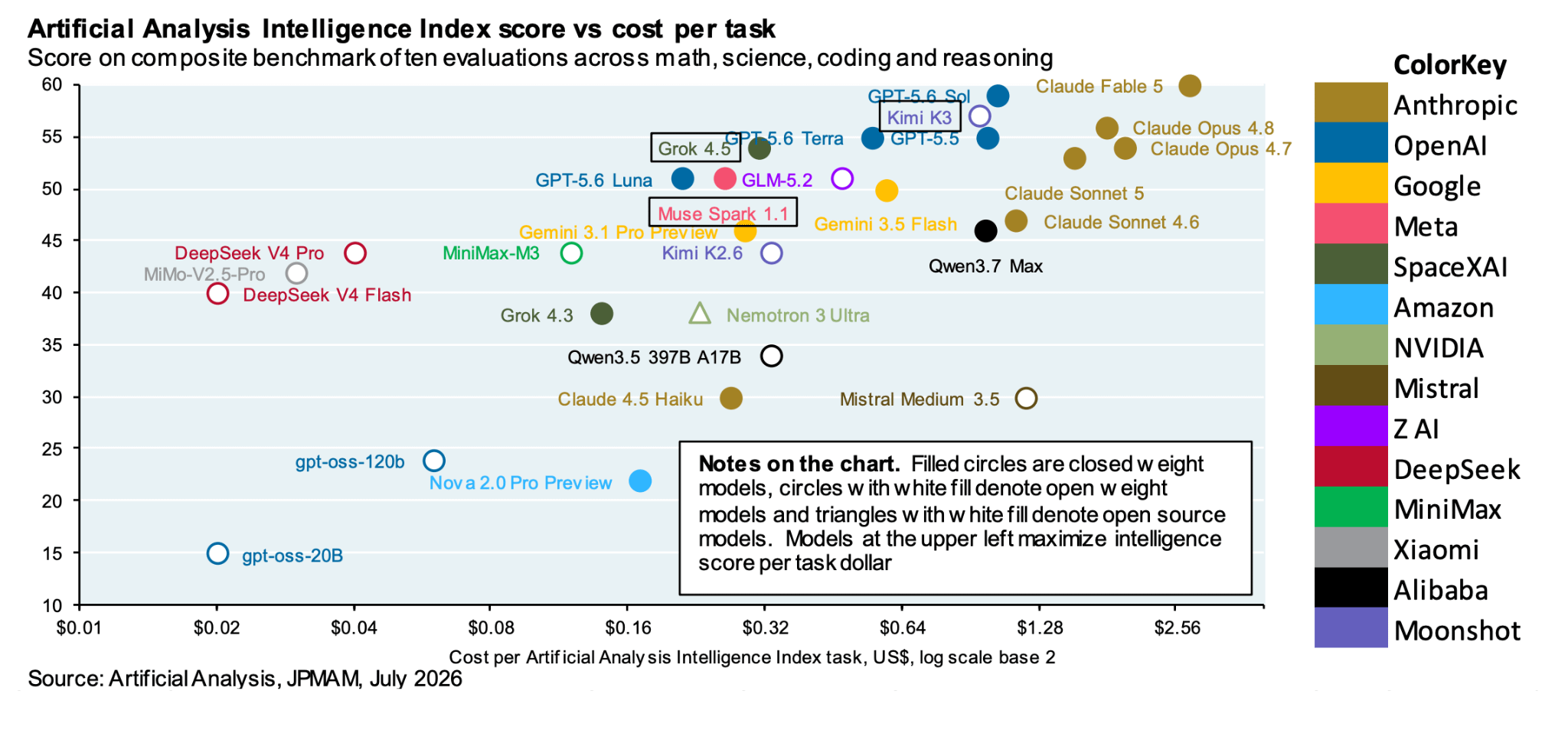
It is now also undoubtedly clear that AI is a national priority, as was seen by the Xi Jinping’s rare public speech on AI.
What is more interesting, is that China now wants to become the AI/tech provider to the South Asia’s partners. This lifts the ceiling on the assumed capacity build-out. Models going into 2026 focused primarily on the China’s own needs for the tech capacity, but now China is focused on turning it into its key export product too (which demands more capacity).
This is all great news for manufacturers of hardware in China. In simple terms:
AI needs chips
Chips need fabs
Fabs need equipment → But, western restrictions mean Chinese fabs must source domestically
So, companies that provide that hardware to manufacturers like SMIC, YMTC, CXMT, etc. do not need to out-compete with global players, they can just absorb all that “forced” demand on their side.
This is where ACM Research sits.
But, AI is not the only demand source for chips/semis. The hardware crunch is spreading across all layers in China.
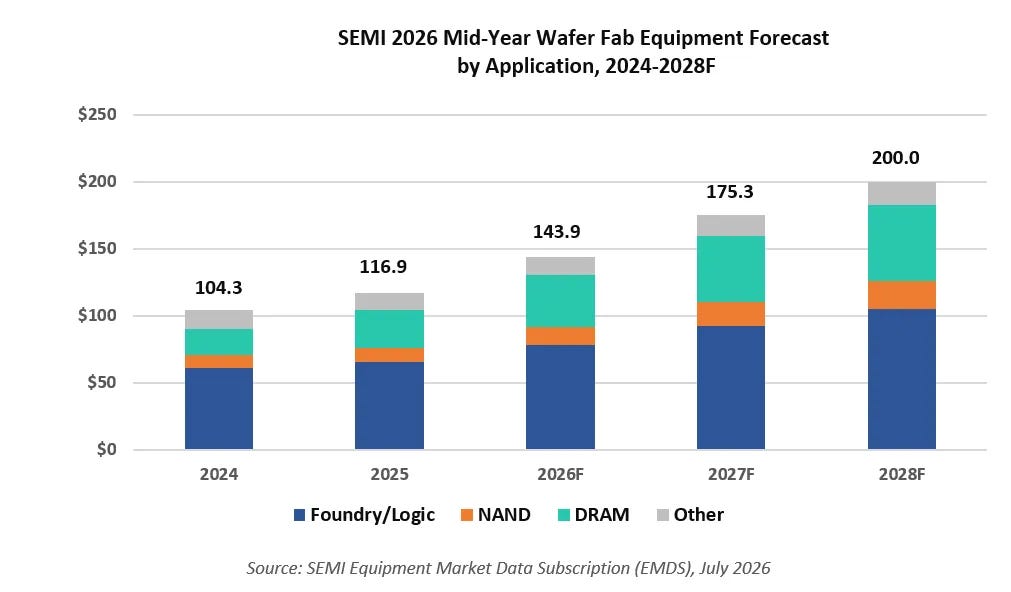
On top of that, markets seemed to have forgotten that you also need chips for other things:
ADAS in newer car models → a $6bln market in China that is growing at 12.4% CAGR.
Autonomous Vehicles → China is probably the most advanced market for them, with TAM growing 12.8%, expected to reach over $140bln by 2033.
Drones (military tech)
Smartphones
Laptops
China has domestic manufacturers for each of the product categories. They are all looking to localise their supply chain. They all will need chips.
And they cannot get these chips globally. Due to restrictions and domestication push from the government, global players are at a disadvantage and are losing market share (Tokyo Electron, Lam Research, SCREEN Holdings) all get displaced by the domestic alternatives.
This all points into a single direction → the target industry of ACMR will continue growing and getting increased investment as it has one of the best set-ups possible.
And we believe these trends will continue, and are not cyclical (short-term fluctuations):
Policy mandate got even stronger. As mentioned earlier, the focus now is not only to localise the Chinese industry, but to have enough capacity to serve other South Asian markets.
Even if on the high level WFE spending stabilises (management has guided to it: “relatively stable WFE spending”), the market share shift within the spending (going from western to local players) will continue.
Tariff cliff for June 2027 creates uncertainty and urgency for Chinese fabs to ensure they can secure their domestic equipment now
The industry setup is as favourable as any we've seen in our coverage. ACM Research is a compelling way to participate in it.
Before we continue further with a more detailed look into ACMR, I want to handover the mic here to my good friend Batu from Hazelnuts Research to share his thoughts on $ACMR:
The nationalisation of China's semiconductor supply chain keeps grinding forward, and memory is where it's loudest right now — CXMT and the likes are being built into national champions, and ACMR sells the wet-clean tools (the machines that strip contamination off wafers between process steps) they need.
The Shanghai subsidiary is doing the heavy lifting, and with the parent still sitting on a ~75% stake we do see this one going higher from here (under the right circumstances lol). But quality and "buy" are two different questions. At these prices it's a no from our side — maybe another 25% lower we'd talk. In hindsight 20/20 it's a total gem, yeah, but your ROI is set by the price you pay in, not by how good the company reads on paper.
So we'll hand it over to Sensus and keep watching this one from where we sit — which is from the GCC, looking at a Chinese national champion through a US-listed holding. Make of that what you will, but we're happy we "only" sold 50% of the position and kept the rest.
Thanks to Gleb for having us over for this quality reports — happy reading!
SENSUS THESIS: On top of the outlined industry setup, we identify three key factors supporting ACMR’s prospects: 1) China’s WFE spending is a structural, multi-year trend 2) Product portfolio expansion drives higher TAM over time and a better margin mix 3) Lingang facility’s impact is still overlooked ($3bln output capacity once completed).
The following sections of the report are structured as follows:
The Business
Financials & Core KPIs
Valuation
How We Deviate from Consensus
Risks
Conclusion
EXTRA: Q2 2026 Snapshot and Earnings Commentary
To tackle the main caveat about the business upfront, let’s clarify the organisational structure.
ACM Research Inc (ticker $ACMR) is a US based and listed company. Its core asset is its 73%+ stake in ACM Shanghai (the core operating entity where the assets are held, manufacturing is done, and products are sold).
To make it even clearer, ACMR is just a holding company that holds a controlling stake in ACM Shanghai.
It reports ACM Shanghai’s results as its own (consolidation accounting), with a minor adjustment for shipment timing recognitions due to different accounting standards.
This is important to consider, as some are still confused about which assets belong to what. The only additional major asset that belongs only to the US entity is a small demo facility in Oregon.
This translates into two core takeaways:
ACM Research cannot operate without ACM Shanghai, so it is in fact completely exposed to the Western restrictions/sanctions (it already is on the BIS Entity List since December 2024).
You have to adjust your valuation approach. Showing the cheap multiple of ACMR and arguing that the discount to its stake is unreasonable is arguing the same point with different wording. Also, HoldCo discounts are always consistent and rarely close - check out Prosus NV’s discount relative to its Tencent and other holdings.
This is something just to keep in mind in the later sections, specifically valuation and projections.
Side note: applying the HoldCo discount on the net cash balance is also needed, since cash is held in China.
Now, turning to the product history and line-ups, ACM Research got started by focusing on selling equipment to semiconductor manufacturers focusing on the cleaning stage of the process.
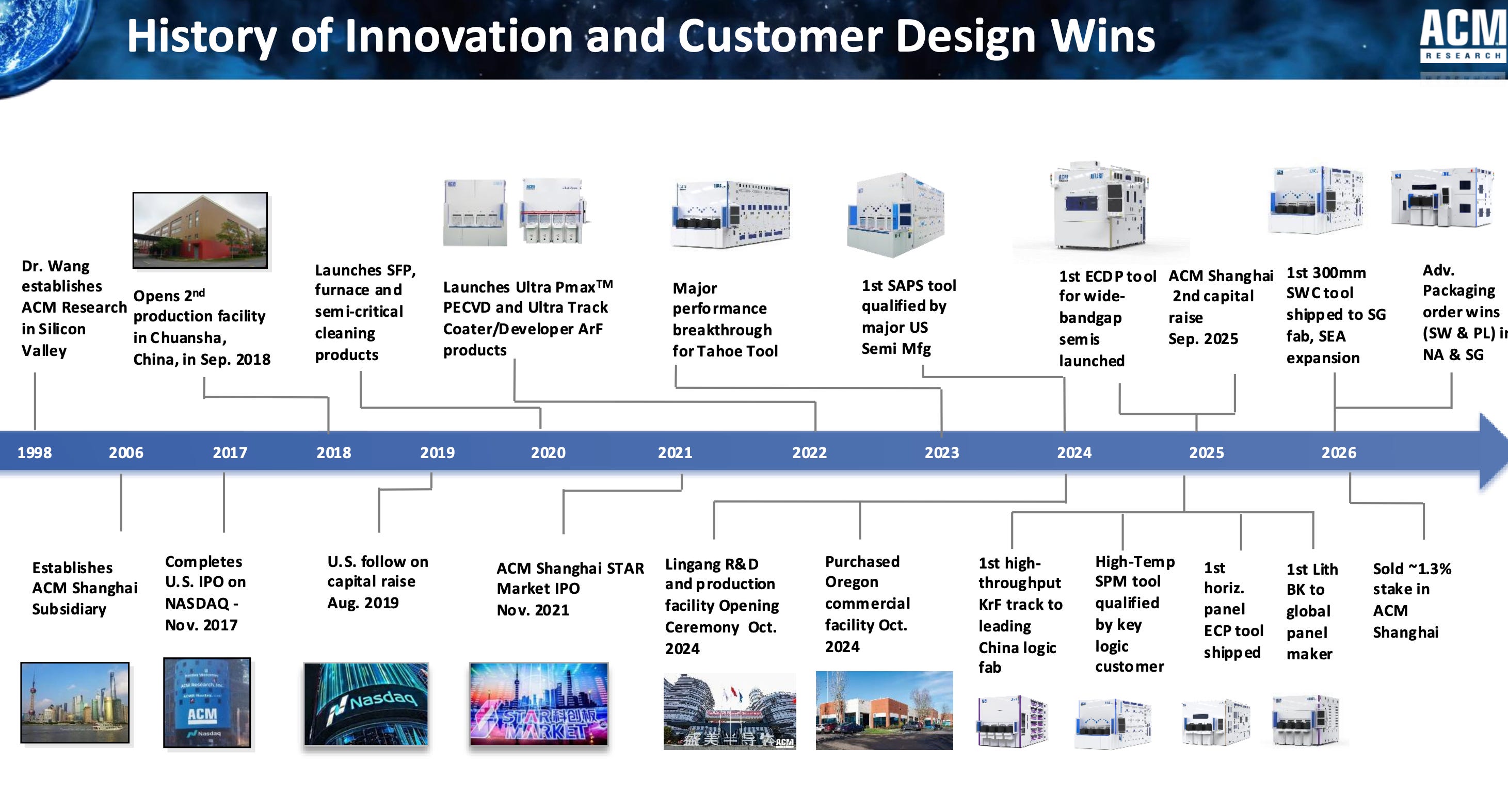
It is now pushing aggressively into other two markets, such as advanced packaging and furnace, which also explains the core part of the excitement surrounding the stock.
There are three reporting segments that matter:
Single Wafer Cleaning, Tahoe and Semi-Critical Cleaning: This is the cleaning segment, which represents the largest share of the company’s revenue, as that is the core focus area. Cleaning tools are used to clean chip discs (wafers) in the manufacturing process.
Front-End Packaging, ECP, Furnace: ECP is an electrochemical plating equipment used for front-end wafer fabrication. ECP is experiencing large growth driven by product innovation. Furnace is still early, to quote the management in Q1 2026 call: “For our vertical furnace business, tools are under evaluation at multiple customer sites, and we continue to expect a more meaningful revenue contribution later this year.”
Advanced Packaging (Excluding ECP): Processing and cleaning equipment used primarily for HBM building and chiplet layouts used in AI and high-performance computing (HPC) hardware.
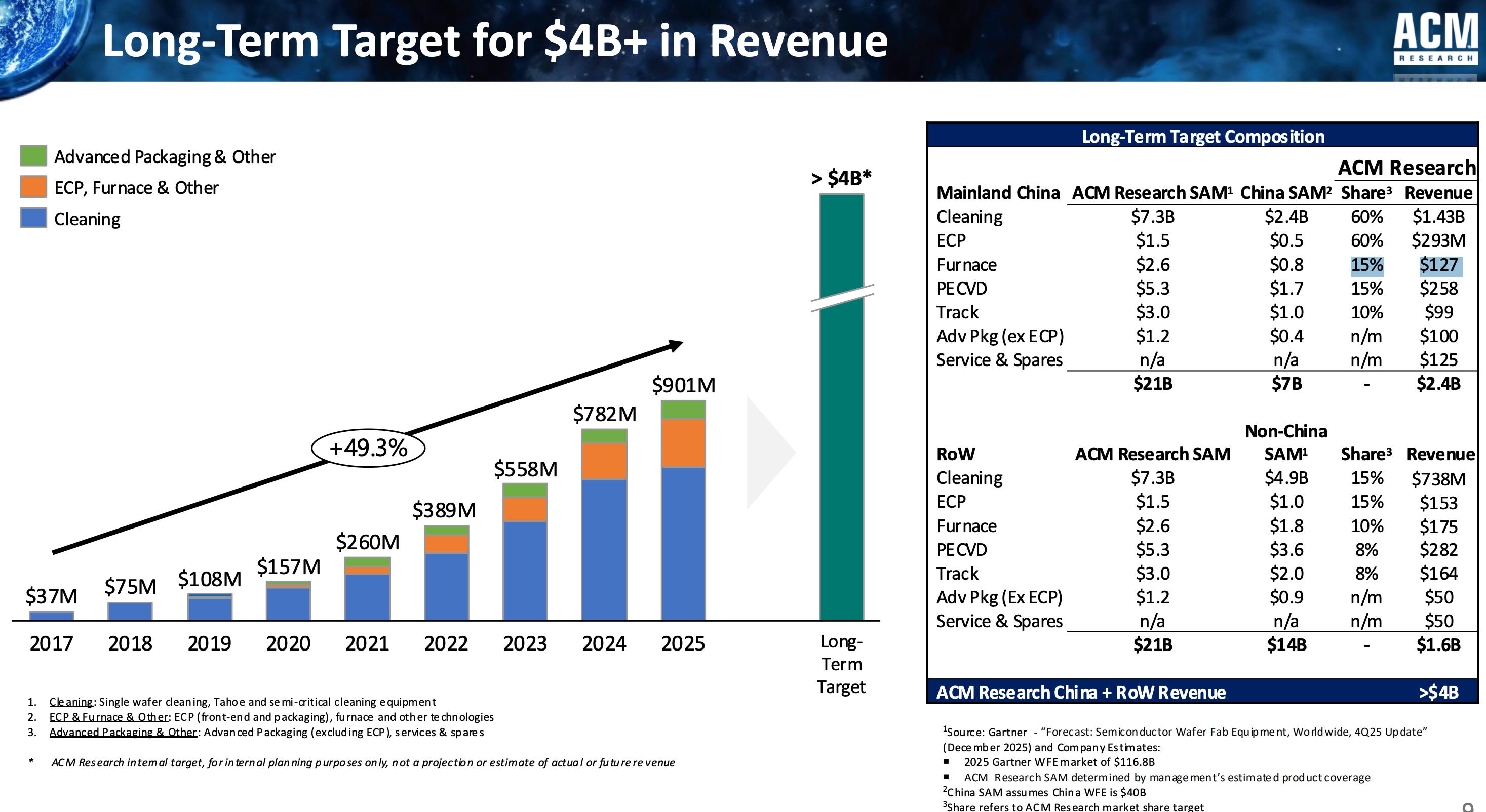
The ability of ACM to expand into the other two markets (away from Cleaning) pushes its TAM from $2.1bln globally to over $4bln.
The recent progress in the last two quarters on both of those fronts, on top of resilient Cleaning performance, is what pushed the stock higher.
The company has been production constrained over the last two years, hence the revenue deceleration last year. However, this is about to be solved thanks to the Lingang facility.
It is a new facility coming online in two phases with the final total output capacity of $3bln (for reference, the company is estimating revenue for this year to be just over $1bln).
Another major impact from Lingang is the mini-line, which went operational in H2 2025. The mini-line allows to run a proper R&D experiment on the company’s and other vendors’ tools. It is not only speeding up the R&D lifecycle, but also speeds up customer evaluation process. To quote David Wang:
We expect this approach to shorten qualification cycle of a new product at the customer site, shorten the time of conversion to revenue and enhance overall capital efficiency.
On the international side, expansion is under way, but still early. So far, only 20+ tools will be installed by the end of 2026 in customer sites excluding Mainland China (primarily Singapore).
Oregon facility is key here, as it is planned to be an in-house demo facility together with some capacity for production, but the total impact is unclear so far.
The international vertical is perhaps the only lever that the management can pull on to close the discount gap (between the holding and its stake). If the US entity starts manufacturing and shipping products directly on its own, the valuation gap will be closed. This is still several years away, but the company can continue using the cash from selling their stake, if needed, to invest in the international operations.
On the customer metrics side, as mentioned earlier, ACMR already has a working relationship with all the major players in China. It has worked on improving its customer concentration, but there is only a limited number of large semiconductor manufacturers out there.
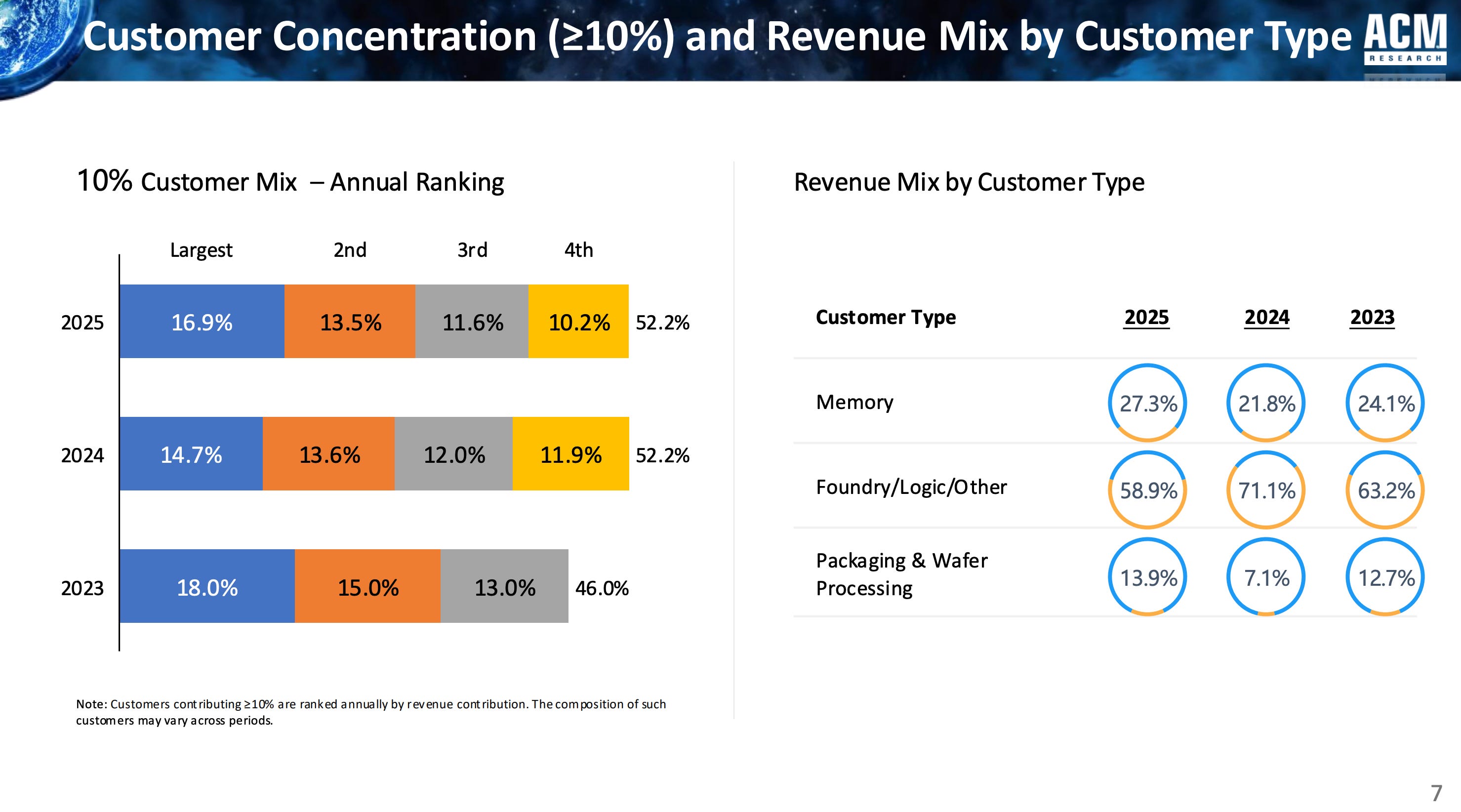
Side note: SK Hynix is a customer within the Memory segment.
In the field that ACM operates in, the moat is driven by customer lock-ins and IP.
There are three core proprietary IP’s powering ACMR’s product family:
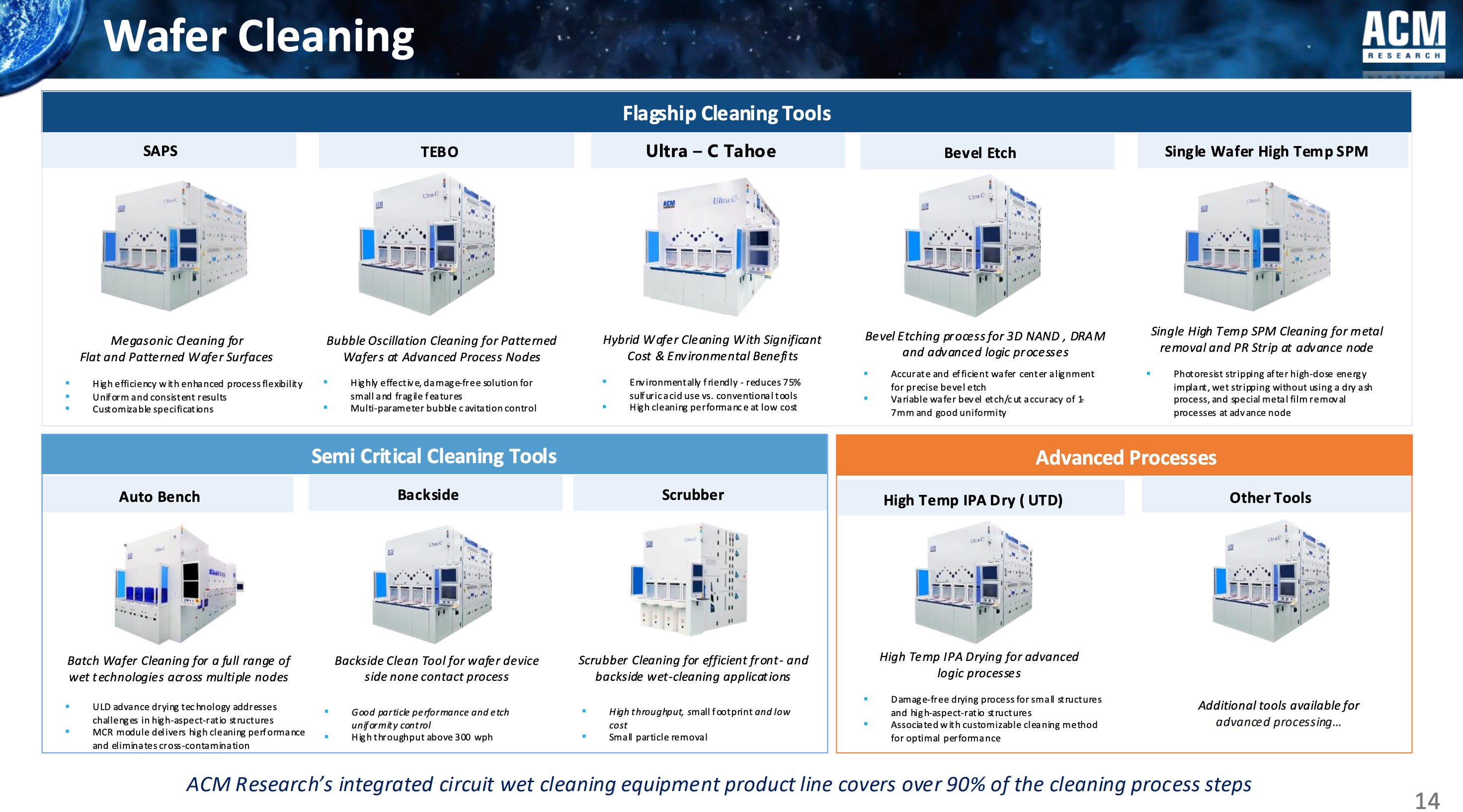
SAPS (Space Alternated Phase Shift megasonic) - patented method for using sound waves to scrub microchips perfectly clean without breaking them.
TEBO (Timely Energised Bubble Oscillation) - another cleaning patent that prevents microscopic bubbles exploding and breaking chip features when cleaning -> more relevant for the newer generation of chips
Tahoe - core patent behind their Ultra C Tahoe washing machine, helps to tackle sulfuric acid waste
Customer lock-ins are also there. This is rather commanded by the nature of the industry. Qualification process (essentially testing and review process) for new equipment is timely and costly. Once ACMR gets their machines qualified and installed, switching would require re-qualification, which means months and millions spent on what can potentially even result in a product line disruption.
On the competition front, we can think of three different tiers of competitors:
Tier 1: The earlier mentioned global, larger players that are losing market share in China: SCREEN Holdings (largest player in the global wet-clean market), Tokyo Electron, Lam Research.
Tier 2: Chinese domestic peers: NAURA Technology, AMEC, Piotech. ACMR’s new products are trying to push into their territory.
Tier 3: In wet-clean specifically, within China, ACMR is the dominant player, holding around 25-30% market share and rising. Historically, their Tahoe machine, held a unique, strong positioning here through its IP.
Core name behind the company - David Wang (CEO and founder).
He is a longtime operator that knows the market and the company inside out. He still holds around 1.2mm shares, although he does have a trading plan in place, through which he sells around 100k shares every quarter.
In the time we covered ACMR, he has been accurate in calling the behaviour of the industry and the company for the next 2-3 quarters out. He also has deep network within the industry and obviously knows the product really well.
On the capital allocation, the firm has been trying to think of a way to monetise their discount to the underlying stake in ACM Shanghai, but so far they have not done anything shareholder unfriendly (no significant equity issuance or SBC, or pointless M&A).
Side note: They cannot really just dividend out the cash, as they must pay the minority owners and get regulatory approval for that.
In terms of where is the capital going inside the company:
CapEx $58mm in 2025, and planned for $200mm in 2026. Significant increase going to Lingang expansion and Oregon facility, which is expected, given that the company is pushing for a $4bln in revenue (compared to $1bln today).
R&D is around 16% historically, which is high for this size of the company, but inline with peers and the product innovation is the result of that.
In the sections below, available to paid subscribers, we cover:
Our financial model and core KPI analysis across the last 3 fiscal years
A detailed valuation framework that accounts for the HoldCo structure
Our specific price target and the assumptions behind it
Where and why we disagree with consensus
The risks that could break the thesis
We also include a real-time earnings verdict incorporating the Q2 2026 results released on August 7.
Comments
Nothing yet. Say the first thing.
Sign in to join the conversation.