
Hold up both index fingers at arm’s length. Line them up so the tips almost touch, one a few inches in front of the other. Now close one eye and try to tap the tips together in one quick motion.
You may find the task noticeably harder with one eye closed and easier when both eyes are open. This is not a diagnostic test. It’s a simple illustration of binocular depth perception: the brain’s ability to combine the slightly different view from each eye to help judge distance.
Studies using validated vision tests have found depth perception and contrast sensitivity more closely associated with fall risk than high-contrast visual acuity alone. The cited research below is based on validated clinical measurements, not the finger exercise above, which is included only to illustrate the concept.
A 20/20 result on the wall chart means your eyes can read small letters in good light from 20 feet away (the standard testing distance, sometimes shortened using mirrors or a calibrated chart in smaller exam rooms). A comprehensive eye examination may include more than this. But the chart alone says nothing about how well you judge the height of a curb, the depth of a stair, or the gap between a rug and the floor.
Those judgments depend on a different set of visual skills: depth perception, contrast sensitivity, and peripheral vision. None of them show up on a standard acuity test.
A study out of the Prince of Wales Medical Research Institute followed 156 adults ages 63 to 90 for a year, tracking a full battery of vision tests against actual falls. Over that year, 43% of participants fell, and 22% fell more than once. Depth perception, contrast sensitivity, and low-contrast visual acuity emerged as the strongest predictors, stronger than the visual acuity your eye chart measures.
A later case-control study out of the University of Liverpool measured this more precisely: older adults with impaired depth perception (stereoacuity worse than 85 seconds of arc) had 3.4 times higher odds of a fall than those with normal depth perception.
Reaction time and balance on an unstable surface also predicted falls independently. High-contrast visual acuity, the measure captured by the standard eye chart, did not remain an independent predictor once the researchers accounted for the other factors.
Depth perception depends on both eyes working together and sending slightly different images to the brain. That’s how you judge distance. A meaningful difference between the two eyes can reduce stereoscopic depth perception, even when the stronger eye sees clearly on its own.
The same research looked at people with unequal vision between their two eyes. People with good vision in one eye and only moderate or poor vision in the other fell at the same elevated rate as people with poor vision in both eyes.
This matters because cataracts, macular changes, and general aging rarely affect both eyes at exactly the same pace. A slight difference between eyes is common after 60. The stronger eye may make the difference less noticeable during some everyday tasks, like reading, driving, and recognizing faces, while binocular depth perception remains reduced.
A separate study from the same research group tested something specific: what multifocal glasses, the bifocal and progressive lenses many adults use after 50, do to depth perception and contrast sensitivity at the distances that matter for spotting hazards.
The lower portion of a multifocal lens, built for reading, blurs the ground a few feet ahead when you look down to check a step or a curb. In that study, multifocal wearers had more than twice the adjusted odds of falling overall (odds ratio 2.29). They also had higher odds of falls caused by trips and falls outside the home, while falls on stairs were more common.
A follow-up randomized trial tested a fix directly: giving regular multifocal wearers a pair of single-vision glasses for outdoor and stair use. Among participants who regularly spent time outdoors, the intervention meaningfully reduced falls. Among participants with low outdoor activity levels, outdoor falls actually increased. The researchers concluded this switch helps people who are already regularly active outdoors, and should be made with an eye care professional’s guidance rather than on your own.
Three practical steps worth taking. Not all have direct trial evidence for fall reduction, but each addresses a gap the research consistently identifies.
Ask for the right tests by name. At your next eye exam, ask specifically for contrast sensitivity testing and a depth perception check, not just the acuity chart. Say exactly this: “Can we test my contrast sensitivity and depth perception, not just my distance vision?” These measures may not be included in a basic visual-acuity screening, so ask whether they’re appropriate for you.
Ask about single-vision options if you’re regularly active outdoors. If you wear bifocals or progressives and spend meaningful time walking outside or on stairs, ask your eye doctor whether a separate pair of single-vision glasses makes sense for those activities. This isn’t a switch to make on your own. The research found real benefit for people who are regularly active outdoors, but the opposite effect, more outdoor falls, in people with low outdoor activity. Your eye doctor can help determine which group you’re in.
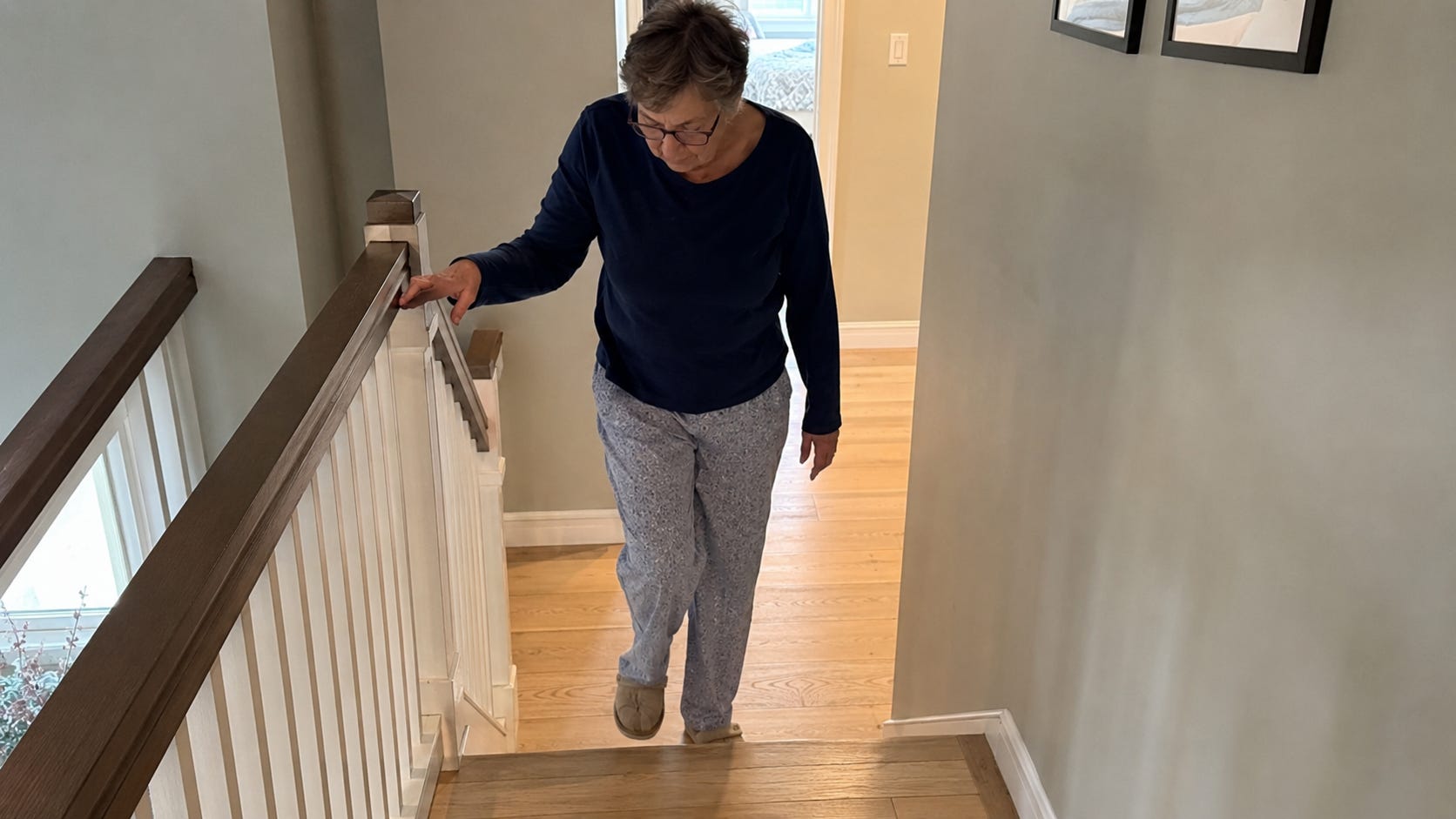
Increase contrast at your own transition points. Stair edges, and the top and bottom step especially, are where depth perception gets tested hardest. A strip of contrasting tape on the leading edge of each stair gives your eyes a sharper edge to judge. If you already use a rug near a stair or room threshold, make sure it contrasts clearly with the floor and is firmly secured; remove loose or curling rugs entirely. A rug that isn’t secured is a tripping hazard on its own, regardless of contrast.
Brightness alone doesn’t fix this. Depth perception and contrast sensitivity depend on how clearly edges stand out, not just how much light is in the room. A well-lit room where the floor, stairs, and furniture all blend into similar tones can still be hard to navigate safely. Lighting and contrast both matter, and neither substitutes for the other.
Reading glasses stronger than you need don’t help either. If your current prescription already corrects your near vision, a stronger lens won’t improve depth perception. A stronger near prescription does not specifically correct binocular depth perception or contrast sensitivity; those depend on different aspects of how your visual system processes what you see.
If you’ve had a fall in the past year, or you already feel unsteady on stairs or uneven ground, don’t wait for a routine exam. Contact your physician and your eye care professional and mention the fall or new unsteadiness specifically. Falls are multifactorial and shouldn’t be treated as only an eye problem. Sudden changes in depth perception can also signal something beyond normal aging, worth ruling out promptly.
If you wear multifocals and switch to single-vision glasses for outdoor use, expect an adjustment period. Test them somewhere familiar and low-risk first, not on an unfamiliar staircase.
If you make any of these changes, follow the reassessment schedule your eye doctor recommends rather than a fixed timeline. Vision changes at different rates for different people, and your eye doctor is better positioned to judge the right interval for you.
None of this means your vision is failing. It means some of the visual skills involved in navigating stairs, curbs, and uneven ground may not be captured by a basic visual-acuity screening. Multifocal lenses can also work against those same skills in certain situations.
The three steps above are worth starting today. On Friday, paid subscribers will receive a companion Vision & Fall Risk Protocol with a room-by-room home audit, evidence-informed contrast and lighting changes, and an eye-care conversation guide.
Lord SR, Dayhew J. Visual risk factors for falls in older people. Journal of the American Geriatrics Society. 2001;49(5):508-515. PMID: 11380741
Mehta J, Czanner G, Harding S, Newsham D, Robinson J. Visual risk factors for falls in older adults: a case-control study. BMC Geriatrics. 2022;22(1):134. PMID: 35177024
Ivers RQ, Cumming RG, Mitchell P, Attebo K. Visual impairment and falls in older adults: the Blue Mountains Eye Study. Journal of the American Geriatrics Society. 1998;46(1):58-64. PMID: 9434666
Lord SR, Dayhew J, Howland A. Multifocal glasses impair edge-contrast sensitivity and depth perception and increase the risk of falls in older people. Journal of the American Geriatrics Society. 2002;50(11):1760-1766. PMID: 12410892
Haran MJ, Cameron ID, Ivers RQ, et al. Effect on falls of providing single lens distance vision glasses to multifocal glasses wearers: VISIBLE randomised controlled trial. BMJ. 2010;340:c2265. PMID: 20501583
Medical Disclaimer: This article is for educational purposes only and does not constitute medical advice. It does not replace a comprehensive eye exam or an individualized fall-risk assessment from a qualified professional. Consult your eye doctor or physician if you have noticed changes in your vision, have fallen recently, or feel unsteady on stairs or uneven ground.
Stay independent. Stay capable.
Published July 2026 | Senior Health Secrets
Evidence-based health research for seniors.
Comments
Nothing yet. Say the first thing.
Sign in to join the conversation.