
Wednesday’s article introduced the ruler-drop test.
If you tried the ruler-drop test and were surprised by your result, this article covers what to do next.
Reaction time is trainable after 60. The nervous system maintains significant plasticity, and specific types of practice produce measurable improvements. The key word is specific.
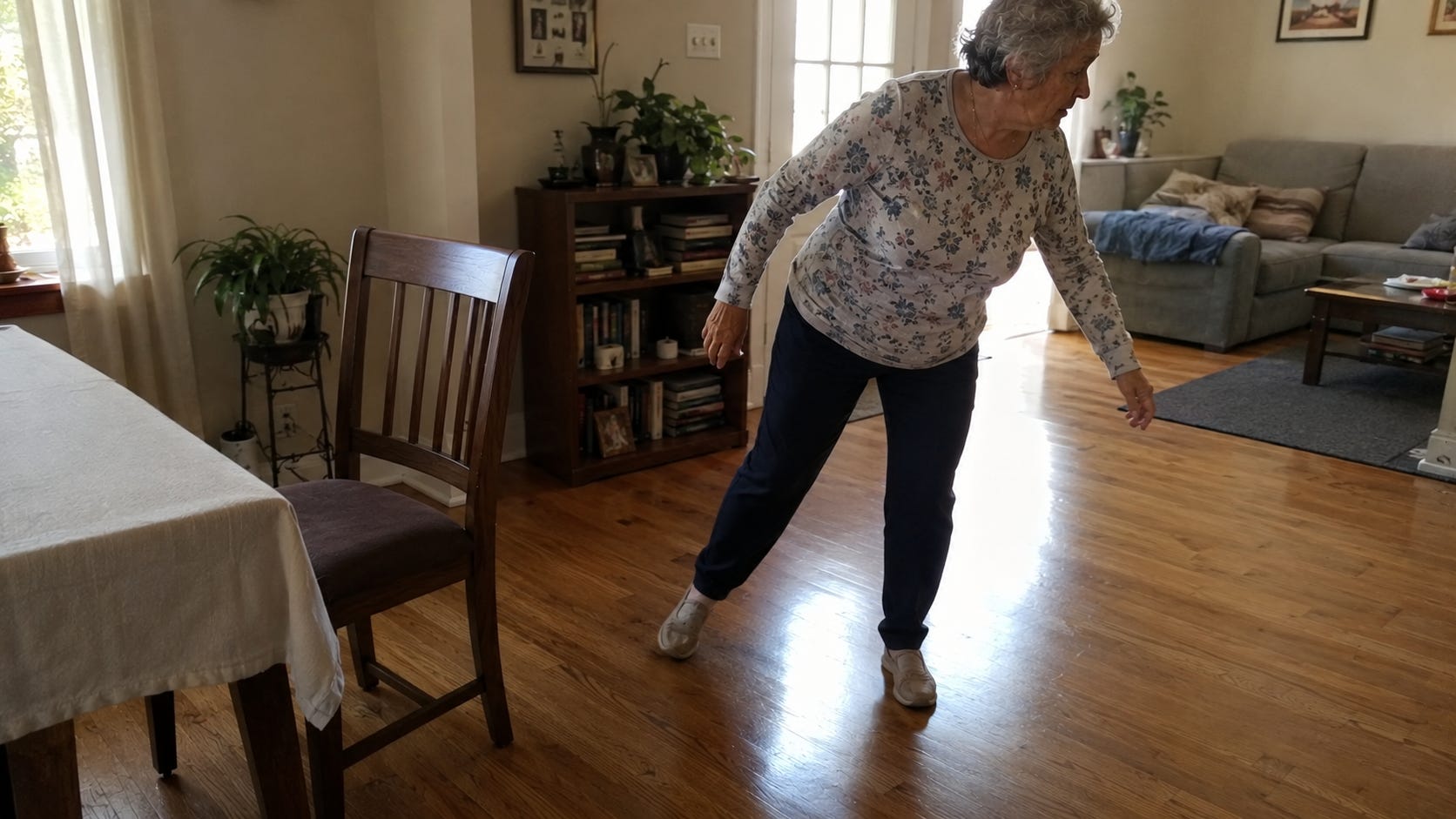
Walking and traditional static balance exercises do not specifically train rapid protective stepping. To train rapid protective stepping, the response itself has to be practised.
That’s what this protocol does.
Stepping practice has a meaningful evidence base for improving reaction time and reducing falls in older adults.
A 2017 systematic review and meta-analysis published in the British Journal of Sports Medicine examined seven randomized trials of reactive and volitional stepping interventions. The findings were significant: these interventions reduced both the rate of falls and the proportion of people who fell by about half. The studied interventions also improved stepping reaction time, gait, balance, and balance recovery.
Those results apply to the structured programs studied in the trials. They should not be treated as a guaranteed effect of any single home program, including this one. But the underlying principle is well established: repeated stepping practice, rapid initiation, and progressively less predictable cues train the nervous system to respond faster.
The principle is straightforward. Stepping in response to an unexpected cue practises the rapid detection, decision, and movement sequence involved in balance recovery.
Falls are multifactorial. Reaction speed is only one part of the picture. Strength, balance, vision, medications, blood pressure, footwear, and home hazards all matter too. This protocol focuses on one specific gap: initiating a fast, appropriate response when something unexpected happens. It is a companion to, not a replacement for, strength and balance training or a clinical fall-risk assessment.
Most fall prevention programs focus on balance and strength. Both matter. But they address a different question than the one this protocol targets.
Balance training answers: can you hold a stable position?
Reaction speed training answers: how quickly can you initiate a corrective movement when that stable position is suddenly disrupted?
These are related but distinct abilities. You can have excellent static balance and still fall if the nervous system cannot trigger a protective step fast enough when something unexpected happens.
Consider the difference between standing on one leg for 30 seconds and stepping sideways in response to a sudden unexpected shift. The first tests how long you can maintain stability when nothing changes. The second tests how quickly you respond when everything changes at once.
The second ability can be critical when balance is suddenly lost. And it declines with age in ways that most exercise programs do not specifically address.
The protocol starts simple. In weeks 1 and 2, the focus is on learning to initiate movements quickly and cleanly. Sitting and standing rapidly. Stepping to the side and returning. Practising the ruler drop to establish a baseline and train a repeatable hand-reaction task. Moving through a four-direction clock pattern to develop stepping accuracy before any unpredictability is added.
The key in these first two weeks is not working hard. It is moving quickly within a range you can control. Speed of initiation is the training stimulus, not effort or fatigue.
In weeks 3 and 4, the same movement patterns return, but now triggered by unpredictable cues rather than self-initiated timing. A partner calls a direction at a random moment. A verbal cue signals when to stand. A visual marker must be identified before the step is taken. A cognitive task runs simultaneously with walking.
The unpredictability is what makes these weeks more demanding, not the physical difficulty. The nervous system must stay genuinely ready rather than anticipating a rhythm.
This is also what makes the training specific to real-world situations. A trip on an uneven surface doesn’t announce itself. A stumble on a step doesn’t come with a countdown. The protective response that catches you has to be fast because the situation doesn’t give you time to prepare.
If you recorded your baseline ruler-drop distance on Wednesday, that number gives you a personal starting point.
The goal is not to reach a universal target or compare your score with someone else’s. The useful question is whether your five-attempt average changes when you repeat the task under the same conditions.
Your result may improve, remain similar, or fluctuate. Partner timing, hand position, attention, fatigue, and familiarity with the task can all influence the measurement. That is why the protocol uses five attempts and asks you to keep the setup as consistent as possible.
A lower average suggests improved performance on this specific hand-reaction task. It does not diagnose fall risk or prove that your protective stepping has improved.
The more relevant signs of progress inside the program are whether you can respond to an unpredictable cue, select the correct direction, initiate the step promptly, and return to center under control. Those abilities are closer to the stepping outcomes examined in the research.
The complete 4-week Reactive Response Protocol is available below for paid subscribers as a printable guide. It includes the safety screen, eight progressive drills, a 12-session schedule, progress tracking tools, common mistakes, and physician conversation scripts.
Prefer a one-time purchase? Get the complete Reactive Response Protocol
Comments
Nothing yet. Say the first thing.
Sign in to join the conversation.