
Wednesday’s article covered several vision skills a standard eye chart may not fully assess: contrast sensitivity, binocular depth perception, differences between the eyes, and peripheral vision.
This protocol covers what to do next.
You can read every line on an eye chart and still misjudge the edge of a step.
The standard chart measures how clearly you can identify high-contrast letters under controlled conditions.
Your home does not provide controlled conditions.
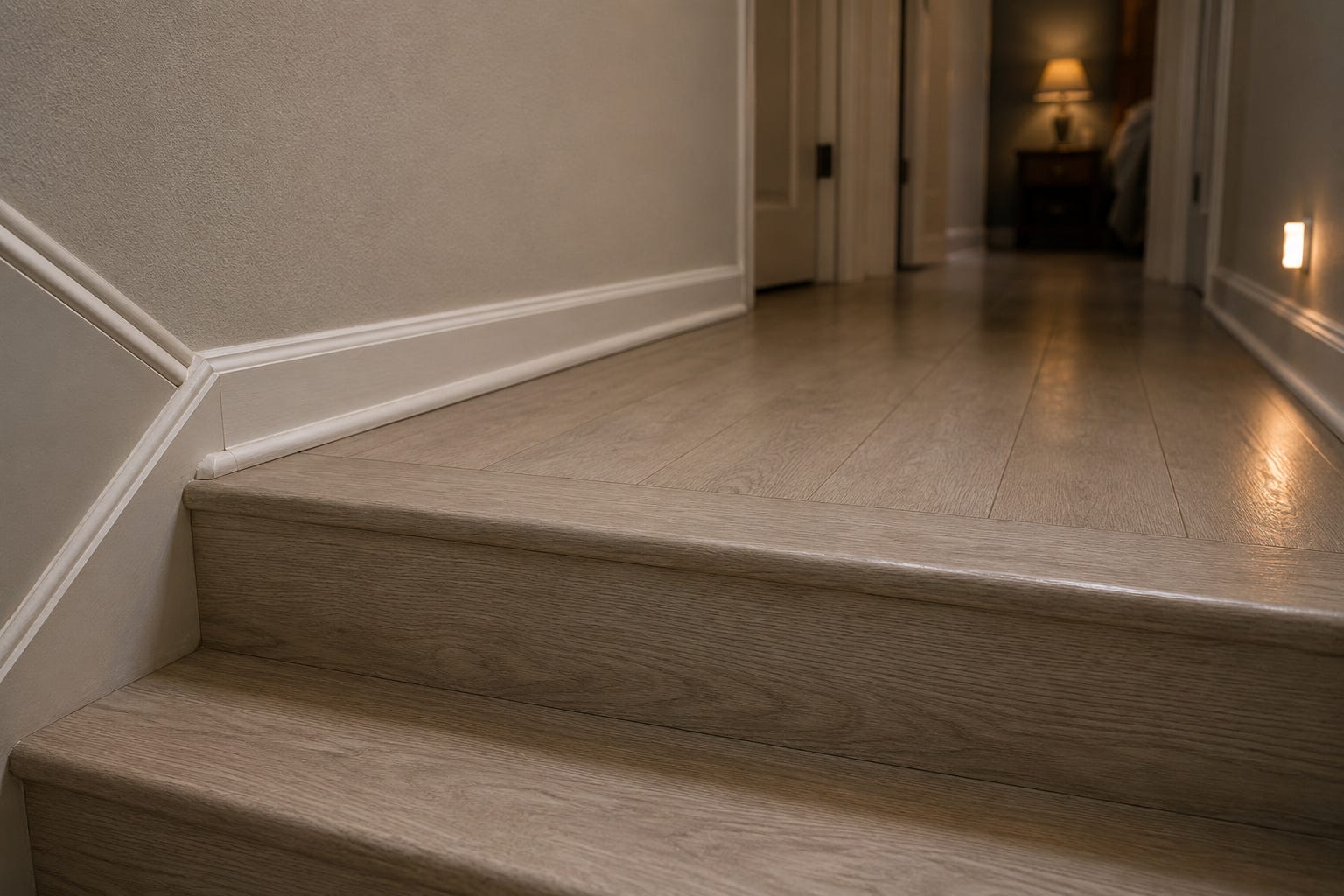
A stair tread may blend into the floor. A bright bulb may create glare while leaving the next step in shadow. The ground may appear blurred when you look down through the reading portion of progressive lenses. A nighttime walk to the bathroom may begin before your eyes have adjusted to the dark.
The problem is not always that your prescription is wrong.
Sometimes the problem is the interaction between your vision and the environment around you.
A standard acuity result is useful. But it does not fully measure how well you detect low-contrast edges, judge depth using both eyes, notice hazards outside the center of your vision, or adjust between bright and dim spaces.
Those abilities matter when you are navigating stairs, curbs, uneven ground, and unfamiliar rooms.
That is why this protocol does two things that are usually treated separately: it helps you prepare for a more useful conversation with your eye care professional, and it helps you identify places inside your home where glare, shadows, poor contrast, and inadequate lighting may make movement less safe.
This protocol is designed for adults over 60 who:
Read the standard eye chart well but still hesitate on stairs or curbs
Feel less confident walking in dim light
Wear bifocal or progressive lenses
Have noticed a difference between their two eyes
Have experienced a fall or near-fall and want to examine whether vision or the home environment may be contributing
Want a structured home audit rather than general fall-prevention advice
If you have fallen recently, feel unsteady, use a mobility aid, or have noticed a recent change in your vision, do not complete the home audit alone. Speak with a physician or eye care professional and ask someone to assist you.
The goal is not to diagnose yourself or change your glasses without professional guidance.
It is to identify situations where low contrast, glare, shadows, poor lighting, or weak depth cues make movement more difficult, and then separate them into three categories: what you can address safely, what requires qualified help, and what should be discussed at your next eye appointment.
The goal is not to make your home perfect. It is to make the next step easier to see before you take it.
The complete 15-page Home Vision Audit includes the six-question safety screen, eye-appointment preparation pages, four conversation scripts, a room-by-room audit, lighting and night-pathway checks, a multifocal-glasses decision guide, 30- and 90-day action trackers, and a printable priority checklist.
The complete protocol is below for paid subscribers.
Not yet a paid subscriber? Unlock this protocol and every future guide.
Comments
Nothing yet. Say the first thing.
Sign in to join the conversation.