
There is something about fashion that fascinates and seduces. It makes us feel as though we belong to it simply by sharing references, names, and places. And yet, that very illusion collapses the moment we realize that we are not as inside fashion as we once believed. Fashion itself seems to insist on this distance: no matter who we are or what we do, we are never entirely within it.
Yesterday, I had the opportunity to attend the premiere of The Devil Wears Prada II. Before moving into the analysis, a brief note of gratitude to Daniel Herranz for the invitation and for the chance to see the film ahead of its release.
It is, in many ways, a sensible decision for the directors and writers to engage with contemporary themes. Still, it is worth stating the obvious: this is, above all, a film. It addresses a specific dimension of fashion, and—however frustrating this may be for some—it does not owe us depth, nor rigorous critique, nor the kind of seriousness often demanded of it.
The premise is straightforward. Twenty years after the original, Andy Sachs—the same figure who once entered Runway in pursuit of “serious journalism” (as the film itself phrases it)—has now become precisely that: a serious journalist. The film makes this explicit from the outset, opening with her receiving a prestigious award.
Up to this point, everything holds. But following an event that exposes the structural crisis of media, Andy finds herself—“by the forces of fate,” a phrase the film subtly insists upon—returning to Runway. Miranda has been effectively canceled, her credibility eroded by controversial statements and questionable commercial ties. Andy’s return becomes strategic: she is not only tasked with restoring Miranda’s reputation, but with salvaging the magazine itself.
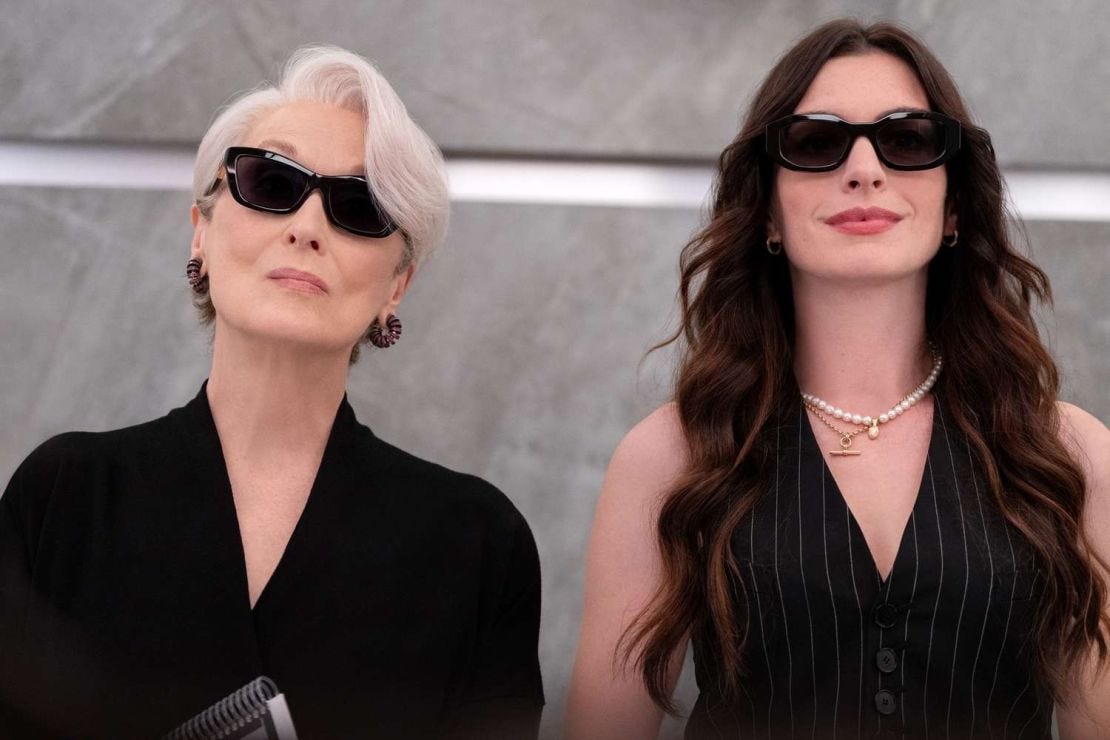
The first half of the film is thus preoccupied with how “serious culture” attempts to rescue both the publication and Miranda’s career. It offers a surprisingly lucid portrayal of traditional media—what might more accurately be called journalistic enterprises—where content is no longer the axis, but rather metrics, advertisers, and institutional alliances. One line condenses the entire logic: “Without them, there is no us.”
Beyond its overt fan service—references to the cerulean belt, the ritual of printed copies delivered to Miranda’s apartment—the film suggests that, despite the passage of time, certain structures remain unchanged: exclusionary, abusive, and fundamentally contradictory, even within systems that insist on political correctness.
This is most evident in Miranda herself. Less myth, more human. The subtext gestures toward a recalibration of female power: the so-called “monster” has softened, or at least shifted. She remains cold, demanding, at times hostile—but also more perceptive, more open, perhaps even more empathetic. A transformation that feels, at moments, almost strategic.
The first half, then, is where the film becomes most legible as an object of analysis—and likely where it will linger in conversations around fashion and, more specifically, fashion journalism.
Here is the underlying tension: fashion journalism continues to be perceived as insufficient, lacking rigor, in need of validation from what is still framed as “real journalism”—that is, journalism aligned with politics, risk, and sacrifice. Andy embodies this hierarchy. She leaves fashion to legitimize herself, only to return as its savior, reintroducing seriousness and, consequently, relevance.
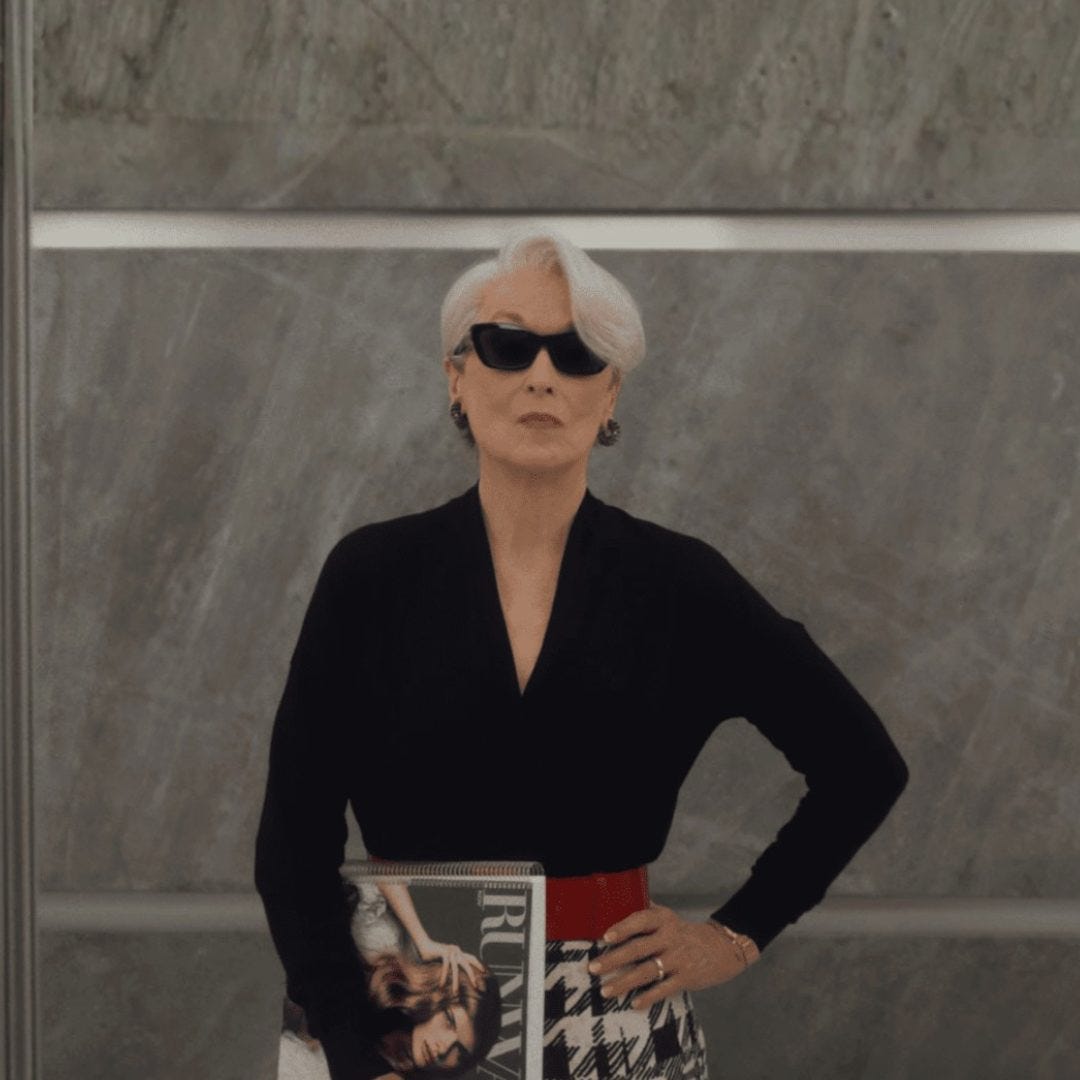
The implication is not subtle. Fashion, in the logic of the film, requires rescue by the anti-glamorous, the austere, the ostensibly authentic. What emerges is a familiar archetype—something akin to a Betty la Fea syndrome—where Andy remains the figure of simplicity: unglamorous, understated, almost deliberately out of place. Her authority is constructed not through aesthetic fluency, but through access, efficiency, and the ability to achieve the impossible (a quiet echo of the Harry Potter manuscript subplot from the original film).
In this dynamic, she forms a kind of Don Quixote–Sancho Panza pairing with Miranda: one imagines, the other resolves. Meanwhile, those who exist fully within fashion—those invested in its surfaces—are subtly ridiculed.
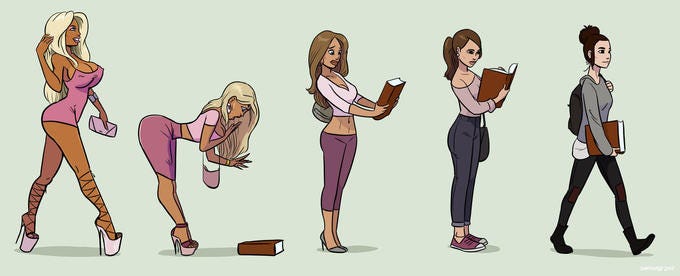
The trope is familiar: the woman in a pink mini dress who becomes “serious” the moment she puts on glasses and picks up a book. The stereotype is unmistakable. Whether it works is another question. But then again, this is cinema.
It is also telling that publications and figures such as The Business of Fashion and Vanessa Friedman are referenced—though notably, Friedman is framed not as a fashion journalist, but as a cultural critic. A rhetorical move that reads almost as a tu quoque directed at the field itself. These references are accompanied by cameos from designers, models, and key figures within the American fashion system.
The second half of the film, triggered by a tragic turn, leans fully into fan service. It mirrors the narrative mechanics of the original, deploying familiar twists and emotional beats. It works—audiences will likely embrace it—but it also shifts the tone into something closer to melodrama: a Los ricos también lloran transposed onto a fashion magazine, where the institution is stripped of its resources, its infrastructure, its illusion of permanence.
Brands such as Dolce & Gabbana, Dior, Marc Jacobs, Valentino—and, inevitably, Prada—appear as part of this ecosystem. So does Lady Gaga, who contributes three original songs and performs in the film wearing an iconic Versace look.
The rest is, in many ways, competent. The absence of Patricia Field is noticeable, though not immediately central to the viewing experience. The Devil Wears Prada functions as what it has always been: a film that romanticizes fashion, acknowledges the crisis of media (and now, the presence of AI), and, above all, preserves its ability to captivate by revealing what appears to be fashion’s hidden side.
A deeper analysis might ultimately be unnecessary. This is, after all, a film. And twenty years later, it delivers exactly what it once did: a carefully constructed fantasy about what is, for many, now simply work.
Comments
Nothing yet. Say the first thing.
Sign in to join the conversation.