

Many books have been written about hormone use and it would take a lot more space than I have here to do the topic justice. However, I do want to make a start on addressing hormone replacement therapy in the hope that beginning to raise, and hopefully clarify, some issues will allow relevant, evidence-based questions to arise.
In her book, The Menopause Manifesto, Dr. Jen Gunter provides a brief, fascinating history of how hormones have been used to address menopause. Although hormones were not actually identified and isolated until the early 1900s, it was known that using extracts from the ovaries of animals could be helpful in treating menopausal symptoms in humans, and in the late 19th century, formulations using encapsulated, powdered cow ovary were marketed. Over the course of the 20th century methods for synthesizing hormones from both natural and chemical compounds reduced the costs of creating hormone supplements—in both pill and injection forms—making them more widely available.
In the 1950s and 60s pharmaceutical companies began to market hormones directly to consumers, in particular, husbands. In 1966 Dr. Robert Wilson published Feminine Forever, a misogynistic masterpiece that described menopause as a “disease” of estrogen “deficiency” and characterizes menopausal women as “desexed” and undesirable. Though Dr. Gunter credits Wilson’s work with contributing to “forward-thinking ideas” about women’s sexuality and aging, she also notes that Wilson’s son revealed in 2002 that the pharmaceutical company Wyeth-Ayerst financed his father’s research.
Despite all the estrogen being encouraged and prescribed during the middle of the century, the role of progesterone in protecting the lining of the uterus was not well understood. In fact, up until 1957, progesterone was only available as an injectable because the technology to create a progesterone that could be readily absorbed through the intestines or skin had not yet been developed. In the 1970s there was a noticeable increase in the incidence of endometrial cancer and eventually the connection between the use of unopposed estrogen and these cancers was made. Progesterones were regularly added to the MHT regimen for women with uteruses.
As time passed the cultural messaging around hormone replacement shifted subtly from portraying MHT to women and men as a miracle drug that would keep women young, desirable (to men), and sexy in tennis skirts to focusing on hormones as a fountain of youth that would allow women to live longer, healthier lives free of cardiovascular disease, osteoporosis, and dementia.
By the 1990s and into the 2000s, perimenopausal women in the United States were routinely prescribed estrogen and progesterone to address the symptoms of menopause. “In 1992 Premarin [the estrogen of choice at the time] was the number one selling prescription drug in the United States…and by 2001 42 percent of menopausal women in the United States were taking MHT” (Gunter, 2021, p.222-3).
In 2002, the Women’s Health Initiative, the largest clinical trial to date looking at hormone replacement for women, abruptly halted the largest portion of the study because researchers were concerned about preliminary numbers showing increases in cardiovascular disease (CVD), breast cancer, blood clots, and stroke among participants. The impact on women’s lives was immediate and devastating. Although there were dissenting voices in 2002 calling for a closer look at the research and encouraging scientists and women alike not to jump to premature conclusions, the damage was done. The threat of breast cancer in particular was too terrifying to chance. As of 2020, less than 5% of American women were using hormone replacement therapy (Wikipedia) and an entire generation of women had negotiated mild to severe symptoms of the menopause transition with almost zero help from the medical establishment.
What we know definitively now is that, while the information gleaned from the study by the WHI is not completely irrelevant, there are many factors present in the study and its population of participants that simply do not apply to a majority of women. The problematic issues of the study were broken down by Dr. Kristi Funk, a breast cancer surgeon, in the recent documentary “Balance: A perimenopause journey.”
· In the WHI study, the average age of participants was 63.3 years. The typical age range for women in perimenopause: 45-55 years.
· There were 0% of women under 50, only 10% between 50 & 54, and the remainder were over 60.
· 50% were current or former smokers—a huge risk for the development of cancer, blood clots, stroke, and CVD, especially when mixed with any form of hormone supplementation, including birth control
· 36% were actively being treated for hypertension
· 14% already had a bone fracture after the age of 55
· The average BMI was 28-30.
· Although numbers range slightly, 34-44% of the study population was overweight, with a large percentage (38-42%) considered obese.
Dr. Gunter also provides a list of issues with the WHI study:
Confusing communication about what the increased “risk” of breast cancer actually meant practically. “Risk”—and its permutations, “relative risk,” “absolute risk,” “odds ratios”—is a tricky concept for non-statisticians to understand when researchers and scientists are throwing it around.
The data should not have been assumed to be true for all forms of hormones. Different formulations of hormones and how they are delivered—orally, transdermally, nasally, etc.—may be metabolized differently and have more adverse or beneficial effects on health.
Although it is rarely mentioned, the small risk of breast cancer with MHT that the WHI found had already been noted a few years previously. That information was known prior to the study’s development!
In spite of the slight increase in breast cancer rates, overall mortality did not increase: “women taking MHT weren’t more likely to die than those who were not taking MHT” (Gunter, 2021, p.225)
And finally, as noted above, it never made sense to extrapolate the data from the study population to all women.
Clearly, the study population was already older, had more risk factors, and had poorer health than the general population. Yet these confounding factors were not taken into account when the WHI made its initial announcement in 2002 and stopped the study. It took years for the not-so-subtle nuances of the research to be made known and they are still not widely known, understood, or accepted by a majority of doctors treating perimenopausal women.
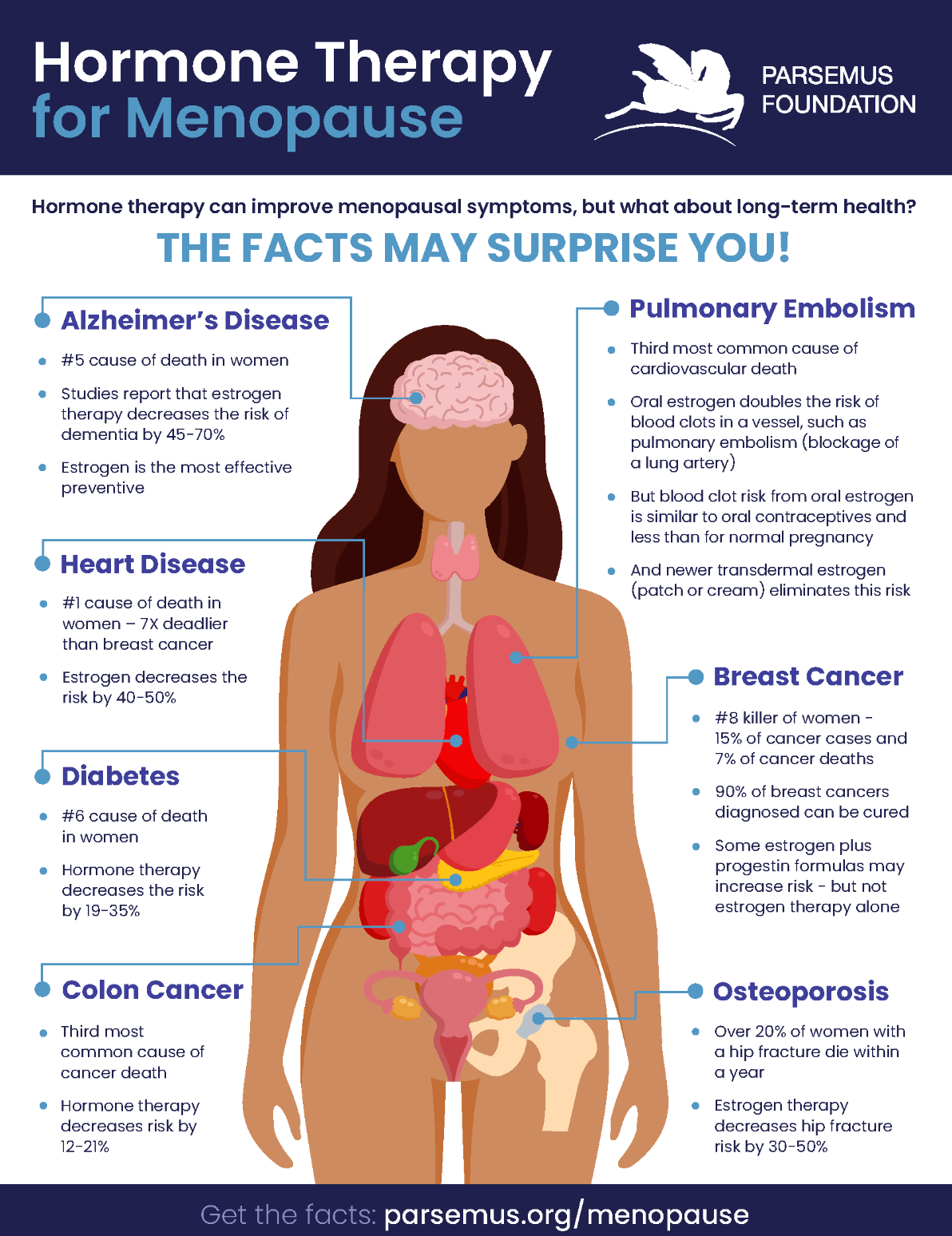
There are some guidelines operative right now that take into account what has been learned from the WHI as well as from much more recent research, some of which has attempted to address and correct gaps and problems made apparent in the structure and function of the WHI study.
1. Hormone replacement therapy (HRT) is now often called Menopause Hormone Therapy (MHT). This shift has arisen because some healthcare professionals have taken issue with the idea that we are trying to replace a woman’s hormones by using hormone therapy. This is not the case. As Dr. Jen Gunter points out, “the name [HRT] falsely implies that estrogen or other hormones are missing because of a medical problem, and the low levels of estrogen after menopause are biologically abnormal” (p.213). MHT is really a supplementation of declining hormones to address symptoms and potential health risks, not a replacement of them. MHT does not prolong or stop menopause from happening. In most cases, it smooths and eases the path somewhat by alleviating symptoms triggered by estrogen, progesterone, and testosterone decline.
2. The best evidence we have right now points to what is called a “timing hypothesis.” It is currently hypothesized that the best time to start MHT is when one is younger than 60 years old and within 10 years of the onset of menopause. (Remember, menopause is that one day when you have gone 13 months without a period. Before that you are in peri-menopause; after, you are in post-menopause. So, “within 10 years” could mean 10 years prior to reaching the day of menopause or 10 years after that day.)
3. Women older than 60 and/or further out from menopause onset than 10 years should proceed cautiously with initiating MHT because there is evidence of increased cardiovascular disease (CVD) risk in this age group.
4. Women who are in their 70s are not currently considered good candidates for MHT. This is not only because of the CVD risk increase in this group, but there tends to be diminishing symptom relief as well.
5. Transdermal hormone therapies that deliver dosages through the skin via creams, gels, or patches are considered safest because the hormones bypass the liver.
a. Transdermal estrogen therapies do not have the clotting risks that oral estrogens have.
b. Transdermal therapies are not any safer than oral routes for those at risk of cancer or CVD.
c. Typically, micronized progesterone is safe to take via capsule. Estrogen is riskier via the oral route, though it may be fine for some women.
6. If you have a uterus and you are taking estrogen, you will need to take progesterone in order to protect the endometrial lining of the uterus from building up and increasing the risk of endometrial or uterine cancer.
7. Vaginal estradiol in the form of a cream or suppository is not systemic and so is considered safe even for those with clotting disorders or cancer or CVD risk. It can be incredibly helpful for sexual health and mitigating the genitourinary symptoms of menopause, which can be progressive and harmful.
8. The hormones used in the Women’s Health Initiative were not synthesized, dosed, or delivered as they would be today. Today, the hormones most often used in MHT are bio-identical, prescribed in lower dosages, and ingested in safer ways.
9. MHT is not for everyone. Factors that impact one’s potential use of MHT:
a. Age and reproductive history
b. Personal and familial cancer history and risk
c. Gall bladder/liver issues
d. Clotting disorders
e. Smoking history
f. Personal comfort with MHT
g. Symptom profile
h. Individual goals for health and well-being
For more information on MHT, here is a link to a recent post from University of Colorado Health that answers a lot of pertinent questions:
UC Health: The Truth About Hormone Therapy
Another excellent resource for an extensive review about hormone supplementation is this Peter Attia interview with Dr. Rachel Rubin:
This interview has a lot of great information, and it is extremely pro-MHT, which may leave people who are not currently able to use MHT feeling upset and left out.
There are non-hormonal options for treating menopause symptoms. These range from new prescription medications to herbal remedies to dietary and lifestyle shifts to environmental troubleshooting.
For more information, please see my post
Thanks for reading Menopause Matters ! Please feel free to share this post
Gunter, Jen. (2021). The Menopause Manifesto. Citadel Pres.
Schweitzer, K. (2025). New Analysis of Women’s Health Initiative Data Aims to “Clear the Air” Over Menopausal Hormone Therapy. doi:10.1001/jama.2025.14187
No posts
Comments
Nothing yet. Say the first thing.
Sign in to join the conversation.