
Every so often, a stock’s chart looks less like a company’s story and more like a warning label. This is one of those weeks.
Over the last year, this company’s share price has moved from roughly ₹14 to a high of ₹684, before settling closer to ₹580 today. That’s close to a 49x move at the extremes, inside a single 52-week window. It currently trades at a P/E under 9, which on the surface looks cheap for a business generating a reported Return on Equity above 50%.
Cheap-looking valuation plus a 49x price swing plus a return on equity above 50% is not a combination you see in an ordinary, steadily growing business. It’s the combination you see when something structural has changed very recently and very fast. So instead of reacting to any single number, let’s walk through the history first, in order, and let the pattern speak for itself.
This entity has existed on the exchanges since 1991, but not in its current form. It was originally incorporated under a completely different name, tied to a publishing business, and only took on its present name and identity in 2011.
For most of the years since, by its own reported numbers, this was a very small, largely dormant company. As recently as a couple of years ago, total assets stood at a fraction of a crore, and reported net sales and profit for entire annual periods were close to zero, or in some periods, small losses. This wasn’t a company doing meaningful business. It was, in effect, a listed shell sitting quietly on the exchange.
In FY25, that changed sharply. The company formally amended its Memorandum of Association, the legal document that defines what a company is permitted to do, to add an entirely new set of permitted activities: NBFC-style lending, leasing, hire-purchase financing, issuing guarantees, and buying, selling, trading, and managing securities and investments. Advisory services around corporate finance were also added to the scope.
In practical terms, this converted the company’s legal purpose from whatever it had been doing before into something resembling a financial services and trading operation, on paper, essentially overnight.
Since then, the business has described itself as operating in two segments: securities market trading and advisory, and bullion trading.
Once the business scope changed, the share capital structure changed too. In an EGM held in December 2025, the company approved a preferential allotment: 18,33,595 equity shares issued to a non-promoter group at ₹290 per share, alongside 3,00,000 convertible warrants issued to promoters at ₹340 per share. The exchange gave in-principle approval to this in January 2026.
More recently, in July 2026, a further 1,50,000 warrants held by a promoter were converted into equity shares, raising the company’s paid-up capital to roughly ₹5.69 crore. At a face value of ₹10 per share, that implies a total share count of only around 57 lakh shares outstanding, a genuinely small number for a company now carrying a market capitalization in excess of ₹300 crore.
Here’s why that share count matters more than it might seem to at first glance:
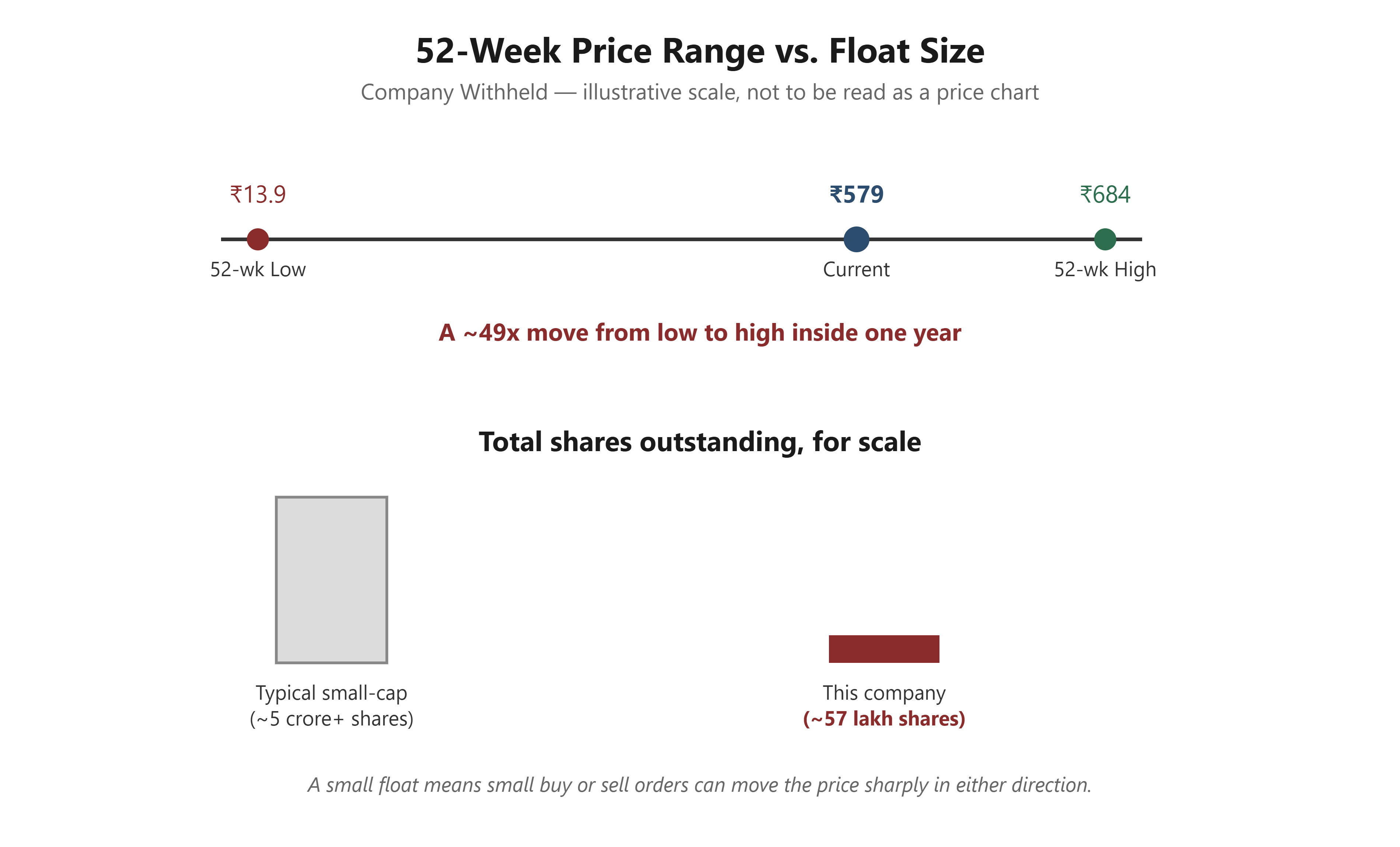
With such a small number of shares outstanding, relatively modest buy or sell orders can move the price sharply in either direction. This company has, in fact, reportedly hit upper circuit limits with only buy orders sitting in the queue and no sellers, which is a distinctive trading pattern typically seen in thinly floated stocks experiencing a sudden wave of buying interest. It is not, on its own, proof of anything improper. But it is a structural fact about this stock that should shape how much weight you put on any single day’s price move, in either direction.
The recent numbers tell an equally sharp story. For the quarter ended June 2026, the company reported a swing to a net profit of roughly ₹17 crore, a dramatic turnaround from a loss in the immediately preceding quarter. For the full FY26 year, standalone revenue was reported at roughly ₹50.5 crore, with net profit of around ₹21.3 crore.
Set that against a company that was reporting close to zero revenue and profit just one or two years prior, and you have one of the sharpest single-year financial transformations you’re likely to come across in listed India. Some of this is described as originating from securities trading and bullion trading activity, both of which can generate large, fast-moving gains or losses depending on market conditions in a given quarter, quite differently from how a manufacturing or services business would generate revenue.
The headline Return on Capital Employed of over 70%, and Return on Equity above 50%, are extraordinary figures in isolation. But context matters enormously here. These ratios are being calculated against a very small equity and capital base that only recently existed in anything like its current form. A small base combined with one strong quarter of trading gains can produce a return ratio that looks spectacular in percentage terms, without necessarily reflecting a durable, repeatable business model.
This is a case where the ratio itself isn’t wrong, but the story it appears to tell, “this business is astonishingly efficient,” needs far more history behind it before that conclusion holds up.
A very short operating history in its current business. The core activities generating these numbers only became part of the company’s legal scope in the last year or so. There is no multi-year track record to judge consistency against.
Extreme price volatility on a tiny float. A stock that can move roughly 49x between its 52-week low and high, on a base of around 57 lakh shares, carries genuinely different risk characteristics from a stock with a large, liquid float.
Recent preferential allotments and warrant conversions involving promoters, at prices well below where the stock later traded, which shareholders should understand fully before drawing conclusions about alignment of interest.
Revenue sourced from securities and bullion trading, both activities that can be highly profitable in a good quarter and reverse just as sharply in a weak one. A single strong quarter is not evidence of a repeatable engine.
Trading patterns consistent with very thin liquidity, including reported upper-circuit sessions with only buy orders and no sellers, which independently increases the risk of sharp price swings unrelated to underlying business fundamentals.
A long dormant history prior to this transformation, which means there is very little precedent within this specific entity to judge how management executes over a full business cycle.
None of these points are an accusation of wrongdoing. They are simply the documented, public facts of this company’s recent history, and taken together, they describe a business that is, at minimum, at a very early and unproven stage of whatever it is becoming next.
At the current price, the company trades at a market capitalization of roughly ₹320 crore, a P/E of about 8.7, and a book value of ₹141 per share, putting the price-to-book multiple at roughly 4 times. Taken purely on these ratios, it doesn’t scream “expensive.” But valuation multiples calculated on one or two quarters of a brand new business line, sitting on top of a company with almost no relevant operating history, are not comparable to the same multiples on an established, multi-year business. Cheap, in this context, may simply mean unproven and largely untested, rather than genuinely undervalued.
This is a company that spent decades as a small, largely inactive listed entity, then pivoted sharply into securities and bullion trading within roughly the last year, alongside preferential share issuances to promoters and a dramatic swing in reported profitability. The price action since has been extraordinarily volatile, on a very small float.
There may be a genuine business here in the making. There may not be enough history yet to tell. What’s clear is that this is a case study in reading a company’s recent past carefully before letting a low P/E or a high ROE number do the talking on its own.
So — which company is it?
Comments
Nothing yet. Say the first thing.
Sign in to join the conversation.