
Most companies try to time their IPO for a year when the numbers look their best. This one didn’t have that luxury. In the year before it went public, profit actually fell by close to 20%. It listed anyway, priced modestly at a discount to what a straightforward earnings multiple might suggest, popped on debut, and has since gone on to nearly double from its issue price.
That’s an unusual arc: a weak year, a cautious IPO price, and a market that decided to look past both. The real question is whether the market is looking at the same numbers you would, or a different, more recent story entirely.
This is a digital-first lender, serving customers who are largely new to formal credit — the mass-market, underserved segment banks have historically found expensive to reach. It operates through two consumer-facing apps, one built around checkout finance at the point of purchase, another offering personal loans and loans against property, both funneling into a single RBI-regulated NBFC lending subsidiary.
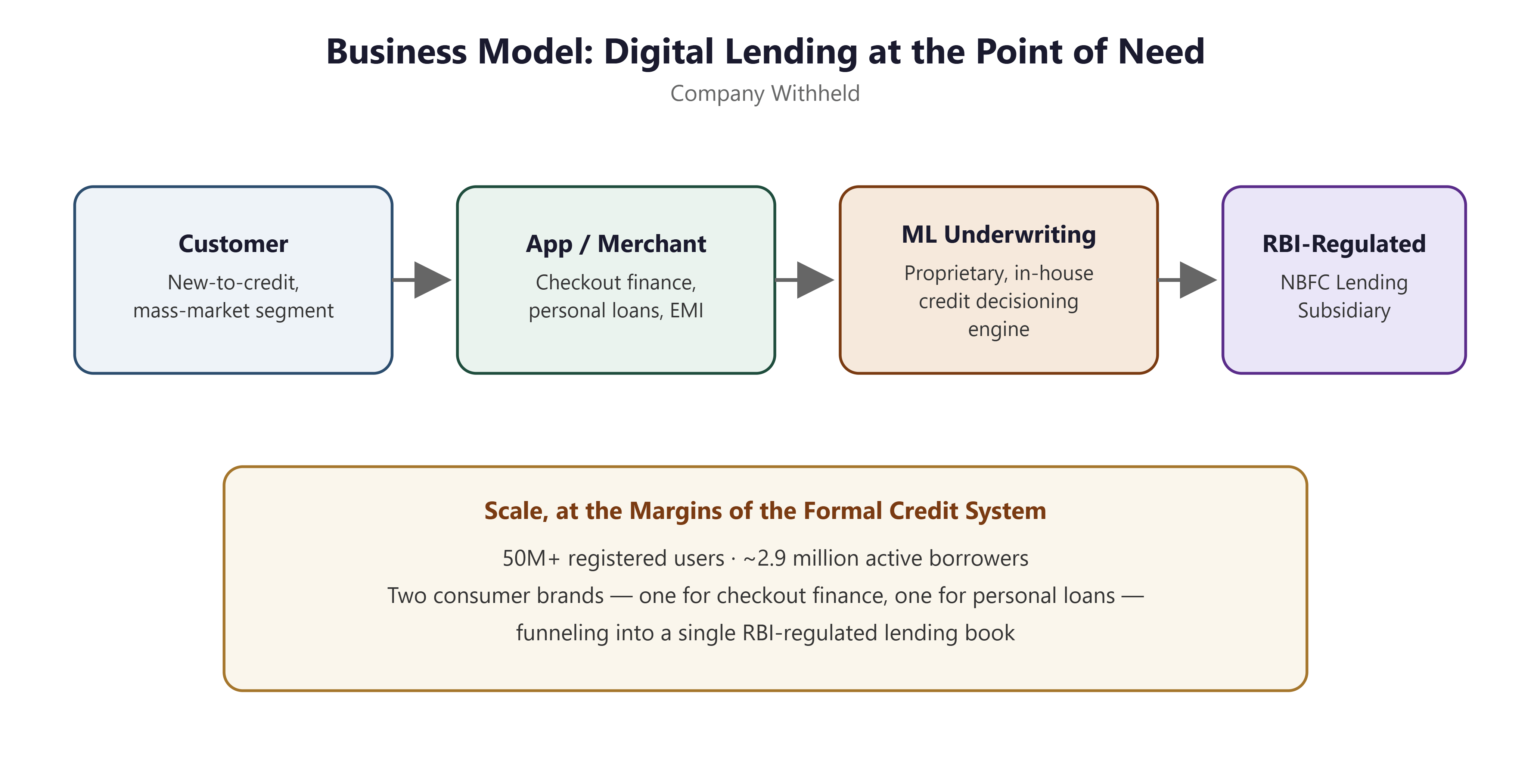
The pitch is genuinely tech-first: a proprietary, in-house machine learning underwriting engine built to assess borrowers with little to no formal credit history, distributed through a mix of digital marketing and merchant partnerships. Scale here is real — more than 50 million registered users and close to 2.9 million active borrowers, with assets under management that grew at a reported compound annual rate of close to 80% between FY23 and FY25.
Here’s where the story gets more interesting than the growth headline alone suggests. Full-year revenue fell from around ₹1,700 crore in FY24 to roughly ₹1,340–1,350 crore in FY25, and profit after tax declined from about ₹197 crore to around ₹160 crore over the same period — a genuine step back, not a rounding error.
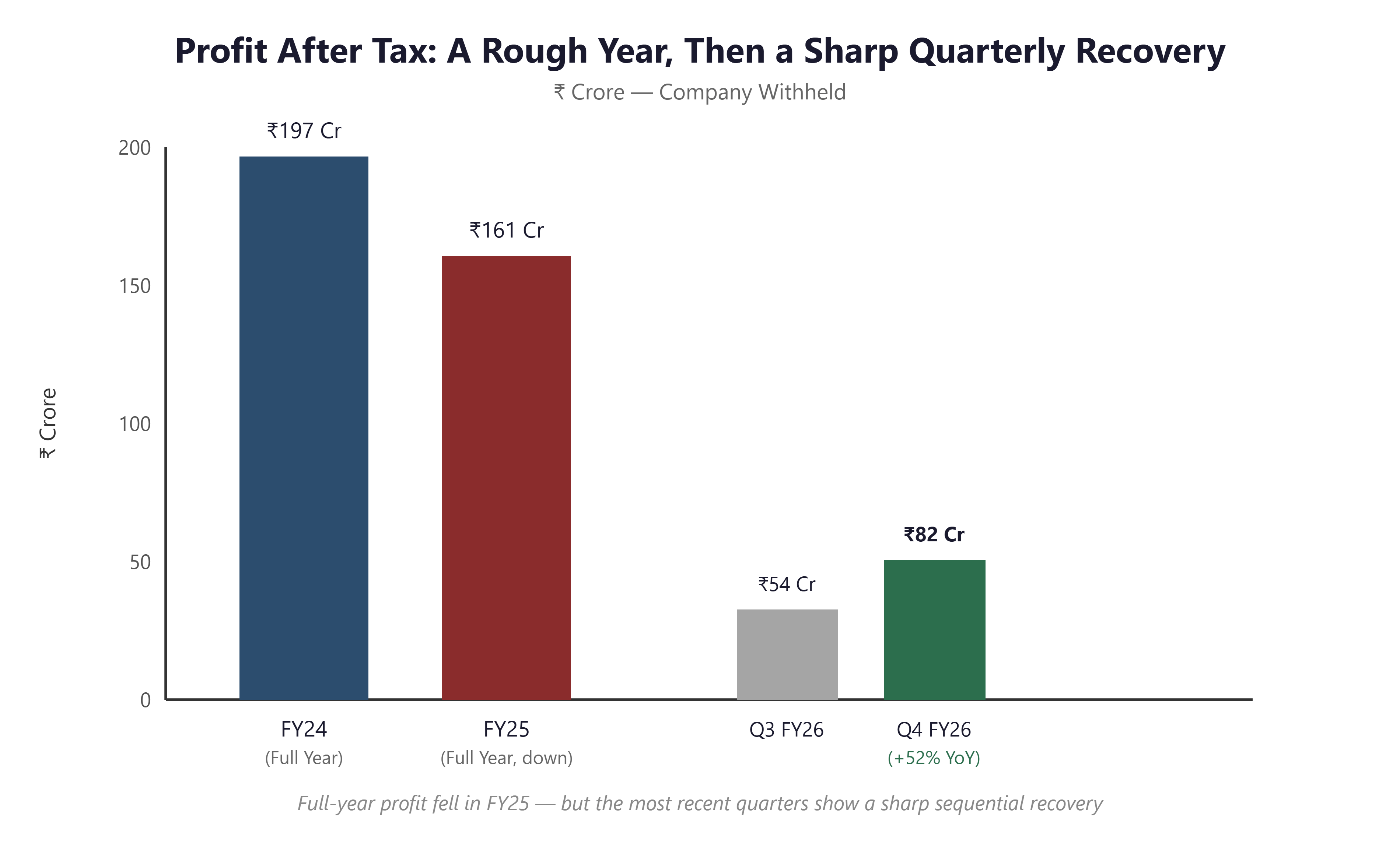
But look at the more recent quarters, and the picture shifts. Quarterly profit has been recovering sharply — the quarter ended March 2026 posted profit after tax of roughly ₹82 crore, up over 50% year-on-year. That’s the tension at the heart of this stock: a full annual report that shows contraction, sitting right next to a run of recent quarters that look like a genuine turnaround.
Asset quality metrics look healthy on the surface — gross NPA near 2.9% and net NPA around 0.38% — reasonable figures for a lender focused on newer-to-credit borrowers, though it’s worth remembering this book is still young, having scaled rapidly in just the last two to three years, and hasn’t yet been tested through a full credit cycle.
Following its IPO, the company routed a large chunk of the fresh capital raised, roughly ₹637 crore, directly into its lending subsidiary via a rights issue priced at a steep premium, specifically to support future loan book growth. That’s a straightforward, sensible use of IPO proceeds for a lending business: more capital directly funding more lending capacity.
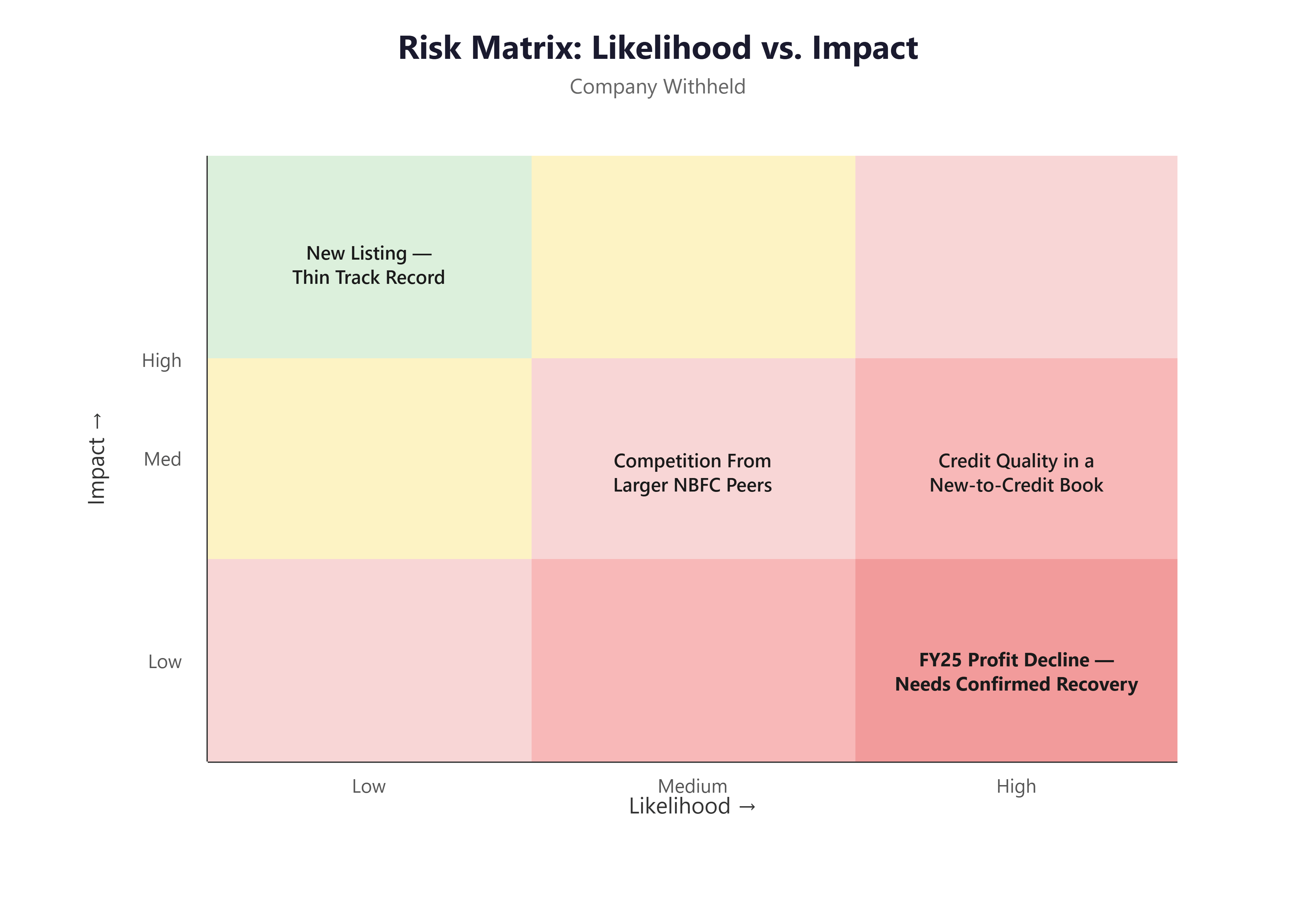
A genuinely short public track record. The company listed only months ago; there isn’t much history yet of how it performs across a full market or credit cycle as a public company
FY25’s profit decline needs a fuller explanation and a confirmed recovery, not just a couple of strong quarters, before it should be read as fully resolved
Untested credit quality at scale. A loan book built rapidly around new-to-credit borrowers is inherently harder to underwrite reliably than one built on borrowers with an established credit history, and current asset quality numbers haven’t yet been through a genuine stress period
Competitive intensity from far larger, better-capitalized NBFC and bank-backed lenders, several of which are actively expanding into the same underserved segment
Regulatory sensitivity. Digital lending in India has faced repeated regulatory scrutiny in recent years around disclosure, recovery practices, and data use — a sector where rules can tighten with limited notice
At a market capitalization of roughly ₹5,700–5,800 crore, the stock trades at a price-to-earnings ratio in the high 30s to around 40, against peers like larger diversified NBFCs and consumer lenders that are substantially bigger in scale. Data on price-to-book here has been genuinely inconsistent across providers, to the point where it’s not reliably usable without a direct check against the company’s own filings, so it’s better set aside than quoted with false precision.
The core valuation question is simple to state and harder to answer: is the market correctly pricing in a genuine turnaround from FY25’s dip, backed by real, sustained quarterly improvement, or is it extrapolating two or three good quarters onto a business that only recently proved it could also have a bad year.
So — which company is it?
OnEMI Technology Solutions Ltd (Kissht)
No posts
Comments
Nothing yet. Say the first thing.
Sign in to join the conversation.