
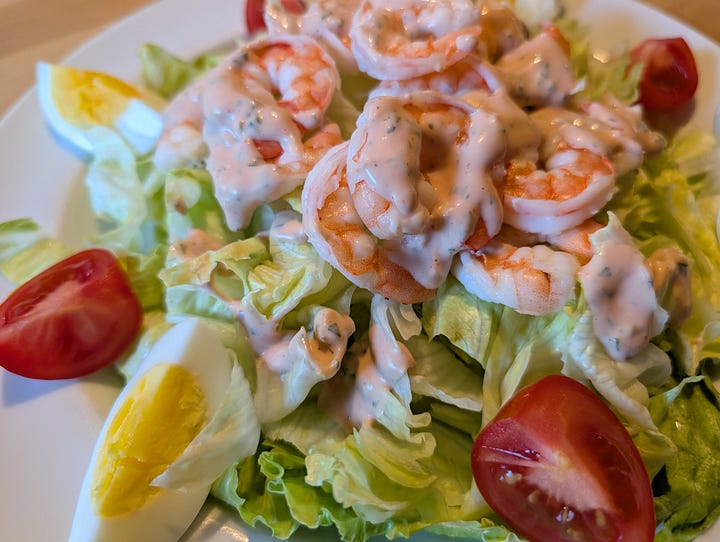
We’ve broken a couple heat records here in Seattle the past week or so, including the 89 degrees hit last Monday. So I kicked off the summer salad-for-dinner season a tad bit ahead of schedule. At first, it was a simple cucumber-tomato-chickpeas-feta combo on that hot Monday; leftovers of which for dinner Tuesday. Wednesday, I pulled some shrimp from the freezer, which I usually do without any specific plan—I’ll wing something come dinnertime, after rummaging through the fridge. This time, it didn’t take long for “Louis” to come to mind, being in a salad frame of mind already.
With so many varieties of seafood and in a variety of forms—including tinned and smoked—there are plenty of ways that seafood becomes a great salad component. In this post from a few summers ago, I talk about the array of off-the-cuff possibilities, singing the praises of leftover (or intentionally cooked ahead of time) seafood as an ideal jump-start for super quick, easy salads. Among other seafood salad ideas I’ve shared thus far are Endive & Radicchio Salad with Fried Oysters & Hazelnuts, Smoked Trout (or Smoked Salmon) and Potato Salad, and Green Goddess Dressing (to dress many seafood salads).
Here, I want to chat about a couple of salads that are classics—to be enjoyed in their more or less traditional form, and as a starting point from which to adapt and follow your whims.
I’d done some research in the past on crab Louis for my crab cookbook and salade Niçoise for a class I taught a couple of years ago. On top of years of simply enjoying them and picking up insights along the way about various ways they are made and presented. That didn’t keep me from going down a couple big (delightful) rabbit holes while writing this.
Once I started comparing references about what comprises a traditional salade Niçoise and seeing such great variance in them, I realized this was not going to be the moment to get to the bottom of whatever the true original form of the salad is.
A while back I’d come across one particularly adamant treatise on true Niçoise in Waverley Root’s 1958 The Food of France. There he has this to say about the traditional salad from Nice, following a paragraph that stated “Nice food is outdoor food.”
“In the same category of hot weather outdoor food is salade niçoise. This is a salad innocent of lettuce, but it contains many other ingredients, all variable except two—it contains tomatoes, which must be cut into quarters (if they are sliced, it’s not a salade niçoise; the local population is adamant on this point), and it is abundantly laced with olive oil mixed with pissala, which means anchovies ground into a paste in a mortar. Black olives are almost invariably included, and so are slices of green pepper. Filets of anchovy may be, in addition to the pissala, perhaps the lima-like beans known as fèves (raw), radishes and occasionally hard-boiled eggs.”
He goes on to say that purists would be horrified by green beans or potatoes being added, that there’s nothing cooked in a genuine version, aside from those possible hard-boiled eggs.
And here’s a piece from the New Yorker back in 2020 that celebrates salade Niçoise, including notes about Auguste Escoffier’s perspective on the true and correct version (daring to say that potatoes and green beans are mainstays), plus insights from NYC chef Eric Ripert.
Based on where I’ve landed with my favorite interpretation of this salad, I agree with Root about no lettuce—I’ve always considered this to be one of the many great examples of greens-free salads out there. No green pepper, fava beans or radishes for me—at least in this context.
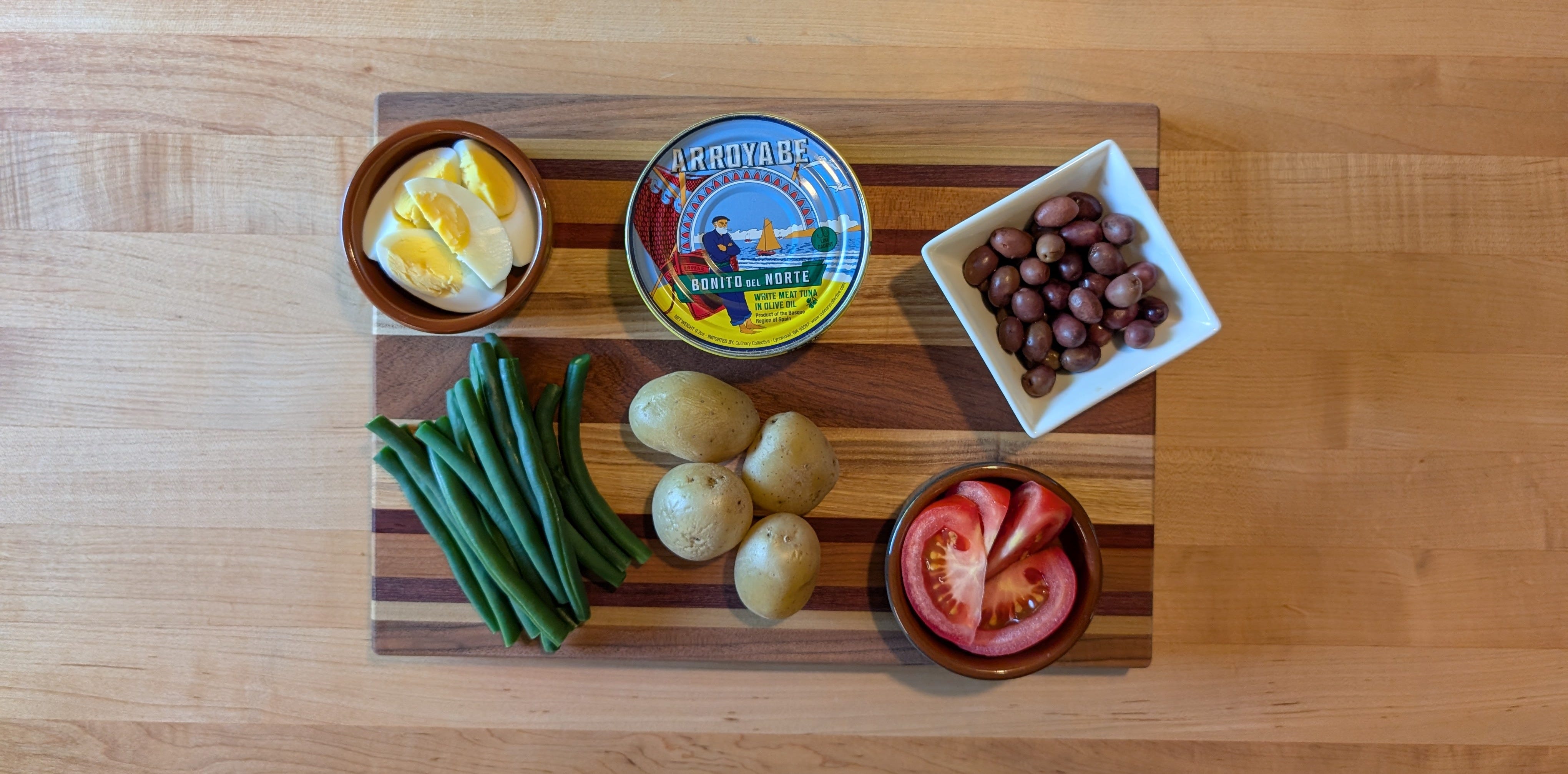
Waverley Root’s record above mentions no tuna, true of a couple other older references I read, anchovies apparently the original seafood element. Today there’s little question that tuna is a key ingredient, Eric Ripert (in that New Yorker piece) echoes my understanding that it has long been canned tuna, not fresh, served on the salad. But not packed in water, “It’s tuna in a can with olive oil,” he states. This is a great time to invest in top-quality, oil-packed tuna. And yes, many a salade Niçoise today are served with grilled or seared tuna steaks, or salmon, or other variants.
I figured the more straight-forward Louis didn’t hold too many mysteries, aside from who exactly the namesake was and whether he was a Louis or a Louie (I’d used Louis in my cookbook, sticking with that option). But glancing through a number of recipes from reliable sources, I see some without tomato, some add olives to the dressing or salad, maybe relish or heavy cream in the dressing. Cucumber, artichoke hearts, and asparagus among other potential additions. Some opt for Boston or bibb lettuce, I find this to be one occasion when old-school iceberg is ideal. Legend leans toward San Francisco as this salad’s birthplace, with some nods to Portland as well.
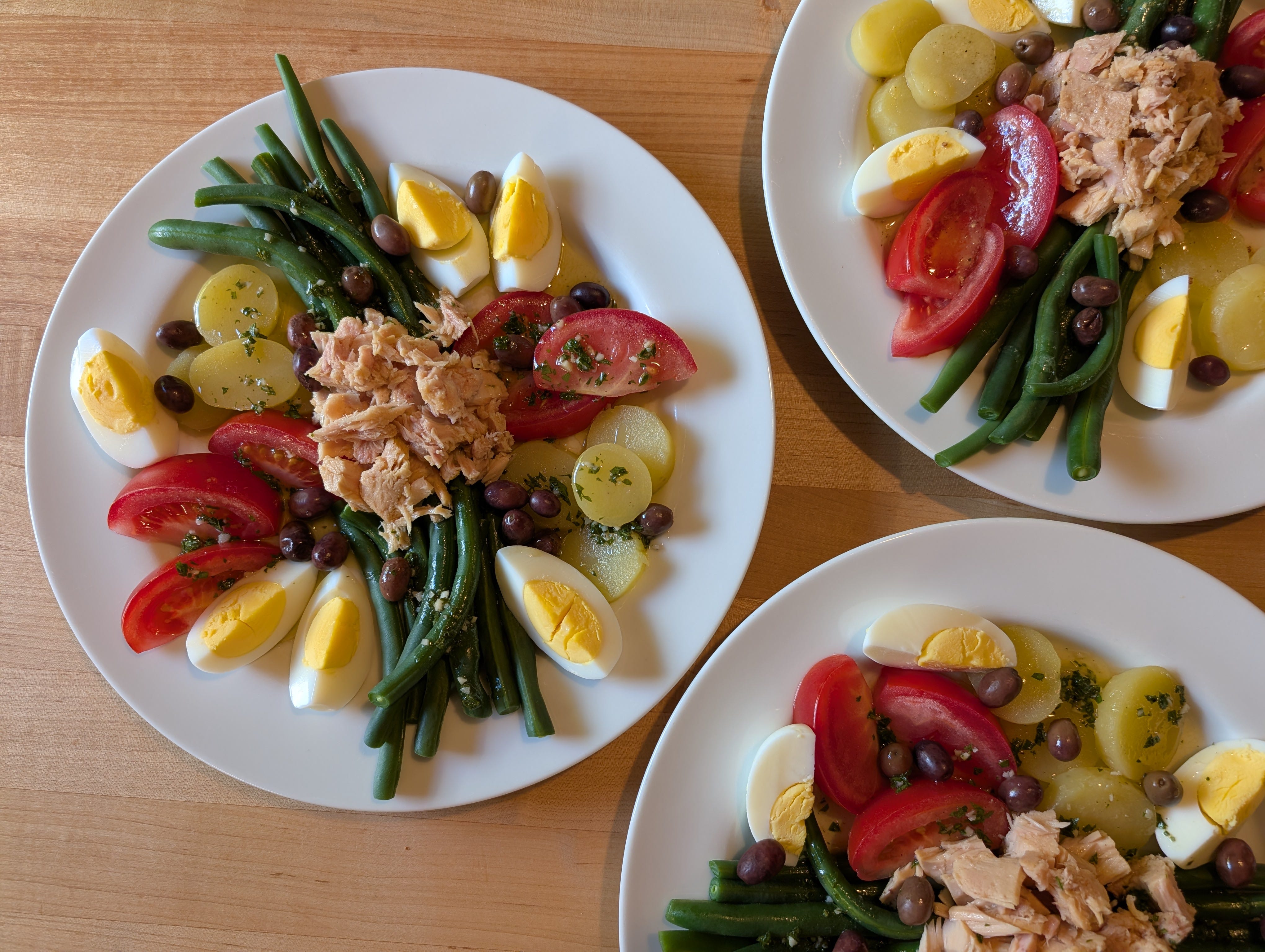
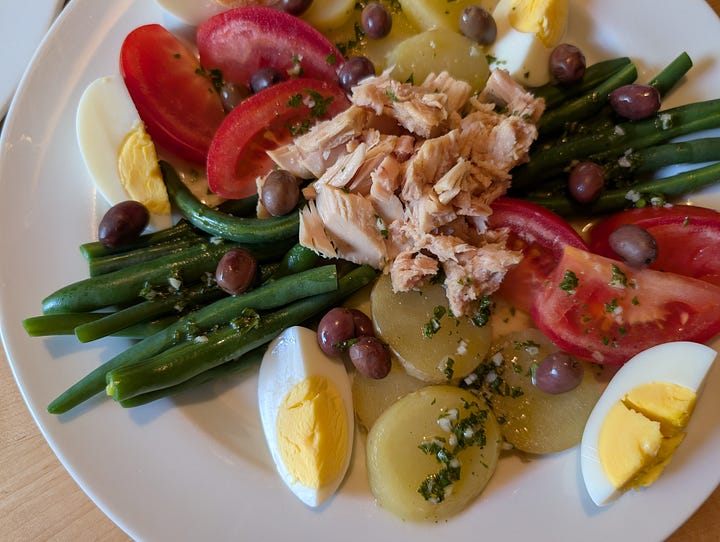
This is the version of this classic salad that I put together for a class I taught a couple of years ago. As noted above, there are a number of different perspectives about what constitutes a salade Niçoise, which gives us room to customize to our tastes. That explains why there are no full fillets of anchovy draped over my salad, just some anchovy in the dressing; despite my efforts, I am not yet a big anchovy fan. All you aficionados can embellish to your heart’s content.
If you’re ever going to invest in some top-quality canned or jarred tuna, this is the time to do it. Package sizes vary a lot, as may the amount you wish to serve on the salads, so the amount below just a guideline. Look for the “drained weight” noted on the package, if there is one, to know how much tuna you’ll have to serve, minus the oil it was packed in.
You’ve got a couple of options for serving. This salad makes for a very showy centerpiece, if you arrange all the components on a large platter from which to serve at the table. Also showy, if a tad less grand, is a similar arrangement on individual plates.
I hadn’t anticipated having a hard time finding Niçoise olives, I struck out a 4 or 5 stores with good specialty selections. Whenever I last bought some, without any trouble, was clearly a while ago. Have a look at a well-stocked olive bar for bulk, or jarred, with other olives. I ended up finding a jar at the fabulous food store Delaurenti in the Pike Place Market. For my taste, kalamata and green olives are too different from Niçoise for using here—but if they make you happy, go for it. An option more similar, I understand, would be Taggiasca or Ligurian olives.
3/4 pound fingerling or new potatoes, scrubbed
10 to 12 ounces green beans, preferably thin young beans, trimmed
About 8 ounces top-quality, oil-packed tuna (drained weight)
3/4 to 1 pound heirloom or other vine-ripe tomatoes, cored and cut into wedges
1/2 cup Niçoise olives or other top-quality dark brined olive
4 hard-cooked eggs, peeled and quartered
Dressing
2 anchovy fillets, chopped, or 1 teaspoon anchovy paste
1 clove garlic, minced or pressed
3 tablespoons white wine vinegar
1/3 cup extra virgin olive oil
1 tablespoon minced flat-leaf parsley
Salt and freshly ground black pepper
Put the potatoes in a medium pan of cold salted water and bring to a boil over medium-high heat. Reduce the heat to medium and simmer until the potatoes are tender when pierced with the tip of a knife, 12 to 15 minutes. Drain and set aside to cool.
Using the same pan, bring salted water to a boil and prepare a medium bowl of ice water. Add the green beans to the boiling water and cook until just barely tender and vivid green, 1 to 3 minutes, depending on their size. Drain well and immediately plunge the beans into the ice water to quickly cool. Drain well and lay out on paper towels.
Cut the cooled potatoes in half lengthwise for fingerlings, or across into 1/2-inch slices for other potatoes.
For the dressing, combine the anchovy and garlic in a small bowl and mix well with a fork, using the tines to crush with the fillets, if using. Add the vinegar and stir to blend, then add the olive oil in a thin stream, blending constantly with the fork. Stir in the parsley with salt and pepper to taste (keeping in mind the anchovies are salty).
The salad can be served either on individual plates or on a platter for family-style service. Arrange the green beans, potato slices and tomato wedges in clusters across the plate or platter. Set the tuna on top in the center, scatter the olives over the vegetables and arrange the hard-cooked egg wedges around the outer edge. Rewhisk the dressing to blend and drizzle it over the vegetables. Serve right away.
Makes 4 servings
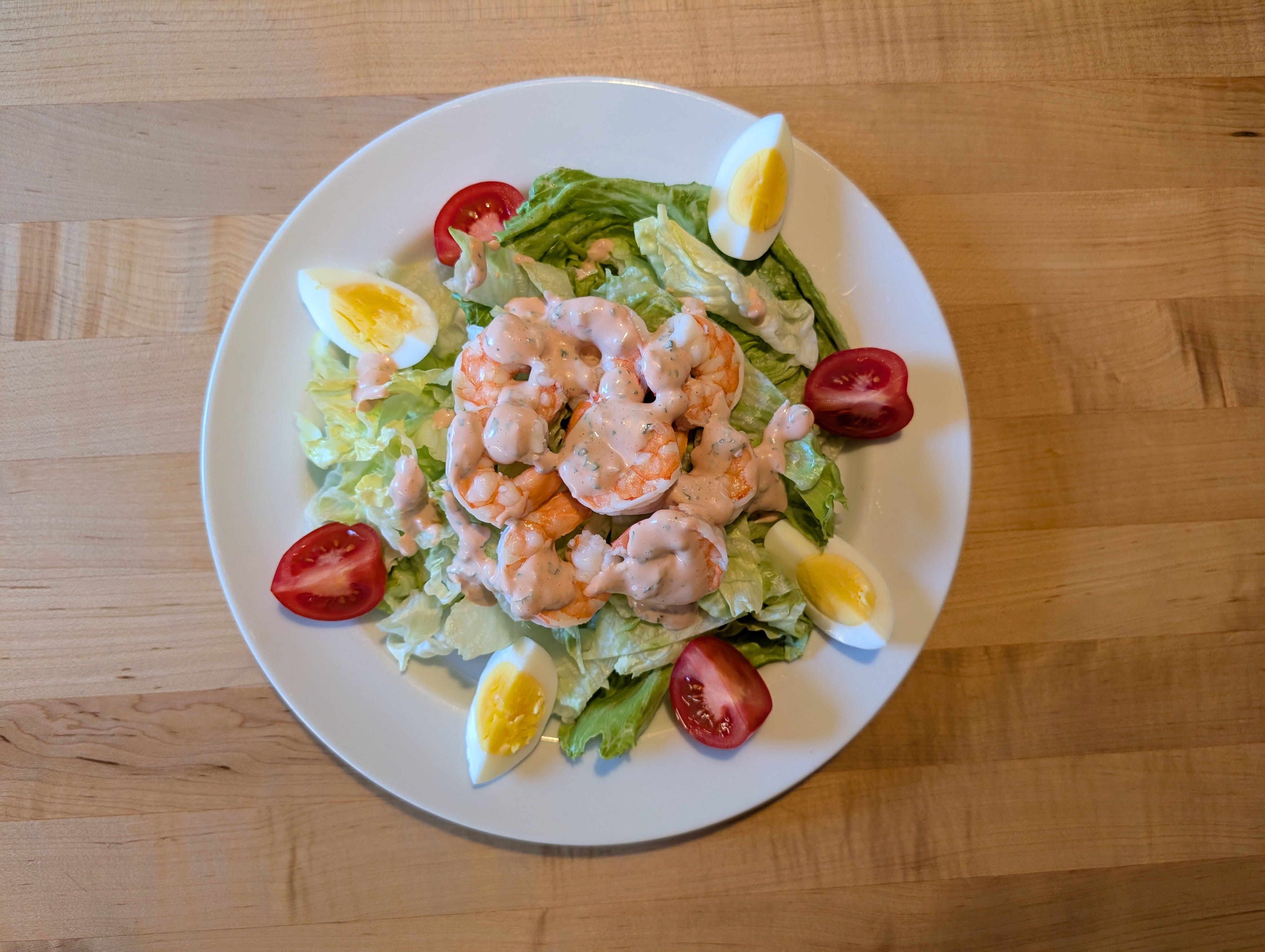
I present this time-honored recipe with its retro character, because to change it much would make it less “Louis,” (or “Louie,” whatever your spelling preference may be) more of a general (albeit delicious) seafood salad. Crisp and bright iceberg lettuce is my go-to, others may opt for butter lettuce or romaine. Hard-cooked eggs and tomato wedges are generally the only accompaniment to the crab, though among common embellishments are avocado and asparagus, which I can get behind. There’s room for you to follow your Louis-inspired whims.
You can start with cooked shrimp, which is quicker and more it’s-too-hot-to-cook-friendly. I most often cook them myself. Of course, it’s easy to translate this to a crab Louis, as per the salad’s origins, topping each serving with two to three ounces of crabmeat—more if you’re extra blessed with fresh crab to serve! Or perhaps opt for some of both.
12 ounces medium shrimp, raw or cooked, or bay shrimp
1 small handful parsley stems (optional)
1 bay leaf, preferably fresh (optional)
1 head iceberg lettuce, cored, leaves separated, rinsed, and dried
4 hard-cooked eggs, peeled and quartered
2 to 3 small tomatoes, cored and cut in wedges
Louis Dressing
3/4 cup mayonnaise
1/3 cup ketchup or chili sauce*
3 tablespoons finely chopped green onion
1 tablespoon minced flat-leaf parsley
Dash Worcestershire sauce
Dash hot pepper sauce
Salt and freshly ground black pepper
For the dressing, combine the mayonnaise, ketchup, green onion, parsley, Worcestershire, and hot pepper sauce in a small bowl and stir to mix. Season to taste with salt and pepper, cover and refrigerate until ready to serve. (The dressing can be made a day ahead.)
If using raw shrimp, put the parsley stems and bay leaf in a medium pot and half-fill it with water. Add a large pinch of salt and bring the water just to a boil over medium-high heat. Add the shrimp, reduce the heat to medium-low and simmer gently until the shrimp are just cooked through, 3 to 5 minutes. Drain well and set aside to cool. If the shrimp were not already peeled, remove the shells when cool. Optional: cut each shrimp in half—lengthwise or crosswise—for smaller pieces to add to the salad.
Coarsely shred the lettuce and arrange an even layer on each plate (chilled plates, if you like). Arrange the shrimp in the center of the lettuce, setting the egg and tomato wedges evenly around. Spoon a bit of the Louis dressing on the shrimp, passing the rest separately. Serve right away.
Makes 4 servings
*I hestitate to even mention the chili sauce option, lest someone unknowingly grab a bottle of spicy, chile-pepper-based sauce to use here. The intended sauce is a tomato-based sauce similar to ketchup but a bit chunkier and with added seasonings, usually not spicy. It’s also sometimes a base for cocktail sauce. Heinz is a traditional chili sauce brand you might see, which includes no hot peppers; other brands may have a touch of spice.
There are many approaches to hard-cooking eggs and you may have a favorite, in which case skip ahead! Today most agree that, though we often call them “hard-boiled” eggs, the eggs really shouldn’t cook at a rolling boil. Gentler heat helps avoid the white becoming rubbery-hard by the time the yolk is cooked through.
This is my preferred approach: Put the eggs in a medium saucepan with enough cold water to cover them by about 1 inch. Set the pan over high heat and bring just to a boil, then take the pan from the heat, cover, and set aside for 10 minutes. Drain the eggs and put them in a bowl of ice water to stop the cooking and cool the eggs quickly. Refrigerate until ready to use.
No posts
Comments
Nothing yet. Say the first thing.
Sign in to join the conversation.