
When was the last time you listened to a DVD commentary track?
Not watched a film. Not binged a series. Not scrolled endlessly through a streaming service trying to decide what to watch.
When was the last time you sat down after a film had finished and listened to the director explain how they made it?
For many movie fans, the answer is probably years.
Somewhere along the way, we lost something.
Streaming gave us access to more films than ever before. We can watch almost anything, anywhere, at any time. It is convenient, affordable and undeniably impressive.
Yet somehow, despite having access to more films than ever, we may understand less about how they are actually made.
The humble DVD commentary track, once a staple of physical media, has quietly disappeared from most people’s lives. Along with it went behind the scenes documentaries, deleted scenes, production diaries, cast interviews and hours of bonus content that transformed watching a film into something much bigger.
And perhaps that is one reason why physical media is making a comeback.
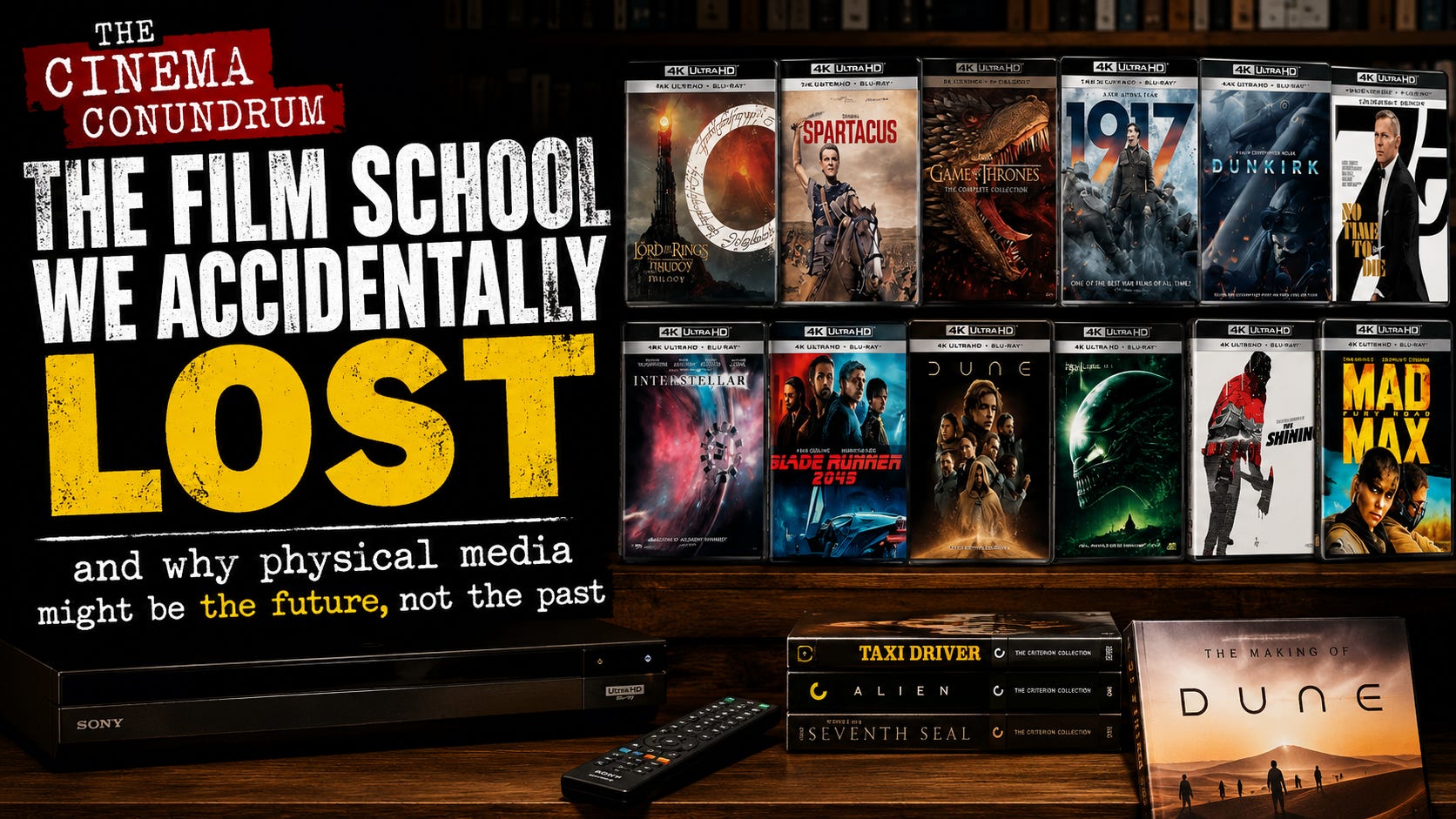
Editor's Note: This article is part of The Cinema Conundrum, Screen One's ongoing series exploring the changing landscape of movies, moviegoing and film fandom.
Long before YouTube essays and TikTok explainers, many film fans learned about filmmaking through DVD extras.
You didn’t need to attend film school.
You could simply put on a commentary track and listen.
Directors explained why scenes were shot a certain way.
Writers discussed story structure.
Editors broke down pacing decisions.
Actors shared insights into performances.
Some releases became legendary for the sheer amount of material included.
The extended editions of The Lord of the Rings felt like an entire filmmaking course packaged alongside the films themselves. Other releases were packed with documentaries that often ran longer than the movie itself.
For movie lovers, this wasn’t filler.
This was education.
This was discovery.
This was part of the hobby.
Streaming changed everything.
At first it felt revolutionary.
No shelves.
No clutter.
No discs.
No boxes taking up space in the living room.
For years physical media was portrayed as old fashioned and inconvenient. Why own a film when you could simply stream it?
It seemed like a logical progression.
But in gaining convenience, we lost much of the experience.
Most streaming services now offer little more than the film itself.
No commentary.
No making-of documentary.
No deleted scenes.
No deep dive into the creative process.
The credits roll and the experience ends.
For a generation raised on physical media, that still feels strangely incomplete.
For years physical media was seen as a relic.
Something your parents collected.
Something that took up too much room.
Something that would inevitably disappear.
Except it hasn’t.
In fact, something rather interesting has happened.
Physical media has evolved.
Modern 4K releases look and sound spectacular. In many cases they still outperform streaming equivalents, particularly when it comes to picture quality, audio fidelity and consistency.
The format has improved while streaming has often become more compressed and more reliant on internet speeds and licensing agreements.
What was once seen as outdated is beginning to look surprisingly future-proof.
A 4K disc cannot disappear because a contract expires.
A film cannot be edited without your knowledge.
A streaming service cannot decide it is no longer available.
You own it.
And ownership is becoming attractive again.
The comparison with vinyl records is impossible to ignore.
For years vinyl was considered obsolete.
Then something changed.
People rediscovered the joy of actually owning music.
Record labels leaned into the format.
Special editions appeared.
Coloured vinyl became commonplace.
Collectors editions became events.
Suddenly buying music felt exciting again.
Owning something tangible mattered.
Physical media is beginning to follow a similar path.
Collectors editions arrive packed with artwork, posters, booklets and exclusive extras.
Boutique labels understand that people are no longer just buying a movie.
They are buying an experience.
They are buying something worth displaying.
Something worth talking about.
Something worth collecting.
Ironically, social media may be helping physical media thrive.
In the age of YouTube, TikTok and content creation, people love sharing what they own.
Unboxing videos attract huge audiences.
Collectors proudly showcase their shelves.
Entire communities have formed around physical media collections.
We even got in on the act ourselves here at Screen One.
What once might have been viewed as a cupboard full of discs is now often presented as a badge of honour.
Movie fans are excited to show off their collections.
And other movie fans love seeing them.
The hobby has become visible again.
Perhaps no company understands this better than Criterion.
While much of the industry rushed towards streaming, Criterion remained committed to physical media.
Not only did they continue producing premium editions, they elevated them.
Their releases became collectibles.
Their packaging became desirable.
Their brand became aspirational.
Today, social media is full of discussions about “Criterion cupboards” and Criterion collections.
Their popular Closet Picks series has become must-watch content for film fans.
Directors, actors and musicians are invited to browse Criterion’s collection and select films they love, filling a tote bag as they go.
The guest list reads like a who’s who of cinema and popular culture.
Martin Scorsese.
Bong Joon-ho.
Robert De Niro.
Winona Ryder.
Cate Blanchett.
Kevin Bacon.
Even Charli XCX.
The message is clear.
People who love movies still love owning movies.
Perhaps one of the most fascinating developments came when Disney effectively handed physical media distribution duties to Sony.
For a company built on one of the most valuable film libraries in history, it felt like an odd move.
Almost as if physical media was no longer worth the effort.
Yet at the very same time, collectors have continued buying premium releases.
Special editions sell out.
Steelbooks disappear quickly.
Boutique labels continue expanding.
The demand clearly exists.
The audience is still there.
In some ways, the industry appears less convinced about physical media than the consumers themselves.
The resurgence of physical media is not really about nostalgia.
At least not entirely.
It is about engagement.
It is about ownership.
It is about rediscovering the parts of movie fandom that quietly disappeared during the streaming revolution.
People are not buying 4K discs simply because they dislike streaming.
Most of us use both.
What they are buying is the experience that surrounds the movie.
The commentary tracks.
The documentaries.
The artwork.
The packaging.
The sense that the film matters enough to deserve preservation.
Perhaps physical media isn’t the future or the past.
Perhaps it’s simply the part of movie fandom we forgot to bring with us.
So step out of the stream for a moment.
The lake’s lovely.
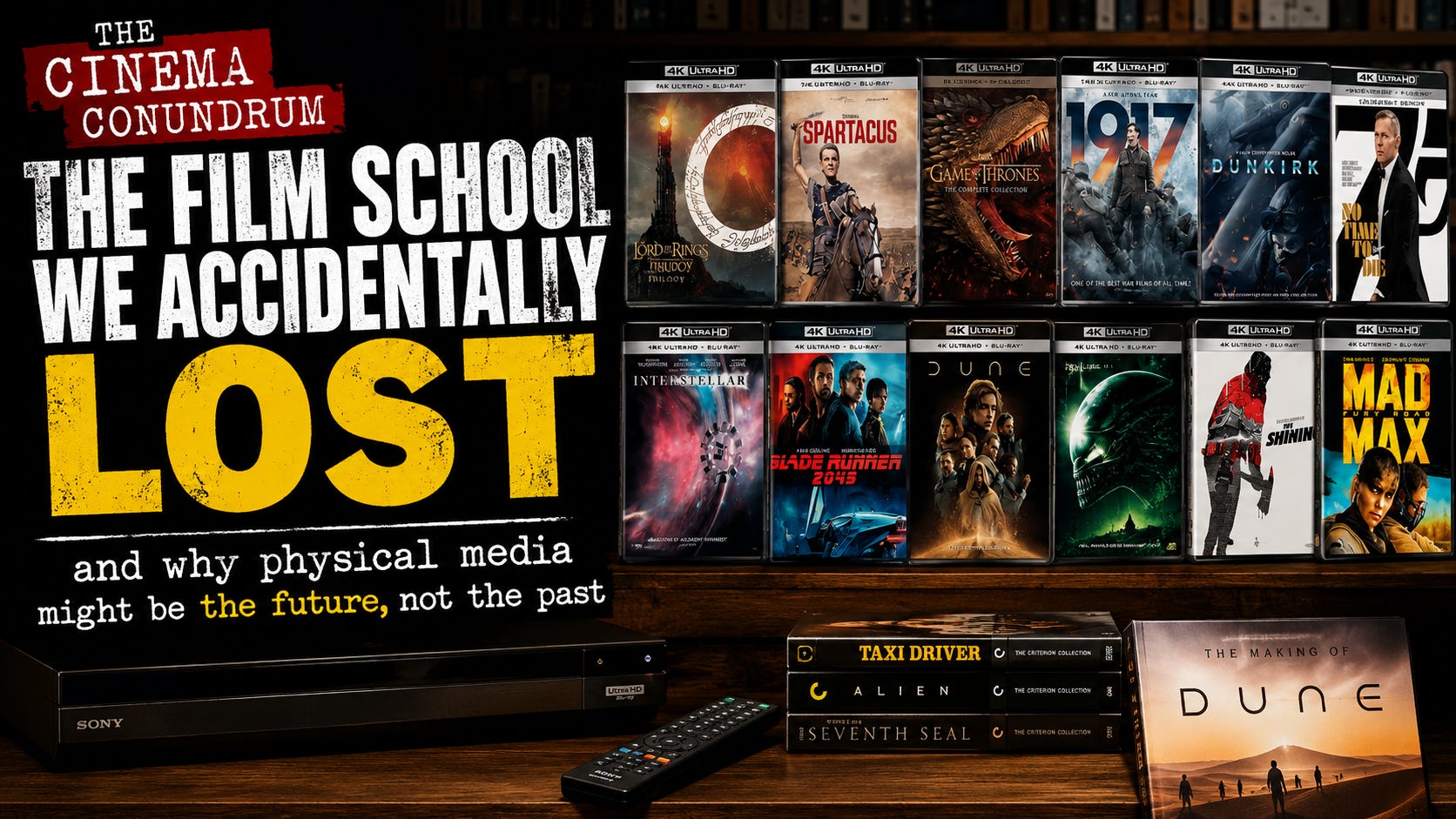
Editor's Note: This article is part of The Cinema Conundrum, Screen One's ongoing series exploring the changing landscape of movies, moviegoing and film fandom.
Comments
Nothing yet. Say the first thing.
Sign in to join the conversation.