
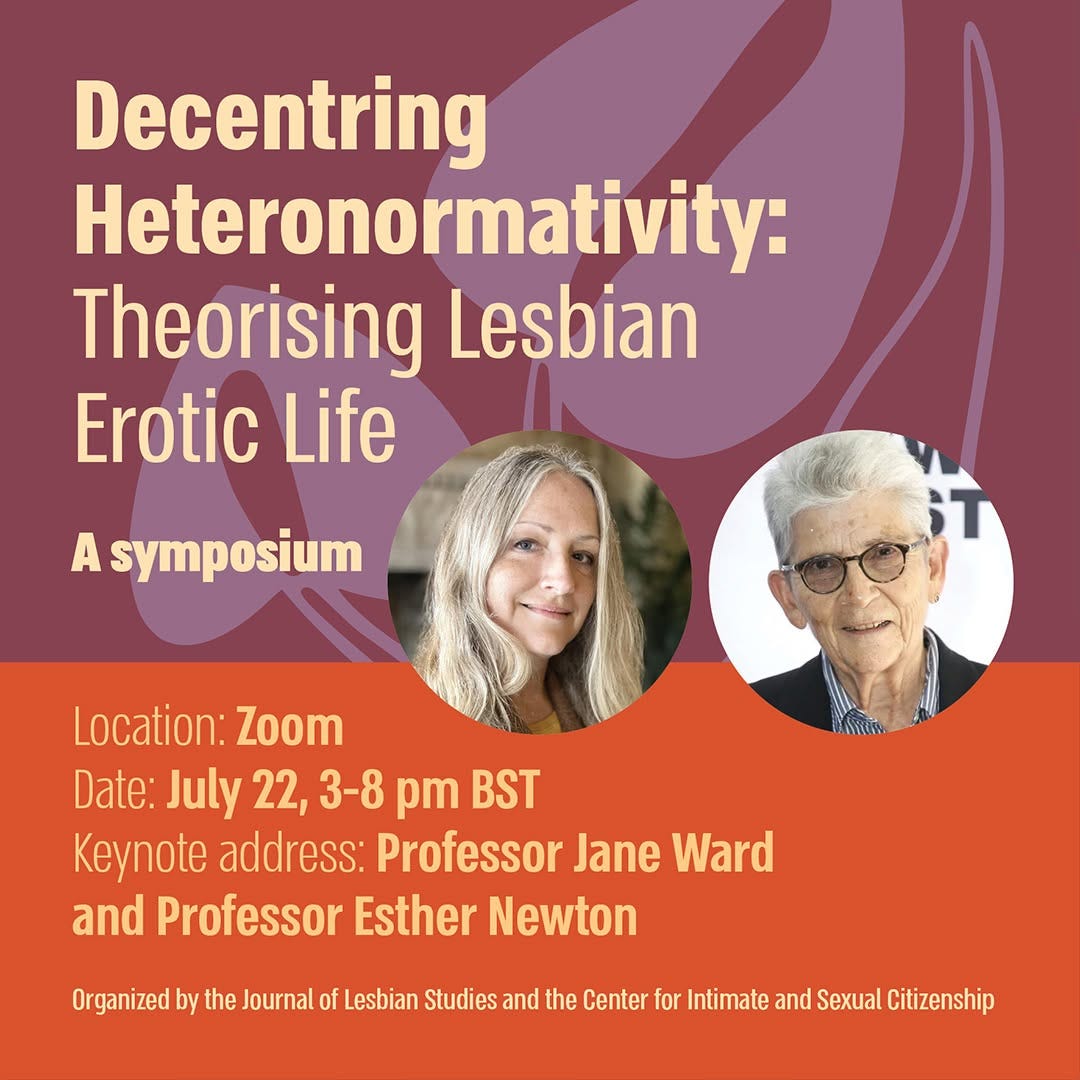
On 22nd July 2026, the Decentring Heteronormativity: Theorising Lesbian Erotic Life Symposium took place online, hosted jointly by the Centre for Intimate and Sexual Citizenship at the University of Essex, and the Journal of Lesbian Studies. Being interested in research as well as whatever is currently being said within academic circles about lesbians, I attended the symposium.
The blurb for the symposium started like this:
Lesbian sexualities have long been rendered invisible, misrepresented, or reduced to stereotypes. The question, ‘How do lesbians have sex?’, is often posed with a lesbophobic undertone, yet for lesbians themselves it opens up rich conversations about intimacy, pleasure, embodiment, creativity, and desire.
I was, naturally, looking forward to hearing how the research presentations would help address some of this misrepresentation and invisibility faced by lesbians. Okay, looking forward is a bit strong, but I was happy to sit through it with my brain switched to ‘critical’.
My review here is based on my own notes and recollections and is as faithful an account as I can give, but the good news is that the Journal of Lesbian Studies will have a special issue next year featuring the papers presented at the symposium, and it will be free to access for a month. I don’t know which month yet, but you can see the Journal of Lesbian Studies’ web presence here.
What is a Lesbian?
Given that the theme was ‘lesbian erotic life’, it was not surprising to hear some speakers pose the old chestnut, what is a lesbian? Anyone expecting a clear definition like the one agreed upon recently, for example, by judges at the UK Supreme Court, was to be disappointed.
In their talk about ‘Lesbian Sexual Practices in Mid-Twentieth-Century Pulp Fiction’, Nicole Marcoux and Denyse Rodrigues proposed the following options: ‘lesbian as an identity – a fixed identity, one along a continuum, or an identity in solidarity with other 2SLGBTQ+ identities’.
Since this was an academic symposium, let’s take a minute to unpack that third suggestion of lesbian as an ‘identity in solidarity’. Our sexual orientation provides, after all, a statement of where our sexual boundaries lie. Does the above suggestion mean that ‘solidarity’ could be a central driving force for calling oneself a lesbian? Surely no lesbian can be propelled through life not by attraction to other women, but by the thought of standing shoulder to shoulder with furries and Nicola Sturgeon at Pride marches.
In other talks, there was no attempt to provide definitions. Introducing their talk, ‘Butch Sex: The Making and Unmaking of Butchness’, the authors Amy Tooth Murphy and Katherine Hubbard explained that they would not be giving a definition of ‘butch’ and the study involved six ‘self-identified’ butches. This talk raised some interesting ideas around stereotypes and expectations, but without knowing whether the subjects were male, female or a mix of the two, or indeed whether any other inclusion/exclusion criteria for butchness were used, it was impossible to fully make sense of the presentation.
Transitioning
Several of the presenters discussed ‘transitioning’. In her talk about ‘stone sexuality’, Róisín Ryan-Flood talked about some lesbians finding touch to be too ‘feminising’ and quoted a lesbian who had explored transition in connection with her dislike of being touched. The author proposed that ‘stone’ lesbians may ‘lack visibility’. In a parallel world, it would be good to know more about this area by researching the possible connections between rigid sexual identities and feeling uncomfortable in one’s own body.
In her presentation, ‘Everyone Wanted a Piece of a Trans Man: Trans Men in Lesbian S/M Scenes, 1985-2005’, Elio Colavito discussed ‘dick in a drawer’ policies adopted by lesbian S&M groups to keep biological men out (i.e. you could be admitted if your ‘dick’ – strap on – could be removed and placed in a drawer). This talk made me feel a bit sad as the author went to great lengths to explore why ‘trans men’ were accepted on the basis of their ‘lesbian pasts’ while the lesbians were not interested in ‘trans women’. So close to recognising same sex sexual orientation, and yet so far.
Due to other commitments, I unfortunately missed a talk by male/female presenting team Sam Bolton and Emily Cousens, in which they presented a case for re-reading Andrea Dworkin through a ‘queer, trans psychoanalytic lens’. I think it’s enough to mention that the symposium went there with an attempt to obfuscate the messages of second-wave feminism.
Queering
There were many presentations in this symposium, and I have not attempted to comment on them all. It was noticeable that although some presentations did appear to be solely by and about women, pronouns were on display and ‘lesbian’ was used interchangeably with ‘queer’; none of the presenters dissented from the unspoken adherence to queer and gender identity theory. Speakers would mention lesbian, queer and trans all in the same sentence when answering questions from the audience, as if these words were completely interchangeable. You can see an example of this phenomenon here from one of the abstracts for the symposium (Nicole Marcoux & Denyse Rodrigues: ‘Between the Covers: Lesbian Sexual Practices in Mid-Twentieth-Century Pulp Fiction’):
Historical accounts of lesbian sex are not easily found. Queer histories are often ignored, erased, or otherwise left out of our collective memories. The persecution and discrimination of 2SLGBTQ+ people throughout history has resulted in significant knowledge gaps of that history. As a result, queer academics have encouraged the use of alternative record-keeping methods for queer histories (Cvetkovich, 2003; Sedgwick, 2008). Lesbian, Gay, and Trans pulp fiction provides a unique insight into lesbian sexual practices from the particularly repressive mid-twentieth century in the United States and Canada.
In a truly confusing presentation, J.J. Wright took an extremely serious topic - rates of sexual violence – and proposed that ‘lesbian sexual joy is a counter-epistemological force against the cisheteropatriarchal logics of rape culture’. She depicted this idea via the medium of collage, with males and females having taken part in depicting their experiences of ‘lesbian joy’ by sticking pictures of butterflies and pants on paper. It was all presented on pretty pastel slides. The evening had reached its lowest point as far as I was concerned.
I was starting to get annoyed. This was supposedly a gathering of academics and yet it seemed that barely anyone could keep hold of a concept from the beginning to the end of a sentence. This field of research, with its unwillingness to define its terms and its keenness on sowing confusion and blurring boundaries – queering -, is not tucked away within academia as a niche area. It is there in place of lesbian and feminist researchers, aggressively so. Their absence is the real lesbian invisibility.
The Male Gaze
It was explained that the symposium had only really been promoted on ‘queer Instagram’, to avoid men attending out of prurient interest in the topic (presumably, someone thought that ‘queer Instagram’ provided a suitably safe organizing space). There were mentions of concepts such as ‘the male gaze’, which did make me wonder what the organizers’ and presenters’ notion of the male gaze was, given that it was a mixed-sex conference and some of the presenters were men pretending to be lesbians. However, as tends to be the way within liberal feminist and queer circles, phrases like ‘male gaze’ were strewn around without any apparent connection to their meanings.
At the end of the talks, breakout rooms were provided for attendees and presenters to chat. I didn’t want to stay and chat, but I tested what would happen if I joined the breakout rooms with my camera and mic switched off. And lo! I was admitted to a breakout room without question. We’d been told that 600 people had signed up for the symposium, and I think it’s safe to say that men, whether they went to the bother of saying they were lesbians or not, were in attendance throughout the event. They were certainly featured as presenters.
With the symposium’s focus on obscuring sexual boundaries, celebration of everything from S&M to polyamory, and its pretence of the male lesbian and the female man, I cannot say that heteronormativity was decentred at this event. Rather, it was reinforced.
No posts
Comments
Nothing yet. Say the first thing.
Sign in to join the conversation.