

Despite the aggressive-sounding title of this book, the author claims to want to introduce a new approach to safety that will benefit the whole of society. This approach is based on anti-carceral thinking, i.e. not relying on police or prison systems for protection, instead understanding how these systems can be weaponised against vulnerable groups. The author describes her own history with work in the ‘gender-based violence’ field, starting with volunteering at a rape crisis facility when she was sixteen.
The book starts off reasonably enough, with the author declaring that she won’t use the term ‘TERF’, because it’s divisive and she wants the book to be read by feminists who disagree with her as well as ones who agree. Further, she does acknowledge that much of what she deems to be ‘anti-trans’ thinking is in fact the domain of feminists. So far, so good, as far as not being called a Nazi bigot is concerned.
She does, however, refer throughout the book to ‘non-trans women’ and occasionally, ‘cis women’, so any woman wanting to read this will need to grit her teeth and put up with her womanhood being defined in terms of lack of being a man.
By Page 9, the author is already quoting hate crime stats at us to show how persecuted she deems trans-identifying people to be, and I’m already wondering what happened to the anti-carceral focus. It’s all a bit carceral, measuring oppression in terms of criminal justice stats, no?
To marry together the two strands of this book – carceral thinking and ‘anti-trans’ (gender critical/sex realist) feminism, Lamble has her work cut out in trying to demonstrate that sex realist women are all adherent to carceral ways of thinking and working to an extent that exceeds the norm, and I’m going to focus here on some of the many ways in which she misinterprets and misrepresents feminists and lesbians.
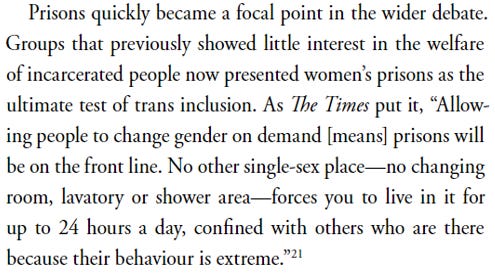
Here, Lamble claims to be surprised by the level of feminist interest in the welfare of female prisoners, claiming that feminists previously showed ‘little interest’ in this group. In fact, in Scotland, the female prison estate was singled out as far back as 2014, as a testing ground at the behest of the Scottish Trans Alliance, to see if the public would object to males being incarcerated with females. (https://forwomen.scot/19/07/2026/the-pot-of-gold-at-the-end-of-the-rainbow/). It is completely unsurprising that there has been grassroots feminist activity in this area, given the deliberate targeting of the female prison population for this test of public feeling.
To make her central argument, Lamble also over-focuses on ‘safety’ as the overarching concern of current-day feminists. In doing so, not only does she overlook privacy and dignity – two concepts usually cited along with safety when talking about the importance of single-sex spaces – she also misses out the entire lesbian argument for having our own spaces. Lesbians, of course, are not attracted to men however they present themselves, and our reasons for needing single-sex, lesbian-only spaces are simply that no man can become a lesbian and our culture and community depend upon us having our own places. This does not suit Lamble’s thesis, and so our arguments are not explained. She mentions Get the L Out’s activity at London Pride in 2018, but describes the group members as ‘middle-aged and white’; she may as well be calling them ‘Karens’.
The launch of Scotland’s Hate Crime and Public Order Act is described as being plagued with ‘vexatious complaints’ as ‘gender critical and trans campaigners argued over which group most needed the law’s protection’. This account again misses important context.
When Scottish hate crime legislation came into effect, it functioned mainly as a one-eyed mechanism for reporting troublesome women, covering hate crime committed on the basis of ‘transgender identity’ but not on ‘sex’. For those of us who were in grassroots feminist groups, the introduction of such skewed legislation had a chilling effect. Women organised information sessions about what to do if we found ourselves accused of hate crimes. We devised plans for leaving our electronic devices at home when we went out to public meetings. Some women stopped using social media. Some of us joined the Free Speech Union so that we could access legal assistance if needed. Far from being delighted at the thought of a new law with which to indulge our carceral desires, women needed to organise quickly to protect ourselves against the new law being weaponised to our detriment.
Elsewhere, there are numerous attempts to over-represent the power and privilege enjoyed by women and under-represent it in men who claim a trans identity. The hounding of Kathleen Stock at the University of Sussex is waived away because it ‘opened doors’ for her, as if this mitigated the experience while it was happening. By contrast, we are repeatedly told that ‘trans people’ are not seen as ideal victims and so are ‘set up to lose’.
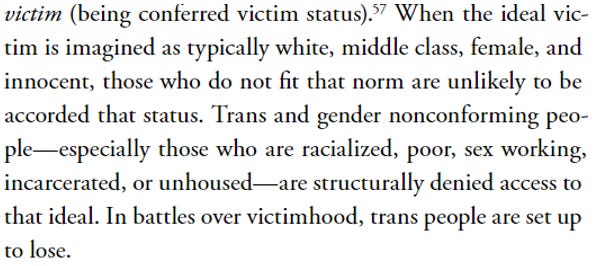
The portrayal of ‘trans people’ in this book sits completely at odds with the fact that the Scottish and, to a lesser extent, UK Governments have been completely in thrall to this group in recent years, with the rights of women being sidelined. Lamble appears to have an absolute blind spot when it comes to privilege and power enjoyed by men who claim a trans identify, whether in the form of legislation written to meet their needs, statutory services adopting the language and symbols of gender identity theory, or just simply good old fashioned male violence continuing to be a feature even after a man has started to pretend he is now a woman. The most egregious example of this blindness is when she recounts the sexual assaults carried out by prisoner Karen White.
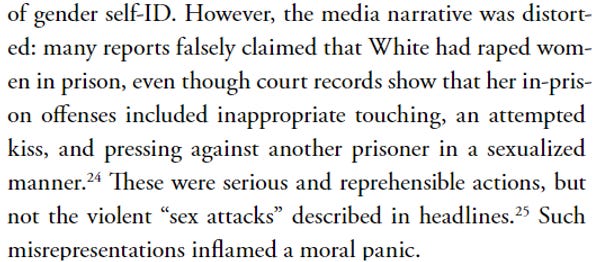
We are told here that White did not add to his career as a rapist while in prison. He merely did some ‘inappropriate touching’, which led to a ‘moral panic’. Women are, by implication, over-reacting to the threats posed by a double rapist continuing to sexually harass women in an environment in which they are unable to escape.
This book ultimately fails in its stated mission to promote the values of anti-carceral safety approaches for everyone. It’s too skewed, too misogynist and too fond of a bit of DARVO for its central premise to land. By the time the author starts to tell us that anti-carceral work rests on the idea of no-one being ‘disposable’, it’s much too late. The hatchet job on women has been received and understood.
Publisher: Haymarket Books
ISBN: 9798888906064
No posts
Comments
Nothing yet. Say the first thing.
Sign in to join the conversation.