
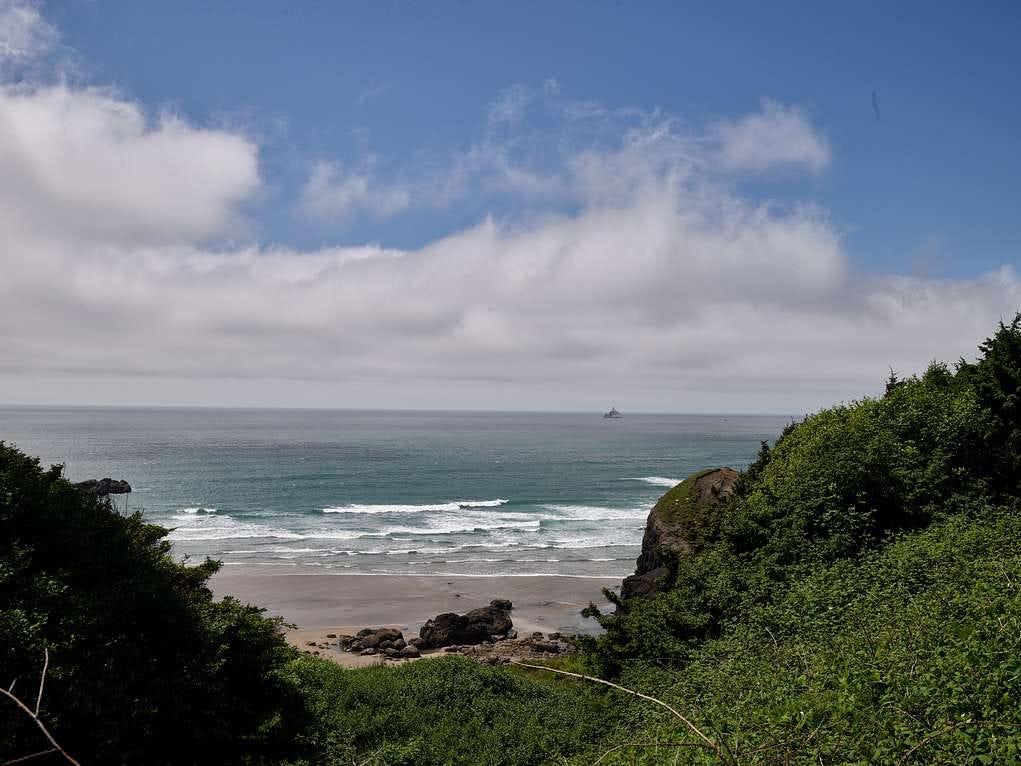
As millions of Americans head to beaches, lakeshores and coastal communities this summer, few will realize how much those places are changing. The waters that support family vacations, local businesses, fishing traditions and major economic sectors are under increasing strain. And if we don’t take action, we’ll learn the hard way that the health of our ocean is what our food supply, national economy and weather system depend on.
The two of us have spent our careers focused on the ocean, so we know this to be true: this is a moment of reckoning. Daunting scientific findings demonstrate how climate change is making our ocean hotter and more acidic, threatening the ability of marine life to develop, function and survive. At the same time, this year’s El Niño could further increase ocean warming to a dangerous degree. As our ocean temperatures rise, the availability of safe and sustainable seafood decreases – leading to jobs lost, food chains imperiled and economies permanently harmed.
Addressing these urgent challenges requires solutions that meet the scale of the moment. Our federal government has not been up to the task as it continues attempts to slash climate and ocean research programs and has fired experts who have key knowledge. But where federal action has stalled, states have stepped up to lead on climate and ocean policy. It is critical for states to work together to drive down carbon emissions, address climate impacts and preserve our oceans. It’s just not our summer vacations at stake – it’s our communities and our economies in peril.
The health of our ocean shouldn’t just matter to environmentalists or climate scientists. It should matter to everyone who has ever spent time by the water – because that means you know what it’s like to shop along a boardwalk supporting local business or eat a delicious fish taco and contribute to a food chain of quality seafood and the jobs behind it. Those summer memories, and the entire communities and local economies that benefit from them, are at risk when we become careless about our ocean. We shouldn’t let our federal government be careless about American jobs and American economies.
More than a dozen U.S. states are now working at various levels to adopt policies and advance action on this front. They are doubling down on research and monitoring to understand the science and document changes already underway. States are coordinating via regional Coastal Acidification Networks (CANs) that bring together governmental, academic and non-government institutions for the express purpose of keeping our oceans safe. New York and New Jersey are undergoing major efforts to slash carbon emissions, restore coastal ecosystems and prevent further pollution of the ocean. These are models worth understanding and emulating – and it means states like these will continue to thrive while others get left behind if they don’t also adopt similar policies that put oceans first.
While states are leading the charge at this pivotal moment, climate mitigation and adaptation efforts still depend on federal investment. The NOAA Sea Grant College program, which was in the crosshairs last year and is again vulnerable to budget cuts, is absolutely essential to address ocean stressors with research and monitoring programs that help protect our coastal economies. Ultimately, states know what the federal government won’t acknowledge – that we love healthy oceans, we love our summer vacations and we know that the two are inseparable.
More than ever, we need state and federal action to protect and preserve our oceans. This is the moment to reaffirm our commitment, across all levels, to the waters we love most and the people who depend on them. Let’s not make a mistake by ignoring it – because the cost will sink our future with permanence.
Dr. Libby Jewett spent the past nearly 20 years working for the National Oceanic and Atmospheric Administration in Washington DC and then in Narragansett RI. Through her leadership of the NOAA Ocean Acidification Program, she spent her career fostering relevant research on how anthropogenic carbon dioxide is affecting the ocean and marine life. She worked at the nexus between science and policy (national and international). She served as a lead author on the last three US National Climate Assessments and the last international assessment done under the auspices of the Intergovernmental Panel on Climate Change. Most recently, she worked for the NOAA Northeast Fisheries Science Center in the Marine Development and Ecology Branch developing a research agenda assessing impacts of offshore wind on marine ecosystems and fisheries. She also led an international effort through the International Council on the Exploration of the Seas (ICES) to gather experts to assess the risks of marine Carbon Dioxide Removal (emerging technologies) on fisheries, aquaculture and indigenous communities. She is very interested in how climate change is impacting the ocean and in how the ocean may be leveraged, carefully, as one of many solutions. She is excited to bring marine expertise to the mountains of VT.
Dr. Richard (Rick) W. Spinrad is an oceanographer with more than 40 years of experience in the public, private, academic, and non-profit sectors. He served from 2021 to 2025 as the United States’ Under Secretary of Commerce for Oceans and Atmosphere and the 11th Administrator of NOAA (National Oceanic and Atmospheric Administrator). He is the 2026 president-elect of the American Meteorological Society, as well as an elected member of the U.S. National Academy of Engineering. He is also currently a professor emeritus of oceanography at Oregon State University (OSU), where he previously served as vice president for research.
Dr. Spinrad served as NOAA’s chief scientist and led NOAA’s Office of Oceanic and Atmospheric Research and National Ocean Service. He also co-led the White House Committee that developed the nation’s first set of ocean research priorities. As program manager at the Office of Naval Research and senior civilian at the Office of the Oceanographer of the Navy, he was awarded the U.S. Navy Distinguished Civilian Service Award. He has held faculty appointments at OSU, the U.S. Naval Academy, and George Mason University; was Executive Director at the Consortium for Oceanographic Research and Education; was President of Sea Tech, Inc.; and worked as a research scientist at the Bigelow Laboratory for Ocean Sciences. Dr. Spinrad served as the U.S. permanent representative to the United Nations’ Intergovernmental Oceanographic Commission. He is the recipient of Presidential Rank Awards from Presidents George W. Bush and Barack H. Obama.
Dr. Spinrad received his B.A. from The Johns Hopkins University, and his M.S. and PhD from Oregon State University. Read full bio.
If you enjoyed today’s post, please like it or share it with others. You can also support the work we do to shine a light on the politicization of science by becoming a paid subscriber!
If you want to share today’s post as a web page with your network, click this button:
If you have suggestions, questions, comments, or want to drop us a line , send it all to scilightsubstack@gmail.com
Comments
Nothing yet. Say the first thing.
Sign in to join the conversation.