
On Language, Empire, and the Strange Mercy of Scattering
Most of us were taught the Tower of Babel (Genesis 11) as a story about arrogance. Human beings tried to build a tower “to heaven,” God became displeased, confused their languages, and scattered them across the earth. The moral was usually presented as some version of this: don’t try to become too powerful, too important, or too close to God.
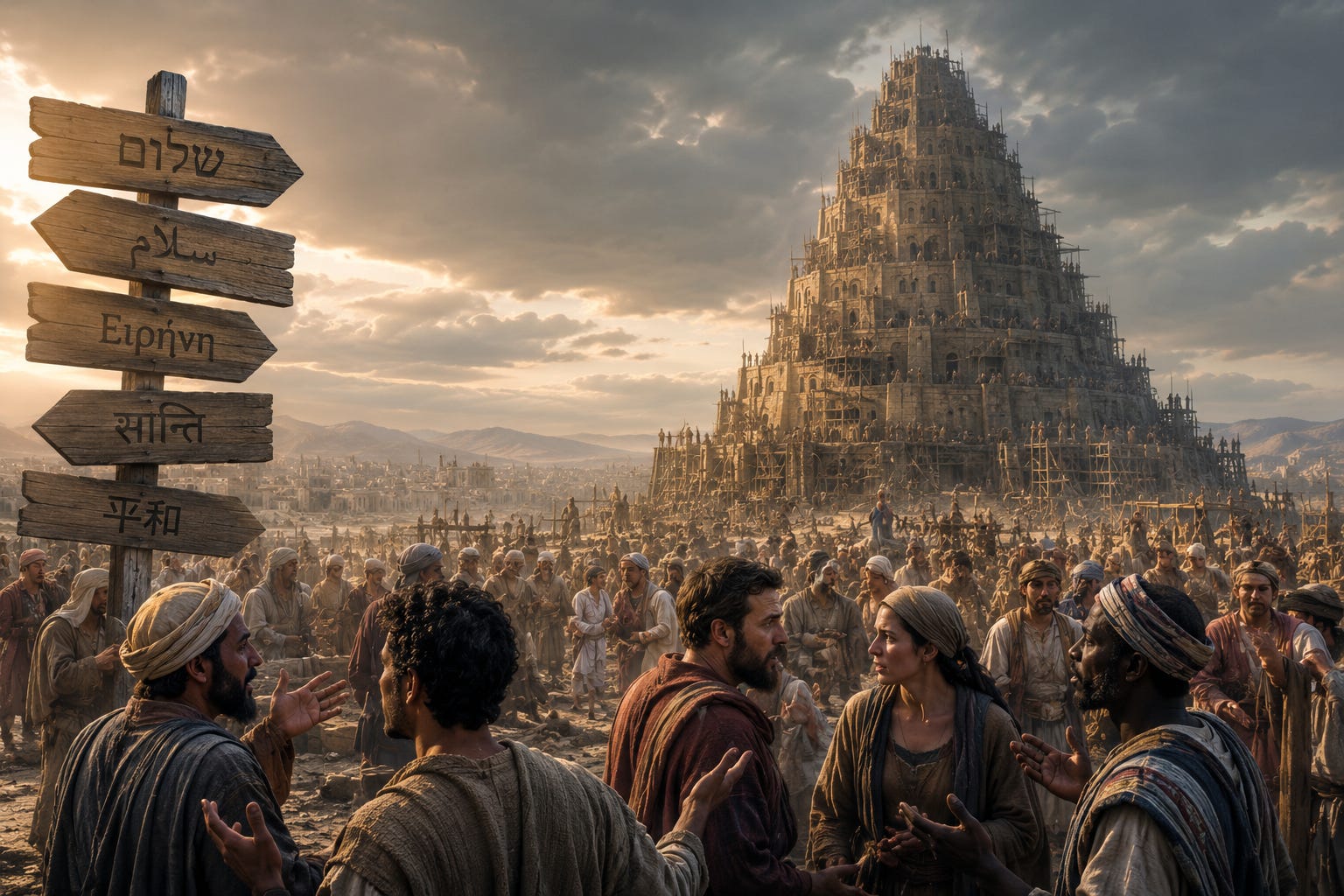
And maybe there is something in the story that warns us about human ambition. I don’t necessarily want to dismiss that completely. The Bible is certainly not naive about the human desire to make ourselves impressive, or permanent. But the longer I spent studying the world surrounding the Hebrew Bible, the less that explanation fully satisfied me.
One of the moments that often startled my students most in college classes was learning about Ancient Near Eastern cosmologies and religious architecture. Many came into class assuming the Bible existed in total isolation from the cultures around it. So when they encountered Babylonian creation stories, flood traditions, temple mountains, or images of ziggurats rising toward the heavens, some felt fascinated. Others felt almost betrayed. I heard questions like, “Why didn’t anyone tell us this before?” and “Does this mean the Bible just copied other myths?” Those are tender questions. They deserve more than quick reassurance.
Because for many people, discovering the Bible’s ancient world feels at first like losing something. The text may feel less protected. Less isolated. Less simple. But over time, many of my students discovered something deeper and more interesting: the presence of shared cultural imagery did not flatten Scripture. It expanded it.
The Bible was not written in a vacuum. It was written by real people living among empires, trade routes, competing religions, political powers, and inherited stories about the world. The writers of Genesis assumed their audience recognized things like temples, cosmic mountains, sea chaos imagery, and towers that connected heaven and earth. They were not embarrassed by those images. They worked with them.
Which brings me back to Babel.
In the ancient world, building upward toward the divine was not unusual. Ziggurats, massive stepped temple towers, were common throughout Mesopotamia. They were not simply monuments to ego. They functioned as sacred spaces, symbolic meeting points between divine and human realms. In many ways, they represented humanity’s attempt to communicate with the gods, to locate human life in relation to heaven.
That does not mean the biblical writers approved of every temple project, every empire, or every attempt to claim divine authority. But it does mean that the usual interpretation of Babel begins to feel incomplete. If the issue is simply that human beings wanted to reach toward God, then Babel sits uneasily beside other biblical stories of divine-human encounter.
After all, Genesis itself gives us Jacob dreaming of a ladder, or stairway, linking heaven and earth, and God speaks through it. Israel later constructs the tabernacle and eventually the Temple as places of divine presence and meeting. Altars appear throughout the biblical narrative. Even churches, synagogues, and cathedrals today are attempts to orient human beings toward transcendence. So why would Genesis 11 portend condemnation of the desire to reach toward God?
This is how I arrived at a new perspective. Perhaps the issue is not the tower itself or its purpose. Perhaps the issue is what surrounds it.
Genesis 11 begins with language before mentioning architecture: “Now the whole earth had one language and the same words.” The text does not immediately ask us to stare up at the tower. It asks us to notice the sameness.
One people.
One speech.
One place.
One project.
One name.
That repetition matters. Some scholars have suggested that Babel is not primarily a story about pride at all, but a story about the origin of cultural difference. Others have read it as a critique of empire, a story about what happens when human unity becomes centralized, controlled, and totalizing. I find those readings compelling, not because they erase the older interpretation, but because they help me notice what the text itself keeps repeating.
The problem may not be that people built something tall, something that connects them to the divine. The problem may be that they wanted to secure themselves against scattering, against difference, against the vulnerability of becoming many. “Let us make a name for ourselves,” they say, “otherwise we shall be scattered abroad upon the face of the whole earth.” That line feels important to me because scattering is not only what God does at the end of the story. Scattering is what the people were trying to prevent.
The older I get, the more suspicious I become of environments where everyone speaks exactly the same way, with the same assumptions, the same vocabulary, the same approved conclusions. Ironically, when everyone speaks the same language culturally or ideologically, true communication can begin to disappear. Difference is what forces us to listen. Translation requires humility. Diversity requires negotiation. Multiplicity creates space for questions, nuance, and dissent. But total sameness can become coercive very quickly.
This is one reason I think the Babel story feels especially important when read alongside the broader biblical tradition. The writers of Scripture often preserve minority voices, wilderness voices, prophetic voices, voices from exile, voices from the underside of empire. They knew what centralized power could do. They knew what happened when a single ruler, a single ideology, or a single narrative became absolute.
Again and again, the biblical tradition preserves arguments, tensions, contradictions, laments, protests, and alternative perspectives. Job argues. The Psalms protest. Ecclesiastes unsettles tidy wisdom. The prophets challenge kings, priests, and nations. Even Genesis itself gives us stories that refuse easy moral flattening. The Bible is not a perfectly smoothed-out voice saying one simple thing in one simple way. It is a library of witness, argument, grief, hope, memory, warning, and imagination.
And perhaps Babel is part of that resistance.
Perhaps God’s scattering of humanity is not merely punishment, but protection. Not the destruction of communication, but the creation of it. Because once humanity no longer shares identical speech, people must begin the difficult work of interpretation. They must learn to encounter what is unfamiliar. They must recognize perspectives beyond themselves. The world becomes more complicated after Babel, but perhaps it also becomes more human.
I do not think we have to choose between every interpretation too quickly. Maybe Babel does warn us about pride. Maybe it does expose the fragility of human ambition. Maybe it does laugh a little at our grand projects, especially the ones we imagine will make us secure forever. But I also wonder whether the story is doing something more subtle. Maybe it is asking what kind of unity we are trying to build.
A unity that protects life, or a unity that controls it. A shared language that helps us understand one another, or a single approved speech that keeps us from asking dangerous questions. A city of welcome, or a city afraid of being scattered.
I no longer read Babel as a simple warning against ambition, technology, or even human cooperation. I read it as a story about the danger of totalizing sameness. And perhaps the strange mercy hidden in the story is this: God disrupts the monologue before it becomes empire.
The scattering of languages makes the world harder to navigate, but richer in perspective, more dependent on humility, and more open to genuine encounter. Maybe the problem was never that humanity wanted to reach toward heaven. Maybe the danger was believing everyone should speak with only one voice.
For readers who want the deeper scholarly trail behind this reflection, I’ll be sharing a companion post on Babel, ziggurats, empire, and cultural difference at Scholarly Wanderlust.
If this reflection resonates with you, I explore these themes more deeply in my teaching series Cosmos & Creation: An Ethical Exploration of Creation, Chaos, and Calling in Genesis 1–11. In the session on Babel, we look at ziggurats, Ancient Near Eastern cosmology, empire, language, and why Genesis may be far more interested in human sameness than simple ambition.
You can watch the teaching video and explore the full Cosmos & Creation series here:
Cosmos and Creation Part 5.
The series is designed for readers and communities who want to engage Scripture with both intellectual depth and spiritual curiosity, allowing the biblical text to become larger, stranger, and perhaps more human than we first imagined.
No posts
Comments
Nothing yet. Say the first thing.
Sign in to join the conversation.