
Hey, friend.
Welcome back to my twenty-week series about how we reclaim our stories, tell the stories that matter, and create together the story of what can be. It’s M-Sat in reels you can follow on facebook, instagram, linkedin, bluesky, and tiktok, but every Friday I pull all that content together in one place — this newsletter, with citations. :)
There’s a pattern I keep running into as I research these newsletters, and this week’s theme is maybe the clearest version of it: the government decides it won’t do something — feed children, house people, provide healthcare — and communities build what they need anyway. Then sometimes the government sees what communities built and takes it over, claims it as policy, and scrubs out the names of the people who actually invented it. And then sometimes, generations later, the government decides to cut that program, and communities have to build it all over again. (I wrote a while back about why some folks choose the political strategy of anarchism — different from anarchy — and this right here is why.)
It’s exhausting. It’s also — and I mean this — kind of amazing. The sociologist Keeanga-Yamahtta Taylor has written that Black radical politics have always had to reckon with “the tension between working within the system and working outside of it.” What this week’s stories show me is that the most durable community institutions often started outside the system entirely, out of necessity, and were built by people who didn’t wait for permission. Mark Twain reportedly said history doesn’t repeat itself, but it rhymes. I’d add: sometimes the rhyme is so close you can barely tell it from the original.
SNAP just lost $187 billion. Food bank grants have been cut. And communities are doing exactly what they’ve always done. And I know that the imposed scarcity by wealth hoarders and their friends in office cannot physically be replaced by volunteerism, no matter how generous we are. (If you’re involved with responding to human needs in our community, you already know that, and all the data backs it up.) That’s why we need government that works well. We need to keep fighting for that. But I love the ways we will not give up on each other even when forces outside of us play games with our lives and communities like they’re doing now.
This week’s theme: mutual aid, community feeding, and the long history of communities caring for themselves when the government won’t. (As always in this series, featuring history that helps us understand the present, a policy horror of the present, and what folks are doing to create a different world.)
The History We Should Have Learned
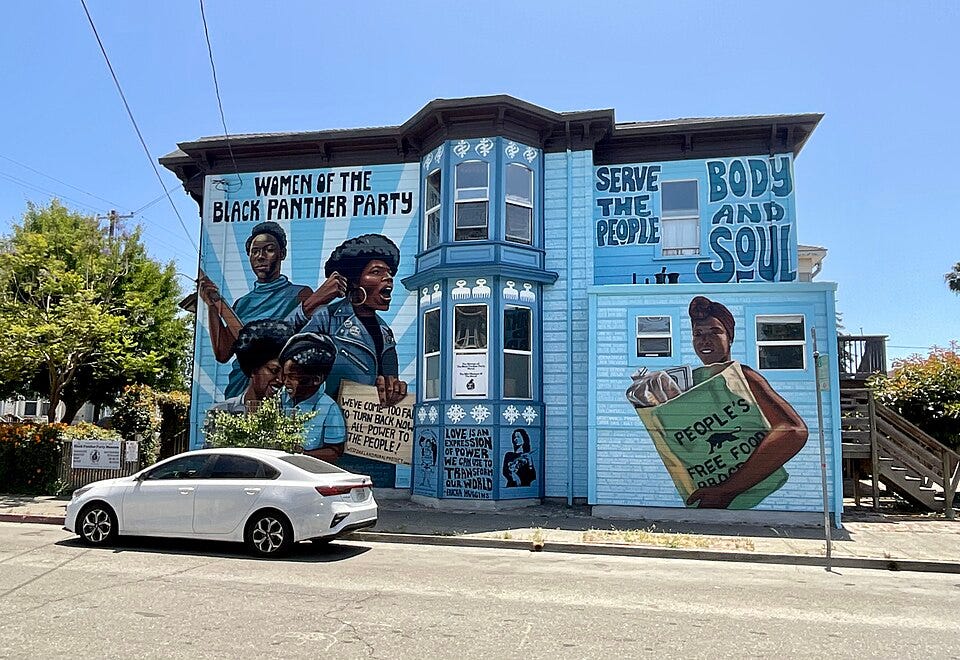
Quick question: what do you know about the Black Panther Party? If you’re like most of us, you were taught they were a militant, scary organization that the government eventually shut down. Here’s what you probably weren’t taught.
The Black Panthers ran free breakfast programs for children in cities across the country. By 1969, they were feeding twenty thousand kids a day before school — in nineteen cities. The administrator of the U.S. National School Lunch Program admitted that year that the Panthers were feeding more low-income children in California than the State of California was. J. Edgar Hoover called the breakfast program — and I am not making this up — the most dangerous of all the Panther programs. Not the guns. The eggs and orange juice. Many of those programs were eventually adopted by the federal government. The School Breakfast Program, which today feeds nearly thirteen million kids every single day, started in a church basement in Oakland.
This is particularly significant to me because a lot of the folks in my community today benefited from those programs (which the party called “survival programs”). For our joint bachelor party in August, my partner and I and some friends went on a walking tour of Oakland led by Panthers, and they showed us a list of programs they ran, many of which continue in our community, administered by schools or city officials, to this day. One of the tour leaders said she benefitted from the school breakfasts as a first grader, and the Panthers also taught her how to advocate for herself; her school assumed she wasn’t smart, instead of that she had a learning disability — and the Panthers taught her to fight for her right to a good education.
The Panthers were strategically and intentionally decimated. Their programs were so constructive that they became federal policy anyhow. And then we were taught to be afraid of the people who created them. I hope we’ll tell the more complete story.
For more:
The Black Panthers’ Public Health Legacy: Think Global Health
The Black Panther Party: Challenging Police and Promoting Social Change: The National Museum of African American History and Culture
The Black Panther Party: How It Actually Worked: How it was supposed to work
(and my personal favorite, because it highlights the women, and I got to see it at the Grand Lake Theater in Oakland with so many people shaped by the Party): The Black Panthers: Vanguard of a Revolution: PBS.
PS—Elaine Brown, one of the original Black Panthers, has recently built affordable housing in West Oakland, despite many other developers failing to get their projects off the ground!
What’s Happening Right Now
The “Big Beautiful Bill” (which I believe Rev. Dr. William Barber called “The Big Ugly and Death Dealing Bill” because he has too much dignity to call it what it was: The Big B***s*** Bill), signed into law on July 4, 2025, cut SNAP — food stamps — by $187 billion over ten years. Between the law’s enactment in July 2025 and January 2026, more than 3.5 million people fell off the SNAP rolls nationwide. Arizona saw a 42% drop in SNAP participation — hunger advocates are clear: that is not because 42% fewer people need food. At the same time, the USDA terminated hundreds of millions of dollars in food bank grants in April 2025, affecting 40 states.
Work requirements suddenly changed, often without warning for those impacted, and taking food out of the mouths of people who couldn’t work or whose families would suffer significantly were they to go to work, or who live in regions where work is scarce. A lot of the changes hit during the summer, when children are also losing free school meals that kept them fed even when resources ran thin at home. All of this in addition to skyrocketing gas prices and inflation causing everything to be more expensive.
At least 3.5 million people have lost food stamp access as Trump’s ‘big beautiful bill’ cuts take effect, analysis finds: CNBC
The Families Going Hungry under the Big Beautiful Bill: NBC.
SNAP Tracker: Center for Budget and Policy Priorities
A Deliberate Policy Design for Decline in SNAP Participation, and the Consequences We Are Already Seeing: Food Research and Action Center
PS: If you’re trying to talk with someone who thinks food banks should be enough and the government doesn’t need to be involved, this article from Forbes might be helpful.
A Saint You Should Know
Martin Luther King Jr. called her “the Mother of the Movement.” He took her to Oslo when he accepted the Nobel Peace Prize. And almost nobody knows her name.
Septima Poinsette Clark was a schoolteacher who refused to resign from her position after South Carolina passed a law banning state employees from belonging to the NAACP. She was fired after nearly 40 years of service and lost her pension. Forty-one teachers stood with her and lost their jobs too. She went to the Highlander Folk School and designed the Citizenship Schools — teaching literacy, voter registration, and civic engagement to Black Southerners across the South, in people’s kitchens, in beauty parlors, under trees. More than 800 schools. An estimated one million new voters. She called out the SCLC men’s treatment of women as one of the greatest weaknesses of the civil rights movement. She was right about that too. “Literacy means liberation,” she said. She meant: when people know their power, nobody can take it from them.
Check out the King Institute’s summary of her contributions HERE.
Good Trouble in Action
Feed Durham is a mutual aid collective in North Carolina that runs a community fridge network, a community garden, a weekly market, and a community kitchen. What makes it distinctive: the people who receive food are also invited to grow it, cook it, distribute it, and help make decisions about how the collective runs. “Dignified food,” Civil Eats called it. Not charity. Not pity. Food with dignity, distributed by people who understand what it means to need it — because they do. At a moment when SNAP benefits have been cut by $187 billion and food bank funding has been slashed, Feed Durham is building something the government didn’t bother to build: a community that feeds itself.
Source: Civil Eats
Solidarity Is Already Happening
In Chicago’s Little Village neighborhood — one of the densest and most predominantly Latine and Black communities in the city — the Little Village Environmental Justice Organization has been building something that refuses the charity model entirely.
LVEJO’s Farm Food Familias program is a mutual aid collaboration between LVEJO, the Getting Grown Collective (a Black-led urban farming organization), and a rotating group of community chefs representing Puerto Rican, Latin American, and African American culinary traditions. Together they source produce from Black and Brown-owned urban farms on Chicago’s South and Southwest sides and deliver culturally specific, restaurant-quality meals to families in Little Village, Englewood, and South Chicago — communities that are majority Latinx and Black and have faced decades of environmental and economic disinvestment. The people receiving food are also invited to grow it, cook it, and shape how the program runs. In December 2024, LVEJO was awarded the national Food Sovereignty Prize for this work — recognition that what they’re building is not a stopgap but a model.
As LVEJO food justice organizer Yasmin Ruiz put it: “It’s not just you being on the receiving end, but giving back. It gives a sense of empowerment to people in the community, and allows us to take direct action to immediate needs we see.”
This is what it looks like when a Latinx environmental justice organization and a Black farming collective decide their neighbor’s hunger is their problem too — and build something together that neither could build alone. Find LVEJO at lvejo.org.
Sources: Civil Eats, Civil Eats AGAIN (I know, but this one is a convo with Feed Durham AND LVEJO! Plus I just discovered this site and am way into it), Borderless Magazine
I think the hashtag that’s big right now is #EverydayResistance or something along those lines, and I love it. Also, I love the ways folks are engaged in #EverydayCreation and #EverydayCare. Thanks for who you are and what you’re up to.
The breakfast programs started in church basements. The mutual aid networks started with a group text. Everything starts somewhere small. I’m grateful to be starting things alongside you. Thanks for helping reclaim the narrative and reclaim what’s possible.
— Sandhya
Thanks for reading Joy In Justice! This post is public so feel free to share it.
No posts
Comments
Nothing yet. Say the first thing.
Sign in to join the conversation.