
Hey, friend.
I planned out this series without thinking about today being Juneteenth, but it feels important, since Juneteenth is about people trying to withhold information in order to retain power, and Black people claiming both that knowledge and that power, as part of a seemingly constant cycle.
Black Wall Street didn’t fail. It was burned. The racial wealth gap didn’t emerge from some neutral economic process.* It was engineered, maintained by law, and is still being actively enforced through biased appraisals and predatory lending practices that continue today. When we talk about repair, we’re not talking about fixing something that broke on its own. We’re talking about addressing something that was broken on purpose.
The poet Lucille Clifton wrote: “won’t you celebrate with me / what i have made of a world / that did not ask me to be.” The people of Greenwood rebuilt in tents in winter. Lessie Benningfield Randle is 109 years old and still fighting. That is not resilience in the passive sense — the kind that gets applauded because it lets everyone off the hook. That is refusal. Determined, principled, exhausting, ongoing refusal to accept that what was taken cannot be returned.
As you know, this is part of a twenty-week series on the stories that get told about us and the stories we can tell…and the stories we can create. It’s on reels you can follow M-Sat on facebook, instagram, linkedin, bluesky, and tiktok, but this newsletter is the weekly round-up where you (a) don’t have to see my endless collection of t-shirts and saris, and (b) can find the sources I used for the reels.
As an aside, this “history we should have learned” section was the second-most suggested when I looked for ideas from friends on facebook. (The most suggested is coming in week 19.)
This week: Black Wall Street, reparations, and the fight to repair what was deliberately destroyed.
*The racial wealth gap is the difference in average Black family wealth (assets minus debts) compared to the average White family wealth. In 2022, the Federal Reserve Bank calculated that Black families on average had 15 cents of wealth to White families’ dollar. If you leave Asians as a single group instead of looking at subgroups, they hold even more wealth; Latine, Indigenous and other groups come in at a little higher than Black families.
The History We Should Have Learned
In 1921, Tulsa, Oklahoma had one of the wealthiest Black communities in the United States. The Greenwood District had Black-owned hotels, hospitals, law offices, newspapers, movie theaters, and hundreds of businesses — so prosperous it was called Black Wall Street. On May 31st and June 1st, a white mob aided by the city police and the Oklahoma National Guard burned it to the ground. Thirty-five square blocks. Over a thousand homes. Every church, every school, every business. As many as three hundred people killed. Ten thousand people made homeless. And for decades, it was just — not taught. It was also not the only case where the Black community lived apart and created an economically viable community which was then decimated because white people and leaders could not tolerate “separate but equal” resulting in decent conditions for their Black neighbors. The town of Rosewood experienced the same violence in Florida two years later — something I learned from the John Singleton movie in 1997. A lot of my friends learned about Tulsa’s race massacre because of the TV show Watchmen in 2019, including friends who grew up in Oklahoma schools.
But here’s what I really want you to know: the people of Greenwood were not passive victims. Black World War I veterans — men who had just come home from fighting for a country that didn’t protect them — armed themselves and held off the mob for hours. One family, the Williamses, defended their home through the night. And when it was over and the city refused to help, the community rebuilt largely on its own within months — in tents, in winter, and sometimes under cover of dark because the mayor and other city leaders tried to wield permitting processes against them. One Black citizen even sued the city for trying to stop him from rebuilding, and won.
Greenwood came back and thrived for decades after this horrific violence. And then “urban planning” placed four highways through the community to destroy it again, this time with federal funding in the late 1960s.
Their descendants are still fighting for recognition and reparations today. That fight is still in the courts in 2026.
For more:
Rebuilding Tusla, With or Without Reparations, Resilience magazine
Decades After the Tulsa Race Massacre, Urban ‘Renewal’ Sparked Black Wall Street’s Second Destruction, Smithsonian Magazine
Thanks for reading Joy In Justice! This post is public so feel free to share it.
What’s Happening Right Now
The Oklahoma Supreme Court dismissed the last reparations lawsuit — brought by the final surviving witnesses to the massacre — in 2024. Congressional bill H.R. 40, which doesn’t even authorize reparations but just offers a study to figure out what reparations might look like, has been introduced in Congress every year since 1989 and still has not passed.
Lessie Benningfield Randle was the last known living survivor of the Tulsa Race Massacre; she died in late 2025 at the age of 111. Her family home was looted and destroyed. She spent years in the legal fight. The Oklahoma Supreme Court dismissed her case. And yet she and civil rights attorney Damario Solomon-Simmons kept fighting. In 2025, Tulsa’s first Black mayor, Monroe Nichols, endorsed a proposal called Project Greenwood, calling for compensating Randle and establishing a scholarship program for descendants of victims.
To learn more:
Justice For Greenwood Foundation
Black Tulsans still feel effects of Greenwood neighborhood's 'second destruction' | KOSU
A Saint You Should Know
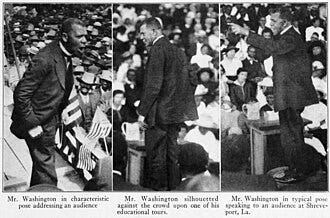
It’s a mistake to talk about the history of building wealth in the Black community without talking about Booker T. Washington.
Washington was born into slavery in a one-room dirt-floor cabin in Virginia around 1856. He didn’t know his exact birth date. He didn’t know his father. He was given no last name. After emancipation, he walked five hundred miles to attend school, working as a janitor to pay his way. (In fact, his admission exam was cleaning a room to stand up to a “white glove” test; what?!). He founded the Tuskegee Institute in 1881, building it literally from the ground up with his students. His partnership with Julius Rosenwald eventually led to nearly five thousand schools for Black children across the South. (More on that in a future newsletter.)
I’ll be honest; I used to think about him, DuBois, and Garvey as representing three unreconcilable strategies for Black liberation in the US, and a lot of the anti-Blackness I had been trained into shaped how I saw those paths. I’m still a DuBois stan, but now, knowing more about Greenwood in Tulsa and Rosewood in Florida, I better understand that while Washington might have seemed like an assimilationist, his goal of “leave us alone and we’ll be ok over here on the other side of town” was just as threatening as Garvey’s Back to Africa strategy and DuBois’s intellectual socialist civil rights strategy. (That’s why Teddy Roosevelt tried to disavow having invited Washington over for dinner at the White House, because a lot of White southerners let him know how outraged they were; check that story out in the History Channel article linked below.)
So yes, Washington’s politics were complicated — he publicly accommodated segregation in ways historians still debate. But his personal story — of a man who had nothing, named himself, and built institutions that outlasted him — is about refusing the limits placed on you at birth. And more than that, his story is about knowing the power of one’s community if they are resourced adequately. The communities of Greenwood and Black Wall Street were built by people who believed the same thing: what you build together cannot be taken. And even when it is — you build again.
To learn more:
Booker T Washington National Monument (U.S. National Park Service) — this one includes his most famous speech, which is FASCINATING and a really important document in studying Black liberation efforts in the US.
Booker T. Washington, Tuskegee University
8 Things You Might Not Know about Booker T. Washington — The History Channel. (I definitely learned some new things here, including the story about Teddy Roosevelt!)
Good Trouble in Action
In Evanston, Illinois, reparations are already happening.
Kenneth Wideman was born in 1945 in a segregated hospital. He attended segregated schools. His neighborhood was deliberately suppressed by city zoning policies for decades. In 2025, he received $25,000 from the City of Evanston’s Local Reparations Program — the first municipal reparations program in American history — funded by a cannabis sales tax and a real estate transfer tax. More than 200 people have now received payments totaling over $5 million. The program is under legal challenge. Evanston is fighting back. Reparations Committee Chair Robin Rue Simmons said at a recent meeting: “This has become part of our lives, like it’s almost routine for us now.” Routine. A city routinely paying reparations.
The Evanston Local Reparations program was built by a coalition. Robin Rue Simmons brought together Black residents who had experienced housing discrimination with faith communities, civic organizations, and city council members. The funding mechanism — a cannabis sales tax — was itself a coalition achievement: it required the city to commit that the revenue from a newly legalized industry would go to the communities most harmed by the war on drugs.
Now the program is deepening. A genealogy testing program is helping descendants trace their family roots. A Student Democracy Program pairs high school and college students with reparations recipients to interview them and preserve their stories. This is solidarity made institutional — white residents voting for a tax that primarily benefits Black residents, young people sitting with elders and asking: tell me what happened to you, so that it can be documented, so that it cannot be erased. It is imperfect. It is underfunded. It is contested. And it is routine. That is what repair looks like when communities commit to it.
To learn more:
How reparations to Black residents are changing lives in Evanston, Illinois, NBC News
Reparations - Evanston RoundTable
Evanston Local Reparations - City of Evanston
PS—I was particularly interested in this story because I was so impressed by the work the CA Reparations Task Force had done in 2022, but I didn’t know what had resulted from their solid work. It turns out a number of their recommendations were proposed in the state legislature and passed. Gov. Newsom proposed the process, and he signed some of the laws into being…but one of the most interesting, about restitution for eminent domain, he vetoed based on fiscal concerns. Because, yeah, taking away Black business districts and homes back in the 1960s resulted in a LOT of wealth taken away by the government. Anyhow, if you’re interested in what’s happening in CA, I hadn’t realized some of these bills, including an increase in firefighter pay that I talked about in a recent newsletter, were part of the reparations task force’s work. Here’s a great summary.
Solidarity Is Already Happening
Historically, Indigenous and Black communities have been deliberately turned against each other — by colonizers who used division as a tool of dispossession, and by enslavers who understood that solidarity between communities was the greatest threat to the system. The Northeast Farmers of Color Land Trust is organizing to repair that rupture directly.
NEFOC runs a program called Braided B.L.I.S.S. — Black Liberation and Indigenous Sovereignty in Solidarity — a long-term convening space for Black and Indigenous land stewards to build relationships, develop shared governance, and work toward both reparations and Indigenous sovereignty simultaneously. Their Reparations Map connects farmers and land stewards across the country with projects working to return land and wealth to communities that were dispossessed of it. Their explicit premise: you cannot advance reparations for Black Americans without honoring Indigenous sovereignty, and you cannot honor Indigenous sovereignty without addressing the dispossession that made the theft of Black labor possible. The two are braided together.
This is repair as solidarity — two communities that power worked hard to divide, choosing each other instead. Find NEFOC Land Trust at nefoclandtrust.org.
For more info:
Article in YES! Magazine
NOTE: I got really excited about this story, and as I poked around a little, it may have been a limited time project that has drawn to a close. I wanted to note that, and also to note what an incredible vision this has, which I’ve certainly seen in other Black land trusts and Black farmers’ collectives.
It would be easy to read this week’s newsletter and be frustrated or even heartbroken that we keep fighting for justice, and when we win, it gets burned down or eminent domained or vetoed out of existence. As Colson Whitehead described America in his book The Underground Railroad, this nation was formed by the combination of stolen land and stolen labor. As long as we can’t reckon with that formally and collectively, as long as we pretend that past does not shape our future, we will continue to have our efforts at justice dismantled.
And yet, I think about the generations of students who went through Booker T Washington’s schools, the decades of citizens of Greenwood who benefitted from a courageous and successful lawsuit to force racist city leaders to let them rebuild, the people in places like Evanston whose lives are materially better because of the fight for reparations. Their lives matter. Their joy matters. Their contributions to moving us in the direction of being a people grounded in justice, dignity and love, that matters.
Repair is slow work, and most of us won’t live to see it finished. That’s hard. But the last survivor of the Greenwood Massacre fighting—and winning—in court at the age of 110, she’s proof that people keep doing this work anyway, across generations, because it is the right work. You are part of that continuity. Your attention to this, your refusal to let it be forgotten, your willingness to stay engaged — that matters. Thank you for being in this with me.
— Sandhya
No posts
Comments
Nothing yet. Say the first thing.
Sign in to join the conversation.