
Hey, friend. Thanks for being on this twenty-week journey with me.
I want to extend a little sympathy up top: when the news is this relentless and the stakes are this high, it can be hard to know what to do with the information we’re taking in, or whether taking it in is even worth the cost to your nervous system. I think about that a lot.
That’s why I keep coming back to history: not because it makes the present feel smaller, but because it makes me feel less alone in it. The people who came before us were not superheroes. They were tired, scared, underfunded, and often unsure whether what they were doing would matter. And they kept going anyway — not out of naive optimism, but because they were embedded in communities that made it possible. As the writer Rebecca Solnit puts it: “Hope is not a lottery ticket you can sit on the sofa and clutch, feeling lucky. It is an ax you break down doors with in an emergency.” [Hope in the Dark, 2010] In other words, hope is a critical element of strategic resistance, not a thing that functions separate from that resistance.
Thanks for reading Joy In Justice! This post is public so feel free to share it.
As you know, much like two years ago, I’m doing twenty weeks of reels you can follow on facebook, instagram, linkedin, bluesky, and tiktok, but every Friday I pull all that content together in one place, this newsletter (and provide source citations—see, I really am in school and developing better habits!). It covers history, current realities, who’s fought these battles before, and who’s fighting them now. (The one exception is Wednesday’s reels — those are weekly affirmations with a moment to breathe, which don’t translate as well to newsletter format; I’ll try to post the videos on substack notes, but you can also find all the clips on the socials.)
This week’s theme is one I want to hold through the whole series: nothing that looks spontaneous actually is. Every uprising, every boycott, every moment of resistance that gets remembered as a turning point was built — deliberately, quietly, over years — by networks of people who showed up for each other long before anybody was watching. And the people in power have always understood this, which is why the first thing they attack is the infrastructure of solidarity: the right to organize, the right to assemble, the right to show up together in public and say: not like this.
Here’s what this week looked like.
The History We Should Have Learned
So here’s what most of us were taught: Rosa Parks was tired one day in 1955, refused to give up her seat on a Montgomery bus, got arrested, and that started the civil rights movement. Sweet story. Also not really the whole story.
Rosa Parks was not tired. She was the secretary of the Montgomery NAACP. She had just come back from training at the Highlander Folk School. She had been doing this work for twelve years before she got on that bus. The Women’s Political Council — a group of Black women who had been planning for exactly this kind of moment — had flyers printed and distributed across Montgomery within hours of her arrest. That is not spontaneous. That is an organization that was ready. The boycott that followed lasted 381 days and nearly bankrupted the bus system, held together by thousands of Black Montgomerians who walked miles to work rather than ride a segregated bus.
Because the incorrect story had already become treated as fact during Parks’s lifetime, she famously said to set the record straight, “The only tired I was, was tired of giving in.”
Rosa Parks wasn’t tired. She was ready. And so was her whole community.
For more: Parks, Rosa | The Martin Luther King, Jr. Research and Education Institute
What’s Happening Right Now
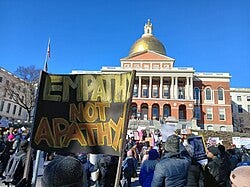
The right to protest — to assemble, to make your grievance visible — is foundational to American democracy. The founders put it first. And yet since 2017, 36 laws restricting protest have passed in 20 states. The Advancement Project found that since January 2024, 103 bills criminalizing protest have been passed or introduced. Anti-protest laws now exist in 45 states. Many of them expand the definition of “riot” so broadly that a peaceful protest where someone else commits an act of violence can expose every participant to felony charges. Some elevate blocking traffic to a felony — which would have made the Montgomery marches illegal.
At the federal level, proposals introduced in 2025 and 2026 would raise penalties for participating in a “riot” to ten years in prison and use RICO — a law designed to prosecute the mafia — to target organizations that fund or coordinate demonstrations.
The International Center for Not-For-Profit Law maintains a real-time US Protest Law Tracker at icnl.org/usprotestlawtracker.
Sources:
Advancement Project report — washingtoninformer.com/advancement-project-report-on-protest-laws|
ICNL US Protest Law Tracker — icnl.org/usprotestlawtracker
Lawfare — lawfaremedia.org/article/state-anti-protest-laws-and-their-constitutional-implications
A Saint You Should Know
On March 2, 1955 — nine months before Rosa Parks — a 15-year-old girl named Claudette Colvin refused to give up her seat on a segregated bus in Montgomery. She was handcuffed, dragged off the bus, and jailed. “It felt like Harriet Tubman’s hands were pushing me down on one shoulder and Sojourner Truth’s hands were pushing me down on the other,” she said later. “I couldn’t get up.”
Civil rights leaders initially considered building their case around her arrest. Then they found out she was pregnant. She was set aside. But Claudette Colvin didn’t disappear — she became one of four plaintiffs in Browder v. Gayle, the federal lawsuit that actually struck down bus segregation in 1956. She won. Then she moved to New York, worked as a nurse’s aide for 35 years, and was largely forgotten. She spent decades trying to have her juvenile record expunged. A judge finally granted it in 2021 — 66 years late. She died on January 13, 2026, at 86. Her name was Claudette Colvin. Say it.
Sources:
NPR obituary — npr.org/2026/01/13/g-s1-105927/claudette-colvin-obituary-montgomery-bus-civil-rights
National Geographic — nationalgeographic.com/history/article/claudette-colvin-montgomery-bus-boycott
Good Trouble in Action
In February 2024, a group of LGBTQ teenagers who met at a church in Park Ridge, Illinois asked if their church could help put on a Pride event. The Rev. Carol Hill said yes — but told them it needed to be bigger than cookies on the lawn. Five churches from different denominations came together and organized the first Pride in Park Ridge. Despite a torrential downpour, more than 200 people showed up. The mayor spoke. Food trucks came. In June 2025, they did it again — with a full drag show in the town park outside City Hall. The churches stayed mostly in the background, by design. “The church has not always been a place where LGBTQ people are welcomed, celebrated or loved,” said Rev. Hill. “The position of the churches needs to be a lot more gentle and in the background.” They weren’t there to take credit. They were there to make space.
Source:
Religion News Service, June 2025 — religionnews.com/2025/06/10/parkridge-pride
Solidarity Is Already Happening
And this one I want you to carry with you into the week: in Chicago in 1969, the Black Panthers under Fred Hampton built something called the original Rainbow Coalition — not just with other Black organizations, but with the Puerto Rican group the Young Lords and the Young Patriots Organization, a group of white Appalachian migrants who had moved to Chicago seeking work and found poverty and police violence instead. If uou saw the movie Judas and the Black Messiah, you know that the Young Patriots wore Confederate flag patches. Fred Hampton went to their meetings anyway. They broke bread together. They built free breakfast programs, health clinics, and police accountability efforts together. The coalition changed the Young Patriots — not because the Panthers told them to change, but because solidarity changed them. If you get a chance to read Hillbilly Nationalists, you’ll get some insight into how that coalition turned some of them into active antiracists. (I checked it out on Libby from my local library!)
The FBI murdered Fred Hampton on December 4, 1969. The coalition fractured. But its model echoed forward — through Harold Washington, through Jesse Jackson, into our present moment. In a week when we’re talking about the right to organize and assemble, that story is not history. It is instruction.
Sources:
The Conversation — theconversation.com/chicago-1969-when-black-panthers-aligned-with-confederate-flag-wielding-working-class-whites-68961
Jacobin — jacobin.com/2017/05/black-panthers-young-patriots-fred-hampton
Young Patriots archive — yporc.org
Knowing is the first step. Acting is the second. And you are not doing any of this alone — even when it feels that way. When you pay attention, when you carry these stories with you, when you show up in whatever way you can, that is a critical part of how we change the story we’re living in. I’m genuinely grateful to be doing this work alongside you.
— Sandhya
PS: If you’re looking for resources on how to make change, you might enjoy my book Transforming Communities: How People Like You are Healing Their Neighborhoods. If you’re trying to make sense of your own ancestors as you seek encouragement for the work, you might enjoy my book Rebels, Despots, and Saints: The Ancestors Who Free Us and the Ancestors We Need to Free.
PPS: When I was looking up those links, I discovered that Chalice Press has both of those books in their summer sale, so now’s a good time to buy them as well as Liberating Love (also on sale), if you’re into progressive devotional content. :)
Thanks for reading Joy In Justice! This post is public so feel free to share it.
No posts
Comments
Nothing yet. Say the first thing.
Sign in to join the conversation.